
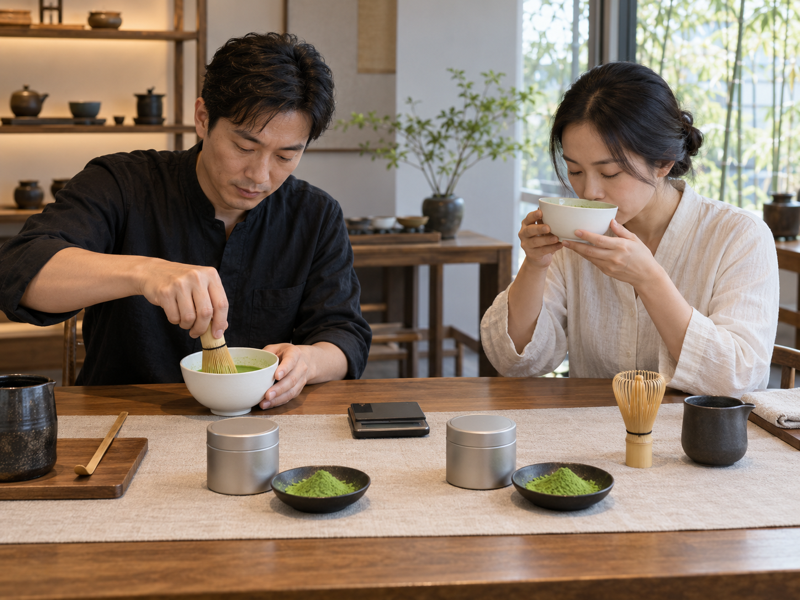
A premium label can raise a matcha brand's selling price, but it cannot tell a purchasing team how a powder tastes in water or whether the next lot will match. “Ceremonial grade matcha” usually signals a tea intended for direct drinking. Buyers still need to define flavor, appearance, origin claims, documents, and supply terms. This guide turns a loose market term into a practical qualification process for retail brands, cafés, and distributors. Matcha Village offers graded matcha products, but each product code needs its own application trial and approval.
Contents
- 1. What does ceremonial grade matcha mean in trade?
- 2. How does ceremonial grade compare with culinary grade?
- 3. Which sensory signs deserve attention in a straight cup?
- 4. Do shading, harvest, and milling prove quality?
- 5. How should a retail brand select a premium matcha?
- 6. What should cafés test before listing ceremonial matcha?
- 7. How can buyers verify food safety and traceability?
- 8. What purchasing terms prevent a premium launch problem?
- 9. Which claims should a premium matcha brand avoid?
- 10. What is a defensible approval checklist for ceremonial matcha?
1. What does ceremonial grade matcha mean in trade?
Understand the label's limits
Ceremonial grade matcha is a common commercial description for powder positioned for straight tea preparation. The term can suggest a fine texture, vivid appearance, and a relatively gentle taste, yet suppliers do not all apply one shared grading scale. A buyer should not write “ceremonial grade” as the only line in a purchase order. The phrase says too little about leaf source, sensory limits, test methods, or the lot that will ship. It is useful as a positioning cue when accompanied by a product specification.
Translate positioning into a test
Ask what the seller means by its grade and request a sample of the named product code. Prepare it without milk or syrup using a fixed dose and water condition. Start with the cup: note aroma, bitterness, texture, foam behavior, color, and finish. Repeat the preparation with more than one operator. A grade label cannot rescue a powder that tastes harsh at your serving dose. Nor does a smooth tasting sample establish traceability or regulatory fit. Decide separately whether the powder meets your consumer promise, production needs, and landed cost.
| Claim on offer | What to verify | Why it matters |
|---|---|---|
| Ceremonial grade | Written sensory standard | Shared acceptance criteria |
| Single origin | Lot-level origin evidence | Accurate brand story |
| Stone ground | Actual process description | Consistent sourcing claim |
| Organic | Certificate scope and chain | Destination-market label |
2. How does ceremonial grade compare with culinary grade?
Compare uses, not prestige
Suppliers often describe ceremonial grades as suited to water and culinary grades as suited to recipes with other ingredients. That division is a useful screening shortcut, not a universal quality law. A bakery could pay for subtle tea notes that disappear after heating. A café might find that a less expensive grade tastes stronger through oat milk and syrup. Conversely, a straight tea sold without sweetener exposes roughness that a dessert formula hides. Prepare each candidate in its actual format before deciding which grade is economical.
Set separate acceptance criteria
For direct drinking, focus on clean aroma, balanced bitterness, texture, and color at service temperature. For a milk latte, test flavor at the real dilution and sweetness level. For a heated product, test after the full bake or thermal process. Use a split trial: take the same candidate powders through water, milk, and any finished product you intend to sell. Record which attributes survive and which don't. A supplier may use the same grade word across several price tiers. Product code, lot, and measurable acceptance limits make the decision repeatable.
3. Which sensory signs deserve attention in a straight cup?
Build a tasting sheet
A straight matcha exposes leaf and milling choices quickly. Evaluate dry aroma, whisked aroma, color, texture, astringency, bitterness, sweetness perception, and finish. Do not assume that a very bright powder must taste better; color and flavor need separate scores. Use white cups under stable lighting, weigh the powder, and keep water temperature and volume the same. Taste blind before anyone sees the price or origin. A simple scale with written anchors works better than a pile of adjectives.
Check service reality
Your customer may drink the tea several minutes after preparation. Test the cup at handoff and after a realistic wait. Watch for settling, foam collapse, and a finish that becomes rough as the drink cools. Ask the second taster: invite a trained colleague who did not select the samples, then compare notes. Disagreement can reveal a vague target rather than a bad powder. Keep an approved reference sample and a short photo record. If a new commercial lot tastes different, those records give the supplier a specific issue to investigate instead of a subjective complaint.
| Sensory attribute | Trial question | Record example |
|---|---|---|
| Aroma | Clean and recognizable? | Dry and whisked notes |
| Bitterness | Balanced at serving dose? | Score with written anchor |
| Texture | Fine or gritty? | Mouthfeel after whisking |
| Finish | Pleasant after cooling? | Note at set time |
4. Do shading, harvest, and milling prove quality?
Connect process with results
Traditional matcha production starts with shaded tea leaf prepared as tencha and ground into powder. The ISO technical report on matcha covers cultivation, manufacturing, and sensory characteristics. Shading, leaf selection, processing, and grinding all influence the finished powder, but a process phrase does not prove a particular sensory score. Ask for the actual product's process and compare it with the cup. Broad statements such as “finest leaves” need a defined sourcing or sensory criterion before they belong in buyer documents.
Verify claims before printing them
A brand may want to describe origin, harvest, or milling on a retail tin. Request evidence linked to the product or production program, and have the labeling team review the wording for each market. Follow the evidence: if a supplier changes origin or milling site, decide whether your label and recipe require a new approval. A stone mill, for example, tells only part of the story. Storage and packaging after grinding still affect what consumers open months later. Commercial consistency rests on controlled steps and retained records, not one evocative manufacturing detail.
5. How should a retail brand select a premium matcha?
Write the consumer promise
Define who will buy the product and how they will prepare it. A retail tin aimed at people drinking plain tea needs clear flavor and preparation guidance. A starter kit sold with a whisk may require powder that disperses predictably for novices. A premium gift product also needs packaging that protects powder through shipping and time on a shelf. Set a target price and expected dose before asking for samples. The target keeps taste decisions connected with pack size and margin.
Validate packaging as a product feature
Test powder from the proposed commercial pack, not only a small sample sachet. Ask about barrier materials, fill method, oxygen exposure controls, shelf-life evidence, and sealing checks. Confirm that the retail label covers the destination market's ingredient, origin, and importer requirements. Open a late-life pack: evaluate a product stored under the supplier's stated conditions near the end of its proposed shelf life. A spectacular day-one tasting does not answer whether customers will like a tin purchased months later. If private label packaging is offered, approve artwork, pack specification, and tea code as separate controlled items.
| Retail decision | Sample-stage check | Launch-stage check |
|---|---|---|
| Tea flavor | Blind water tasting | Commercial-lot comparison |
| Pack | Barrier sample | Seal and shelf-life evidence |
| Claims | Supplier evidence | Market label review |
| Price | Dose economics | Landed margin |
6. What should cafés test before listing ceremonial matcha?
Design a service trial
A tea bar may sell a straight bowl, a latte, or both. If the menu calls one drink ceremonial, train staff to use a specified tea code and preparation card. Record powder grams, water temperature and volume, whisking method, and target cup. Run tests during ordinary service, because queue pressure changes dosing and mixing habits. Watch how long each cup takes and how many need remaking. If a premium powder requires delicate handling that the station cannot support, adjust the station or the offer.
Protect the name on the menu
Customers may read “ceremonial” as a quality promise. Staff should be able to explain what it means in your business without inventing a legal grading standard. Try the milk test too: if you use the same powder in lattes, check whether its tea character remains visible at normal milk volume. A separate latte grade may reduce cost while improving flavor. Keep separate recipe cards and inventory codes to prevent substitutions. When a distributor proposes a replacement product, approve a new trial before service. Consistent cups matter more than a prestigious label that changes every quarter.
7. How can buyers verify food safety and traceability?
Review the actual lot
Request a current specification, lot-linked certificate of analysis, ingredient and allergen statements, storage instructions, and shelf-life support. Agree which contaminant and microbiological checks apply to your market and product. If a seller claims organic status, verify certificates, product scope, and chain documents. Record the tested lot and compare it with the commercial shipment. “Ceremonial” is a sensory and market description; it does not replace food-safety controls.
Map the route to market
Import requirements differ by country. For U.S. buyers, FDA guidance describes food-import obligations such as applicable facility registration, prior notice, and importer verification duties. Ask your importer and regulatory adviser to confirm the exact requirements for your product and shipment. Document the handoff: note who supplies each record, who reviews it, and what happens when a lot is placed on hold. A premium retail product can suffer a costly launch delay if documents arrive after packaging has been printed. Audit a supplier's complaint and recall process as well as its tasting notes.
| Record | Link it to | Buyer use |
|---|---|---|
| Certificate of analysis | Shipped lot | Release decision |
| Traceability record | Production and packing lots | Investigation |
| Organic certificate, if claimed | Named product and market | Label support |
| Storage and shelf life | Commercial packaging | Inventory policy |
8. What purchasing terms prevent a premium launch problem?
Specify continuity
A purchase agreement should identify product code, pack format, lot documentation, acceptance criteria, lead time, order quantities, and change notices. Include the process for a failed lot: sample retention, investigation, replacement, and commercial remedy. Premium matcha can have variable demand around a brand launch; give the supplier a forecast range while keeping firm purchase orders realistic. Ask whether its quoted lead time includes production, packing, testing, and export preparation.
Model a replacement decision
If the approved code becomes unavailable, a substitute needs sensory and document approval. Do not rely on a seller's statement that another powder is “the same grade.” Prepare the fallback: maintain a second qualified option when interruption would stop sales, and record any label changes it would cause. Calculate landed cost including freight, duties, testing, packaging, and inventory holding. A lower kilogram price may not help if order size leaves powder aging in storage. Matcha Village describes broad supply and OEM capacity, but buyers should confirm order-specific terms in writing before committing to retail launch dates.
| Contract point | Write down | Review trigger |
|---|---|---|
| Product identity | Approved code and pack | Substitute offer |
| Delivery | Lead time and order window | Forecast change |
| Quality issue | Hold and investigation process | Failed lot |
9. Which claims should a premium matcha brand avoid?
Keep claims tied to evidence
Avoid presenting “ceremonial grade” as an internationally uniform legal rank. Do not imply a particular harvest, origin, or milling process without product-specific documentation. Health claims deserve special care; matcha contains tea components, but a product label or advert cannot turn general interest in tea into a medical promise. Local rules govern what can be said, and a recipe with sugar or other ingredients changes the finished product's profile. Let regulatory staff approve claims before artwork is printed.
Make useful claims instead
A buyer can often communicate concrete facts: ingredient composition, preparation method, taste profile, tested lot, pack format, and verified origin. Say what a customer can test: “unsweetened powder intended for whisking with water” is clearer than a string of superlatives. A brand can describe its own tasting standard, provided it has a procedure and records. If a description does not help a customer choose or prepare the tea, it may not earn space on the label. Claims discipline also makes supplier changes easier to manage, because each statement has an evidence owner.
10. What is a defensible approval checklist for ceremonial matcha?
Sign off across teams
R&D should approve sensory performance in the intended cup. Quality should approve specifications, lot testing, traceability, and storage. Regulatory should approve labels and import documents. Procurement should confirm price, lead time, pack size, and change terms. Marketing should use only claims supported by this file. Attach a retained reference sample, tasting sheet, approved artwork, and product code. A one-page cover sheet can show who approved each part and the date of review.
Recheck when conditions change
Run a new comparison after origin, process, pack, or recipe changes. Investigate repeat complaints against lot records and retained samples rather than rewriting the tasting standard after each shipment. Your next step: send suppliers one brief describing the target cup, destination, packaging, and forecast. Request product-code samples and documents, then test blind under the same preparation. Select the powder that delivers the promised cup across lots at a sustainable landed cost. That decision will stand up better than a purchase order carrying only a grade adjective.
Further reading
The ISO matcha technical report describes the scope of matcha identity. Japan's agriculture ministry explains tencha and its relationship to matcha. U.S. importers can consult FDA food-import guidance.
FAQ
Q1: Is ceremonial grade matcha an official universal grade?
No. Treat it as a seller's positioning term and ask for a product-specific sensory standard and specification.
Q2: Should a latte program buy ceremonial grade?
Only if a blind test in its real recipe supports the result and cost. Another grade may perform better through milk.
Q3: Does bright green color prove high quality?
No. Evaluate color alongside flavor, texture, lot consistency, documents, and finished-product performance.
Q4: What should appear on a premium matcha purchase order?
Use the approved product code, pack format, specifications, document requirements, lead time, and change-notice terms.
Q5: Can a brand make health claims about ceremonial matcha?
Claims require market-specific review and evidence. Avoid medical promises based on a grade name or tea's general reputation.