
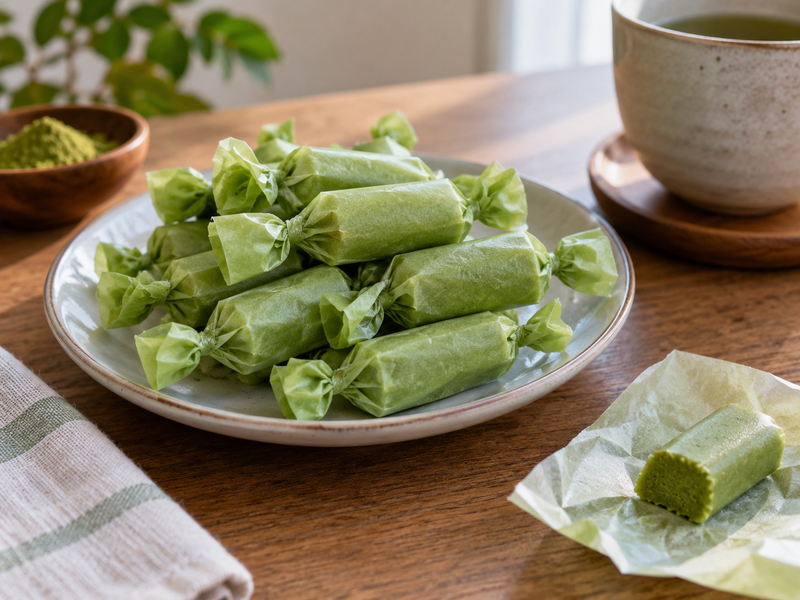
Matcha pastillas look easy to add to a café counter: cook a milk base, roll it green, coat it in sugar and wrap each piece. Yet a batch can turn sticky inside the wrapper, show dark tea flecks, or vary so much in size that a ten-piece pack feels uneven. Define a soft milk-candy bite, a measurable piece weight and a wrapper test before scaling. The Fork & Spoon matcha pastillas recipe shows a milk-and-cream reduction mixed with powdered milk and matcha, then rolled, sugared and individually wrapped. Use it as a format reference while developing a process for your own ingredients, equipment and sales channel.
Contents
- 1. What should a matcha pastillas piece be?
- 2. Which milk-candy base should a producer trial?
- 3. How can matcha be mixed evenly?
- 4. What signals a workable reduction endpoint?
- 5. How should pieces be divided and rolled?
- 6. Does a sugar coating help this recipe?
- 7. Which wrapper protects the finished candy?
- 8. How should a counter-pack trial be run?
- 9. What should an ingredient buyer compare?
- 10. What makes the final production card usable?
1. What should a matcha pastillas piece be?
Describe the unwrapped bite
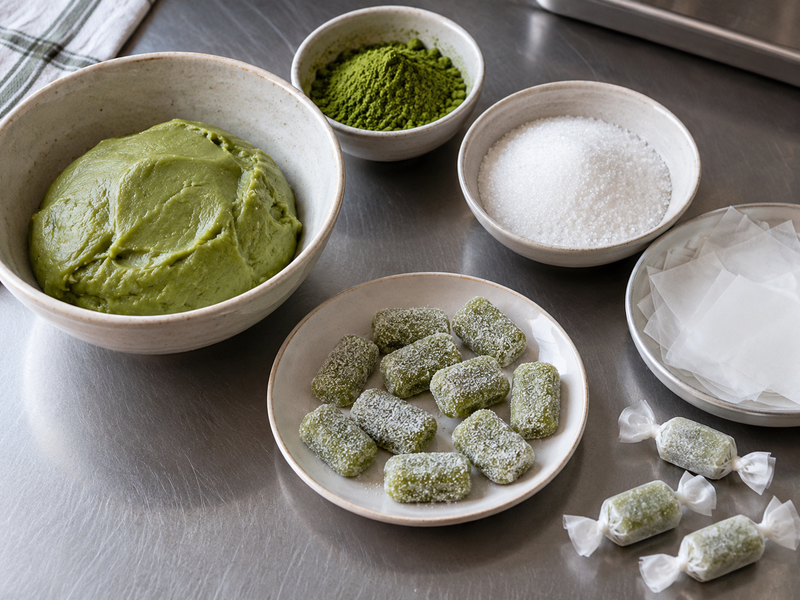
Pastillas de leche are Filipino milk candies. The cited recipe forms bite-sized cylinders and coats them with sugar. A café product needs a more exact brief: weight, length, color, tea strength, surface feel and how cleanly the wrapper peels away. Taste a plain piece before sugar coating and another after coating. Sugar can create a pleasant outer texture while hiding matcha in an already sweet base. A darker green does not automatically mean a better bite if the powder leaves a dry finish.
Choose how the candy will be sold. A single piece with coffee, a small counter bag and a boxed gift assortment face different handling. Wrap a few pieces for each format and ask staff to open them as a guest would. If sugar stays on the paper or the milk candy stretches into threads, note the defect before changing packaging graphics. Define an accepted photograph under counter light and a tactile target in ordinary words, such as soft enough to bite cleanly but firm enough to hold a cylinder. This is a sensory target for trials, not a shelf-life or food-safety specification.
| Product feature | Trial record | Question at handoff |
|---|---|---|
| Shape | Length and diameter | Do pieces look uniform? |
| Center | Plain bite texture | Is it soft without sticking to teeth? |
| Tea | Blind flavor score | Can tasters identify matcha? |
| Wrapper | Peel and residue check | Can a guest open it cleanly? |
2. Which milk-candy base should a producer trial?
Keep cooked and quick-mix methods separate
One route reduces milk and cream before adding powdered milk; another may rely more heavily on ready-made condensed ingredients. They should be treated as different formulas, not interchangeable shortcuts. The reference reduces liquid dairy and then blends in powdered milk and matcha. Record the source and composition of each milk ingredient, since solids, fat and sweetness affect the dough’s feel. A trial should keep the same base while comparing tea, then keep the accepted tea constant while comparing bases. Changing both at once makes a sticky result hard to diagnose.
Write formulas in grams and note finished mass after cooking or mixing. A quick-mix sample can look convenient at bench scale yet behave differently in a wrapper because free moisture and sugar distribution differ. A cooked batch may offer a different flavor but require careful heat control and a planned cooling route. For both, taste after the candy reaches sale condition, not only while the mixture is warm. Cost the accepted piece using actual sellable yield. A cheaper milk ingredient has little value if more product sticks to equipment or fails the wrapper test. Keep each trial labeled so the team can compare recipe, cook loss, texture and unit cost on one sheet.
3. How can matcha be mixed evenly?
Add powder where the mixture can still move
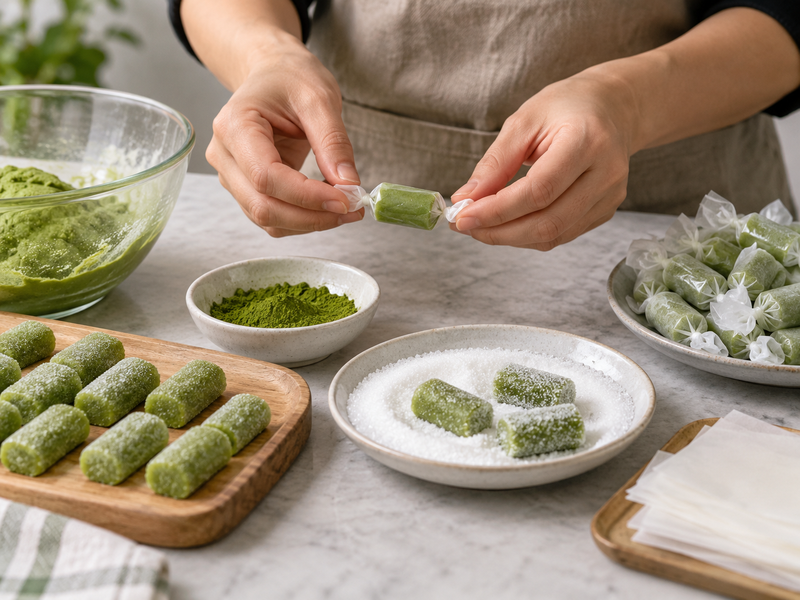
Matcha is ground tea suspended in a food base. It can clump when dry powder meets a dense milk paste. Weigh the tea, check whether the lot contains hard lumps and test sifting if needed. Make a small, smooth paste with a measured portion of the formula before adding it to the main batch. Mix while the base is still workable enough to fold evenly. Scrape the vessel walls and cut a test piece through the center; a smooth outer surface can hide streaks inside.
Compare two tea doses in the same milk base. Record flavor in an uncoated piece and after sugar coating. A low dose may disappear; a high dose may add bitterness or a dry mouthfeel. Photograph cross-sections under fixed light rather than judging loose powder color. If the tea appears dull after cooking, compare mixing point and heat exposure in controlled batches. Any change in mixing point must fit the site’s approved food-safety process. Matcha Village’s pure matcha page recommends checking powder in the finished application; this milk candy gives a direct test of flavor and fine-particle texture.
| Mix test | Hold constant | Look for |
|---|---|---|
| Powder dose A/B | Milk base and batch mass | Tea clarity versus dryness |
| Paste versus dry mixing | Powder lot and dose | Dark pockets or streaks |
| Mixing point | Approved process | Color and aroma after cooling |
| Two powder lots | Formula and method | Repeatability of bite |
4. What signals a workable reduction endpoint?
Test cooled dough, not pan appearance alone
In a cooked version, the operator evaporates water until the mass can be handled and shaped. The source recipe gives a home-scale simmer and then adds powdered milk. A larger vessel changes evaporation area and stirring effort, so minutes from a small pan should not become the factory endpoint. Record starting and finished mass, product temperature, vessel dimensions and the point at which the mixture changes from fluid to dough-like. Cool equal samples through the same approved route and test rolling after each candidate endpoint.
The undercooked sample may smear on gloves or pull into strings. The overcooked one may crack at the ends or resist an even coating. Ask two operators to roll several pieces from each batch; if only the developer can handle one endpoint, it is a poor routine choice. Scrape the kettle frequently enough to prevent localized darkening, but document the method rather than relying on a cook’s memory. Keep safety validation separate from this texture experiment. The FDA Food Code is a US retail-food model for handling and cooling; each producer must follow its own approved plan and local requirements.
5. How should pieces be divided and rolled?
Measure center weight before wrapping
Choose a target piece mass based on pack count, serving use and desired bite. Divide a trial slab into weighed portions, then measure ten finished cylinders. Record minimum, maximum and average weight as well as length. A dough rope cut by eye may be fast for a small batch but drift as it warms. A fixed cutting guide or small depositor might improve repeatability; test whether it damages the soft surface. Staff should work with a batch size they can finish before texture changes at the table.
Weigh the uncoated center separately from its sugar coating and wrapper. Otherwise a heavy sugar shell can hide a light center while the total pack weight appears right. If a piece cracks, inspect dough endpoint and rolling pressure before adding more milk. If pieces flatten after rest, note the time and temperature when that happens. The reference format is cylindrical, but a café may choose shorter bites for a tasting pack. Whatever the geometry, pack photographs and customer expectations should match the approved unit. Count rejected and trimmed pieces, since sellable yield, not theoretical dough divisions, controls cost.
| Portion control | Trial method | Decision |
|---|---|---|
| Center mass | Weigh ten pieces | Set acceptable variation |
| Length | Measure after rolling | Fit chosen wrapper |
| Coating pickup | Weigh before and after sugar | Cost and sweetness |
| Saleable yield | Count accepted pieces | Price pack accurately |
6. Does a sugar coating help this recipe?
Test function as well as appearance
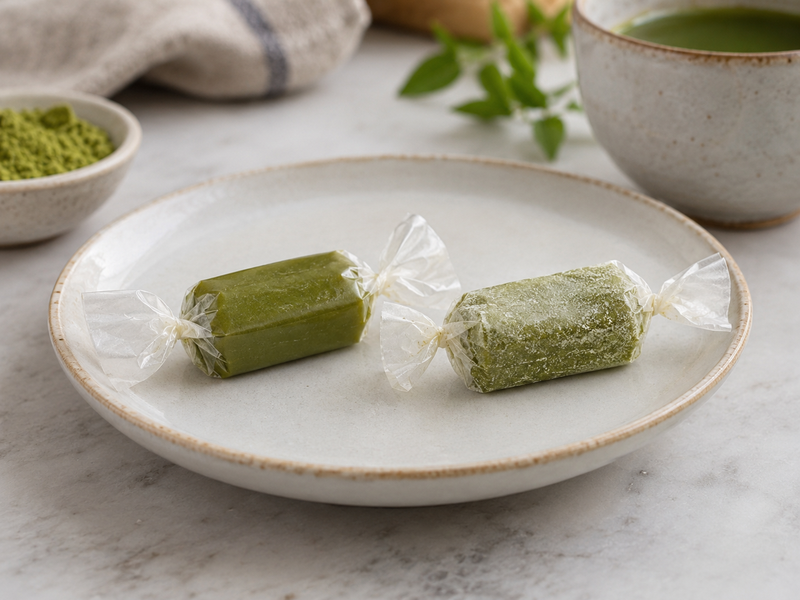
Sugar can give pastillas a familiar finish, but its effect depends on surface moisture and crystal size. Roll equal pieces from one batch in fine sugar, a coarser grade and no coating. Inspect immediately, after wrapping and when the pack reaches the intended sale condition. A coating that becomes syrupy inside paper may make the piece harder to open. One that sheds heavily can leave the wrapper looking dirty. Taste each option; a bright sugar crunch may be pleasant, yet it can overwhelm a delicate tea dose.
Keep the coating tool and container separate from other confectionery finishes so fragments do not change the ingredient declaration. Measure pickup rather than estimating by sight. If a bakery adds coconut, nuts or white chocolate, treat that as a new product trial with an allergen and label review. The FDA allergen overview identifies milk, tree nuts, soy and other US major allergens; the selling market sets the actual requirements. A no-coating version may reduce mess but expose tackiness. Select the finish that performs in the final wrapper, not the one that looks cleanest on the production tray.
7. Which wrapper protects the finished candy?
Test peel, twist and contact surfaces
Individually wrapped pieces are part of the pastillas experience. The cited recipe describes a plain inner paper and decorative outer paper. For commercial use, choose food-contact materials appropriate for the product and market, then test them with the actual candy. Wrap at the approved product condition and inspect whether paper adheres, tears, transfers color or traps condensation. A beautiful twist that takes twenty seconds per piece may also make labor cost dominate a low-priced counter pack. Time the wrap and opening steps across several staff members.
Place finished pieces in the planned pouch or box and carry it through the normal handoff route. Inspect crushed ends, sugar loss and smearing. If the inner wrapper peels cleanly but the outer label blocks opening, change the layout before ordering printed stock. Keep lot and ingredient information in the format required for the sales channel. A loose café jar, a sealed retail bag and an export gift box are different packaging projects. A sensory test can show whether the piece remains attractive; it cannot alone establish a safe sale period. Ask the quality team to approve packaging, handling and date decisions for the exact formulation.
| Wrapper trial | What to measure | Failure to note |
|---|---|---|
| Inner paper | Peel effort and residue | Candy sticks or paper tears |
| Twist ends | Seconds per piece | Ends crush or reopen |
| Outer pack | Carry test and opening | Smear or mixed pieces |
| Label area | Required information fit | Text hidden by fold |
8. How should a counter-pack trial be run?
Inspect pieces at real service points
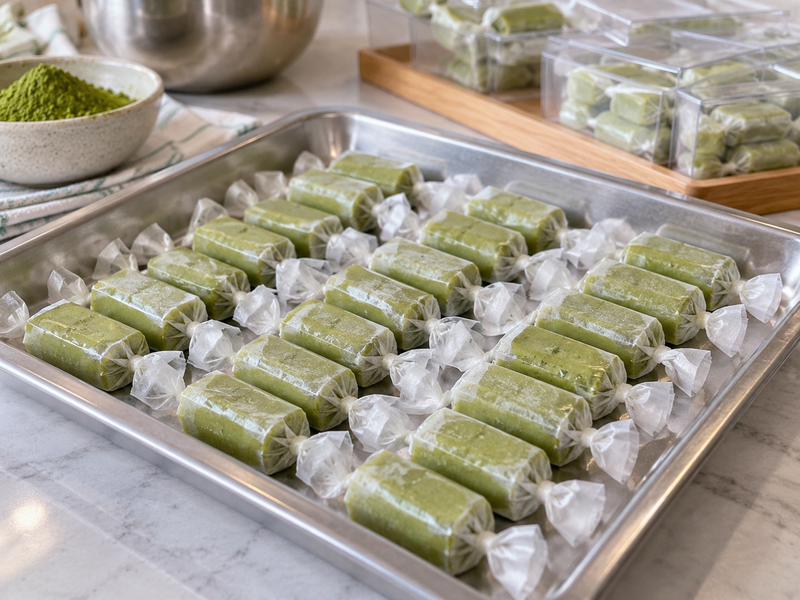
Pack enough units for a small supervised sale simulation. Record production time, product temperature according to the site’s plan, pack count and who wrapped each group. Put samples in the intended counter location or approved refrigerated display, then inspect at scheduled points chosen by the quality team. Check wrapper release, sugar texture, color and tea flavor. Photograph an opened piece, not only the closed branded pack. Staff should also record what guests handle or leave behind; frequent requests for napkins may signal a sticky surface.
Keep quality and safety decisions distinct. The trial tells a café what the candy looks and tastes like across its intended sales period. It does not validate shelf life or exempt the product from dairy handling rules. If pieces fail the wrap before the planned last sale point, shorten the quality window for further testing or revise the formula and pack. Do not double the matcha to dry the dough; powder cost and bitterness may rise without fixing moisture. Check the cook endpoint, powdered-milk level, cooling and contact paper in separate tests. Record actual labor per accepted pack so the menu price reflects hand finishing.
9. What should an ingredient buyer compare?
Buy to the candy application
Send tea suppliers a concise brief: cooked or quick-mix milk candy, expected dose range, proposed pack, target tea taste, color and intended purchase volume. Request lot-linked samples, ingredient identity, pack size, storage guidance and quality documents needed for the destination market. Test each sample at an equal measured dose in the approved recipe. Compare the uncoated center and the wrapped piece. A powder that tastes strong in water can fade under condensed dairy and sugar; another can leave visible specks despite a good aroma.
Calculate cost per accepted pack using the actual grams of tea, milk ingredients, coating, paper, box and labor. Add rejects and wrap losses. A higher-priced tea that gives clear flavor at a lower dose may compare favorably with a weaker one, but the product trial decides. Matcha Village’s buyer guide to choosing matcha makes the same application-based purchasing point. Keep any origin or certification claim tied to the offered lot’s records. Ask how a change in tea specification will be communicated before committing packaging that names a particular origin or grade.
| Buying file item | Supplier evidence | Production proof |
|---|---|---|
| Powder identity | Lot and specification | Approved trial batch |
| Color | Sample | Cut-piece photograph |
| Flavor | Sample | Blind wrapped-piece tasting |
| Economics | Delivered price | Cost per accepted pack |
10. What makes the final production card usable?
Specify the handwork another shift must repeat
The card should name the selected milk ingredients, gram weights, powder lot or specification, cook or mix route, mixing order, endpoint, cooling method, piece mass, coating pickup target and wrapper. Include a photograph of an accepted cut center and an acceptable wrapped piece. Keep the site’s food-safety, allergen and label records connected to the card. Give it a date and version number. A seasonal operator should not have to guess whether a displayed pack used the old powdered-milk level or the new one.
Ask another shift to prepare a small batch without verbal coaching. Observe where it stalls: a vague “cook until thick,” an undefined wrapper size, or an unmeasured handful of sugar. Revise the instruction and repeat the affected check. Compare ten pieces from the new batch with the accepted size, opening test and tea flavor. A supplier conversation can then use precise feedback such as uneven green in a specific milk base or tea fading under sugar. That is far more useful than requesting the brightest powder available. Launch only after the recipe, handwork, pack and sales conditions agree.
FAQ
Q1. Are matcha pastillas the same as brigadeiros? No. Pastillas are milk candies commonly shaped and individually wrapped; brigadeiros use a different cooked confection method and finish.
Q2. Can powdered milk replace a cooked reduction? It creates a separate formula. Compare texture, wrapping and approved handling before making that substitution.
Q3. Why does the wrapper stick? Surface moisture, cook endpoint, coating and paper can all contribute. Change one variable per trial.
Q4. Must every piece be rolled in sugar? No. Test coated and uncoated pieces in the planned wrapper and choose by taste and handling.
Q5. How long can a pack be sold? Determine that from product-specific quality and safety validation under the rules for the market and sales format.