
A pouch can use a strong barrier film and still leak at a dusty seal or folded gusset. That failure can undermine matcha color and aroma before a buyer opens the pack. Matcha packaging seal integrity needs checks on filled packs made on the real line, not only a film certificate. YPAK’s airtight packaging guide points to dirty heat seals and closure details as practical risks. This article turns those risks into a release plan for buyers and packing teams.
Contents
- 1. What does matcha packaging seal integrity cover?
- 2. Where do filled matcha packs tend to leak?
- 3. How should a team define an acceptable seal?
- 4. What should happen at line startup?
- 5. How can powder contamination at seals be controlled?
- 6. Which in-process inspections are useful?
- 7. How should zipper and closure claims be checked?
- 8. What changes require a new seal trial?
- 9. How should defects be contained and traced?
- 10. What belongs in a buyer-ready seal record?
1. What does matcha packaging seal integrity cover?
Look beyond the laminate specification
A pack protects only when its material, formed shape and closure work together. A heat-sealed pouch has a top seal, side seals and often a folded bottom; a zipper adds a consumer reclosure after the permanent top is opened. A tin may use a lid plus an inner membrane or liner. Define which closure protects an unopened product and which only helps after opening. The YPAK reference makes this distinction useful for purchasing, because a barrier rating does not describe a contaminated seal.
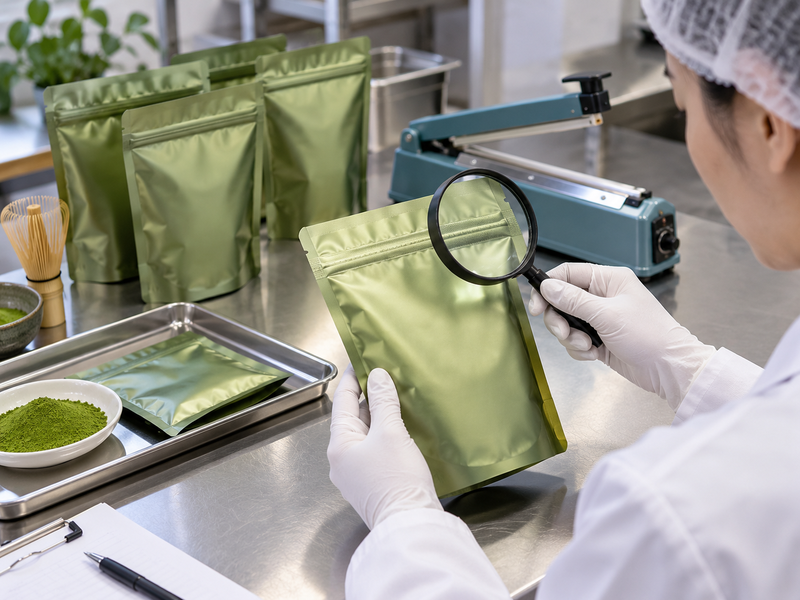
Inspect the filled article. Ask for samples run at normal line speed with the actual matcha powder and fill weight. Empty prototype pouches may seal more cleanly than filled ones. Record where powder collects, how packs pass through handling and whether the seal lies flat. Matcha Village’s packaging overview covers broader pack choices; this guide narrows attention to the physical closure accepted for each lot.
| Pack area | Failure to seek | Evidence |
|---|---|---|
| Top heat seal | Powder channel or unbonded edge | Visual and validated test |
| Side seam | Crease or weak corner | Edge inspection |
| Bottom gusset | Fold leak | Formed-pack test |
| Zipper | Poor engagement | Opening and reclosure trial |
2. Where do filled matcha packs tend to leak?
Follow powder and folds
Fine powder can land on the seal land during filling. A visible green stripe trapped through the seam deserves investigation, even when the pouch looks closed. Folded corners and gussets introduce layers that can heat unevenly. Zipper ends, spouts and tear notches create further transition points. Map them on an annotated pack drawing. Ask operators which locations caused rejects in earlier runs; the actual line history is more useful than a generic “airtight” label.
Change the view. Inspect under consistent light, rotate the pouch and look at both sides. Pinches, wrinkles and powder contamination can hide when packs sit flat in a carton. Open a few rejected units to see how the seam failed. If the same corner recurs, investigate form alignment and seal-bar contact before raising temperature blindly. A hotter bar may damage film or create a seal that opens poorly. Keep all changes tied to one observed defect and one controlled trial.
| Leak location | Process question | Trial response |
|---|---|---|
| Powdered top | Is fill timing sending dust upward? | Adjust filling or dust control |
| Folded corner | Does film lie flat in jaws? | Check form and pressure |
| Zipper end | Is closure aligned? | Check applicator setting |
| Cut edge | Is trim damaging seam? | Inspect cutting setup |
3. How should a team define an acceptable seal?
Write measurable acceptance criteria
Define seal width, position, appearance and the chosen integrity or strength test for the material and pack design. Avoid copying a numeric strength threshold from a different pouch. A strength result from one strip cannot prove that every corner of a whole pack is leak free. Combine it with visual checks and an integrity method appropriate to the exact structure. The FDA’s container-examination manual describes food trapped in a seam and fold-over wrinkles as pouch defects; its specific criteria concern the container types covered there, so set acceptance rules for this matcha pack separately.
Keep a defect library. Save labeled photos of an approved seal, wrinkles, powder channels, burn-through and incomplete bonding. State which are automatic rejects and which need further testing. For tins or other rigid formats, choose an inspection method suited to their closure rather than applying pouch rules by analogy. Record how many samples are tested, where they came from in the run and who has release authority. A buyer can then review actual evidence instead of a broad claim that the packaging is “sealed.”
4. What should happen at line startup?
Hold initial packs until the process is stable
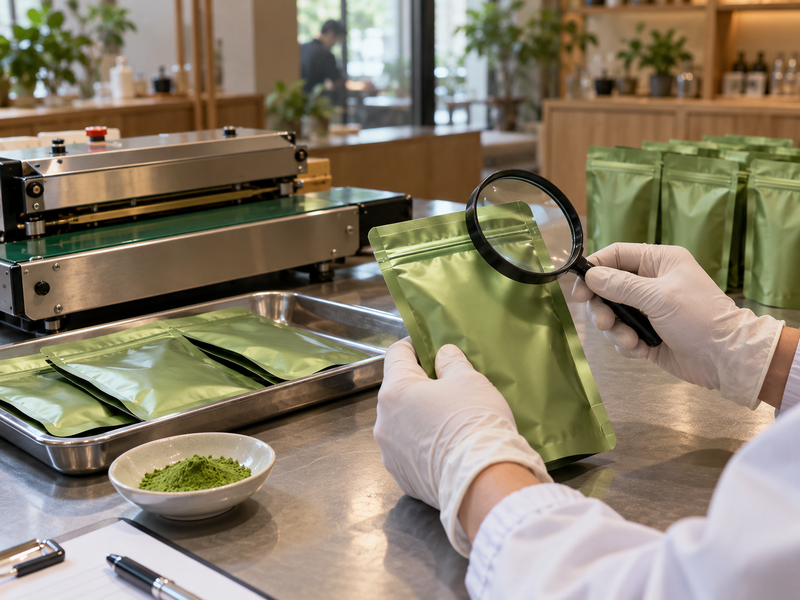
At the start of a run, confirm film identity, pouch dimensions, fill weight, seal-bar condition, temperature setting, pressure setting and dwell or line speed according to the machine’s validated setup. Produce a short startup group and inspect filled units before normal output enters released stock. This is where leftover powder, wrong film or a cold seal jaw can appear. Use the actual line settings and record the time of approval, operator and sample code.
Make the release visible. Label startup product as held until quality staff complete the approved checks. If one sample fails, investigate and repeat the startup set after correction rather than simply removing the bad pack. Keep a sample from the accepted startup group for later comparison. Where several matcha grades share a line, verify the correct packaging and labels at the same time. A well-sealed pack with the wrong content or date code is still a failed shipment.
| Startup check | Record | Release condition |
|---|---|---|
| Material identity | Supplier and film lot | Matches approved specification |
| Machine settings | Actual setpoints | Within validated window |
| Filled-pack appearance | Sample photos | No defined critical defect |
| Test result | Method and result | Meets local acceptance rule |
5. How can powder contamination at seals be controlled?
Treat dust as a process variable
Watch the filler during normal speed, especially at the point the top seal closes. A small cloud can settle in the seal area after a slow demonstration shows none. Check the relationship among fill height, pouch mouth, drop distance and filling rhythm. Adjust one variable in a short controlled trial, then inspect packs from the beginning, middle and end of the run. Cleaning the jaws repeatedly may be necessary, but it does not replace correcting a persistent contamination source.
Record the cleaning trigger. Operators should know what visible residue calls for a stop, how to clean safely and which product must be held since the last acceptable check. Photograph powder caught in the seam; compare it with the defect library. Do not assume every speck causes a leak, and do not wave away a continuous green channel. Test the finished pack using the validated method. This connects a visual warning to actual performance without turning an impression into a release decision.
6. Which in-process inspections are useful?
Sample across the run and after interruptions
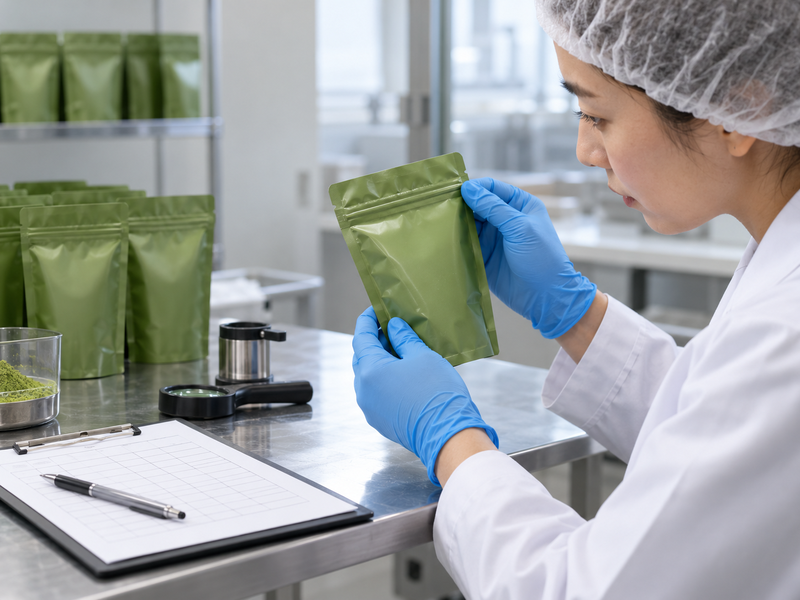
Set a sampling frequency based on the validated line, defect history and buyer requirements. Check the first acceptable group, regular intervals, any restart after a stoppage and the final group. Include packs from different machine lanes or jaws if applicable. Record sample time, line speed, fill weight, appearance and test results. If a test destroys a pack, account for that sample separately from saleable yield. Keep the actual result, not only a tick box marked “passed.”
Watch trends. A gradually narrowing seal or rising reject count can warn of drift before a formal failure. Inspect the physical jaws and film tracking when a trend appears. Choose and validate checks that fit this food package rather than assuming a method designed for another material applies directly. The FDA’s food CGMP guidance gives the broader quality-control context. Train staff on when to stop and who can restart the line.
| Sampling point | Why inspect | Trace record |
|---|---|---|
| Startup | Confirm stable setup | Approval time |
| Timed interval | Detect drift | Last passing sample |
| Restart | Catch changed conditions | Stop reason and settings |
| End of run | Confirm finish | Final lot boundary |
7. How should zipper and closure claims be checked?
Separate factory seal from consumer use
A zipper can help a buyer close a pouch after opening, but it does not replace the permanent factory seal before first use. Test both functions. Open the top seal using the intended tear notch, then close and reopen the zipper several times with dry hands. Look for powder in the track, misaligned ends and a mouth that is hard to grip. Ask an unfamiliar user to repeat the test; operators who know the pouch may compensate for a poor design.
Observe the full sequence. A strong top seal can still tear through the zipper or create a rough edge that makes reclosure unpleasant. A pack may reclose well empty but poorly after a consumer scoops matcha and contaminates the track. Run the trial with product inside, using a realistic scoop. Do not describe the opened pouch as having the same oxygen protection as its unopened factory state without product-specific evidence. Put any consumer storage instruction through the product and label review process.
8. What changes require a new seal trial?
Treat small substitutions as process changes
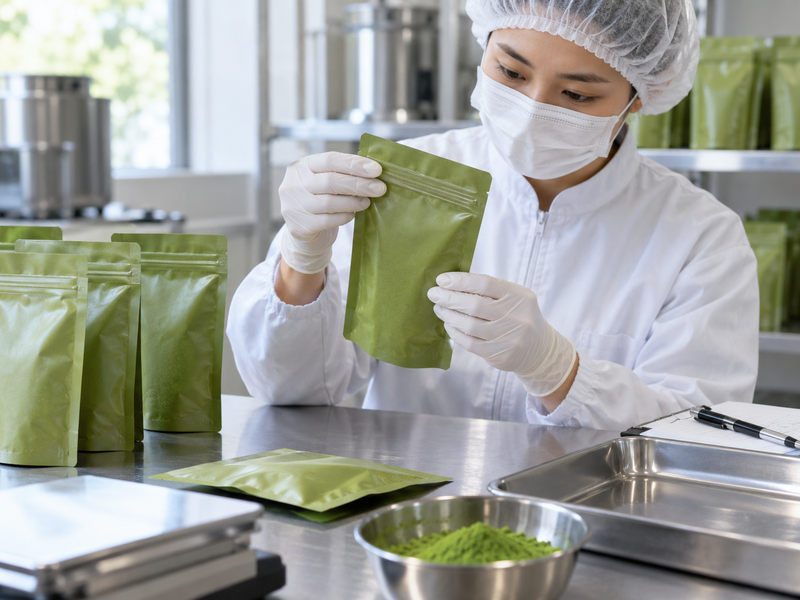
A new film laminate, inner sealant layer, pouch supplier, size, zipper, fill weight or machine can change heat transfer and jaw contact. A new powder grade may also change dust behavior during filling. List these triggers in the packaging specification. When one occurs, run a documented trial before using old settings at full output. Check samples from startup and normal speed; a hand-fed test pack may not represent continuous production.
Control revisions. Record the old and new material codes, machine settings and observed results. Give purchasing a route for urgent substitutions, but do not let a delivery deadline silently bypass qualification. If a buyer requests a different pack size for retail, test transport and opening in that size too. A process window belongs to a defined material and geometry. Keep the approved range with its evidence so a later team knows when it no longer applies.
| Change | Risk to recheck | Record owner |
|---|---|---|
| New film or sealant | Bonding window | Packaging engineer |
| New pouch shape | Folds and corners | Line quality |
| Higher fill weight | Dust and headspace | Production |
| New filler speed | Powder at seam | Production and quality |
9. How should defects be contained and traced?
Define the affected interval
When a check fails, hold product made since the last documented passing check, or use the site’s validated trace rule if it is stricter. Identify cartons by line, time, material lot and finished-product lot. Quarantine them physically and in the inventory system. Investigate whether the problem is a single pouch, one jaw or a continuing process condition. Retesting can inform disposition, but it should follow an approved plan and release authority.
Keep the rejected pack. A photograph helps, but a retained physical sample can show the failure mode. Record corrective action, the first passing test after correction and what happened to held stock. If packs have reached a customer, follow the site’s complaint and recall procedures. A traceable seal record is especially useful when a buyer notices a faded or clumped pack months later; it narrows the investigation to the relevant line and interval without guessing at the cause.
10. What belongs in a buyer-ready seal record?
Share the evidence that describes this lot
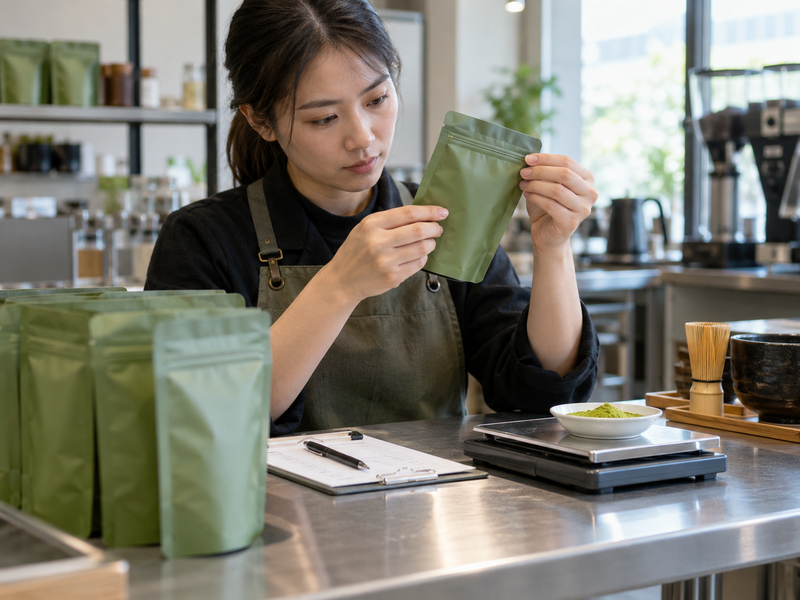
The record should identify pack structure, material and pouch lots, machine and line, product fill, accepted settings, test method, sampling plan, observed results, deviations and disposition. Include a photograph of the approved filled pack and its closure details. Buyers may also need the packaging specification and food-contact documentation appropriate to their market. A generic “airtight” sentence cannot show whether this lot met a controlled process.
Ask one practical question at approval. Could another quality manager read the record and tell which packs were made under passing conditions? If the answer is no, tighten time stamps and lot boundaries. Review customer complaints against the same data and update the defect library when a new failure appears. The release decision should rest on filled-pack evidence, documented checks and a process the next shift can repeat.
FAQ
Q1: What is matcha packaging seal integrity?
It is the demonstrated performance of a filled pack’s permanent closure, checked through defined visual and appropriate integrity methods.
Q2: Is a high-barrier film enough to protect matcha?
No. A dirty or folded seal can leak even when the film itself has strong barrier properties.
Q3: Does a zipper replace the top heat seal?
No. The zipper supports reclosure after opening; the factory seal protects the unopened pouch.
Q4: When should a line repeat its seal trial?
Repeat after changes in material, pouch shape, fill, equipment or conditions that affect seal formation.
Q5: What should buyers request from a packer?
Request the pack specification, filled-pack test plan, lot results and a traceable deviation record.