
Matcha nama chocolate is a soft chocolate-and-cream confection that needs to cut cleanly while remaining tender when served. Its small ingredient list can be misleading: changing the white chocolate, cream or tea may alter the texture enough to affect every square in a tray. A confectionery team should define the intended chilled bite, build a controlled small batch and examine it through cutting, dusting and packing before approving a larger production run.
Contents: Texture · Chocolate · Trials · Tea · Mixing · Setting · Cutting · Dusting · Packing · Scale
1. What should matcha nama chocolate feel like?
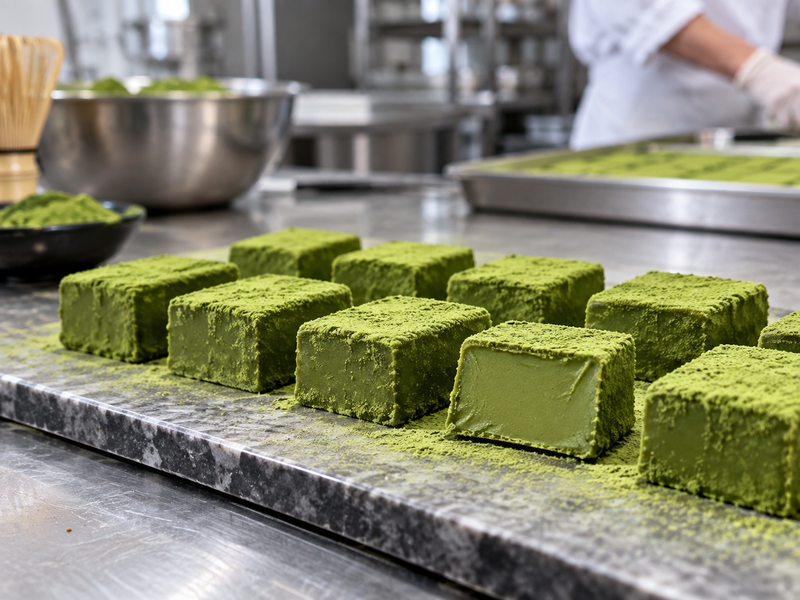
The target is a smooth, tender square that can be lifted from its pack without collapsing. It should not need the hard snap of a solid chocolate bar. The Just One Cookbook reference uses white chocolate, cream, butter and matcha to make a chilled confection with a truffle-like texture. That identifies the style without supplying a commercial specification.
Define the serving condition with the bite
| Attribute | Observe during the trial | Why it matters |
|---|---|---|
| Cut face | Smooth and uniform | Shows mixing and cutting quality |
| Lift | Square keeps its shape | Supports packing and serving |
| Mouthfeel | Tender without graininess | Defines the intended experience |
| Surface | Even, modest powder coat | Controls appearance and bitterness |
Agree on the condition at which the buyer or customer will eat the product. A square evaluated immediately from a cold room may seem much firmer than one handled through service. Compare the planned route under the business’s approved chilled controls.
Record a photograph and a short sensory description together. Color alone cannot show whether the product feels gritty, oily or excessively firm. Avoid approving a sample simply because its cut edges look sharp in a product photograph.
2. Which white chocolate should the team buy?
Start with a named white chocolate product and its ingredient specification. Products sold for coating, baking or general confectionery can differ in composition and working behavior. Do not assume that any pale chips are interchangeable with the chocolate used in the approved trial. Ask the supplier for the exact code and intended applications.
Keep the chocolate identity attached to the formula
Check cocoa butter, milk ingredients, sugar and any other fats or emulsifiers listed for the offered product. These details help explain changes in sweetness, melting and set texture. A different chocolate may require a different cream balance, so a purchasing substitution should trigger a small trial before a full tray is made.
Professional recipes can be product-specific. Callebaut’s white ganache for enrobing, for example, names a chocolate and includes several additional ingredients. Its handling and storage claims belong to that formulation; they should not be transferred to a simpler nama-style confection.
Taste the chocolate before adding tea. A pronounced caramel or milky note can be desirable, but it changes how much tea seems necessary. Compare candidate chocolates with the same matcha rather than selecting the cheapest chocolate first and compensating later with an ever-higher tea dose.
3. How can the chocolate and cream balance be tested?
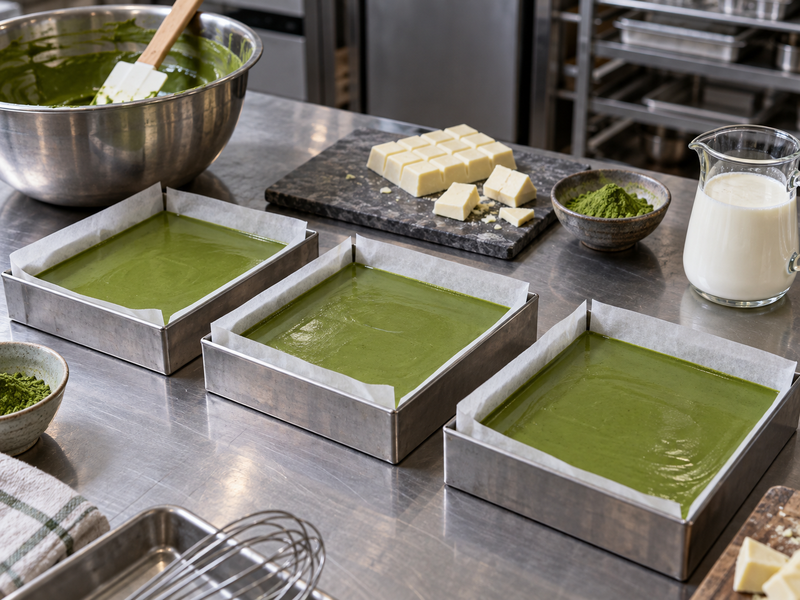
Use a small ratio comparison to establish a workable set with the chosen chocolate. The following is a proposed screening formulation, not a tested recipe, a shelf-life specification or a guarantee of a particular texture. It deliberately keeps butter and tea fixed while varying the cream. Use one cream product throughout.
Compare small batches at the same depth
| Ingredient | Firmer trial | Middle trial | Softer trial |
|---|---|---|---|
| Selected white chocolate | 200 g | 200 g | 200 g |
| Selected dairy cream | 50 g | 65 g | 80 g |
| Unsalted butter | 8 g | 8 g | 8 g |
| Sifted matcha | 4 g | 4 g | 4 g |
Keep tray depth and the evaluation condition similar so geometry does not confuse the comparison. Record whether each sample releases, cuts and lifts cleanly, then taste it. The winning batch is not necessarily the one that produces the sharpest edge; an excessively firm piece may miss the intended eating texture.
Once the chocolate-to-cream balance is promising, refine the tea dose separately. Changing cream and tea together makes it difficult to know why one sample feels drier. Record all adjustments by weight, including any material left in the bowl.
4. How should matcha be dispersed in the mixture?
Sift the tea before it reaches the chocolate mixture. Powder clumps can remain as dark specks even when the surrounding ganache looks smooth. Inspect the sifted powder and a thin smear of the mixed product under good light. A glossy bowl surface can conceal small lumps below it.
Account for every liquid addition
If the process uses a paste made with part of the measured cream, reserve that cream from the formula. Do not add an extra spoonful of water or milk simply to make the powder easier to stir. That changes the formulation and can make a previously firm slab softer. Document the chosen sequence so another operator repeats it.
Matcha is dispersed through the mixture; the goal is an even suspension without dry pockets. It does not need to be described as fully dissolved. Test the powder in the actual chocolate system because a smooth result in water does not establish how it will behave in a fat-rich confection.
The Matcha Village ingredient buyer guide can help frame a request for pure tea powder and traceable samples. Tell the supplier that smoothness in a chilled white chocolate center matters, and include the dose used in the trial rather than asking only for a greener powder.
5. What does a controlled mixing process look like?
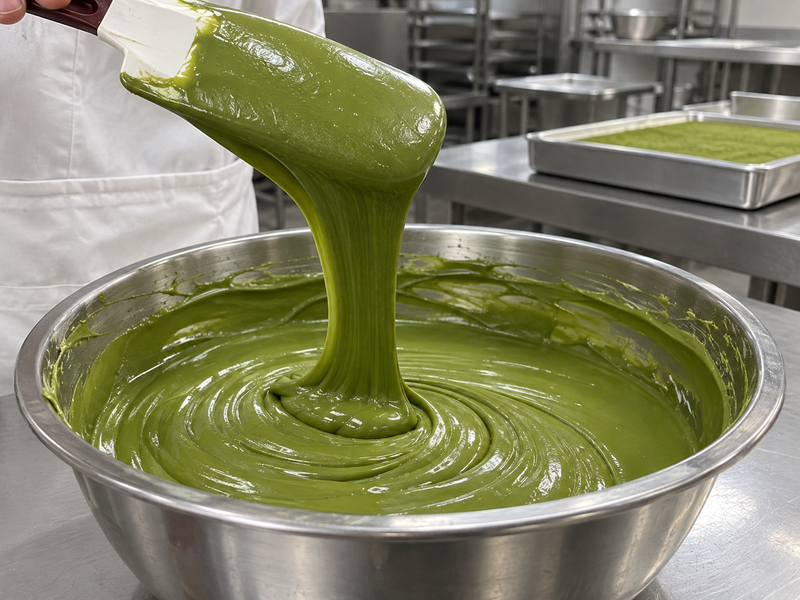
Prepare the lined tray, scale and mixing tools before heating ingredients. Use the chocolate supplier’s working guidance and the chosen formula’s sequence. Gentle, controlled heating and thorough mixing give the team more useful information than repeated unmeasured heating whenever the mixture seems thick.
Distinguish defects before trying to correct them
| Observation | Possible issue to investigate | Useful record |
|---|---|---|
| Pale solid pieces | Unmelted chocolate | Ingredient size and heat history |
| Dark green specks | Poor tea dispersion | Sifting and incorporation method |
| Oily appearance | Separation | Temperature and mixing sequence |
| Many small bubbles | Air incorporation | Tool position and mixing speed |
Keep tools dry where stray water would change the process, while remembering that the formula already contains a measured aqueous ingredient in the cream. The practical distinction is controlled composition. An accidental splash is not equivalent to the cream deliberately included in the recipe.
If using an immersion blender, select a vessel and batch depth that allow safe operation with the head submerged. Avoid drawing air into the mixture. A smooth emulsion is the goal; a whipped, aerated texture would be another product. Record a failed trial honestly rather than making multiple undocumented corrections and treating the rescued result as a repeatable formula.
6. How do tray size and cooling affect the slab?
The same batch poured into two different trays produces different depths and may set differently. Measure the usable internal area and target slab height. Line the tray so the finished slab can be lifted without bending or dragging a soft corner. Uneven parchment folds can create trimming losses along the edges.
Set the geometry before the production quantity
Pour onto a level surface and spread the mixture consistently. Check corners, where a thicker pool can remain even when the center looks flat. Record the mixture condition at pouring and the filled tray weight. Those details help explain a later batch with a different height or setting pattern.
Use your approved chilling process and evaluate the slab at a defined condition. Do not assume a larger tray is ready after the same elapsed time as a small development sample. Check the center and edge before cutting. The visible surface alone does not reveal whether the slab is uniformly workable.
Plan tray capacity around the intended cut size. A neat grid that fits the internal dimensions can reduce trim, but do not reduce the piece so far that dusting and handling become awkward. Confirm the shape in the actual sales pack before ordering a large number of custom inserts.
7. How can you cut clean, even squares?
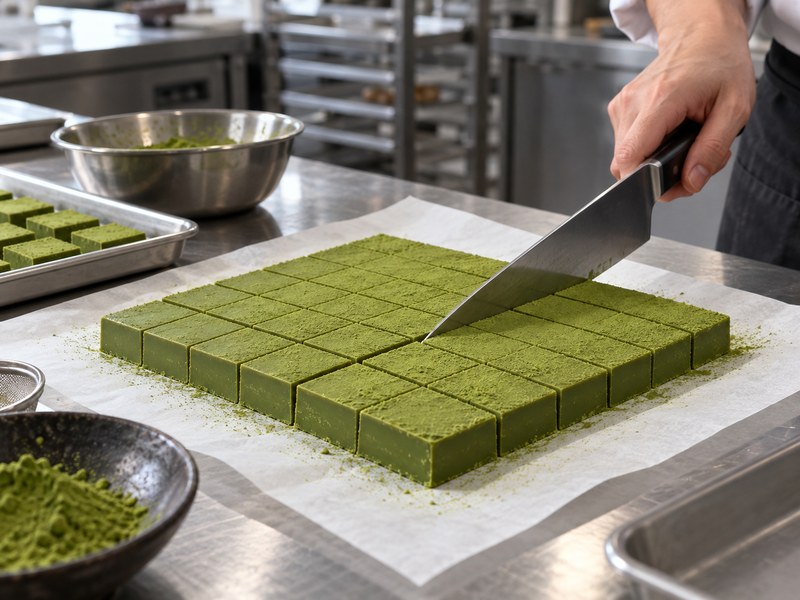
Cut a test strip before marking the entire slab. If the blade drags, smears or fractures the edge, check the product condition and cutting method. A warmer blade may help some formulations, but it must be clean and dry, and excess heat can melt the surface. Establish the method through the chosen slab rather than treating a warm knife as a universal correction.
Inspect the piece after lifting
| Cutting observation | Investigate | Acceptance check |
|---|---|---|
| Dragged edge | Slab condition or dirty blade | Smooth cut face |
| Bent corner | Lifting tool or soft set | Shape after transfer |
| Uneven height | Pouring and leveling | Several pieces across the tray |
| Variable weight | Grid and trim control | Weighed sample of squares |
Wipe the blade between cuts according to the production procedure. Keep residues from accumulating and pulling through the next face. Use a suitable lifting tool so staff do not pinch the soft sides while transferring pieces to the pack.
Measure the actual trimmed yield. End pieces may be useful for internal tasting, but they should not be counted as full retail portions unless they meet the same specification. A cutting map and a weighed sample run make the output more predictable than estimating yield from the original ingredient total.
8. How much matcha belongs on the surface?
A light dusting can distinguish nama chocolate visually and add tea aroma at the first bite. It also puts dry powder directly on the tongue. Evaluate the surface and center together; a balanced interior can become harsh when heavily coated. Treat dusting as a measured finishing ingredient rather than an unlimited decorative step.
Compare a plain control with two finishes
Set aside undusted squares, lightly dusted squares and a second slightly heavier finish as a proposed tasting comparison. Keep their weights and serving condition the same. Record the powder used and the amount consumed by the finishing station. Some falls between the pieces, so ingredient issued is not identical to ingredient retained.
Look at the surface after the normal packing delay. Moisture or contact with the lid may change its appearance. A dense powder layer that looks attractive immediately may mark the insert or create uneven dark patches later. Check the actual closed pack rather than leaving every trial exposed on a plate.
If a supplier changes the dusting powder, repeat this comparison even when the center formula stays unchanged. Surface tea is tasted differently from tea dispersed in chocolate. A single purchasing approval should state whether it covers the interior, the finish or both.
9. What should a chilled packaging trial check?
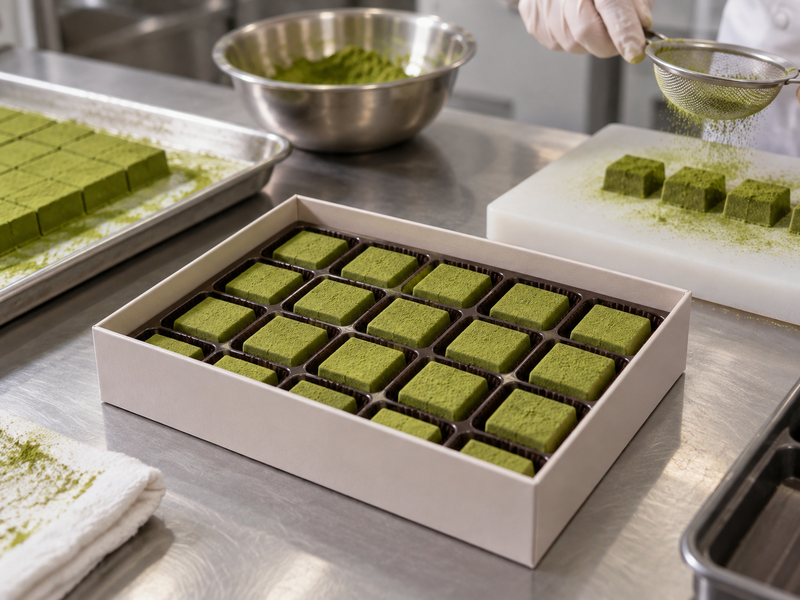
The pack needs to protect a soft square through lifting, transport and opening. Choose an insert with enough clearance to avoid scraping the sides, but not so much that pieces slide into one another. Test with the actual finished dimensions, including dusting. A sample made slightly smaller for photography can give a misleading impression of fit.
Evaluate the complete handling route
| Check | Look for | Decision |
|---|---|---|
| Insert clearance | Side smears or tight removal | Adjust cavity size |
| Lid clearance | Powder transfer | Increase headspace |
| Transport | Shifted or damaged pieces | Improve support |
| Chilled handling | Surface moisture changes | Review pack and procedure |
Keep the product within the operation’s approved chilled controls. Record how it moves from setting to cutting, packing and dispatch so a long intermediate wait does not disappear from the process description. Quality checks should run alongside the food safety assessment for the actual formula.
Do not print a commercial shelf life copied from a home recipe or a different professional ganache. Ingredients, process and packaging differ. Arrange product-specific validation and make the final storage instructions consistent with the handling route the business can actually maintain.
10. What information is needed before scaling production?
Scaling requires more than multiplying grams. Record the vessel, mixing tool, batch depth, tray dimensions and chilling arrangement that produced the approved sample. A larger mass may need a different mixing setup and a longer time to reach the cutting condition. Confirm those changes with an intermediate run before filling every tray in the kitchen.
Give each approval a clear boundary
The ingredient approval should identify chocolate, cream, butter and matcha codes. The process approval should describe mixing, pouring, setting, cutting and finishing. The pack approval should identify the insert and handling conditions. Together they define the product the customer tasted; none should be replaced informally during a busy order.
Keep a small retained reference or a documented comparison procedure for incoming tea lots. Matcha Village can use an application brief describing the white chocolate base, trial dose and desired chilled flavor. Request commercial documents for the exact material offered rather than relying on an attractive sample alone.
Make the next trial large enough to fill the intended production tray. Weigh the saleable cut pieces, record trim and dusting loss, and have the packing team complete a box before releasing the formula for a customer order.
Frequently asked questions
Q1: Is nama chocolate the same as a solid chocolate bar?
No. This style contains cream and has a softer texture and different handling needs. Its storage instructions must follow the actual confection formulation and validation.
Q2: Can milk replace cream at the same weight?
Treat that as a new formulation. The composition changes, so setting and mouthfeel may change too. Run a separate small trial with the exact products.
Q3: Why are there dark specks in the cut face?
Check tea clumps and the incorporation method. Sift first and inspect a thin smear before pouring. Extra mixing after the slab is set cannot correct the distribution.
Q4: Does a very sharp cut prove the formula is good?
It proves only one handling attribute. Taste the square at the intended service condition and check lifting, smoothness and flavor before approving the batch.
Q5: Can the surface powder be omitted?
Yes, if the undusted product meets the intended flavor and appearance. Compare it directly with a lightly dusted sample and update the portion cost and product image accordingly.