
Matcha ganache needs a job before it needs a ratio. A center piped into a macaron, a layer inside a cake and a coating poured over a dessert ask for different behavior. The same mixture may perform one task well and make another difficult. For a bakery developing a tea filling, the fastest useful approach is to name the application, select the actual chocolate and cream, then compare a few small batches under the conditions where staff will use them.
Contents: Use · Ingredients · Ratios · Tea · Emulsion · Setting · Piping · Dessert · Scale · Specification
1. What must the matcha ganache do?
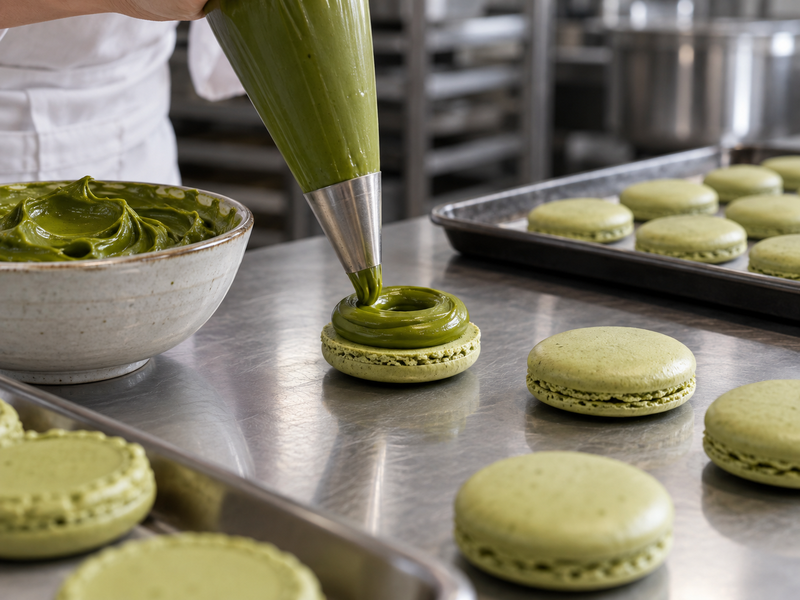
Write one visible performance requirement first. A macaron filling may need to hold a round deposit when the top shell is applied. A cake layer needs to spread without tearing the crumb and remain in place under another layer. A drip needs controlled flow. These requirements should guide the first trial instead of a universal claim that one ganache fits every dessert.
Define the working condition
| Application | Useful bench test | Failure to watch |
|---|---|---|
| Piped center | Deposit through the chosen nozzle | Slump or excessive pressure |
| Cake layer | Spread on the actual cake | Tearing or sliding |
| Coating or drip | Apply to a test dessert | Uneven flow or pooling |
| Cut insert | Slice a small slab | Dragging or collapse |
The Chelsweets reference presents a white chocolate filling and explicitly points to a different ratio for cake drips. That distinction is useful: application changes deserve their own formula checks.
Record the condition at use as well as the finished serving condition. A mixture can be easy to pipe when freshly conditioned but become too firm for the intended bite. The product needs to satisfy both the operator and the customer.
2. Why do the chocolate and cream specifications matter?
Use one named white chocolate for the first trial series. Its sugar, cocoa butter and milk ingredients influence sweetness and texture. A different product may behave differently even at the same chocolate-to-cream weight ratio. Keep the supplier code with the formula so purchasing does not unknowingly introduce a new variable.
Read the ingredient list before substituting
The cream also needs an exact identity. Record its fat content and whether the product contains other ingredients relevant to the application. Milk, dairy cream, coconut cream and prepared plant whipping products are not interchangeable simply because they are pale liquids. A dairy-free development needs suitable chocolate as well as a suitable replacement for cream.
Professional chocolate manufacturers often write recipes for particular products. Callebaut’s white chocolate ganache for enrobing includes a named chocolate and additional formulation ingredients. Its cuttable texture belongs to that complete system. Copying only its liquid ratio into a three-ingredient filling would omit important differences.
Ask ingredient suppliers for the information your business needs to approve the material, including composition and traceability. Taste the chocolate and cream base without tea once. That reference helps distinguish the tea’s bitterness from the chocolate’s sweetness or a dairy flavor that remains prominent in the finished filling.
3. How should a small ratio trial be designed?
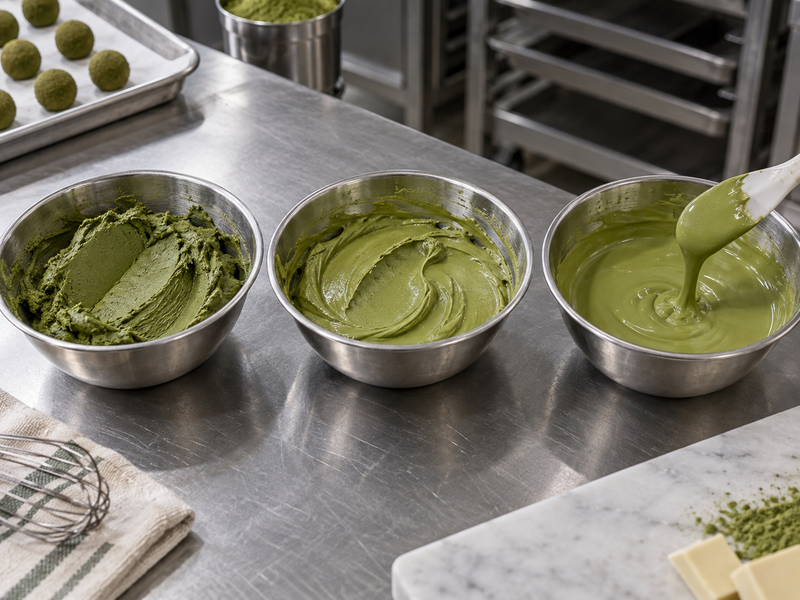
Hold chocolate and matcha steady while changing one liquid amount. The table below proposes a screening exercise for a white chocolate filling. It is not a tested universal recipe or a storage specification. The exact chocolate and cream may require other proportions, and a coating application may need a separate trial beyond these points.
Compare after the same conditioning process
| Ingredient | Trial A | Trial B | Trial C |
|---|---|---|---|
| Selected white chocolate | 150 g | 150 g | 150 g |
| Selected dairy cream | 60 g | 75 g | 90 g |
| Sifted matcha | 3 g | 3 g | 3 g |
Use similar vessels and depths, and record the process for each. Compare the samples at the same working condition rather than piping one straight from chilling and another after a long bench wait. A condition difference can look like a formula difference.
Keep a plain control if the tea seems to change texture substantially. Once one ratio works, refine the tea dose in that base. Resist adding extra chocolate to one trial and extra cream to another without writing down the correction. Those adjustments may produce usable filling, but they erase the comparison unless the final weights are known.
4. How can matcha be incorporated without grit?
Sift the powder and choose an incorporation sequence that can be repeated. A small portion of measured cream can be reserved for dispersion if the process calls for it. Alternatively, the sifted powder may be incorporated into the mixed base through an established method. Compare the results in a small batch before choosing the sequence.
Inspect a thin smear
Spread a little ganache across a clean plate or spatula. Dark concentrated specks suggest uneven tea dispersion, while pale pieces may be unmelted chocolate. Treat those as different observations. A blender can help distribute material, but it does not make an unsuitable powder or an uncontrolled formula automatically acceptable.
Keep every dispersion liquid inside the recorded formula. An extra splash added by one operator changes the trial, even when it appears too small to matter. Matcha is dispersed rather than fully dissolved, so the goal is a smooth eating texture with no dry pockets, not a claim that all tea particles disappear.
Tell the tea supplier the intended use and dose. The Matcha Village ingredient buyer guide provides context for comparing pure powders and blends. For this application, request a sample that can be evaluated in the chosen white chocolate system and traced to a product code if approved.
5. What should the team watch during emulsification?
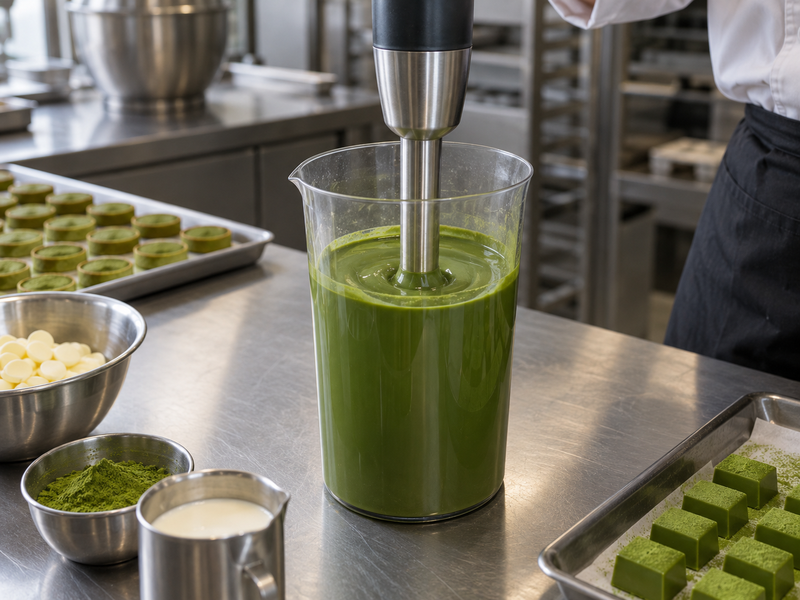
Ganache production needs controlled heat and mixing. Prepare the ingredients and equipment before starting so the mixture does not sit while someone searches for a spatula or tray. Follow the selected chocolate’s working guidance and the formula’s process, recording the temperatures that actually occur rather than relying only on a timer.
Keep air out of the mixing step
| Observation | Possible process issue | What to record |
|---|---|---|
| Oil visible on the surface | Separation | Heat and addition sequence |
| Air bubbles throughout | Blender position or agitation | Vessel depth and tool use |
| Unmelted pieces | Incomplete melting | Chocolate size and heat input |
| Uneven green streaks | Incomplete dispersion | Powder addition method |
If using an immersion blender, choose a vessel that allows the head to remain submerged and operate it safely. A shallow quantity in a wide bowl may be unsuitable for that tool. Avoid turning a smooth filling into an aerated mixture unless a whipped product is deliberately being developed.
Do not repeatedly overheat a batch to remove every visible defect. Identify whether the problem is unmelted chocolate, tea clumps or separation first. A rescued trial should be recorded with every correction, and the corrected formula should be repeated cleanly before it becomes the production standard.
6. When is the ganache ready to use?
Readiness is a handling condition, not simply the end of a fixed waiting period. Check whether the filling can pass through the intended nozzle or spread to the intended layer without tearing. Record how it reaches that condition through the approved cooling and conditioning procedure. A larger batch may behave differently from a shallow test bowl.
Distinguish working texture from final texture
The Chelsweets recipe describes allowing its filling to set before piping. That is relevant to its specific formula, but another chocolate, ratio or batch size can change the interval. Establish your own observable endpoint and retain the actual temperature and timing records from successful trials.
If a filling is too firm, follow a documented conditioning method rather than adding unmeasured liquid. If it is too loose, assess whether it has reached the intended condition before changing the recipe. A formula correction made too early may produce an overly firm filling later.
Keep the working quantity appropriate to the service or assembly run. Repeatedly moving one large bowl through changing conditions can make the first and last deposits differ. Smaller controlled portions may be easier to manage, provided the operation’s food safety and traceability procedures are maintained throughout.
7. How do you test piping and layering performance?
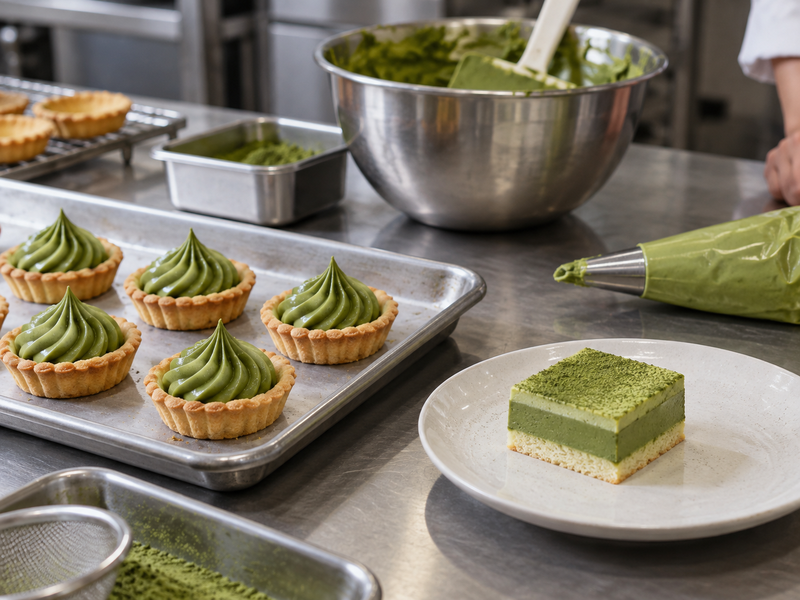
Use the actual bag, nozzle, depositor or spreading tool planned for production. A spoon test can identify a broad difference, but it cannot reveal how much pressure an operator needs to fill twenty shells. Test through a short run and compare the first deposits with the last.
Give the trial an observable result
| Test | Hold constant | Observe |
|---|---|---|
| Piping | Nozzle and target weight | Shape and operator effort |
| Sandwich closure | Shell pair and pressure | Filling spread |
| Cake layering | Layer thickness and cake type | Smearing or sliding |
| Surface coating | Dessert condition and quantity | Flow and coverage |
Weigh deposits rather than judging volume alone. A decorative swirl can look larger while containing little extra filling, and an unevenly filled center can alter the whole dessert’s balance. Photograph the acceptable shape from a consistent angle for the production sheet.
For a cake, test a small stacked section under the normal assembly and handling sequence. A layer that spreads smoothly may still move under weight. Record any failure at the actual stage where it occurs; calling the ganache too soft without that context gives the next trial too little direction.
8. What changes when ganache meets the finished dessert?
The surrounding food changes the eating experience and may change texture during holding. A sweet macaron shell can make tea seem less assertive. A dry cake crumb can make a modest filling layer feel insufficient. A crisp biscuit may soften where it contacts the center. Evaluate the complete dessert before approving the ganache on a spoon tasting.
Keep component controls for comparison
Retain some ganache separately and some unfilled pastry from the same run. Compare them with the assembled samples during the planned quality study. This helps identify whether a change belongs to the filling, the shell or their interaction. Use the same approved holding conditions for meaningful comparisons.
Check flavor at the intended service condition too. The relative impression of sweetness, fat and tea can change as a chilled dessert moves through service. Do not select a tea dose only from a warm bowl at the mixing bench. The customer’s spoonful or bite is the relevant endpoint.
Shelf life belongs to the finished product and its process. A ganache recipe’s domestic storage advice does not establish a commercial period for a filled cake or biscuit. Arrange the required product-specific assessment and keep its approved instructions attached to the exact dessert formulation and packaging.
9. How can a larger batch be made repeatably?
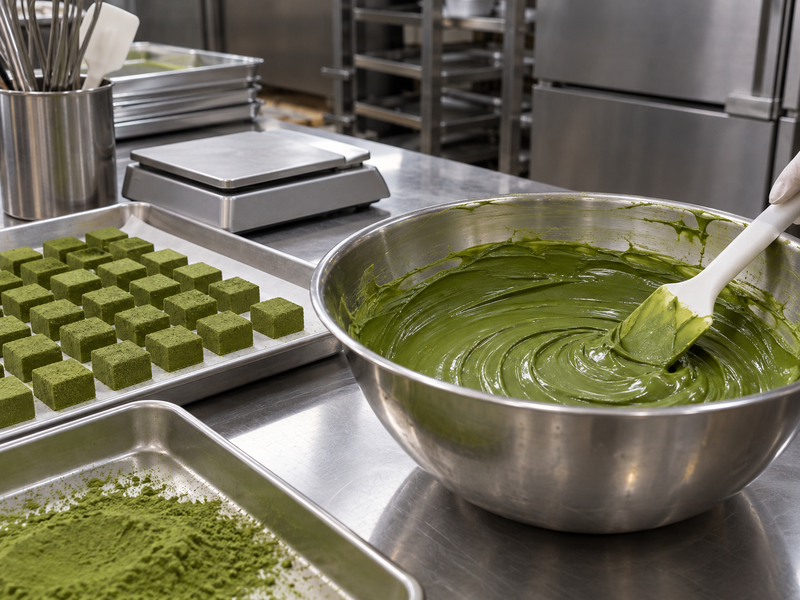
Scale the process in stages. A larger vessel changes the depth available to the mixer, while a larger mass changes heating and cooling behavior. Multiplying ingredients is only the starting calculation. Confirm that the equipment can distribute the tea and produce a uniform texture throughout the batch.
Measure material that never reaches the dessert
| Production record | Where to measure | Why it helps |
|---|---|---|
| Batch input | Before mixing | Formula traceability |
| Usable filling | After transfer | Bowl and tool losses |
| Deposit weight | During assembly | Portion consistency |
| Retained material | Bag or depositor at finish | Cost and batch planning |
| Conditioning history | Before and during use | Explains texture changes |
Compare samples from different parts of the vessel before filling the entire order. If color or consistency varies, stop and investigate mixing rather than allowing staff to compensate with different deposit sizes. That kind of correction creates inconsistent desserts and unreliable cost records.
Time the normal operator through the selected assembly task. A formula that pipes beautifully from a small test bag may be tiring or slow over a longer run. Include this labor observation when deciding between two otherwise similar formulations, especially for wholesale orders with fixed dispatch times.
10. What belongs in an approved ganache specification?
Name the application, ingredient codes, exact weights and process sequence. Add the working condition, nozzle or spreading tool and target deposit. Include a photograph of the acceptable result in the finished dessert. A note saying smooth green ganache is too vague to help staff when a batch behaves differently.
Connect purchasing changes to practical checks
When chocolate changes, repeat the ratio and working-texture comparison. When cream changes, reassess composition and set behavior. When tea changes, compare dispersion, flavor and color at the approved dose. These focused checks are more informative than altering several ingredients and asking whether the new dessert is generally acceptable.
For an OEM or wholesale ingredient discussion, explain whether the ganache is piped, layered or coated and how the finished dessert is served. Matcha Village can use that information to select traceable tea samples for the actual application. Keep commercial documentation and ingredient declarations aligned with the material eventually ordered.
Before the next production commitment, make an intermediate batch with the intended mixer and container. Pipe or spread it through a normal staff run, inspect the assembled dessert and record the yield that can be delivered at the approved quality.
Frequently asked questions
Q1: Is one ganache ratio suitable for fillings and drips?
Usually the applications need separate checks. A filling must hold shape, while a drip needs controlled flow. Develop each around the exact chocolate and intended working condition.
Q2: Can a dairy-free version use coconut cream alone?
The chocolate must also meet the intended ingredient requirements. Treat the complete dairy-free version as a new formulation and review all ingredient declarations and handling controls.
Q3: Why is the ganache grainy?
Inspect for tea clumps, unmelted chocolate or a mixing problem. Those observations suggest different corrections. Record what the graininess looks and feels like before reheating or adding ingredients.
Q4: Should extra cream be added when piping is difficult?
First check the working condition against the approved process. If a formula change is necessary, weigh it, record it and repeat the revised formula in a separate trial.
Q5: What is the most useful supplier sample test?
Compare samples in the actual ganache base at the same dose, then evaluate the finished dessert. A tea tasting in water alone does not establish filling performance.