
Matcha measurements drift quickly in a busy café. One worker uses a heaped spoon, another levels it, and a third adds extra powder when the milk cup looks pale. The drinks no longer taste the same, and the ingredient cost becomes impossible to predict. A reliable recipe starts with weighed powder and measured liquid, then adjusts for cup size, ice and customer preference.
Contents: Weight · Spoons · Water · Milk · Ice · Batch · Tools · Powder · Cost · Card
1. Why Should Matcha Be Measured by Weight?
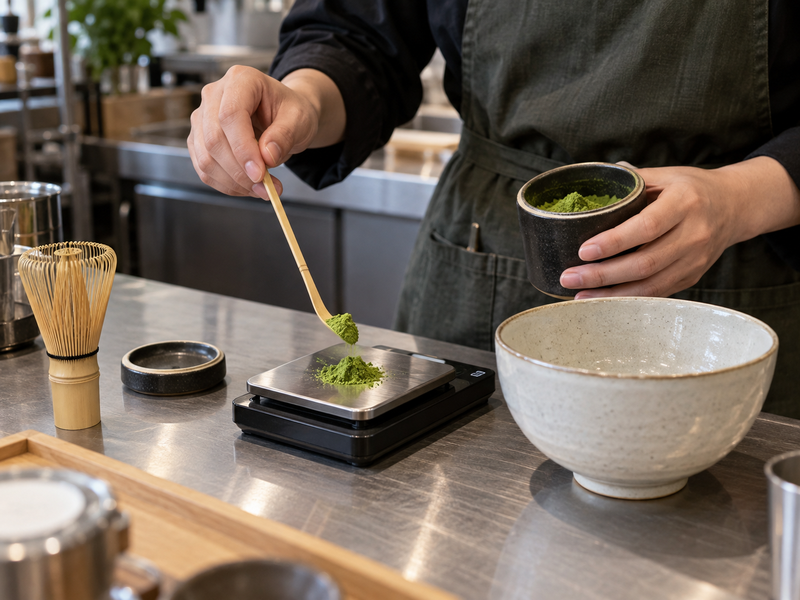
A gram is more reliable than a mound on a spoon
Fine powders settle, compact and cling to tools. Two scoops that look alike can hold different amounts of matcha. Weighing the powder removes that ambiguity during development and staff training. It also makes sensory tests fair: a buyer cannot compare two supplier samples meaningfully if one cup contains more powder than the other. Use a scale suited to small amounts, place a dry vessel on it, tare, then add the specified weight.
The recipe should identify the weight for each cup size and any allowed tolerance. That does not mean every café must weigh each order forever. A chain can select a calibrated scoop after testing it against a scale with the actual powder and staff method. Recheck the scoop whenever the powder, container or tool changes. A manufacturing line needs stronger controls, with batch weights recorded and checked against yield. The principle is the same at both scales: define the dose before debating flavor.
Weighing also clarifies supplier comparisons. If powder A tastes balanced at 2 grams and powder B needs 3 grams, price per kilogram alone tells an incomplete story. Cost per drink is the relevant number.
| Measure | Useful for | Main limitation |
|---|---|---|
| Digital scale | Development and audits | Needs a clean, stable station |
| Calibrated scoop | Fast café service | Must be checked for each powder |
| Volumetric cup | Liquids | Ice and foam change actual volume |
| Batch scale | Production | Requires documented checks |
2. Can a Teaspoon Stand In for a Scale?
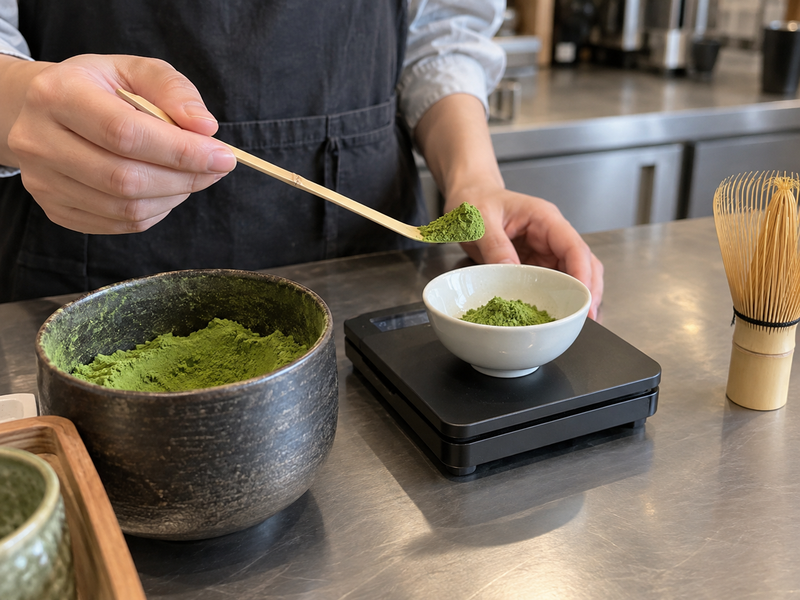
Use volume only after calibrating it
A teaspoon can be a convenient service tool, but “one teaspoon” is not a fixed weight for every powder. Fineness, moisture, compaction and whether the spoon is level or heaped all change the amount. In development, weigh ten normal scoops made by different workers, then look at the spread. If the variation is too wide for flavor or cost targets, change the tool or method. A level scoop with a straight edge may work better than a household spoon whose bowl shape varies.
Do not borrow a ratio from an online recipe and assume its “teaspoon” matches your café’s utensil. Record the tool model or photograph it for training, and specify level or heaped. Keep it dry. Wet residue can change the next serving and make powder clump in the container. If the powder is transferred to a service jar, keep the same scoop and check that staff do not bury it in the powder between uses.
The scale remains the reference. A scoop is a shortcut that should reproduce the weighed dose closely enough for the product, not a separate recipe.
3. How Much Water Should Start the Matcha Base?
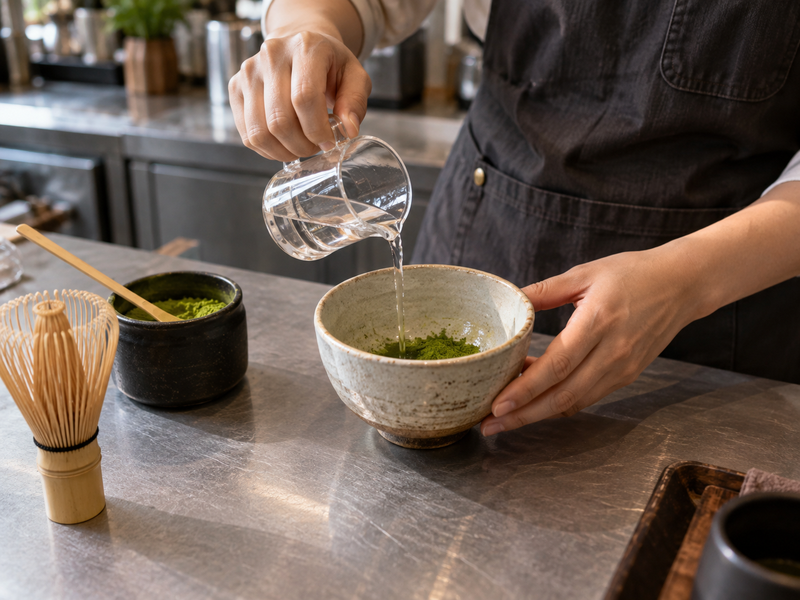
Begin with a small, smooth suspension
Matcha is a suspension of fine tea particles, not a powder that vanishes into water. A small measured amount of water helps wet and disperse the powder before it meets milk or ice. For an illustrative café pilot, a team might test 2 grams of powder with 50–70 milliliters of water, then adjust the finished drink. That is a development starting point, not a rule for every powder or cup. Follow the supplier’s preparation advice and taste the result with the intended liquid.
Record water temperature as well as volume. Temperature can affect flavor and how easily staff mix the base. An unnecessarily hot base can alter the finished taste or slow cold service; too little water may leave a thick paste that is hard to whisk. Use the same bowl, whisk or mixer while comparing candidate ratios. Note dry clumps on the vessel wall and sediment after a short wait. The goal is a smooth base that can be reproduced during a rush.
If the drink is plain matcha, the base may be the finished cup. For a milk drink, count the base water in the total liquid rather than adding it invisibly on top of the stated serving size.
| Pilot variable | Example starting point | What to adjust |
|---|---|---|
| Powder | 2 g per test cup | Desired tea strength |
| Base water | 50–70 ml | Mixing and dilution |
| Water temperature | Supplier-guided range | Taste and service speed |
| Mixing | Fixed tool and time | Clumps and foam |
4. How Do Milk and Cup Size Change the Ratio?
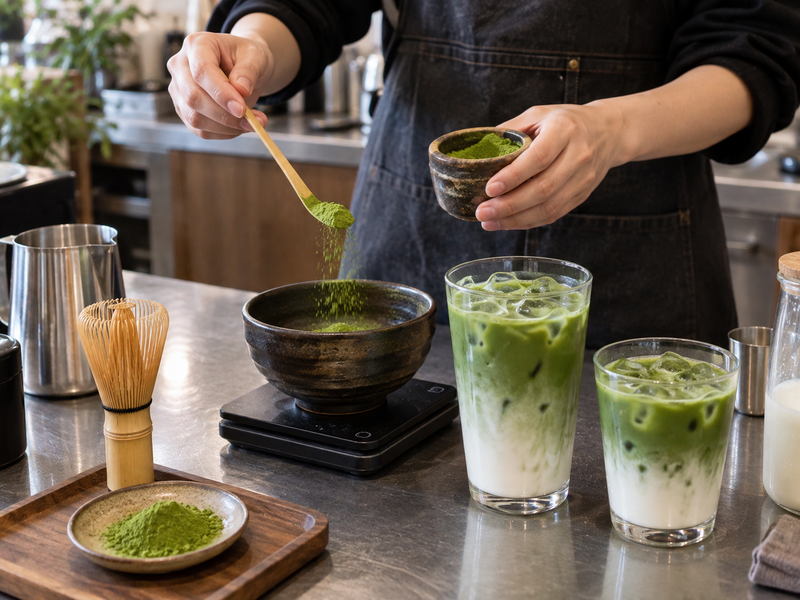
Keep the tea dose linked to the finished drink
A larger cup usually needs a considered change in the recipe, not an automatic doubling of every ingredient. Milk type, sweetener and customer expectation affect how much tea is perceptible. Build one standard cup first. For example, a team might begin with a 2 gram matcha base and add 150 milliliters of milk, then taste it alongside a stronger test at 2.5 grams. These are pilot values; the approved dose must come from the product’s sensory and cost results.
For a second cup size, decide what the customer is buying. If the larger cup simply adds milk, tea flavor may become weak. If it scales powder and syrup too, cost and sweetness rise. Test both deliberately and write the outcome into the recipe card. Plant-based milks can be sweeter or more assertive than dairy milk, so test common substitutions at the standard dose. A formula that needs extra powder only with one milk may deserve a separate menu note or recipe.
Avoid “color correction” by eye. A pale drink can result from milk, lighting or a different powder lot. Taste and weigh before changing the recipe.
5. What Does Ice Do to the Measurement?
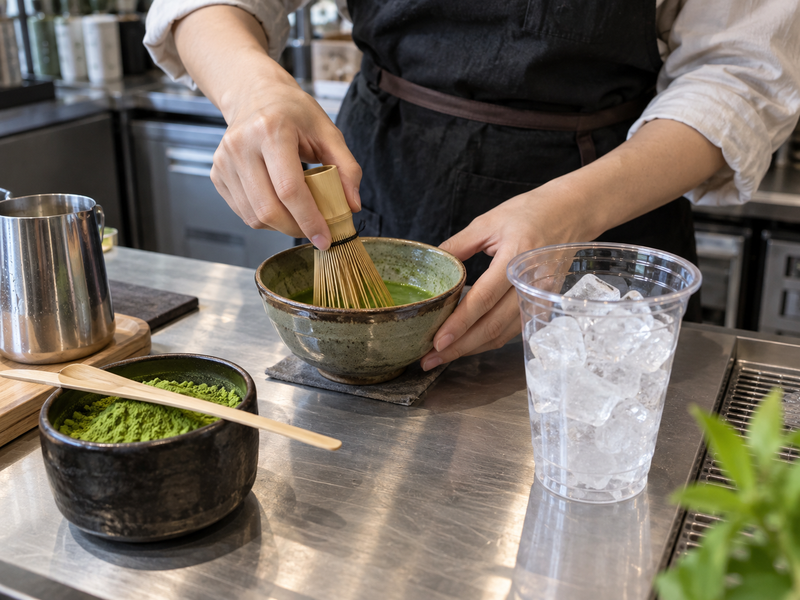
Ice is part of the cup, even when it melts
In an iced drink, ice affects fill volume, dilution and temperature. “Fill the cup with ice” leaves too much room for variation. Weigh or standardize the ice scoop during development, and measure liquid that goes in before and after ice. Taste the drink immediately and after a realistic carry time. A formula that tastes balanced at handoff may become thin when the ice melts. Conversely, an overly strong concentrate may need dilution before it tastes pleasant.
Clear cups make uneven mixing obvious, but opaque takeaway cups do not remove the problem. Check the bottom of the cup for concentrated powder. A prepared matcha base should be mixed with the rest of the drink in a defined sequence. If staff pour it over ice for a layered appearance, decide whether the customer should stir. The photo and menu description should reflect the drink they will actually receive.
For batching, do not count ice as an exact substitute for water; melting depends on service time and conditions. Record both the initial liquid volume and ice amount.
| Cold-drink variable | Define it as | Why |
|---|---|---|
| Matcha | Grams | Flavor and cost |
| Base water | Milliliters | Dispersion |
| Milk or other liquid | Milliliters | Finished strength |
| Ice | Grams or calibrated scoop | Fill and dilution |
6. How Do You Scale a Recipe Without Drift?
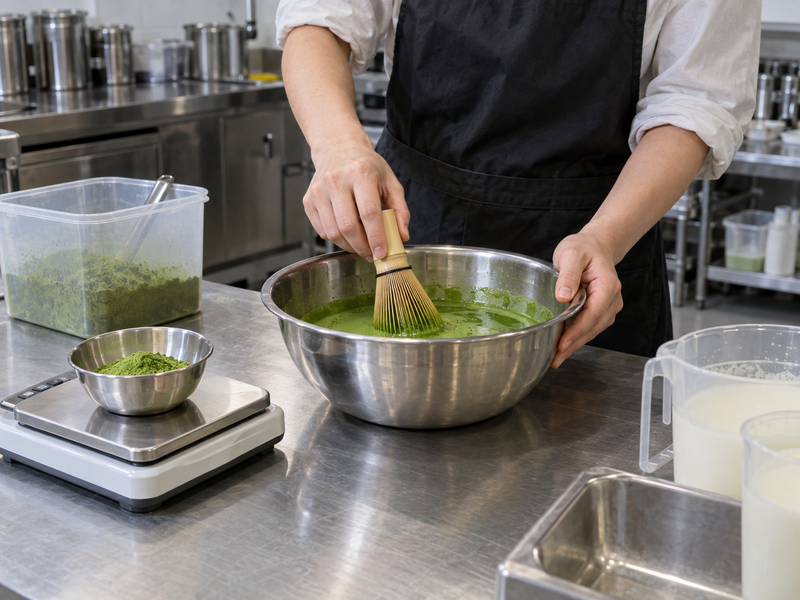
Multiply the weighed formula, then test the process
If one cup uses 2 grams of powder, ten cups theoretically need 20 grams. That arithmetic is simple. The preparation is less so. A larger batch may need a different vessel or mixing time to prevent dry pockets. Powder can settle while staff serve from a pitcher, so the first and last cups may differ. Test a small production batch and compare cups from the beginning, middle and end. Record the hold time and any re-mixing rule.
For a bottled or food-manufacturing product, use a batch sheet with ingredient weights, lot codes, order of addition, mixing conditions and yield. A scale-up from a café bowl is not a validated production process. The finished product may require stability and food-safety testing under the chosen package and distribution conditions. A qualified production team should approve those controls.
When developing a pilot, keep conversions explicit. Do not mix grams, ounces and milliliters on a single card without a clear unit next to every number. One copy-and-paste error can change a whole day’s production.
7. Which Tools Make the Method Repeatable?
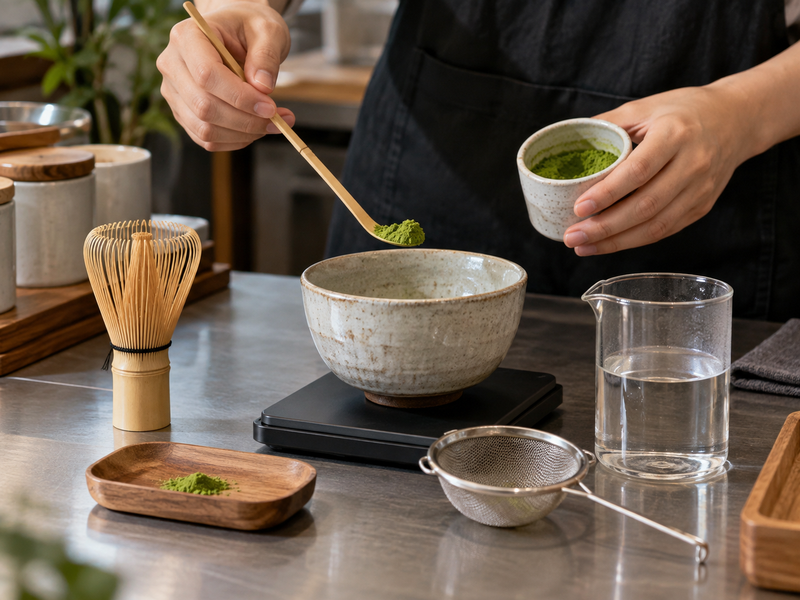
Choose tools staff will actually use
A small scale, dry scoop, graduated liquid measure and consistent mixing vessel cover most café development needs. A fine sieve can reduce visible clumps when a powder compacts in storage. A bamboo whisk works well for small cups, but a commercial mixer may be faster for a high-volume bar. Test the tool in the actual service setting. A technique that needs a specialist’s touch will drift when new staff join the rota.
Give each tool a place. A scoop left in a damp sink area can carry water into the powder. A scale near the steam wand may be hard to keep stable or clean. Store the reserve matcha in a closed, opaque pack and refill a small working container. These handling details affect whether measurements remain accurate through the shift.
Audits need not be elaborate. Have two workers prepare the same recipe without coaching and compare weights, times and finished cups. If they diverge, improve the written method or tool choice before blaming the powder.
8. Should Different Powders Use the Same Dose?
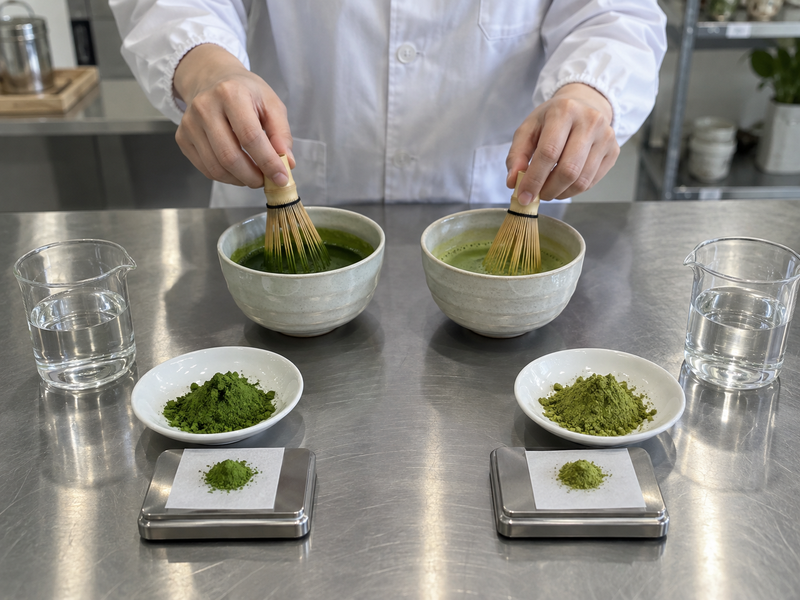
Standardize testing, then approve the final dose separately
During supplier screening, use the same powder weight and recipe so the comparison is fair. After choosing finalists, adjust dose to find each powder’s useful range. A mild powder may need more grams in milk; a stronger one may taste harsh at the same dose in water. Fineness can also affect perceived texture and dispersion. Record the approved dose for the specific product and lot profile, not for an abstract grade name.
Matcha Village describes multiple matcha applications in its company material. A buyer should request representative production samples and test them at a fixed starting dose, then calculate cost at the winning recipe. When a new lot arrives, check it against the retained sample before changing the card. If the difference is meaningful, discuss it with the supplier and document any adjustment. Staff should not compensate silently by adding an extra scoop.
| Comparison stage | Dose rule | Decision |
|---|---|---|
| Initial screen | Same weight for every powder | Fair sensory comparison |
| Final formula | Adjust within a planned test | Target taste and cost |
| Repeat lot | Start with approved dose | Detect supplier variation |
| Service audit | Follow card exactly | Detect staff variation |
9. How Do Measurements Affect Cost and Waste?
Price the gram that reaches the cup
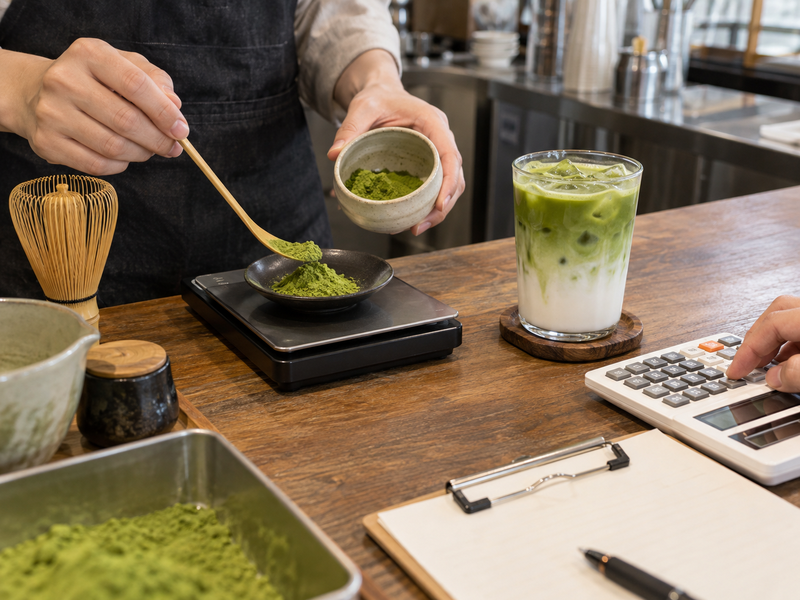
A few tenths of a gram may seem trivial, but repeated across many drinks it changes ingredient use and margin. Calculate powder cost from the approved grams per serving and purchase price per kilogram. Add milk, sweetener, cup, labor and expected waste to understand the drink’s real economics. If a powder clumps and staff discard bases, include that loss. If a large pack remains open for too long, smaller packs may reduce waste even at a higher unit price.
Measure actual usage during a pilot. Compare inventory removed from stock with cups sold and planned dose. The difference can reveal over-scooping, remakes, spills or unrecorded staff drinks. Do not treat every discrepancy as a staff fault; the recipe may be hard to execute or the scoop unreliable. Fix the system first, then train against a clear standard.
Cost pressure should not encourage an under-dosed drink that no longer delivers tea flavor. Test changes with a panel and, when possible, customers who buy the product.
10. What Belongs on the Final Recipe Card?
Make a one-page instruction that survives a rush
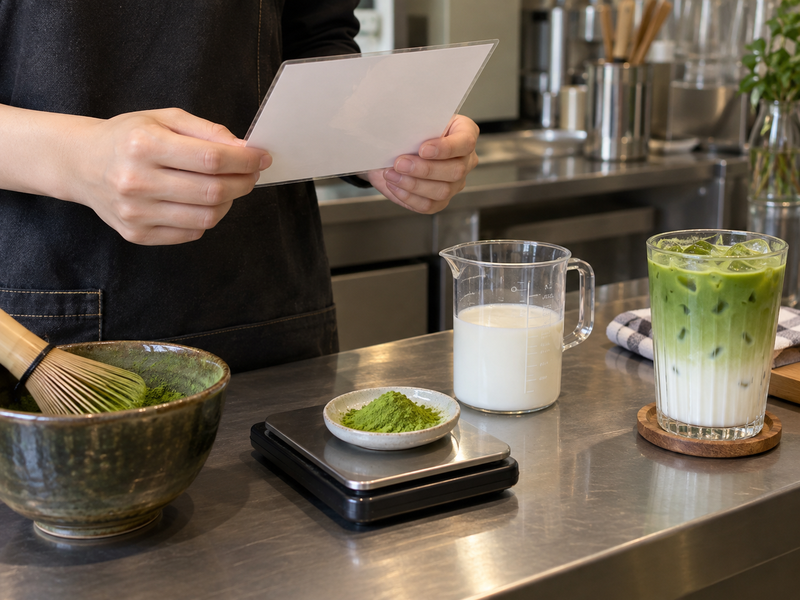
The card should show powder product and lot rule, grams per cup size, base water volume and temperature, milk or other liquid volume, ice quantity, sweetener, mixing tool, order of addition and final cup size. Include a photo of a normal finished cup only if it accurately represents service. Add a brief quality check: no dry clumps, expected tea flavor and acceptable fill line. Make substitutions explicit instead of leaving staff to improvise.
Keep the development record behind the card. It should explain why the dose was chosen, what samples were tested and what cost was approved. The service card itself should be short enough to read at the bar. Review it when the supplier changes powder, the cup changes size, or a new milk becomes standard. The measurements belong to that whole system, not to the powder alone.
| Card line | Example format | Owner |
|---|---|---|
| Powder dose | Grams by cup size | Product team |
| Liquids | Milliliters and sequence | Operations |
| Ice | Weight or calibrated scoop | Store manager |
| Quality check | Taste and visual standard | Trainer |
FAQ
Q1. Is one teaspoon of matcha always two grams?
No. Powder density and scoop shape vary. Weigh your own normal scoops with the powder you use, then decide whether the variation is acceptable.
Q2. Should a latte use more matcha than plain tea?
It may need more to remain perceptible after milk and sweetener, but the approved dose depends on powder strength, cup size and the desired flavor. Test the finished drink.
Q3. Do I count base water in the final cup volume?
Yes. It contributes to the finished beverage and affects dilution. Put it on the recipe card rather than treating it as an invisible preparation aid.
Q4. Can I scale a one-cup recipe by simple multiplication?
Use multiplication for starting ingredient weights, then validate the larger mixing process and check first and last servings for settling or clumps.
Q5. When should measurements be revised?
Review them when the powder lot or supplier changes, a new cup or milk is introduced, or service audits show a consistent difference between the card and actual drinks.
For a consumer brewing reference, see Hugo Tea’s matcha ratios and tools guide. For B2B powder choice, see our bulk matcha buyer guide. The ratios in this article are pilot examples; approve the exact method with the powder and product you sell.