
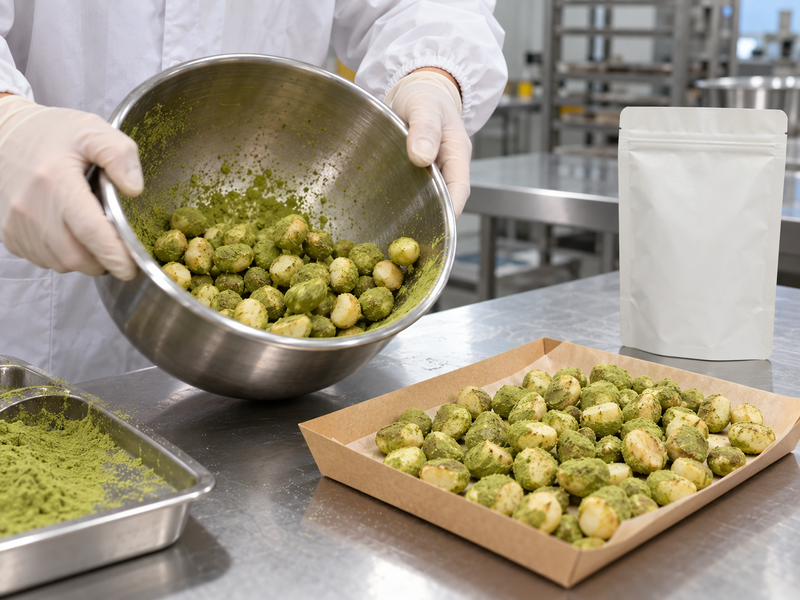
Matcha macadamia snacks often look better in a mixing bowl than at the bottom of a shipped pouch. Loose tea dust can gather around broken nuts while the top layer still looks clean. Snack buyers should measure coating adhesion, crunch and packed yield.
Contents
- 1. What should matcha macadamia deliver to the customer?
- 2. Which tea works in the sweet base?
- 3. How should the coating or center be formulated?
- 4. Where can mixing and setting go wrong?
- 5. Does the full piece taste like matcha?
- 6. What changes during the shelf trial?
- 7. Which wrapper protects the finished piece?
- 8. How much saleable product does a run yield?
- 9. Which ingredient and allergen records are needed?
- 10. What should the packed reference show?
1. What should matcha macadamia deliver to the customer?
Define the product before approving a sample
Set the snack's format before choosing a coating: dry-dusted nut, lightly glazed nut or chocolate-covered nut. Each changes tea visibility, sweetness and package behavior. The product should still taste like macadamia, not only sugar and powder.
Specify the snack format before selecting powder. A roasted nut with a dry tea dust should feel different from a glazed or chocolate-coated macadamia. Write the target roast, sweetness and green coverage. Customers should still taste the nut. If a heavy coating masks macadamia and leaves loose green powder on fingers, the formula has missed the product brief even if the tray looks vivid.
For sweets, color and flavor must survive sugar, fat and handling. Define the bite and the packed appearance together, not as separate design tasks.
2. Which tea works in the sweet base?
Choose powder against the finished application
Compare matcha grades in the finished coating. Nut fat and roast notes can mask a delicate tea. A higher powder dose may increase bitterness and loose dust without improving the eating experience.
Run small coating tests with the same roast level and nut size. Compare dry dusting with a measured light binder, then sieve equal sample weights after tumbling. Record how much loose matcha falls through and whether the coating makes nuts stick together. Taste whole nuts rather than loose coating, since fat from macadamia changes how bitterness appears.
The cheapest dry powder may require a dose that raises bitterness or leaves loose green dust. Test it inside the real sweet system.
For a related production decision, see our matcha roasted almond coating guide.
| Candidate | Specific check | Keep if |
|---|---|---|
| Powder | Compare matcha grades in the finished coating | Tea fits the finished application |
| Formula | Apply coating to a consistent nut temperature and batch mass | Dose stays practical |
| Tasting | Taste intact nuts and pouch-bottom crumbs separately | Flavor remains clear |
3. How should the coating or center be formulated?
Change one variable at a time
Apply coating to a consistent nut temperature and batch mass. Record binder amount and tumbling time. If pieces clump or the coating stripes, adjust process conditions before switching matcha.
Use nuts from one roast lot and coat equal batch weights. Compare a dry application with measured binder levels, then sieve finished samples to quantify loose matcha. Record nut temperature when tea is added; an overheated surface can change adhesion and flavor. If a batch clumps, check binder distribution before reducing matcha to the point where the tea note disappears.
Keep sample masses small and repeatable so a failed batch teaches something. The same sugar concentration and piece size make tea-dose comparisons meaningful.
4. Where can mixing and setting go wrong?
Write a method another operator can repeat
Sample the top, middle and bottom of the coater. Large nuts and fines may distribute differently. Weigh loose green powder after a sieve check so operators can distinguish coating loss from broken nuts.
Take samples at the start, middle and end of the tumbler discharge. Weigh green fines and broken nuts separately. If the last portion is powder-heavy, the issue may be mixing pattern or binder distribution. A stronger matcha powder will not fix poor adhesion. Write a coating endpoint that operators can check without relying on one person's memory of the prototype.
Note temperature, residence time and equipment contact. Confectionery failures often arise after a lovely hand-poured bench sample moves to a warmer line.
| Process point | Specific check | Record |
|---|---|---|
| Preparation | Apply coating to a consistent nut temperature and batch mass | Tool and dose |
| Production | Sample the top, middle and bottom of the coater | Start and end samples |
| Finished unit | Taste intact nuts and pouch-bottom crumbs separately | Sensory result |
5. Does the full piece taste like matcha?
Taste the portion a customer receives
Taste intact nuts and pouch-bottom crumbs separately. A sample taken from the top may be balanced while the final handful is bitter from accumulated matcha dust.
Taste a nut from the top of the coating bowl and another from the final discharge. Ask whether the matcha forms a pleasant finish or a dusty bitter layer. Then taste a handful from the bottom of a handled pouch, where loose powder tends to collect. A snack that scores well in a clean tasting cup can disappoint customers when the final handful is coated in fines.
Taste a whole serving, including its edge or coating. A decorative green surface may hide a center whose flavor does not support the label.
6. What changes during the shelf trial?
Use the real shelf or counter conditions
Check crunch, oxidation odor and coating adhesion over the proposed shelf period. Nut fat can turn stale even when green powder looks acceptable. Test with the final barrier pouch, not an open sample bowl.
Pack nuts in the proposed pouch and shake or transport the cartons as expected. Open top and bottom pouches to inspect dust, breakage and rancid or stale aroma. A clear window can show appealing green coverage, but it may also display dust after transit. Test barrier properties with the real nut and matcha system through the proposed shelf period.
Humidity and oxygen can change a packed sweet in different ways. Challenge the final formula under the expected route before stating a sale window.
| Observation | Specific check | Action |
|---|---|---|
| Storage | Check crunch, oxidation odor and coating adhesion over the proposed shelf period | Compare with control |
| Pack | Seal pilot pouches at production speed and run a representative transport test | Inspect opened unit |
| Customer portion | Taste intact nuts and pouch-bottom crumbs separately | Taste again |
7. Which wrapper protects the finished piece?
Test the actual selling format
Seal pilot pouches at production speed and run a representative transport test. Inspect fines, scuffs and seal contamination. A clear window may advertise color but also reveal unattractive dust.
Choose a pouch that protects nut crispness and tea color. Fill it at the proposed weight, seal at production speed and move cartons as they will be shipped. Inspect the bottom seam for green dust and nut fragments. A transparent window can help sell the color but also display coating loss. Keep a barrier trial tied to the full proposed shelf period before approving pack artwork.
The wrapper should prevent abrasion and moisture pickup without creating seal contamination from powder or fat. Inspect packed units after handling.
8. How much saleable product does a run yield?
Measure yield and repeatability
Calculate saleable yield after coating and packing. Account for fines, nut breakage, binder and powder stuck in the machine. The low-cost powder is not always cheaper per finished pack if it sheds badly.
Calculate cost per accepted pack after coating losses, nut breakage and sealing rejects. A premium nut is expensive to waste. If a lighter tea coating reduces loose powder and preserves crunch, it may be the better product even when the finished nut looks less green. Keep tree-nut labeling and line cleaning in the commercial plan.
Record fines, breakage and pieces rejected for appearance. Those units change the economics of matcha more than a small difference in powder price.
| Pilot measure | Specific check | Commercial use |
|---|---|---|
| Yield | Calculate saleable yield after coating and packing | Cost per saleable unit |
| Loss | Check crunch, oxidation odor and coating adhesion over the proposed shelf period | Set acceptance limit |
| Supply | Macadamia is a tree nut; label and cross-contact review belong in the launch file | Confirm lot evidence |
9. Which ingredient and allergen records are needed?
Link claims and batches to documents
Macadamia is a tree nut; label and cross-contact review belong in the launch file. Obtain matcha lot records and nut roast specifications, and check any claims about origin or 'natural' color.
File a current specification, complete ingredient statement, lot-linked test results and origin support for any origin wording. Ask the supplier to explain how a material change will be communicated. The buyer should be able to connect a finished product batch back to the ingredient lot without relying on a salesperson's memory. Check the label for the actual sales market and the complete formula, including carriers and processing aids where relevant.
Sugar, milk, nuts and other confectionery ingredients can drive allergen review. Matcha identity and all shared-line risks belong in the file.
10. What should the packed reference show?
Release against a written reference
Approve the snack from a packed pouch after handling and storage. Keep a photograph of acceptable coating coverage and a measured limit for loose powder.
Make the launch decision with a physical reference and a short written standard. State the approved formula, supplier code, acceptable sensory range, process limits, pack, selling window and person who can release a later lot. Keep a failed example too; it makes training more concrete than a perfect photograph alone. A small controlled launch can show whether operators and customers experience the product as the development team expected.
Keep a packed reference, not only a tray photograph. It lets the next operator compare a commercial unit with the approved product.
| Release item | Specific check | Owner |
|---|---|---|
| Formula | Approve the snack from a packed pouch after handling and storage | Development |
| Supplier | Macadamia is a tree nut; label and cross-contact review belong in the launch file | Purchasing |
| Pack | Seal pilot pouches at production speed and run a representative transport test | Quality |
A final production check
The final check begins with a handled pouch. Pour out the full contents and weigh green fines separately from intact nuts. Taste the final handful, where loose powder tends to gather, and compare crunch with the retained reference. If the coating looks good only in a fresh bowl, adjust binder, tumbling or pack before offering a premium retail snack. Keep the tree-nut label review with the lot file.
Further reading
Use ISO/TR 21380:2022 on matcha identity to frame matcha identity, FDA food allergen labeling guidance for the exact ingredient system, and FDA water activity technical guide when the product's validated shelf-life work depends on moisture.
FAQ
Q1: What is matcha macadamia in a commercial product?
Set the snack's format before choosing a coating: dry-dusted nut, lightly glazed nut or chocolate-covered nut. Each changes tea visibility, sweetness and package behavior.
Q2: How should a buyer compare matcha for this use?
Compare matcha grades in the finished coating. Nut fat and roast notes can mask a delicate tea.
Q3: What usually causes the first quality failure?
Check crunch, oxidation odor and coating adhesion over the proposed shelf period. Nut fat can turn stale even when green powder looks acceptable.
Q4: Which documents should the supplier provide?
Macadamia is a tree nut; label and cross-contact review belong in the launch file. Obtain matcha lot records and nut roast specifications, and check any claims about origin or 'natural' color.
Q5: When should the formula be approved?
Approve the snack from a packed pouch after handling and storage. Keep a photograph of acceptable coating coverage and a measured limit for loose powder.