
Matcha roasted almonds can lose their appeal in the package: powder gathers at the bottom, honey turns tacky, or a few nuts carry most of the tea. A snack producer should measure coating pickup, test sweetness and check the packed product after handling. The Small Town Foodie’s honey-matcha almonds use a warm honey coating followed by matcha and salt. That small-batch idea needs a reproducible roast and pack process before retail sale. Matcha Village’s sample service can support powder comparisons.
Contents
- 1. What should one handful taste and feel like?
- 2. Which almond size and roast should be selected?
- 3. How should sweet coating be controlled?
- 4. When should matcha be added?
- 5. How can coverage be measured across a batch?
- 6. What cooling step prevents clumps?
- 7. Which packaging trial shows the real product?
- 8. How should allergens and storage be reviewed?
- 9. What is the yield and cost per pack?
- 10. When is the snack ready for a retail test?
1. What should one handful taste and feel like?
Write a coating target
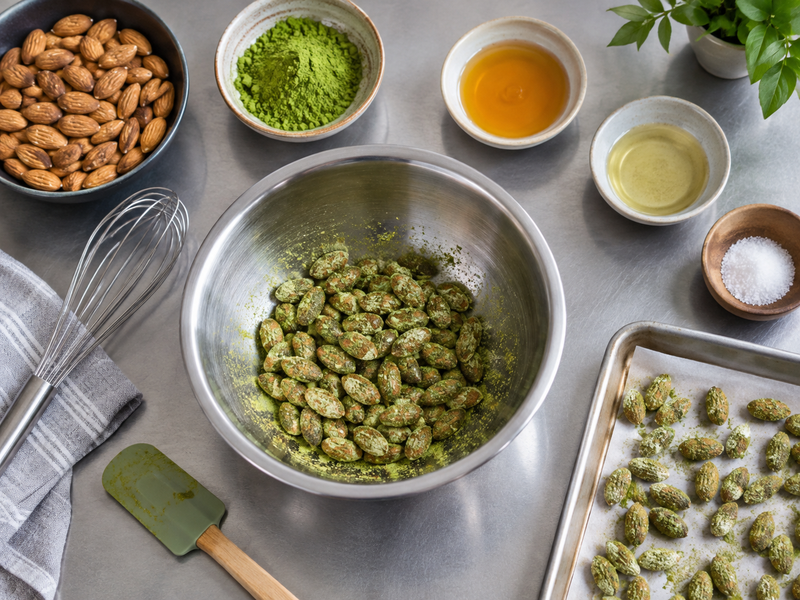
The snack should be recognizably almond, with a controlled matcha note and enough sweetness to balance the tea. Decide whether the finish is dry and powdery, lightly glazed or deliberately sticky. The first option may leave green dust on fingers; the second can lose crunch if packed too soon. Set a serving weight and taste several nuts together, not one perfect coated almond. A customer buys a handful, so variation between individual pieces matters.
Compare the snack with other café counter packs. If it is sold beside sweet pastries, a lightly sweet version may be more useful than a candy-like one. If it is a gift pack, appearance and clean handling may carry more weight. Photograph the approved mix in a clear bowl and the opened pack after transport. A bright surface on a tray does not prove the product will look even once it has been shaken in a pouch.
2. Which almond size and roast should be selected?
Control the nut before the coating
Choose a specified almond size and form. A mix of small and large nuts gives different surface areas and can cause uneven coating. Inspect incoming nuts for broken pieces, off odors and lot information under the operation’s receiving plan. Roast a plain control and taste it beside a coated sample. If the base nut is stale or under-roasted, matcha cannot make the finished snack appealing.
The reference recipe roasts almonds before and after a honey addition. A producer should test its oven, tray load and turning method rather than adopting the home timing. Record nut weight per tray, oven load and the sensory endpoint. Over-roasting can make both nut and matcha taste bitter. If pre-roasted almonds are purchased, review their salt and oil content because those change the coating formula.
| Almond variable | Why it matters | Trial record |
|---|---|---|
| Size grade | Surface area and pack look | Weight range |
| Broken pieces | Powder accumulation | Reject percentage |
| Roast level | Crunch and flavor | Sensory reference |
| Pre-salted nut | Final balance | Salt specification |
3. How should sweet coating be controlled?
Use just enough binder
Honey can help matcha adhere, but more honey can turn the snack sticky and soften crunch. Weigh it as a percentage of nut weight. Make two coating trials while keeping matcha and salt fixed. Observe coverage, finger feel and how the nuts separate after cooling. A syrup or another binder would require its own process and label review; it is not a drop-in substitution.
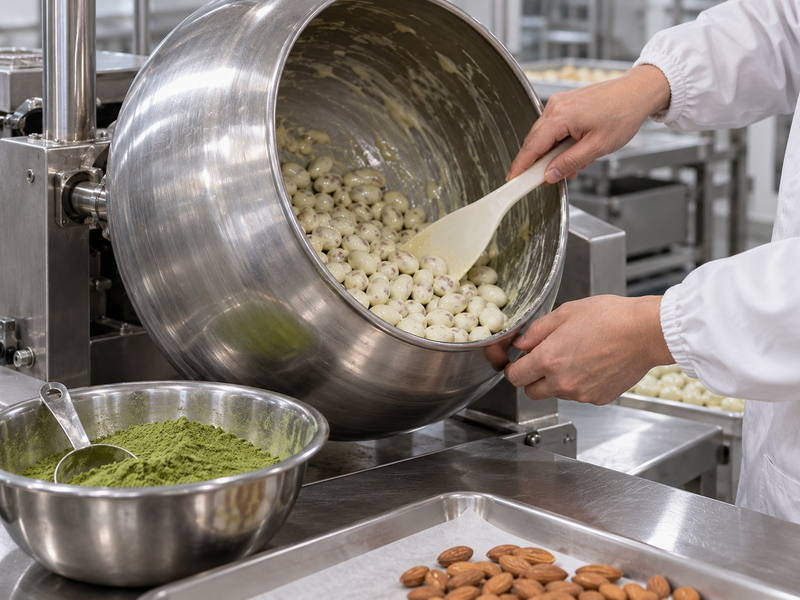
The coat must distribute before it begins to set. Document the mixing vessel, nut temperature and time from binder addition to spreading on trays. A bowl with a small batch may coat evenly, while a larger batch can leave dry nuts at the top and sticky ones at the bottom. If the coating seems too sweet, reduce the binder carefully and recheck matcha pickup rather than only adding more salt.
4. When should matcha be added?
Protect flavor while obtaining adhesion
The reference adds matcha after the honey-coated nuts cool enough to remain slightly sticky. That timing avoids prolonged roasting of the tea. A production trial should compare two specific points: while nuts are still warm and after a longer cooling interval. Keep matcha weight the same. Check how much stays on the nuts and how much remains in the mixing bowl or at the bottom of the package.
Sift powder before tossing. If it lands in one clump, a few almonds will taste bitter and most will taste plain. Mix salt with matcha only if the trial shows an even result; separate addition may be easier to control. Taste after full cooling and after the planned pack hold. A powder that looks bright on day one may dull or taste different in the final snack. Record the selected matcha lot and obtain current product documents for any origin or certification claim.
| Tea timing | Potential result | Measurement |
|---|---|---|
| Early, warm coat | Better adhesion | Flavor and color |
| Later, tacky coat | Fresher tea note | Loose powder |
| Too late, dry coat | Weak pickup | Bowl and pouch residue |
5. How can coverage be measured across a batch?
Sample from several positions
Take equal-size samples from the beginning, middle and end of the coating vessel. Count visibly bare nuts, heavily coated nuts and clusters. Taste each sample blind if practical. Weigh the batch before and after coating, then note residue left on equipment. These checks are simple enough for a pilot and expose a problem that an attractive top layer can hide.
If coverage differs across the batch, look at load size and mixing pattern before changing the tea dose. A larger tumbler or bowl may need a different fill level. Trial a slower addition of binder or powder if the first portion absorbs most of it. Keep the outcome in the batch record as a range, not a vague “well coated.” The acceptable range should match what customers will see in a handful and the amount of dust they find in the bottom of a pouch.
6. What cooling step prevents clumps?
Spread the nuts before sealing
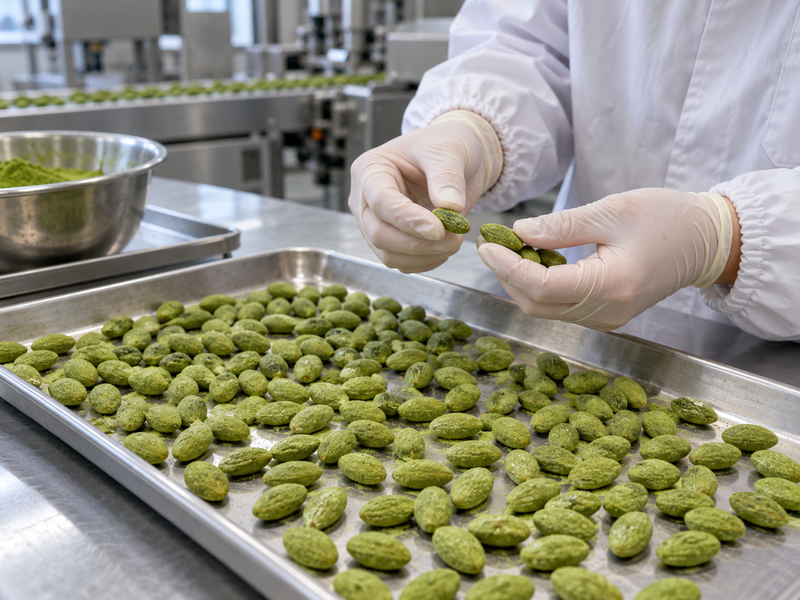
Warm honey-coated almonds can stick together. Spread them in a measured layer on a clean tray and record cooling conditions. Compare a thin spread with a deeper pile using the same batch. Separate clusters gently as appropriate under the process plan, then assess whether nuts remain crisp. Do not pack a warm batch simply because production is behind schedule; the pack may trap moisture and change texture.
The reference notes that honey-coated nuts can become sticky in humid conditions. For commercial planning, test the actual facility and packaging route rather than borrowing its storage advice as a shelf-life claim. Weigh any pieces rejected for large clumps. If the desired finish is dry, record how much loose matcha appears after cooling. If a lightly glazed finish is acceptable, train staff to distinguish an intended sheen from a tacky product that will adhere to the pack.
| Cooling check | Pass condition | Fault to investigate |
|---|---|---|
| Surface | Separate nuts | Excess binder or pile depth |
| Crunch | Comparable to control | Moisture or roast |
| Powder | Even on nut | Late addition or mixing |
| Pack-ready | No warm condensation risk | Cooling route |
7. Which packaging trial shows the real product?
Shake, open and pour
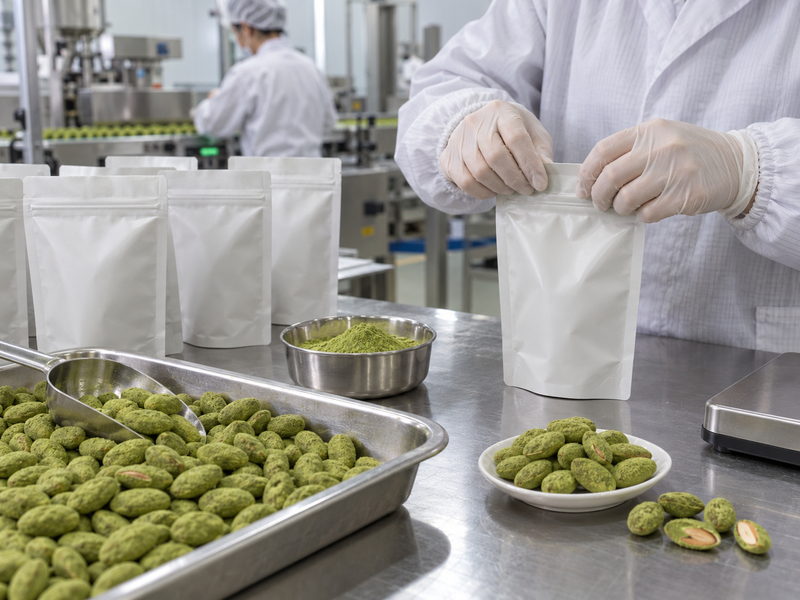
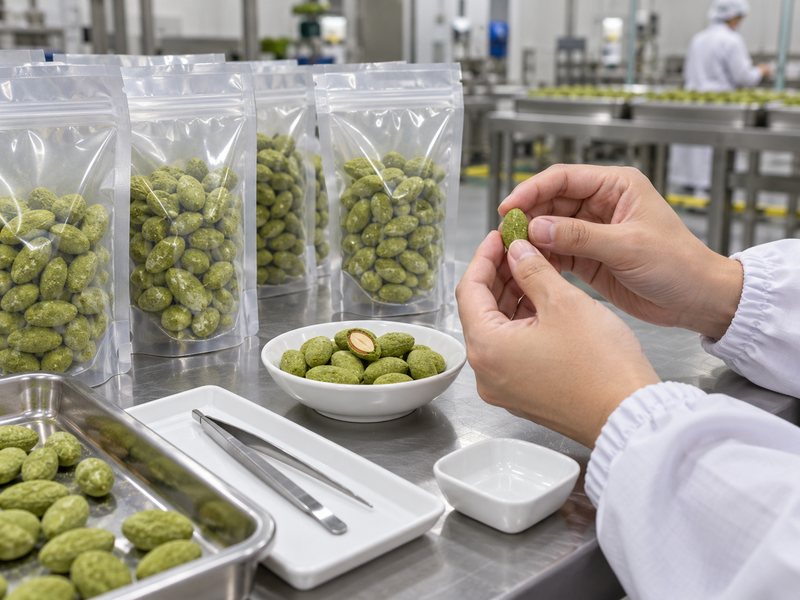
Pack the intended portion in candidate pouches or jars. Handle them as a customer would: carry in a bag, set on a shelf and pour some nuts out. Inspect breakage, clusters, green powder left behind and whether the container opens cleanly. A very clear film may display the color well but make powder residue more visible. A jar may protect shape but add weight and cost.
Ask a packaging supplier for food-contact suitability and seal information. A quality observation after a short trial can compare texture and appearance, but it cannot establish a retail shelf-life date. If a wider distribution product is planned, arrange appropriate validation for the final formulation and package. Check pack fill weight and headspace as well; too much empty space can let nuts tumble and abrade the coating.
Set up a simple pack comparison with equal nut weights and two candidate containers. Handle both in the same way, then pour each through a sieve over a clean tray to collect loose tea and small fragments. Record the residue weight and photograph the opened nuts. The best package is not necessarily the one with the least visible dust through the wall; it is the one that protects eating quality and makes the product easy to use. Check whether a resealable closure is needed for the intended pack size, and whether repeated opening leaves powder in the seal track.
8. How should allergens and storage be reviewed?
Make the nut declaration unmistakable
Almonds are tree nuts. The FDA major food allergen guidance is a primary U.S. reference; destination rules govern the final label. Honey, salt, matcha and any added flavoring also need current ingredient documentation. If equipment handles peanuts or other nuts, review cross-contact controls. A “simple four-ingredient snack” description does not remove the need for a proper label.
Document roasting, coating, cooling, packing and storage under the operation’s food-safety plan. The FDA Food Code is a U.S. model for retail handling, not a shelf-life certificate. Keep the quality window separate from safety validation. A product may remain crisp but have an unverified date code, or be safe under a plan yet lose its matcha color before the proposed sales period.
| Review item | Evidence |
|---|---|
| Almond allergen | Ingredient and label record |
| Shared equipment | Cleaning and cross-contact plan |
| Pack date | Validated final product program |
| Matcha claim | Current supplier documentation |
9. What is the yield and cost per pack?
Account for coating loss
Cost almonds, honey or binder, matcha, salt, packaging and labor from actual packed yield. Count nuts discarded for breakage or clusters, plus matcha left in the bowl and dust left in the pack after a trial. A small increase in powder can be expensive at scale without improving the taste of a handful. Compare two pack weights and check whether a customer perceives the chosen portion as fair.
Record throughput for the actual oven and coating equipment. A small tray may be easy to manage but inefficient for regular production; a larger load may lose even coverage. Compare the cost of a pouch and jar with the product’s likely shelf and gift use. During a limited sale, note whether customers buy it alone or with a drink and how many packs remain unsold under the approved product plan.
Also record the weight of almonds broken during roasting separately from those broken after packing. The first loss points toward handling or tray movement; the second points toward the container and transport route. Keeping those causes apart prevents the team from changing the coating formula to solve a packaging problem.
10. When is the snack ready for a retail test?
Repeat the roast and coating
The final sheet should name almond item and size, roast method, binder percentage, matcha and salt weights, coating order, cooling route, pack and target net weight. Include a photograph of an acceptable opened pack, not only loose nuts. Make a second full-size batch with different staff and compare crunch, coverage, clusters and powder residue. A one-bowl home-style success does not prove the larger run.
Run a limited sale only after the ingredient, allergen and storage decisions are reviewed for the channel. Collect precise feedback: too sweet, sticky, dusty, bitter or uneven. Each points toward a different correction. The snack belongs on the retail shelf when its first handful and last handful taste similar and the package carries the promised weight without a pile of matcha at the bottom.
| Decision | Evidence | Next step |
|---|---|---|
| Launch | Even coverage and approved pack | Schedule run |
| Revise | One traceable coating fault | Controlled test |
| Hold | Unvalidated date or label | Finish review |
FAQ
Q1. Should matcha be roasted with the almonds? Compare timing; adding it after roasting may protect a clearer tea note.
Q2. Why does powder collect in the pouch? The coating may be too dry, the tea added too late, or the pack may abrade it.
Q3. Can honey be reduced? Yes, in a measured trial that checks both sweetness and matcha adhesion.
Q4. Are matcha roasted almonds suitable for nut-free customers? No. Almond is a tree nut and requires clear allergen review.
Q5. What is the key pack check? Open and pour a handled pack, then compare the nuts and loose powder with the approved sample.
Roast one specified almond lot, divide it into two binder trials and pack both. Their coating and crunch after handling will show which formula deserves a larger production run.