
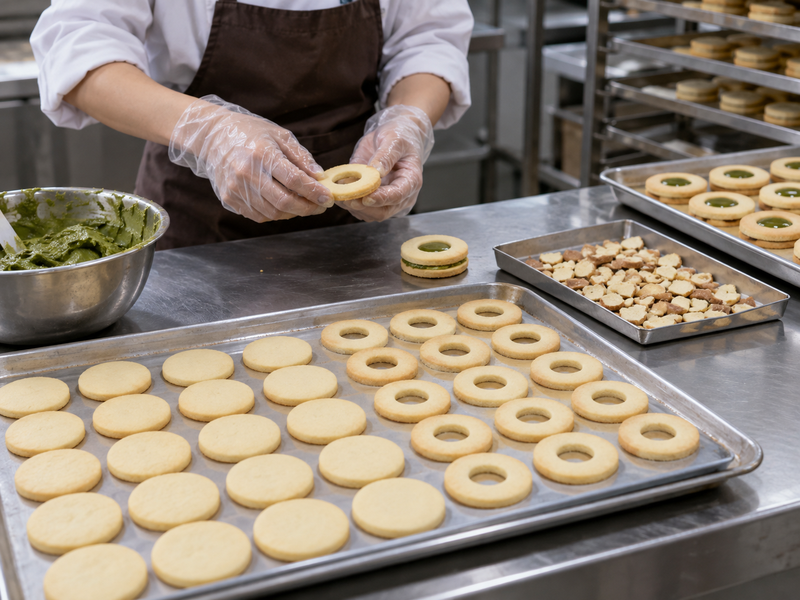
Matcha linzer cookies put a green filling behind a cutout window, giving bakeries a product whose appearance depends on careful pairing as much as flavor. A tray of attractive biscuit halves can still produce disappointing sandwiches if the filling squeezes out or the tops break. Develop the dough, window and filling as one assembled item.
1. Where should the tea sit in matcha linzer cookies? · 2. Which dough properties matter for reliable windows? · 3. How should the first matcha filling trial be organized? · 4. How large should the cookie and window be? · 5. How can rolling and cutting avoid mismatched pairs? · 6. What should the baking and cooling checks cover? · 7. How much filling should go into each sandwich? · 8. What does a packed-cookie trial need to reveal? · 9. How do purchasing and yield affect the selling price? · 10. Which instructions should another shift receive?
1. Where should the tea sit in matcha linzer cookies?
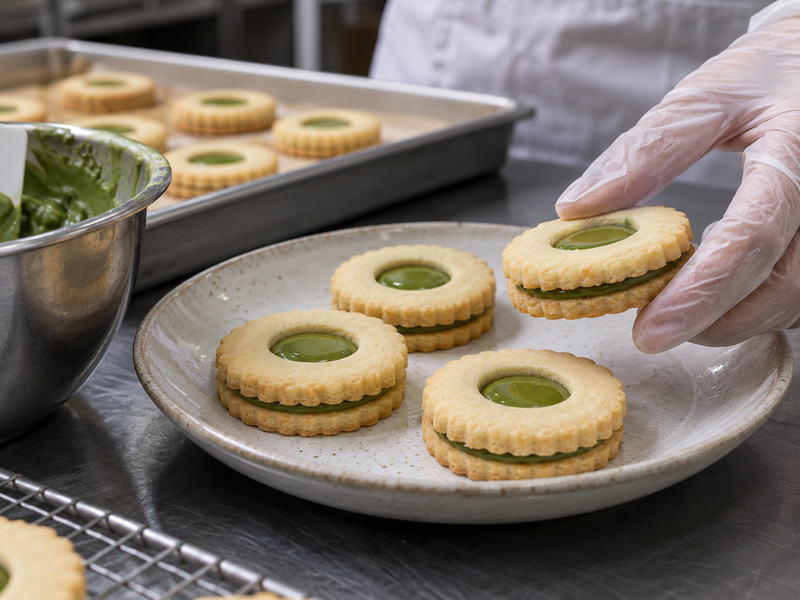
Choose the visible product before mixing
You can put tea in the biscuit, the filling or both. For an initial bakery trial, a pale biscuit with green filling gives the team a clear way to judge the window and filling placement. Adding tea to both components at once makes it harder to locate the source of bitterness or a color difference.
Teak & Thyme’s matcha linzer cookies use matcha ganache inside cutout biscuits. That is a useful reference for the product format, rather than a requirement to copy its decorative shape or recipe.
Decide whether the filling should sit flush with the window or slightly below it. A raised surface can smear against packaging. A deep recess may look underfilled even when the total filling weight is correct.
Write the product description from the customer’s view: the biscuit should separate cleanly when bitten, while the filling stays between the halves. Include the intended serving temperature. A ganache that spreads neatly during assembly can feel quite different after chilling or after a permitted display period.
2. Which dough properties matter for reliable windows?
Evaluate strength during handling
Use a proven linzer dough as the starting point. The bakery needs a dough that rolls evenly and produces tops strong enough to lift after cooling. Almond content, butter condition and flour choice should stay fixed while the team establishes the cutout design.
King Arthur Baking’s linzer recipe provides a second published method and describes cutting the center after transferring the top pieces to the baking sheet. That handling sequence is worth comparing with your existing practice. It can reduce the amount of movement an open shape must withstand.
| Dough detail | Production question | Record to keep |
|---|---|---|
| Flour blend | Are supplier products unchanged? | Product codes |
| Rolling state | Does the sheet crack or stick? | Dough observation |
| Thickness | Are edges and center alike? | Gauge setting |
| Scrap inclusion | Does reworked dough behave differently? | Rework identity |
Keep a separate tray for reworked dough during development. Combining fresh and heavily worked pieces without marking them can hide the cause of an uneven bake. Approve how scraps return to the process only after seeing their finished sandwiches.
3. How should the first matcha filling trial be organized?
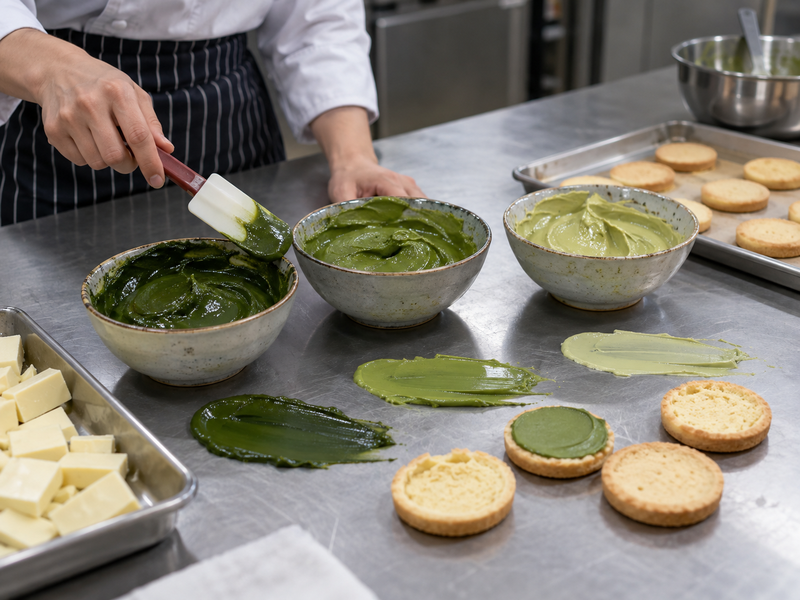
Test the filling inside the biscuit
Begin with a ganache base your kitchen already uses successfully for filled biscuits. Divide it into small portions before adding tea. As an unvalidated screening proposal, compare 0.8, 1.2 and 1.6 grams of unsweetened matcha per 100 grams of the prepared base. These quantities are trial points, not a guaranteed formula or a recommendation for every chocolate.
Use a consistent dispersion method across all samples. If you reserve warm cream from the base to wet the powder, account for that cream in the recipe rather than adding extra liquid. Scrape the mixing bowl thoroughly and check for dry specks on a thin smear.
Taste each filling alone, then taste the same amount between two biscuits. Sweet biscuit dough can change the impression of a filling that seemed balanced from a spoon. Have tasters note whether the tea appears immediately or mainly in the aftertaste.
Record the white chocolate’s exact product. Replacing it with a compound coating or another chocolate is a formulation change. Its behavior cannot be inferred from color or package size, so run that replacement as a separate trial after choosing the tea level.
4. How large should the cookie and window be?
Leave enough biscuit around the opening
A dramatic cutout can weaken the top. Start with a simple round or oval opening before testing narrow points and detailed shapes. The practical question is whether staff can lift, fill and pack the cookie without breaking its rim.
For a proposed tooling comparison, try a 50-millimeter outside cutter with either a 15- or 20-millimeter round opening. These are design trial dimensions. Confirm bite size, breakage and box fit before purchasing production quantities of cutters.
| Feature | Small pilot comparison | Decision to make |
|---|---|---|
| Outer shape | Round versus scalloped | Handling and appearance |
| Window | Smaller versus wider opening | Rim strength |
| Biscuit thickness | Two measured settings | Bite and breakage |
| Finished pack | Flat versus upright placement | Surface contact |
Make the comparison using finished sandwiches. A plain biscuit top may seem sturdy until filling pressure is applied underneath.
Check the cutter itself for clean edges and easy release. Bent or inconsistent cutters can produce mismatched halves even when rolling is controlled. Keep approved tools together instead of borrowing similar-looking cutters from another product station during a busy shift.
5. How can rolling and cutting avoid mismatched pairs?
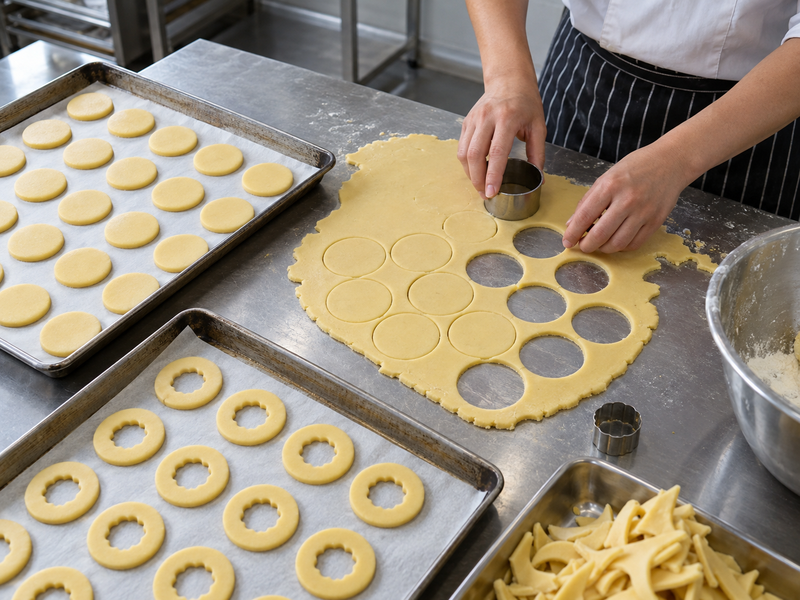
Count tops and bottoms as separate components
Set up two clearly separated tray positions for solid bottoms and windowed tops. During a small run, tally each as it is cut. Finding an extra tray of bottoms at the end means the batch yield was planned around pieces rather than sandwiches.
Use rolling guides when available, and measure the sheet at more than its center. Flour used on the bench should be controlled; repeatedly adding dusting flour can create a different working dough toward the end of the run. Record how scraps feel rather than forcing them through the same settings.
Transfer pieces with a tool that supports their full width. A thin top stretched during lifting may retain an elongated window after baking. If the dough becomes too soft for clean release, return it to the appropriate controlled resting condition for your recipe.
Test cutter layout on the sheet before scaling. Tight nesting can reduce trim, but an operator also needs space to remove shapes intact. The lowest theoretical scrap area does not always produce the best actual yield. Count damaged pieces alongside usable offcuts when evaluating a layout.
6. What should the baking and cooling checks cover?
Compare the halves before assembly
Bake solid and windowed pieces in a way that allows separate assessment. Their exposed shapes differ, so do not assume they reach the desired finish at the same moment. Use your established base method as the pilot starting point and record which tray holds each component.
Check flatness after cooling. A bowed bottom may rock during piping, while a warped top can require pressure that cracks the rim. Set suspect pieces on a flat surface and observe the gap before deciding whether the filling can accommodate it.
| Component | Check after cooling | Assembly consequence |
|---|---|---|
| Solid bottom | Flatness and full bake | Stable filling platform |
| Windowed top | Rim strength | Survives placement |
| Both halves | Diameter and shape | Pairs without overhang |
| Surface | Loose crumbs or flour | Clean visible finish |
Sort pairs before filling during the first pilot. This extra step reveals how much variation the bake produces. If pairing takes too long, investigate rolling, cutting or oven distribution rather than treating sorting as an inevitable labor cost. Record the time so the commercial cost includes what staff actually do.
7. How much filling should go into each sandwich?
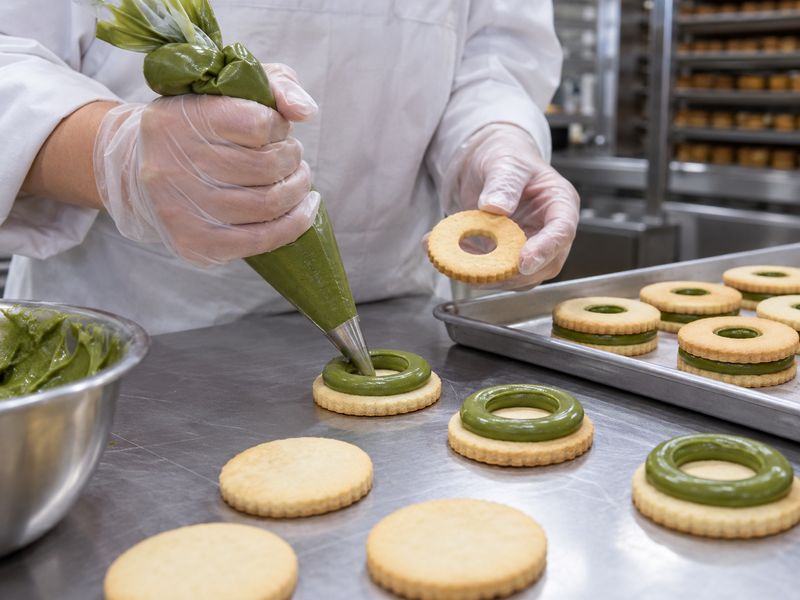
Control mass and placement together
Weigh an empty bottom, pipe the proposed filling amount and weigh it again. Repeat across several pieces before service. The piping tip and operator’s hand pressure can change the result, so a filled-cookie weight check is more useful than counting seconds.
As a proposed assembly comparison, test 4 and 6 grams of filling in the same approved biscuit size. These are starting trials. Record whether each amount reaches the visible window without escaping at the outside edge. The appropriate amount depends on the actual biscuit and filling consistency.
Place the top level and lower it gently. Pressing one side first can move filling toward the opposite edge. Train staff using an exposed cross-section so they understand the intended filling layer rather than memorizing a vague instruction to press lightly.
If you plan a sugar dusting, test dusting tops before assembly. Judge whether powder lands in the green window and whether that affects the photograph on the menu. The finished sample should reflect routine service, including the practical dusting technique, rather than a carefully cleaned display piece.
8. What does a packed-cookie trial need to reveal?
Track the window as well as the bite
Use the proposed commercial pack from the beginning of evaluation. Look through its closed lid or film under normal shop lighting. Reflections, condensation or powder can obscure the green filling that motivated the product design.
Run a handling simulation that matches the intended channel. A cafe sleeve, courier box and retail gift tray impose different contact points. Record the route and handling conditions instead of claiming that one shake test proves shipping suitability.
| Package observation | Likely commercial issue | Next comparison |
|---|---|---|
| Filling touches film | Smeared window | Greater headspace |
| Tops chip at edges | Insufficient support | Compartment insert |
| Sugar marks the lid | Surface contact | Pack orientation |
| Biscuit softens | Texture change after assembly | Filling and pack study |
A filling’s effect on biscuit texture needs testing over the intended sale period. The reference author’s experience with one ganache does not establish performance for another chocolate or package.
Keep texture trials separate from food-safety validation. Any cream-containing filling requires an appropriate handling plan. The final product’s permitted storage and shelf life must be established for the actual recipe, process and sales conditions.
9. How do purchasing and yield affect the selling price?
Calculate sandwiches rather than biscuit halves
A linzer batch has at least two yields: baked components and assembled saleable cookies. Track both. A tray may bake successfully yet lose a meaningful number of tops during pairing or packing.
For a hypothetical example, 120 usable bottoms and 108 usable tops can make at most 108 sandwiches before further losses. Costing the batch as 120 finished cookies understates the cost. Record the mismatch explicitly; do not hide it in a general waste estimate.
Matcha cost should be calculated from the approved filling addition and actual filling usage. Include residue in bowls and piping bags during the pilot. A small batch with several changeovers may use more ingredient per saleable cookie than a longer uninterrupted run.
For tea selection, use the site’s matcha ingredient guide to structure a supplier discussion. Send Matcha Village a photograph of the green window, the filling ingredient list and the chosen trial addition. These details give a Chinese matcha supplier something specific to evaluate, including whether the intended flavor survives the sweet biscuit and chocolate base.
10. Which instructions should another shift receive?
Show the complete assembly standard
Photograph a solid half, a windowed half, the piped bottom and the closed sandwich. Include a side view showing filling thickness. These four images can explain placement more effectively than a long paragraph about neat assembly.
Make the working sheet name the cutter, rolling guide, tray arrangement and filling product code. If the tea lot changes, record the change and compare the assembled cookie before a large production run.
| Release check | Owner | Evidence needed |
|---|---|---|
| Pair counts | Baking lead | Bottom and top tally |
| Filling dose | Assembly lead | Weighed setup pieces |
| Window appearance | Product owner | Packed reference sample |
| Ingredient claims | Quality lead | Complete current declarations |
Allergen information must cover the biscuit and filling together. Almond flour, wheat, egg and dairy may all be relevant, depending on the selected recipes. Do not borrow a claim from the matcha bag and apply it to the finished sandwich.
Ask the next shift to assemble a small batch without verbal coaching. Compare its packed output with the approved sample, then revise any instruction that required guesswork before scheduling the first customer order.
FAQ
Q1: Must the biscuit dough contain matcha?
No. A green matcha filling inside a pale biscuit is a workable product direction and keeps the first flavor trial easier to interpret.
Q2: Can jam replace the ganache?
It becomes a different filling trial. Check spreading, flavor, moisture transfer and the storage plan using the complete assembled cookie.
Q3: Why do windowed tops break more often?
Check rim width, dough thickness, transfer technique and the baked finish. A wider opening leaves less biscuit available to carry assembly pressure.
Q4: Is a piping-time standard enough to control filling?
Use weight checks as well. Filling consistency, tip choice and operator pressure can change the quantity delivered in the same time.
Q5: Can these cookies be shipped in a plain pouch?
Test the actual pouch and distribution route. Window damage, filling contact and biscuit breakage can require a supporting tray or more headspace.