
Matcha fortune cookies need a thin, crisp shell that can still fold at the right moment after baking. For a bakery or promotional-gift supplier, the hard part is coordinating that short handling stage with messages, cooling and packing. Develop the cookie around the people and equipment doing the folding, then choose a tea level that survives the bake.
1. What makes matcha fortune cookies a workable commercial product? · 2. How should a bakery choose its batter and matcha? · 3. What should a small tea-strength experiment look like? · 4. How can staff spread discs without thick centers? · 5. How should the hot-folding station be arranged? · 6. What controls belong around the message insert? · 7. What should cooling reveal about shell quality? · 8. Which packaging questions matter for a crisp cookie? · 9. How should yield and labor be measured? · 10. What should an OEM buyer approve before ordering?
1. What makes matcha fortune cookies a workable commercial product?
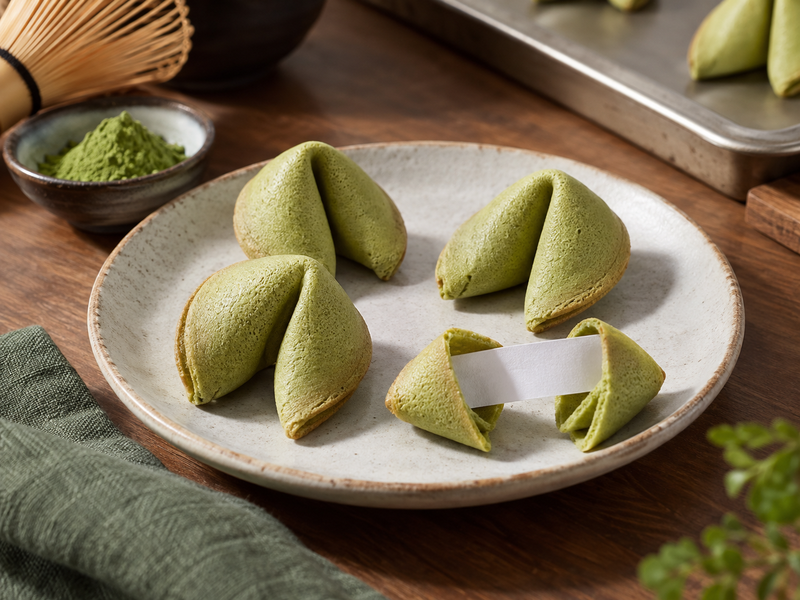
Specify the folded cookie and its purpose
A restaurant accompaniment, a wedding favor and a branded retail pack need different specifications. Decide whether the buyer expects a single uncoated cookie or a decorated gift item. Chocolate dipping and sprinkles add operations that can conceal the shell’s original texture, so establish the plain version first.
Aiya’s matcha fortune cookie recipe describes a thin baked disc folded while hot. It confirms a practical matcha application, but its listed cake-flour quantity lacks a clear unit. Do not use that incomplete quantity as a production formula.
Prepare a plain folded sample that fits the proposed pouch without forcing the corners inward. Open another sample and check how the message comes out. The customer should not need to crush the entire cookie to retrieve an awkwardly positioned slip.
Agree on the role of the message before testing flavors. A cookie intended for a campaign needs controlled message versions and packing counts, while a cafe accompaniment may use one standard message. That choice affects the assembly station as directly as the batter does.
2. How should a bakery choose its batter and matcha?
Start from a complete base recipe
Use a fortune-cookie batter already proven in your kitchen or a complete recipe whose ingredients and method can be checked. Preserve its flour, fat, sugar and egg quantities during the initial tea comparison. Trying to repair an incomplete reference while developing a new flavor creates two unknowns.
Choose unsweetened matcha and ask for its ingredient declaration. A sweetened drink mix changes the batter’s sugar content as well as its tea flavor. Record the flour product too; swapping flour without a trial may change spreading and handling.
| Ingredient decision | Information to retain | Pilot question |
|---|---|---|
| Flour | Product and weighed amount | Does the disc spread evenly? |
| Fat | Type and condition | Does the shell release cleanly? |
| Egg component | Product specification | Is the batter consistent? |
| Matcha | Lot and plain-powder identity | Is the baked flavor clear? |
The matcha ingredients guide can help frame the supplier inquiry. Give Matcha Village the intended thin-biscuit application and your approximate addition level. A powder selected for a milk drink still needs a separate evaluation in a baked shell.
3. What should a small tea-strength experiment look like?
Keep spreading and folding conditions fixed
As a proposed screening plan, compare additions of 1, 1.5 and 2 grams of matcha for each 100 grams of flour in your established base. These are unvalidated trial levels. Make only enough batter to observe spreading, folding and the fully cooled bite before selecting a direction.
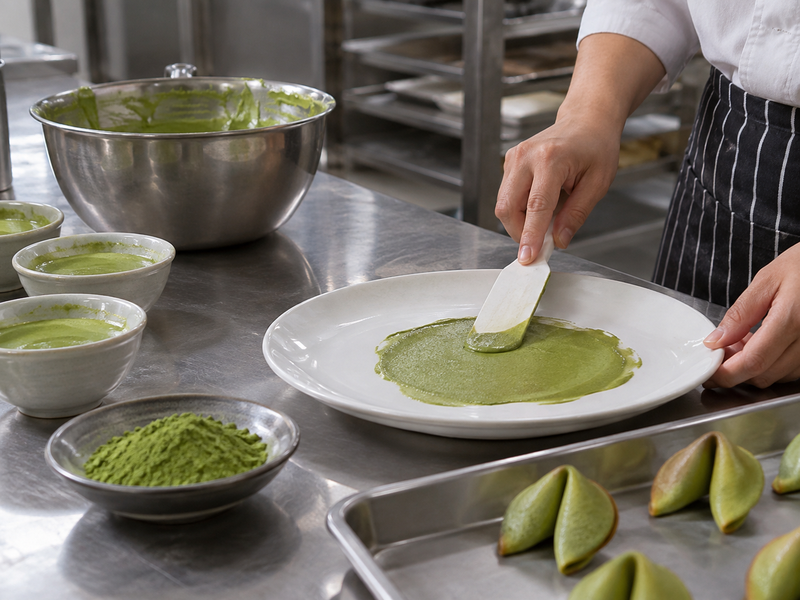
Blend the tea with a small portion of flour before incorporating the remaining dry ingredients. Check the mixed batter by spreading a thin smear on a pale plate. Dark specks can be easier to see there than in the mixing bowl. Do not judge dispersion solely from an apparently uniform green surface.
Give each trial the same spreading tool, disc size and baking position. If one operator makes thicker discs for the strongest tea sample, any difference in crispness becomes ambiguous.
Record the batter’s rest and working conditions according to the chosen base method. Stirring or leaving it uncovered at different points can introduce variation between early and late discs. Compare the first and last cookies from each small batch, since a supplier order must work through an entire production run.
4. How can staff spread discs without thick centers?
Match the stencil to the folding task
A disc with a thick center and thin rim can appear baked at its edge while the middle remains difficult to handle. Spread from the center outward with a repeatable motion, then inspect the disc against the light-colored liner. Keep the spreading tool clear of dried batter.
For an initial tooling trial, compare two measured disc diameters, such as 70 and 80 millimeters. These are proposed dimensions, not established settings. Check whether the larger disc improves message space enough to justify its greater ingredient use and packaging footprint.
| Spreading variable | What staff should observe | What to hold constant |
|---|---|---|
| Disc outline | Roundness and clean edges | Stencil or template |
| Batter deposit | Actual amount per disc | Weighed setup samples |
| Center thickness | Visible mound | Spreading motion |
| Sheet loading | Reachable folding sequence | Number of discs |
Avoid covering a large tray simply because it has room. The number of discs should match how many cookies the folding station can shape before they become too rigid. Begin with a deliberately small tray load, record the result and increase only when the operator can maintain the intended shape.
5. How should the hot-folding station be arranged?
Put every movement within easy reach
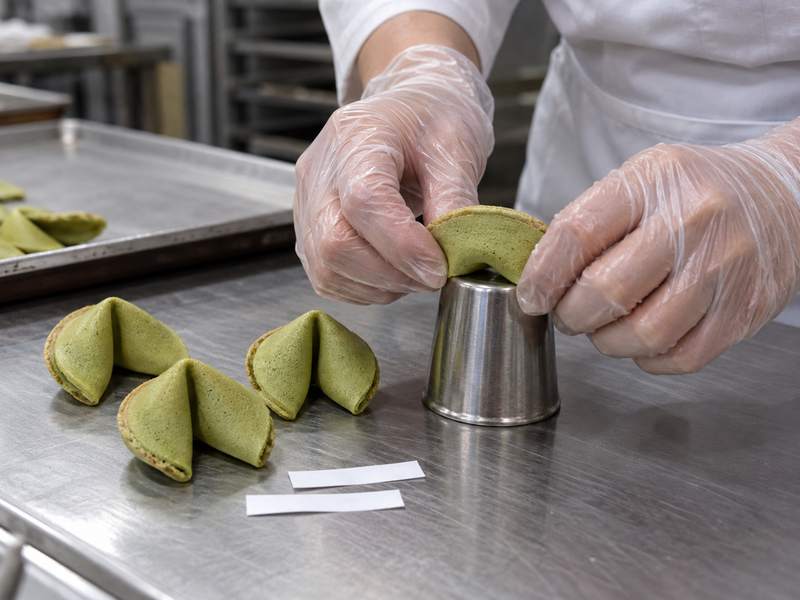
Set the approved message slips, shaping support and cooling holders beside the receiving area before baking starts. Arrange them in the order used. An operator should not cross over a hot tray or reach behind another worker to collect an insert.
Follow the site’s approved protection and handling procedures for hot equipment. Test the tools and protective equipment during the pilot; theoretical speed has little value if the setup is uncomfortable or unsafe to repeat. Assign someone to remove trays if the folding operator cannot do both jobs smoothly.
Observe which cookie gets folded first and which gets folded last. Record splits, incomplete bends and reopened seams by their position in that sequence. The pattern may show that tray loading exceeds the available working window.
Use the same shaping support for the comparison. A different rim or forming tool can change the curve and internal space. Photograph the approved profile from the side and from above so another shift can recognize the intended fold without pressing a cooled sample until it breaks.
6. What controls belong around the message insert?
Treat the slip as part of the product
Purchase paper and printing suitable for their intended food-contact use, supported by the supplier’s documentation. Ordinary office printouts should not become a default ingredient at the folding bench. Verify the insert’s intended conditions of contact, dimensions and print process before ordering.
Create an approved message file with a version identifier. The production team needs to know which version belongs in which order. A personalized campaign can be spoiled by an old message even when every cookie is technically acceptable.
| Insert control | Practical check | Person to involve |
|---|---|---|
| Material suitability | Supplier documentation | Purchasing and quality |
| Message version | Approved customer proof | Account manager |
| Size and position | Retrieval from sample cookie | Production lead |
| Order separation | Separate insert containers | Packing supervisor |
Run blank food-contact-suitable slips during early shaping trials if wording is not yet approved. That allows geometry testing without mixing obsolete promotional content into finished stock.
Keep the slip entirely within the intended shell space. Test retrieval on cooled samples and examine whether paper adheres to the interior. Any ink transfer, unusual odor or damaged insert needs investigation before the format is released.
7. What should cooling reveal about shell quality?
Judge the set shape before decoration
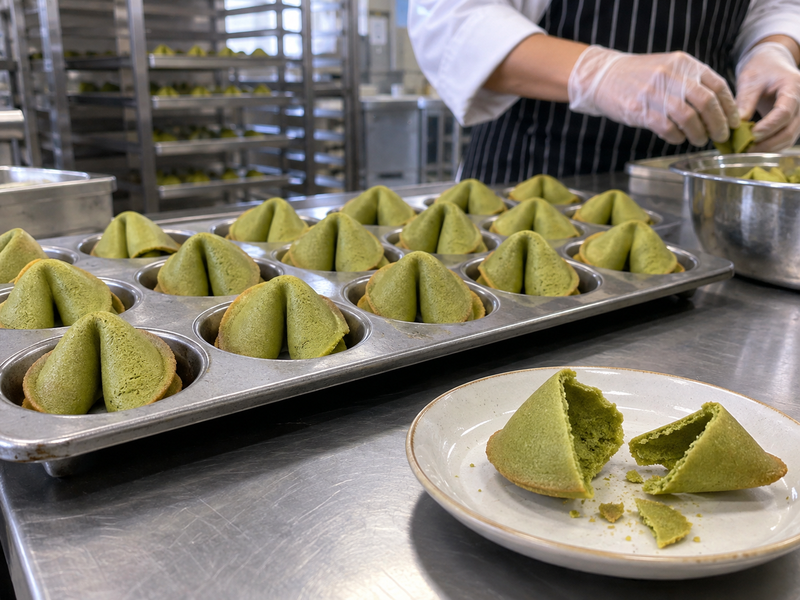
Place newly formed cookies in the selected supports without crowding them. Let them reach the handling condition required by your base process before removal. Test whether the shell retains its curve when moved to the packing table.
Break a sample from the beginning, middle and end of the pilot. Compare the snap, center thickness and internal appearance. A thin rim can be crisp while a thick fold remains less dry, so inspect the central bend rather than relying on the sound from one edge.
Do this assessment before dipping in chocolate or adding decoration. Otherwise a coating can hide weak structure, and the team may blame the coating later for a defect already present in the shell.
Keep rejected samples with their tray-position notes while investigating. A row of similarly split cookies often tells more than a single carefully photographed failure. Record the working room conditions if they change noticeably during production; the pilot should explain when the process worked, not merely state that it worked once.
8. Which packaging questions matter for a crisp cookie?
Check shape protection and closure quality
Fortune cookies have projecting ends and a hollow center. Put a finished sample inside the proposed wrapper, close it and place it in the intended outer carton. Check whether the pack presses against the tips when stacked.
Wonton Food’s commercial fortune-cookie range includes individually wrapped products and a custom program. This is evidence of established packaging and personalization formats, not evidence that your matcha recipe has the same performance.
| Pack feature | Development check | Possible response |
|---|---|---|
| Pouch dimensions | Corners under pressure | Compare a larger pouch |
| Seal area | Crumbs or coating contamination | Change filling position |
| Outer carton | Compression at lower layers | Add appropriate support |
| Finished appearance | Broken ends visible through film | Revisit handling sequence |
Crispness over time must be studied in the actual packaging. Ask the packaging supplier for relevant material specifications and validate the complete product rather than choosing a film by appearance.
Do not add an assumed expiry date based on another manufacturer’s product. Commercial shelf life depends on your shell, handling, package integrity and storage conditions, including any decoration added after baking.
9. How should yield and labor be measured?
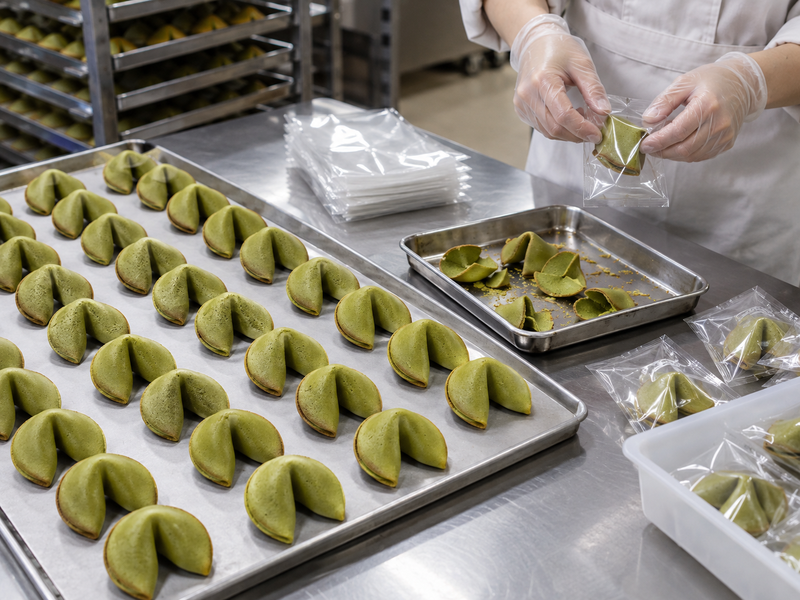
Follow each disc into its final pack
Count spread discs, successfully folded shells and acceptable packaged cookies separately. These figures reveal whether losses occur during baking, forming or packing. A single finished-yield number cannot show which workstation needs attention.
For an illustrative calculation, 100 spread discs might produce 88 usable folds and 84 saleable packs. Those hypothetical figures would identify four additional losses after folding. They are not expected performance targets; use your own pilot counts to decide whether the process is commercially workable.
Time the folding station at a realistic pace with normal cleanup and replenishment. A short demonstration using prearranged slips can overstate capacity. Include pauses needed to clear broken shells or refill packaging.
Matcha cost belongs in the full unit calculation, but forming labor and breakage may dominate the difference between alternatives. Before rejecting a powder over a small price difference, check whether its approved recipe needs thicker discs, more handling or a different coating. Compare total cost per acceptable packed cookie.
10. What should an OEM buyer approve before ordering?
Separate cookie approval from message approval
Send the manufacturer a physical shape sample, a flavor description and packaging requirements. Request a pilot using the intended production line, rather than approving only a hand-shaped kitchen sample. Record any difference between the two processes.
Review message content as its own approval item. Wording, language, print size and version count can affect scheduling even when the cookie recipe stays unchanged. Confirm how surplus printed slips and rejected packs will be controlled.
| Approval item | Evidence to request | What it settles |
|---|---|---|
| Baked cookie | Representative pilot samples | Flavor and structure |
| Fold and insert | Opened sample set | Retrieval and fit |
| Individual pack | Closed production sample | Protection and appearance |
| Order plan | Counts by message version | Correct campaign allocation |
Include all ingredients, decorations and processing aids in the product information review. A matcha ingredient’s claims cannot stand in for the finished cookie’s declaration.
Before the first commercial order, ask the supplier to pack a small pilot carton with the final approved inserts and closures, then assess both an unopened carton and several opened cookies against the agreed specification.
FAQ
Q1: Can matcha be added to any thin-cookie batter?
Treat that as a new formulation trial. A fortune cookie must both bake through and remain workable during folding.
Q2: Why do cookies split while being shaped?
Compare disc thickness, bake exposure, folding sequence and tooling. Start by recording where each failure occurred on the tray.
Q3: Should a whole tray be baked at once?
Only when the forming station can handle it consistently. Pilot tray size should follow actual folding capacity.
Q4: Can ordinary printed paper be used for fortunes?
Use materials documented as suitable for the intended food-contact application and confirm the printing process with the supplier.
Q5: Does individual wrapping establish shelf life?
No. It is one part of the system. The recipe, handling, pack integrity and intended conditions still require product-specific validation.