
A matcha latte with caramel combines tea, milk, and a caramel ingredient in one hot or iced cup. Commercial difficulty comes from syrup dose, color, layering, and ingredient variation across stores. This guide treats caramel as a beverage component and sets practical checks for a repeatable menu drink. It differs from matcha caramel candy, where cooking sugar is the product rather than a latte addition.
Search-intent reference: “Layered iced caramel matcha latte”. Its title points to an iced layered cup; this article develops original foodservice specifications.
1. Which caramel matcha latte should the brand sell?
Define the finished cup before trialing ingredients
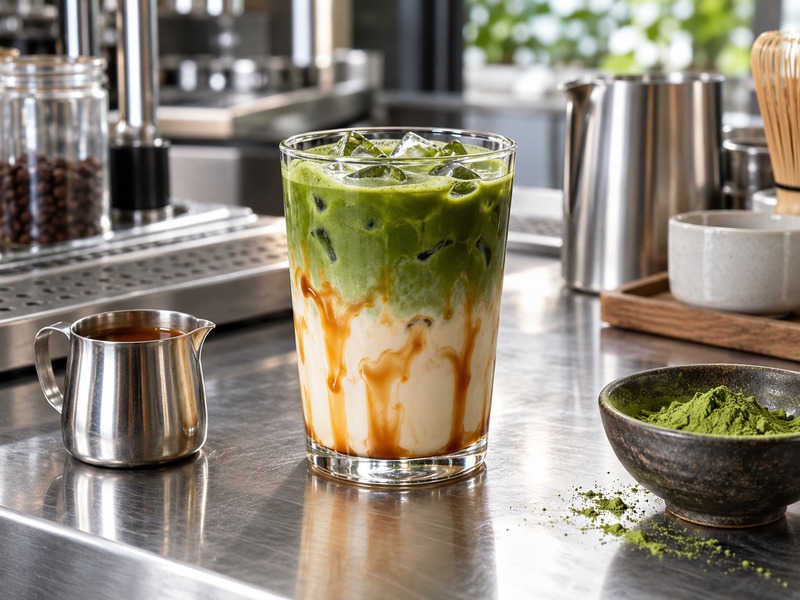
A layered iced cup and a fully mixed hot latte promise different experiences. A layered drink uses visual separation at handoff, followed by a customer stir or gradual mixing through a straw. A mixed latte puts consistent flavor in every sip. Decide whether caramel should appear as a bottom layer, a cup-wall drizzle, or a measured ingredient in the milk. Write the brief: name cup mass, tea intensity, sweetness, appearance, and the period the cup should remain attractive after handoff.
Set a default syrup level and a lower-sweetness option only after tasting both. A dramatic dark swirl can obscure matcha green, while a pale caramel may disappear visually. The two ingredients also compete for aroma. Ask staff to rate tea, caramel, milk, and aftertaste separately in a blind trial. Menu photographs should show an achievable service cup rather than a studio arrangement that falls apart immediately. A clear product brief prevents a chain from buying a syrup because its bottle looks appealing while the final drink tastes mainly of sugar.
2. What caramel ingredient fits beverage service?
Compare syrup, sauce, and flavored base
A pourable caramel syrup can be easy to dose cold. A thicker sauce may create a strong visual line but resist mixing and leave residue in the cup. A powdered flavor base can simplify some operations yet adds a different reconstitution step. Ask suppliers for ingredients, allergens, concentration or solids guidance, viscosity, storage, lot coding, and usable pack size. Some caramel sauces contain dairy while some syrups do not. Read the exact specification: the word “caramel” does not settle allergen or handling questions.
Test a candidate with the intended milk and matcha, not in water alone. Record pump dose by mass; the same stroke can deliver different amounts when product temperature or viscosity changes. Look for clumps in cold milk and film on cup walls. If the syrup is acidic or carries added color, measure its effect on the final drink rather than assuming the green tea will remain unchanged. A supplier sample should cover a normal-shift trial, including opened-bottle handling and cleaning. Choose a pack that staff can use within its validated storage instructions.
| Caramel route | Useful feature | Trial risk |
|---|---|---|
| Thin syrup | Easy cold dosing | Fast layer mixing |
| Thick sauce | Visible swirl | Residue and uneven sweetness |
| Powdered base | Dry storage option | Reconstitution and dust |
| Caramel milk base | Few bar steps | Less sweetness control |
3. Which matcha stays clear beside caramel?
Screen flavor after full mixing
Caramel’s cooked-sugar note can mask a delicate tea. A matcha with balanced bitterness and visible green may give better finished-cup value than a powder chosen solely for drinking with water. Run matched formulas with candidate lots and compare the cup after stirring. A separated iced cup can look green at handoff yet taste weak once caramel mixes through it. Taste the mixed cup: customers will eventually combine the layers even if staff serve them apart.
Request a specification, identity and origin details, lot code, storage advice, and applicable test documents. Compare tea particles after the intended hold, since caramel viscosity does not solve poor matcha dispersion. If a grade change improves color but raises cost, calculate the effect per accepted cup. Matcha Village describes bulk tea supply on its homepage; provide the caramel and milk formula when requesting application samples. Keep a reference drink prepared under fixed light and equipment settings for later lot checks.
4. What pilot formula makes a fair starting cup?
Use masses and include ice in the total
The example below is an illustrative 400 g iced serving, not a validated menu recipe. It reserves visible room for caramel while keeping matcha measured. If a syrup is much sweeter or thicker than the trial material, its dose needs a separate evaluation. Avoid copying milliliter pump counts into a new store without weighing the actual output. Set one baseline: an approval tasting cannot explain a result if tea grade, syrup, milk, and ice all change together.
Prepare at least two versions: one intentionally layered and one fully mixed from the start. Weigh poured mass, observe cup-wall residue, and taste at handoff and after a realistic wait. A hot version should be developed separately because ice disappears and syrup behavior changes. Keep the ingredient list for each variant current; a “vegan” callout would require checking both caramel and milk components. Record service time and remakes, since a visually delicate layered cup may create more labor than its ingredient cost suggests.
| Ingredient | Illustrative 400 g iced cup | Function |
|---|---|---|
| Specified milk base | 230 g | Body and color background |
| Water for tea premix | 45 g | Matcha dispersion |
| Matcha | 4 g | Tea flavor |
| Caramel syrup | 30 g | Sweetness and caramel note |
| Ice | 91 g | Temperature and fill |
5. How can a layered iced cup be repeated?
Control density, temperature, and pour motion
Layering depends on the actual syrup, milk, tea premix, ice geometry, and pouring sequence. Denser caramel may sit near the base, but a thick sauce can streak unpredictably. Develop the method with the exact cup and ice machine used in stores. Staff can pour against a spoon or along the cup wall if that method proves repeatable, then add a measured matcha layer. Judge a service window: a photograph taken at the moment of pouring does not establish what a customer will see at pickup.
Take timed photos under normal lighting and weigh components from several staff members. If a layer fails after a few minutes, the brand can accept a short-lived visual effect, change the formula, or present the cup as mixed. Do not pressure staff to rebuild a safe drink merely because the interface softens naturally. Provide a mixing cue on the menu only when customers need it for balanced flavor. A layered cup should also be tasted from the top, middle, and bottom through the intended straw to check whether one sip is overly sweet.
6. What changes in a hot caramel matcha latte?
Set a separate formula and steam method
Heating changes caramel flow, milk sweetness perception, and tea aroma. A hot cup usually favors full integration over a long-lived visual layer. Make the matcha premix, combine measured caramel with milk according to the trial method, and record heating and foam settings. Avoid overheating either ingredient beyond its supplier guidance and the bar’s food safety procedure. Taste as it cools: a cup balanced at the handoff temperature may seem much sweeter later.
Use a separate hot recipe code rather than removing the ice from the iced formula and filling the gap by eye. Calibrate a syrup pump for warm service if the bottle sits near equipment. Check whether caramel foams, separates, or marks the steam wand. Cleaning time belongs in the operational cost. If a dairy-free hot version is offered, test the specific plant milk with caramel and matcha; a sauce may still contain dairy even when the milk does not. Train staff on the full ingredient and allergen profile.
| Format | Primary check | Why it matters |
|---|---|---|
| Iced layered | Timed appearance | Visual promise |
| Iced mixed | Even sweetness | Flavor in every sip |
| Hot mixed | Foam and aroma | Handoff quality |
| Plant-milk variant | Caramel ingredients | Label accuracy |
7. Can caramel and matcha bases be batched?
Separate safe holding from visual assembly
A chain may want a measured matcha concentrate and a caramel station setup to reduce service time. Define each component’s preparation method, container, lot trace, mixing step, and permitted hold under its food safety plan. A fully mixed caramel-matcha base may lose the layered appearance and develop sediment. Test whether any labor saved outweighs that compromise. Observe the rush: a premix that works in a quiet lab can be mishandled when containers are refilled mid-service.
Keep the caramel bottle and matcha concentrate separately identifiable. Record when each was prepared or opened, and how staff stir the tea base before portioning. Use a sample from the beginning and end of the container to check concentration drift. If a syrup crystallizes or thickens during storage, follow its supplier guidance rather than adding water without documentation. A central-kitchen blend requires uniformity and packaging checks before it can replace store-level weighing. Any bulk preparation must be validated for the actual ingredients and hold conditions.
8. Which defects should quality teams track?
Use visible symptoms that point to a cause
Green clumps suggest tea dispersion trouble. A dark puddle at the base may be intended layering or an overdose of syrup; the recipe and timed photo distinguish them. A muddy cup color may come from caramel color, milk tone, or oxidized tea. A greasy surface could trace to a sauce or milk base. Name the defect: “bad drink” gives purchasing no useful evidence. Log syrup lot, matcha lot, milk item, operator, cup mass, and the moment the photo was taken.
Review the finished drink against a reference made with approved ingredients. If a new syrup has different viscosity, recalibrate pump output and layering before changing matcha. If an iced cup tastes bland after waiting, check ice mass and syrup dilution. Use a small reject taxonomy for stores so repeated issues can be counted. A packaged adaptation would need its own release tests, not a café photo standard. Quality records should help teams isolate changes without making every customer complaint a supplier dispute.
| Complaint | Initial check | Evidence |
|---|---|---|
| Too sweet at base | Syrup dose and mixing cue | Weighed cup, timed tasting |
| Weak tea | Powder dose and caramel level | Reference-cup comparison |
| Muddy green | Tea, milk, and syrup color | Fixed-light photo |
| Green clumps | Premix order | Jar-wall inspection |
9. Can the concept become a ready-to-drink bottle?
Rebuild the process for packaged distribution
A café’s layered visual is unlikely to survive filling, transport, and consumer shaking in the same way. Decide whether the packaged product will be a homogeneous caramel matcha latte or a deliberately separated beverage that customers must mix. That choice affects process, packaging, label wording, and quality tests. Qualified technologists must validate thermal or other processing, microbiological safety, sediment behavior, and shelf life for the final formula. Do not borrow a café hold time: a sealed product follows a different route and risk profile.
Caramel syrup can carry sugar, color, acidity, and flavoring that change under processing. Matcha can settle and shift color. Test the exact ingredients after processing and through representative distribution. Review label ingredients and allergens, especially when caramel contains milk or the base uses a plant allergen. If the product is described as “layered,” prove that the final package delivers that experience through its sales period. A shelf-life claim belongs on the product only after a documented study under the chosen process and market.
10. How should a buyer cost and source this drink?
Price the accepted cup, not the visual prototype
Calculate matcha, milk, caramel, ice, cup, lid, labor, cleaning, and remakes per saleable serving. A thick sauce can cost more in line residue than its bottle price suggests. A visually layered method can add time and rejected cups if staff cannot repeat it during peak service. Compare that cost with a fully mixed version using the same finished mass. Run a normal shift: bench yield often misses overpours and syrup left on the cup wall.
Send matcha suppliers the caramel type, milk base, dose, expected volume, market, and required documents. Send syrup suppliers the desired flavor, viscosity, pack, and allergen requirements. Test commercial lots before approval and agree how changes will be communicated. Matcha Village can discuss matcha options through its contact page. A launch decision should rest on flavor after stirring, a realistic appearance window, staff execution, and a cost sheet built from accepted cups.
| Cost line | Measurement | Why record it |
|---|---|---|
| Matcha | Grams per cup | Flavor cost |
| Caramel | Dispensed grams | Sweetness and residue |
| Service labor | Seconds per accepted cup | Peak capacity |
| Remakes | Count and cause | True margin |
FAQ
Q1: Does caramel always contain dairy? No. Check the exact syrup or sauce ingredient and allergen statement.
Q2: Why do the layers mix quickly? Ingredient density, viscosity, ice, and pour method determine how long separation remains visible.
Q3: Can caramel be added to hot matcha? Yes, with a separately tested hot formula and handling method.
Q4: Does a darker caramel mean stronger flavor? Color alone cannot establish flavor intensity; compare measured doses in the finished drink.
Q5: Can a layered café cup be bottled unchanged? No. A packaged version needs separate process and shelf-life work.