
Can you make matcha ahead of time for a café rush? Yes, but “ahead” can mean preweighing powder, whisking a same-shift base, or manufacturing a sealed drink. Each choice changes flavor, labor, holding controls, and waste. A pitcher that looks fine at opening may settle before the next barista uses it. A sweetened latte may need a different handling plan from unsweetened matcha in water. This article gives café operators and beverage developers a method for choosing a prep level, validating it, and training staff. Our supplier perspective begins with how matcha behaves in the actual menu recipe, not a blanket promise about how long a drink will keep.
1. What does “can you make matcha ahead of time” mean for café prep?
Separate ingredient prep from finished drink prep
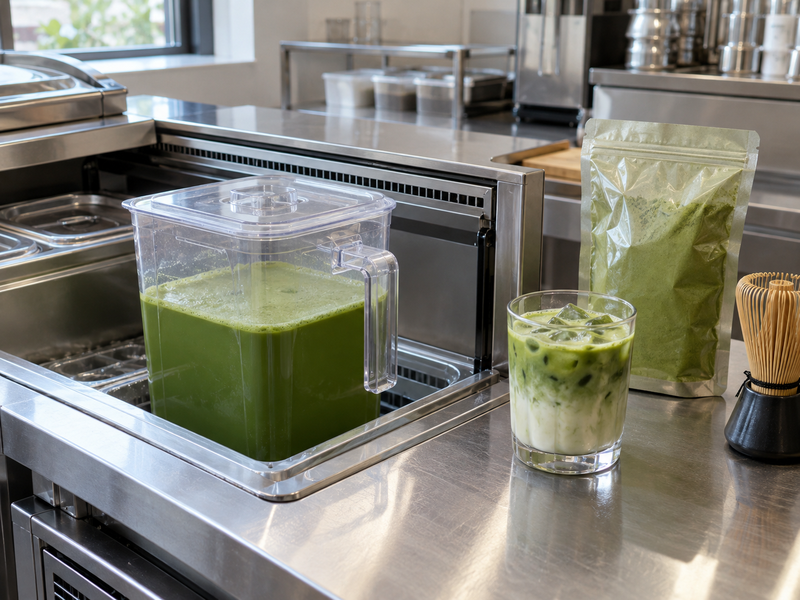
Some stores call a preweighed sachet “batching.” Others mean a pitcher of whisked matcha. A manufacturer may mean an RTD product filled and processed for distribution. Those processes have different controls, so write down the state of the product at each stage. Is the powder dry? Is matcha dispersed in water? Have milk and sweetener been added? Is the pack sealed? The answers determine how staff should store, label, and use it.
For a café, the lowest-risk operational experiment is often preportioning the dry ingredient while keeping final mixing close to service. This removes measuring variability without assuming that a wet base will remain suitable throughout a shift. A busy chain might prefer a short-run wet base if it measurably reduces ticket time. Define the target: how many drinks must be served during the busiest interval, what quality standard customers expect, and how much staff time may be saved. Make-ahead preparation is a workflow design choice, not a single recipe trick.
2. Which preparation level suits the service volume?
Choose the least complicated method that removes the bottleneck
Map your current line. If measuring powder slows service, portion it in advance. If whisking slows service, test a small wet base. If multiple outlets need identical flavor, consider a controlled concentrate or manufactured product. Each extra step before the customer orders creates another handoff and another point where quality can drift. A larger batch also means more product at risk if sales fall short.
| Prep level | Best use | Main control |
|---|---|---|
| Dry preportion | Variable-demand café | Dry, sealed storage and portion accuracy |
| Small water-based base | Predictable rush | Validated holding and remixing method |
| Sweetened concentrate | Standard chain recipe | Dilution and opened-pack handling |
| Sealed finished drink | Retail distribution | Qualified processing and shelf-life evidence |
Trial the prep level with a forecast, not just a recipe. For example, count expected matcha orders in a peak hour and prepare only a test quantity. Record how many servings sell, how many remain, and whether the last serving meets the same standard as the first. If a store needs only a few cups per day, a big pitcher may save seconds while increasing waste. The right batch size follows demand.
3. Can you make matcha ahead of time as a concentrated base?
Control powder dose, liquid, and mixing energy
Matcha is finely milled tea leaf, not a completely soluble powder. A wet base is a suspension that can settle. Begin with a documented powder weight and liquid volume, then use the same water temperature, vessel, and mixing method each time. Many teams find it easier to disperse matcha in a smaller portion of liquid before adding the rest, but the final method should be selected by testing the intended powder and recipe. Sift only if that step is practical at scale and solves a measured clumping problem.
| Variable | Record during trial | Visible failure |
|---|---|---|
| Powder dose | Weight per finished serving | Weak or overly bitter cup |
| Initial liquid | Volume and temperature | Dry clumps |
| Mixing | Tool, time, and vessel | Foam or uneven dispersion |
| Remixing | Method before each pour | Strong last serving |
Check the first, middle, and last pours from a pitcher. If the last cup tastes stronger, sediment is staying at the bottom. Try a smaller batch or a repeatable gentle remix before pouring. Avoid asking staff to “shake as needed”; specify the action in a way a new hire can reproduce. A base that needs constant vigorous correction may not be the right format for a rushed bar.
4. Can you make matcha ahead of time and hold it safely?
Set a verified limit for the exact recipe
There is no single reliable holding time for every prepared matcha drink. The answer depends on ingredients, processing, temperature, container, hygiene, and local food rules. Milk, plant-based beverages, fruit components, and sweeteners can change both quality and safety considerations. A water-only base can lose color or aroma even when managed safely. A café should use its food-safety plan and applicable rules, including the FDA Food Code where relevant in the U.S., to set a documented limit; a manufacturer should support any shelf-life statement with suitable validation.
Run a controlled quality trial within that plan. Prepare the base using the normal station, hold it under the intended conditions, and compare pours at planned intervals. Record color, smell, texture, sediment, and taste. Staff should not extend a limit because a batch still “looks okay.” Nor should a batch prepared yesterday be folded into today’s product without an approved procedure. A useful rule for the test: if the last planned serving does not match the reference cup, shorten the batch period or return mixing to service. Operational convenience cannot override a validated limit.
5. What storage and labeling controls does a café need?
Make ownership visible at the station
Use food-safe containers that can be cleaned and closed according to the operation’s procedures. Keep the prepared product under the storage conditions specified by the approved recipe and local requirements. Each batch needs an identity: recipe, preparation time, responsible person, and discard or use-by time determined by the food-safety plan. If allergens enter at a later stage, distinguish the matcha base from the finished dairy or plant-milk drink so staff do not confuse them.
| Control point | What staff record | Why it matters |
|---|---|---|
| Batch identity | Recipe and ingredient lot | Traceable quality feedback |
| Preparation | Time and preparer | Consistent holding decision |
| Storage | Approved location and condition | Procedure can be audited |
| Disposition | Used or discarded volume | Better batch-size forecast |
Design the container for the shift. A wide jug may be easy to mix but awkward to fit in a crowded refrigerator. A spout may pour neatly but trap residue. Try normal cleaning and closing routines before buying a large quantity of containers. The best label is one staff can read quickly and update honestly, not a complex form that sits empty.
6. Do milk, sugar, and other additions change the decision?
Keep formula branches separate
Yes. A plain matcha-and-water base, a sweetened concentrate, and a complete latte are different products. Mixing milk into the batch may reduce steps at service, but it also fixes the customer’s milk choice and can complicate allergen control. Plant-based milks vary in viscosity and may separate or foam differently. Syrups add sweetness and solids; fruit purées introduce yet another texture and handling variable. Do not borrow a holding procedure from one branch for another.
Build a recipe tree. At the root, define the matcha base. From there, decide which additions belong before service and which are added per order. For a café with dairy and oat-milk options, keeping milk out of the common base can simplify customization. For a single signature bottled drink, a fully formulated batch may make sense, but the processor must qualify the final formula and pack. Ask for ingredient specifications and allergen statements before approving a new branch. Make-ahead matcha should preserve menu flexibility where it matters, rather than force every guest into the same drink.
7. How can operators measure flavor and visual drift?
Build a reference cup and compare against it
Prepare a fresh cup using the approved recipe. Photograph it under fixed light in the usual service vessel. For each test interval, remix the held batch exactly as staff would, pour the same finished volume, and compare appearance and taste. Look for dull color, stale aroma, hard sediment, graininess, or an uneven milk layer. Taste blind when possible. A team that knows which sample is older can easily talk itself into a difference that customers may not notice—or miss one that they would.
| Observation | Possible cause to investigate | Action for next trial |
|---|---|---|
| Strong final pour | Settled powder | Smaller batch or set remix step |
| Clumps at opening | Incomplete initial dispersion | Change mixing method |
| Flat aroma | Time, oxygen, or ingredient fit | Shorter prep window |
| Inconsistent color | Dose or lighting variation | Weigh ingredients and standardize photos |
Do not solve every issue by increasing matcha dose. That can raise ingredient cost and change bitterness without fixing poor mixing. Record results by lot and preparer; then adjust one variable at a time. A repeatable scorecard is far more useful than comments such as “tastes fine.”
8. What does a practical prep-station routine look like?
Write one page staff can follow during a rush
Show exact powder weight, liquid volume, vessel, mixing method, batch label fields, storage location, remix instruction, and discard rule. Put the procedure where the work happens. A staff member should be able to prepare a batch without reading a development report. Train both opening and closing teams; otherwise a morning batch may be prepared correctly but handled inconsistently later. Use the same measuring tools at every site.
Pilot in the busiest store and one lower-volume store. The high-volume site will reveal throughput limits; the quieter site will show waste. Observe whether staff change the batch size because the standard container is too large or because measuring is awkward. Those changes are clues to redesign. If a base must be stirred before every pour, position the stirrer and container so the movement is natural. If the action is consistently skipped, a different format may be better. A make-ahead program succeeds only when its written procedure and the actual bar layout agree.
9. Does make-ahead preparation save money after waste?
Count accepted drinks and discarded base
Compare cost per accepted cup, not just minutes saved in preparation. Include powder, milk, cups, labor, container washing, and discarded product. A prep method may save thirty seconds during peak service yet lose margin if half a batch is discarded each afternoon. Demand varies by day, weather, and promotion, so test at least a busy and a slow trading pattern. Track the actual volume made and served; estimates based on expected orders hide waste.
| Metric | Why track it | Decision it informs |
|---|---|---|
| Batch yield | Actual servings from one prep | Recipe and container size |
| Accepted cups | Customer-ready output | Unit cost |
| Discarded volume | Unsold or out-of-standard product | Batch timing |
| Labor minutes | Prep, service, and washing | Staffing value |
Set a target batch size that covers likely demand with a modest buffer allowed by your approved process. When demand is uncertain, make smaller batches more often or stay with dry preportioning. The most profitable method may be a mixed system: a small prepared base during the rush and fresh mixing at quiet times.
10. Can you make matcha ahead of time at commercial scale?
Scale only after the recipe and demand are stable
A multi-store operator may reach a point where site-by-site mixing creates too much variation. A manufactured concentrate or ready-to-drink product can standardize the base, but it introduces packaging, production minimums, distribution, and shelf-life validation. Document the drink that already sells: ingredient weights, target color and taste, dilution, serving temperature, and sales by outlet. That brief gives a manufacturer something concrete to reproduce.
Expect the factory sample to need its own trial. Processing and packaging can change a matcha drink, so compare the packed product with the café reference after realistic storage. Calculate the landed cost per served cup, including packaging and freight. Keep a manual fallback for supply interruptions. If you are asking, “Can you make matcha ahead of time?” at chain scale, the answer is still yes, provided the method fits a tested formula, a documented safety system, and measurable demand. For ingredient or blend selection, send your recipe and target process to Matcha Village and request samples for the intended application.
FAQ
Q1. Can you make matcha ahead of time for an iced latte?
Yes, a café can test a prepared matcha base. Set its holding and storage rules for the exact formula and add milk at the stage your menu requires.
Q2. Why does premixed matcha settle?
Matcha contains finely milled tea particles suspended in liquid. Test a repeatable remixing step and compare first and last pours.
Q3. Can leftover matcha base be used the next day?
Only if the operation’s approved procedure and validated holding limit allow it. Appearance alone is not a safety test.
Q4. Is dry preportioning worth trying before wet batching?
Often. It can reduce dosing time while leaving final mixing close to service.
Q5. What should a chain send a concentrate supplier?
Provide the finished-drink recipe, target serving, sensory standard, expected volume, storage route, and required documentation.