
A seasonal bun can sell on its color and still leave a bakery with uneven proofing, a faint tea flavor and stale stock by afternoon. Matcha hot cross buns need a more exact brief than “make the dough green.” Set a target for crumb, spice, cross and glaze; bake measured trials; then check how each bun eats at service time. Jenki’s matcha hot cross buns provide a consumer reference. The plan below turns that idea into a bakery trial with recorded decisions.
Contents
- 1. What should matcha hot cross buns taste and look like?
- 2. Which dough works for a repeatable seasonal batch?
- 3. How much matcha should go into the dough?
- 4. Which fruit and spice pairings keep matcha clear?
- 5. How can bakers control mixing and proofing?
- 6. How should the cross and glaze be applied?
- 7. What bake checks protect crumb and color?
- 8. How should the buns be held and sold?
- 9. How can a bakery plan the seasonal production calendar?
- 10. What should buyers record before approving a rollout?
1. What should matcha hot cross buns taste and look like?
Write a product target before writing a recipe
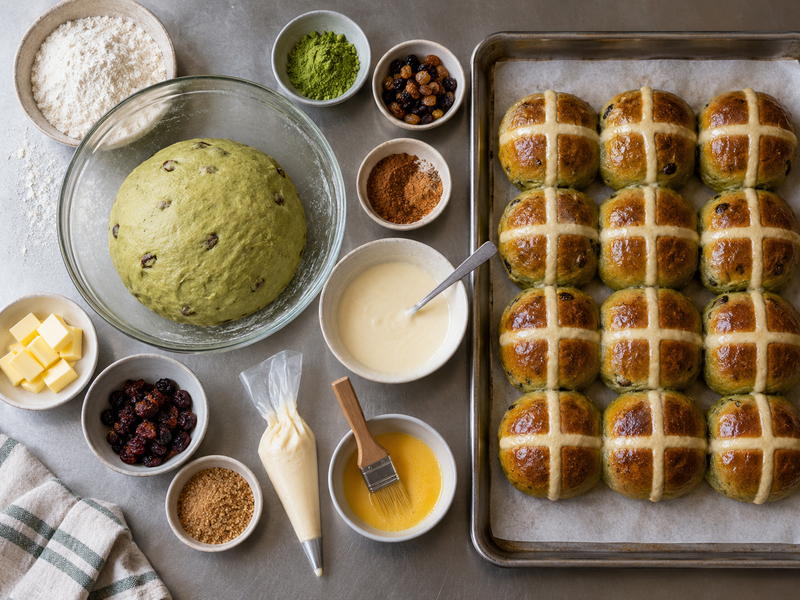
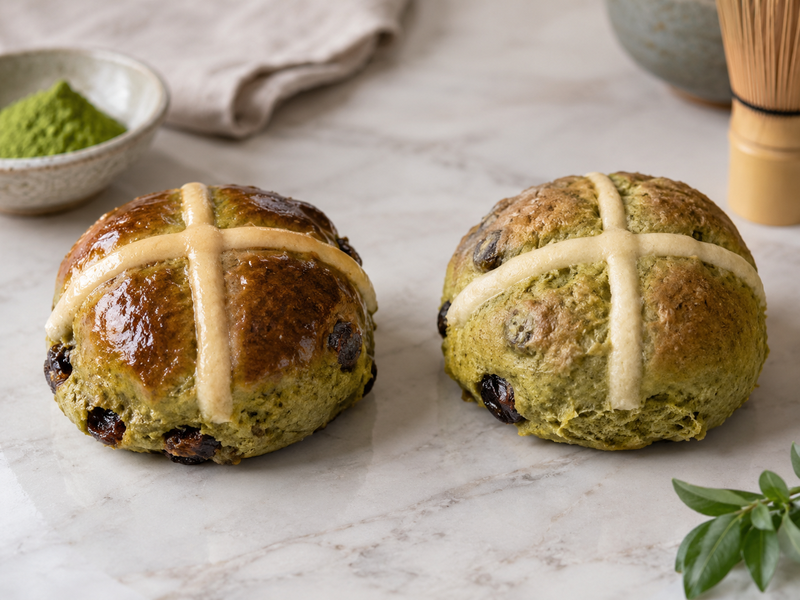
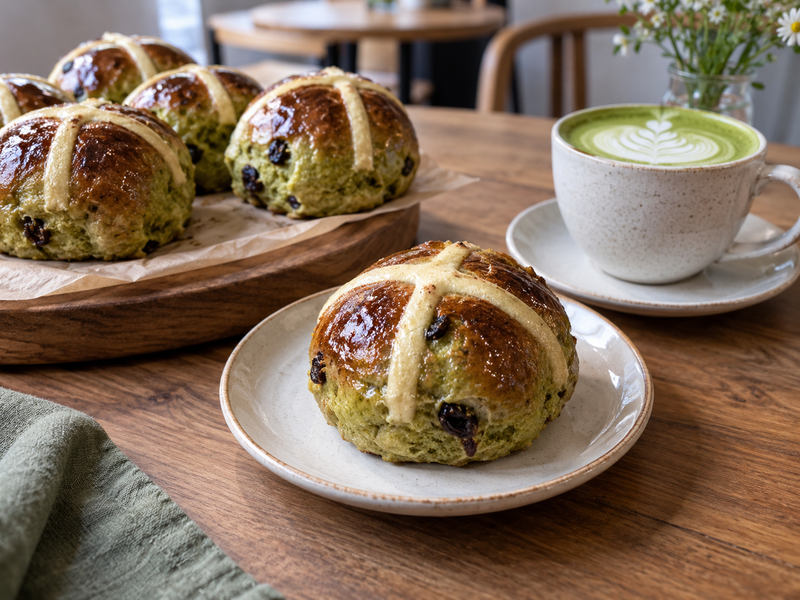
A customer expects a soft enriched bun with a visible cross. Matcha adds a tea note and a green crumb, while fruit, spice and glaze remain recognizable. Those components can compete. A heavily spiced bun may taste like a standard hot cross bun with green coloring; a heavily dosed bun may lose the familiar seasonal flavor. Decide whether tea should lead or sit alongside citrus and spice. Describe the accepted sample in words a new baker can use: even green interior, distinct but gentle tea flavor, soft crumb, dispersed fruit and a cross that stays visible after glazing.
Use the cut face as evidence. Photograph an accepted bun under counter light. Cut pieces from different tray positions. Compare crumb shade, fruit placement and softness. Ask tasters to evaluate the bun plain, then toasted. A bun that tastes balanced only under thick butter may need a formula change. Keep a plain control bun from the same dough batch, so the team can tell which changes come from matcha rather than proofing or baking.
| Finished-bun check | Record during trial | Reject when |
|---|---|---|
| Crumb | Color and softness at cooling and sale | Gray patches or dense center |
| Flavor | Tea, spice and fruit in a blind tasting | One note hides the others |
| Cross | Width and visibility after glaze | It dissolves or breaks away |
| Portion | Cooled weight and diameter | Display units vary noticeably |
2. Which dough works for a repeatable seasonal batch?
Start with an approved enriched base
Use a familiar bun dough that the bakery already produces reliably. This limits the number of moving parts in the pilot. Record flour, yeast, fat, egg or milk ingredients, sugar, salt, dough weight and mixer sequence. If the current dough uses a lot of dark fruit or dark sugar, its green crumb may look muted even when matcha quality is good. Make a small control batch and change only one variable at a time. A lighter base may improve color, but it can also change sweetness, browning and cost.
Watch the dough, not the clock alone. Matcha is a fine dry ingredient, so adding it changes the dry mix and can shift the feel of dough. Resist correcting every batch by eye with unrecorded water. Note dough temperature and texture after mixing, then compare them with the plain control. Set one target piece weight and use a scale during dividing. If pieces differ before proofing, tray color and bake time will differ too. For food handling, use the bakery’s approved controls for enriched dough and fillings; the FDA Food Code is a model for US retail practice, while local rules and your food safety plan govern the operation.
| Dough variable | Baseline record | Trial question |
|---|---|---|
| Base flour | Supplier and lot | Does structure remain soft? |
| Matcha | Lot and grams per batch | Does tea survive the bake? |
| Liquid | Weight and temperature | Has the dough become too firm? |
| Fruit | Drained weight | Is distribution even? |
| Piece weight | Target and observed spread | Can staff divide it reliably? |
3. How much matcha should go into the dough?
Run a dose ladder by weight
A spoon measurement gives poor control because powder compacts. Weigh matcha as a percentage of flour for your internal tests, then state the exact grams on the production sheet. For example, one bakery could compare three small doughs at 1%, 2% and 3% of flour weight. These are illustrative trial points, not a universal formula or a claim about optimum taste. Keep flour, fruit, spice, mixing and bake conditions constant. Mark trays by a code that tasting staff cannot decode, and taste samples only after they have cooled to service temperature.
Color is only one vote. Matcha that looks vivid before baking may taste harsh at the higher dose; a lower dose can vanish under cinnamon and glaze. Score tea clarity, bitterness, green crumb and cost per bun separately. Compare powder lots in the same dough, especially before a seasonal promotion or a large purchase. Ask a supplier for lot documentation and a sample big enough for a pilot batch. Matcha Village’s wholesale café overview can frame buyer questions, while the bakery’s own bake test must decide whether a powder suits this bun.
4. Which fruit and spice pairings keep matcha clear?
Change one supporting flavor at a time
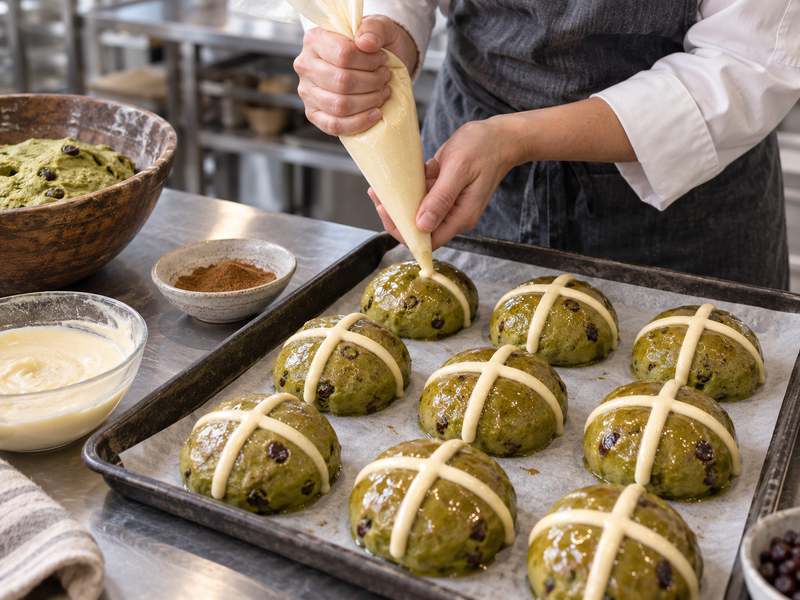
Hot cross buns invite citrus peel, raisins and warm spice. Those familiar notes are useful because customers recognize the product, but a generous cinnamon or clove dose can cover tea. Build a small tasting matrix. Hold matcha steady and compare a low-spice control, a citrus-led version and a traditional fruit-and-spice version. Name the fruit on the ingredient record rather than writing “mixed fruit,” because size and moisture affect distribution. If dried fruit feels hard, test a documented preparation method; do not add an informal soak that changes liquid balance and handling.
Test the sale occasion. A bun eaten warm with butter delivers flavor differently from a cold wrapped bun. Taste both forms. If the item will be sold in a four-pack, check that fruit does not bleed into adjacent crumb during the intended holding period. If the bun will be toasted, assess whether a citrus glaze scorches or becomes sticky. Record panel comments such as “tea appears after the orange” rather than only a total score. This gives a buyer useful language when discussing the next matcha lot or asking a bakery to adjust spice.
| Pairing trial | Hold constant | Sensory question |
|---|---|---|
| Low spice | Tea dose, fruit weight | Is matcha clear but bun still familiar? |
| Citrus-led | Tea dose, total inclusions | Does peel support or hide tea? |
| Traditional spice | Tea dose, sweetness | Does cinnamon dominate after toasting? |
| No fruit control | Dough and bake | Is fruit changing moisture or perception? |
5. How can bakers control mixing and proofing?
Record dough behavior through the shift
The pilot should capture more than a final bake photo. Note mixing time, final dough temperature, rest time, proof environment and the visual point at which pieces enter the oven. A green dough can make surface cues harder to read, so compare volume, touch and a plain control rather than relying on color. Weigh pieces before panning and space them according to expected expansion. If the bakery uses retarding, test it as a separate process, with its own start and end temperatures and its own bake assessment.
Take samples across the batch. Check one bun from the front, middle and back of a full tray. A perfect center sample can hide edge overbaking. Keep the same pan, liner and oven loading pattern during a formulation comparison. For a chain rollout, film a short approved shaping and panning sequence; a written “shape tightly” instruction leaves too much interpretation. Staff can then compare dough resistance and finished height against a real example. The approved proof is the condition the team can reproduce during a busy shift, not the most photogenic sample from a quiet test kitchen.
6. How should the cross and glaze be applied?
Treat both as separate formulas
The cross announces the product from across a display case. Define its width, piping consistency and placement. A thin paste may run down the bun; a thick paste may tear the proofed surface. Pipe a short line onto parchment during setup, then compare it with the approved photograph. Decide whether the cross should remain pale for contrast or carry a flavor. Test one piping bag tip and pressure before training staff, because tip size changes the appearance faster than minor recipe changes.
Glaze after an observed cooling point. Glaze adds shine and sweetness, but excessive liquid can soften the cross or leave a sticky wrapper. Measure glaze per tray, apply it with the same brush or sprayer and note whether buns are warm, cool or fully cold. Run a simple comparison at opening, midday and close: visible cross, dry-to-touch wrapper, and flavor after toasting. A bakery that sells unpackaged buns may accept a different finish from one packing them in film. Record those choices in the specification; “glaze lightly” is too vague for multiple stores.
| Finish check | Practical method | What to log |
|---|---|---|
| Cross flow | Pipe sample line before tray | Spread and breakage |
| Cross contrast | Photograph cooled bun | Visibility under shop light |
| Glaze dose | Weigh used glaze by tray | Stickiness and sweetness |
| Wrap contact | Inspect packed bun after hold | Smears or softened surface |
7. What bake checks protect crumb and color?
Judge a cooled bun, not its oven appearance
Matcha’s surface color may shift with heat, yet a dark exterior does not automatically mean a dry center. Set an oven trial using your normal bun profile, then adjust one factor at a time: load, temperature or time. Weigh a sample before and after baking to track loss in the same way each trial. Cut cooled buns from several tray positions. Check whether the crumb pulls cleanly, whether fruit pockets remain wet and whether the bottom has set without becoming hard. A probe reading can support an internal standard, but the bakery must validate any number against its own dough and local food rules.
Document the failed tray. If the top browns before the center is satisfactory, record where that happens and which oven shelf was used. If the crumb loses green color, compare the control and matcha dough from the same run before blaming the powder. Store photographs with lighting and timing noted, or later teams may mistake camera color for product color. A good pilot yields a repeatable oven profile and clear rejection signs, not a single perfect bun baked in an empty oven.
8. How should the buns be held and sold?
Define the real service window
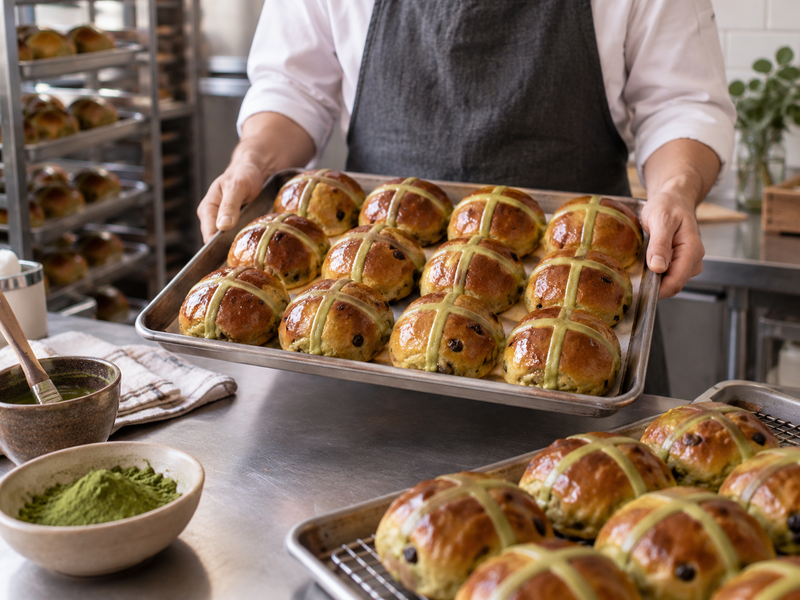
Decide whether buns are sold loose, bagged singly, in four-packs or warmed on request. Each format changes moisture transfer and visible condensation. In a pilot, inspect the bun at the time customers will buy it, then again near the end of the proposed sale period. Record softness, cross visibility, wrapper contact and fruit texture. Do not borrow a shelf-life claim from a home recipe. Packaging, process, storage conditions and local food requirements determine what can be claimed for your own product.
Make service part of the trial. Warm one bun using the actual store equipment and time the handoff. Check whether the glaze sticks to a heated bag or the fruit becomes uncomfortably hot. Train staff to state whether the bun contains common allergens from dough, glaze or toppings using the approved ingredient sheet. Seasonal speed matters: if each order requires several ad hoc steps, the queue will lengthen on busy mornings. Test a simple assembly and handoff sequence with ordinary staff, then note which steps cause rework.
| Sale format | Quality risk | Pilot observation |
|---|---|---|
| Loose display | Dry surface | Check crumb at close |
| Single wrap | Condensation and smearing | Inspect film after cooling |
| Multi-pack | Crushed crosses | Test stack and transport |
| Warmed order | Slow handoff | Time service and inspect bag |
9. How can a bakery plan the seasonal production calendar?
Work backward from the sales week
Hot cross buns have a short calendar opportunity, so late powder approval can waste the launch. Put tasting, supplier sample approval, label review, staff training and packaging proof on a dated plan. Work backward from the first planned sale day and allow a full production shift for the final test. A bench batch can miss issues that appear when multiple trays are proofing and baking while other products share the oven. Reserve that full-load trial before committing to a promotion.
Give each decision an owner. The baker signs off on process, purchasing signs off on the lot and lead time, and the store team signs off on display and handoff. Define a stop date for formula changes so packaging and ingredient information do not lag behind the bun. Set a modest initial daily forecast, count unsold units and adjust production by day of week rather than repeating the same number daily. A calendar is useful when it connects real decisions, not when it merely lists a launch date and a poster deadline.
10. What should buyers record before approving a rollout?
Keep one decision sheet for formula and supply
The approval record should identify recipe revision, powder lot, finished weight range, cross and glaze method, packaging format and selling condition. Attach tasting notes and a full-load bake result. For a new matcha supplier, retain the agreed specification and lot records. Put cost per saleable bun beside yield; frequent rework can make a cheap dough expensive.
Keep the next batch comparable. Repeat the trial with a second powder lot. If results change, investigate before altering several formula variables. Tell purchasing which features matter: tea flavor after baking, green crumb, pack size and timely delivery. Show staff the approved cut sample, portion target and rejection examples. After the first selling week, review waste and comments against the pilot notes, then revise next season’s record.
FAQ
Q1: What are matcha hot cross buns?
They are spiced, usually fruit-filled seasonal buns with matcha in the dough or another defined component and a visible piped cross.
Q2: Can a bakery use its existing hot cross bun dough?
Yes. Use that dough as a control, then test weighed matcha additions and record any changes in mixing, proofing and color.
Q3: How should staff judge the right matcha dose?
Compare coded buns after cooling and after the intended service step. Score tea flavor, bitterness, crumb color and cost separately.
Q4: Can the buns be packed for later sale?
Test the chosen pack for softness, condensation and glaze contact under the intended conditions; set sale periods through your own validated process.
Q5: What should a wholesale buyer request?
Request a sample lot, specification, lead time and enough powder for a full bakery trial before approving a seasonal order.