
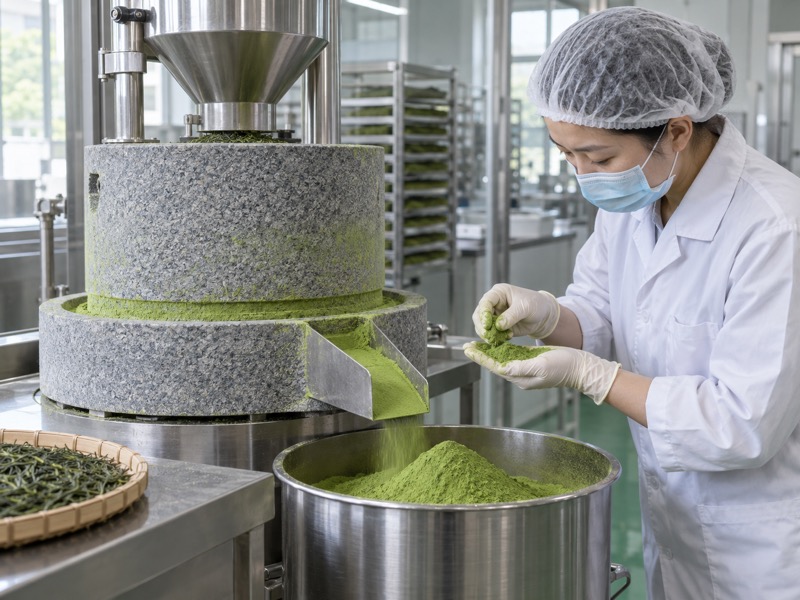
A matcha grinder turns prepared tea material into a fine powder for whisking, drinks and food use. The machine’s name is only the start of the buying decision. Feed condition, particle size, heat, cleaning, output rate and changeover all affect the powder a customer receives. The Kyoto Prefectural Tea Industry Chamber notes that modern matcha can be ground with equipment beyond traditional tea mills. Chajin’s discussion of matcha grinding adds a consumer-facing view. A producer needs to evaluate a grinder on its own tea, target product and documented quality controls rather than assuming one machine makes every powder alike.
For: tea processors, ingredient buyers, product developers and factory quality teams. Decision: whether a grinding route delivers the required sensory profile and throughput without creating quality or sanitation problems.
1. What material will the grinder receive?
Define the feed before the equipment
The tea entering a grinder should be identified by lot, preparation state and target application. Tencha-style material, other prepared tea leaves and blended inputs are not interchangeable simply because the final powder is green. Ask the production team for the intended feed specification: moisture condition, leaf preparation, foreign-material controls and permitted blend components. The applicable process and label rules should be checked for the market and product. Grinding cannot repair a poor incoming lot or create a verified origin claim.
Run a real feed trial. A demonstration using a supplier’s ideal tea says little about your own material. Use representative lots, including one at the edge of the approved incoming range. Record how the material feeds, whether it bridges or clogs, and how the powder tastes. Keep the starting lot and finished powder connected in the batch record. A machine comparison is meaningful only when the input and target are clear.
| Feed question | Why it matters | Evidence |
|---|---|---|
| What leaf material? | Defines product identity | Lot and process record |
| How was it prepared? | Changes feed behavior | Incoming specification |
| What is the target use? | Sets powder standard | Application trial |
2. Which powder properties should be specified?
Measure performance, not adjectives
“Fine” and “smooth” are not complete specifications. Define the particle-size method relevant to the product, plus sensory targets for color, aroma, bitterness, mouthfeel and dispersion. A laboratory particle result should be connected to actual use: whisked tea, latte, bakery batter or blend. A powder that feels smooth in water may still clump in a cold factory mix. Different measurement methods can give different results, so state the method whenever numbers are compared.
Keep an approved sample. Retain a reference lot and test candidate powder beside it in a controlled recipe. Compare the top, middle and bottom of a production run for uniformity. If a supplier quotes a single particle number, ask how it was measured and whether it describes the distribution or only an average. The aim is a powder that performs consistently in the buyer’s process, not the smallest number on a brochure.
3. How should grinding heat be evaluated?
Check the powder, not just the machine casing
Grinding can add heat to the material. How much depends on the feed, equipment, speed, run length and environmental conditions. Excess heat may affect aroma or color, but the effect must be tested on the actual route. During a trial, record inlet and outlet conditions using the facility’s approved measurement method and take powder samples across the run. Compare color and aroma after grinding and after a short, controlled hold. A brief machine demonstration may miss changes that appear later in a full shift.
Change one factor at a time. If quality drifts, examine feed rate, run duration, cooling and equipment settings within the manufacturer’s approved operating limits. Do not lower a safety control to improve a color photograph. If a claimed “cold grinding” process is used in marketing, define what is measured and keep records that support the statement. The buyer should judge the finished powder, not an unverified machine label.
| Trial stage | Sample | Compare |
|---|---|---|
| Start | First acceptable powder | Aroma and color |
| Mid-run | Stable operation | Particle and taste |
| End | Warmest likely condition | Drift from start |
4. What throughput does the business really need?
Include usable yield
Nameplate capacity may assume a different feed or particle target than your product. Measure kilograms of approved powder per hour on representative tea, including startup, adjustment, screening and cleaning. Record powder rejected for oversize particles or sensory defects. A machine that runs quickly but produces substantial rework may have lower usable output than a slower route. Consider how often the line changes lots and whether small batches can be handled without excessive waste.
Model the production calendar. Calculate required output by SKU, expected growth, sanitation time and planned downtime. A plant serving both a plain drinking tea and a food-ingredient powder may need separate schedules or controls. Do not assume a single setting will meet both specifications. Ask the equipment supplier for a trial using the intended material and a written description of capacity conditions. A defensible purchase case uses saleable yield, labor and energy as well as machine price.
5. How should sanitation and changeover work?
Design cleaning before purchase
Fine tea powder reaches seams, seals and collection points. Examine the grinder’s food-contact parts, access for cleaning, dust control and the documented maintenance method. Follow the equipment maker’s instructions and the factory’s food-safety plan. If the line handles ingredients with allergens or different organic status, map changeover and verification with the responsible quality team. A machine that is difficult to inspect can become expensive to operate even if its powder tastes good on the first day.
Trial the changeover. Time disassembly, cleaning, reassembly and first acceptable run. Check whether retained powder from the previous lot appears in the next one. Decide what level of residue is acceptable under the applicable program and validate the cleaning method. Record who performs each step and how it is checked. Do not describe a grinder as “easy to clean” from a sales video; watch the team complete the procedure in the actual plant.
| Control point | Question | Trial evidence |
|---|---|---|
| Food-contact access | Can staff reach residue? | Cleaning observation |
| Dust management | Is powder contained? | Area inspection |
| Lot changeover | Does prior powder carry over? | First-run samples |
6. What should be checked for safety and maintenance?
Use qualified equipment review
Rotating equipment and fine powders require a proper engineering and safety assessment. The plant should follow the maker’s installation, guarding, electrical, ventilation and maintenance instructions, along with applicable local requirements. This article cannot replace that review. Ask for service parts, wear-point information, inspection intervals and support arrangements. A breakdown that stops a scarce tea lot mid-run can affect both delivery and product quality.
Keep maintenance tied to quality. Worn parts can change particle behavior or introduce contamination risk. Record maintenance and compare powder after significant work. Set a rule for requalification when grinding surfaces, screens or settings change. Include dust collection and operator ergonomics in the review; a theoretically high-capacity machine is not useful if staff cannot run and clean it safely through a shift.
7. How should batches be sampled?
Sample across time and location
Take powder from the start, middle and end of a run, and from relevant collection points if the system has more than one. Record the feed lot, settings, time, operator and sample location. Check the selected physical and sensory measures using consistent methods. One scoop from the top of a large collection bin can miss variation. Retain samples under defined conditions so a later customer complaint can be compared with the approved batch.
Test in application. A latte buyer should prepare a latte; a bakery buyer should run a small batter trial. Powder size and color alone do not describe flavor through milk or heat. Compare new runs with the signed-off reference sample and investigate meaningful drift. If a machine setting changes to improve capacity, repeat the application test before assuming the powder remains equivalent.
8. How should packaging follow grinding?
Protect the new powder
The grinding route ends only when the powder reaches a suitable pack. Decide whether it is collected, screened, blended or packed immediately, and validate the conditions at each step. Minimize unnecessary exposure and follow the product’s approved storage guidance. Ask whether the pack size fits the buyer’s use rate and whether the lot code survives every transfer. A high-quality grind can lose commercial value if the powder is handled poorly after it leaves the machine.
Test the sale route. Fill the actual foodservice or retail pack, then check the powder after the intended storage and distribution period. Compare color, aroma, clumping and application performance. If a buyer requests a smaller pack, evaluate whether repacking changes the traceability or quality controls. A package claim about grinding method should be supported by the batch record for that lot, not by the fact that the factory owns a certain machine.
| Post-grind step | Risk | Check |
|---|---|---|
| Collection | Mixed or lost lot identity | Container labels |
| Hold | Aroma or color drift | Timed sample comparison |
| Packing | Exposure and traceability | Finished-pack trial |
9. How should grinders be compared commercially?
Use cost per approved kilogram
Compare equipment price, usable throughput, labor, energy, consumables, maintenance, sanitation and rejected powder. A machine that makes the target powder with little waste can be better value than a faster machine that needs rework. Include production changeovers and the realistic batch size. Ask for a witnessed trial and a written acceptance protocol before committing to a capital decision. The protocol should state the feed, output quality and usable yield criteria.
Consider customer needs. If the factory supplies several buyers, one may care most about whisked mouthfeel while another needs stable dispersion in a sweet blend. Determine whether a single grinder and process can meet both, or whether separate routes are needed. Do not promise an exact output rate or particle profile to customers until the plant has validated it. A good commercial model accounts for the specifications the business can actually deliver.
10. What trial should approve the grinder?
Run a representative production test
Use intended tea lots and run long enough to include startup, stable operation, and end-of-run conditions. Record feed and powder weights, settings, temperatures by the approved method, samples across the run, downtime, cleaning time and reject reasons. Have operators perform the work rather than relying only on the vendor’s demonstration team. Taste the powder in the target applications and compare it with the existing approved product. Include a changeover if that is part of the planned operation.
Sign off what was proven. The final equipment file should contain the accepted feed range, powder specification, sampling plan, maintenance and cleaning method, expected usable output, and conditions that trigger requalification. The next step is a controlled factory trial with both quality and operations present. A matcha grinder is a good choice when the powder, yield and day-to-day operation all meet the business’s real requirements.
| Acceptance gate | Pass question | Evidence |
|---|---|---|
| Powder | Does it meet target use? | Sensory and physical tests |
| Yield | Is approved output sufficient? | Run balance |
| Sanitation | Can staff clean it reliably? | Observed changeover |
| Traceability | Is every pack linked to feed? | Lot record |
Grinding choices affect powder behavior; the matcha particle size guide explains how to measure it.
Reference: Matcha Grinding is the article indexed in the search result. The Kyoto Prefectural Tea Industry Chamber provides context on matcha types and grinding. The equipment evaluation framework above is independent.
FAQ
Q1: Is a stone mill the only matcha grinder? No. Current matcha production uses more than one grinding technology; the powder and label should be evaluated on the actual process.
Q2: Does finer powder always taste better? Not necessarily. Test mouthfeel, flavor and dispersion in the intended application.
Q3: What capacity should a buyer compare? Kilograms of approved powder per hour under representative conditions, including loss and changeover.
Q4: Can a grinder fix a poor tea lot? No. Feed quality and preparation still determine what enters the process.
Q5: What should trigger powder requalification? A material change in feed, grinding parts, settings, cleaning or packing route.