
Matcha particle size distribution gives a buyer more useful information than an unexplained claim that powder is very fine. To use a report in purchasing, establish how the laboratory measured the sample, what the reported values represent and whether the powder performs in your process. Build the specification around a demonstrated application need before negotiating a micron limit.
Contents
- 1. Why request matcha particle size distribution instead of one average?
- 2. What do Dv10, Dv50 and Dv90 mean?
- 3. How do reporting bases change the comparison?
- 4. Which sample preparation details belong in the report?
- 5. How should the buyer choose a representative test portion?
- 6. How do distribution results connect to beverage performance?
- 7. What should confectionery or bakery trials record?
- 8. How should a particle specification be negotiated?
- 9. What should happen when laboratories disagree?
- 10. What should the next technical request contain?
1. Why request matcha particle size distribution instead of one average?
Define the process concern
Start with the problem production wants to manage. A beverage developer may be investigating perceived particles, while a confectionery team may be assessing how a powder behaves during mixing. Tell the supplier which observation prompted the request. That context helps its laboratory propose a relevant report rather than sending whichever number appears on the product brochure.
A single summary value leaves questions about the rest of the sample. Request the distribution plot and its reporting basis alongside any summary statistics. Keep the original report so the technical team can inspect features that a purchasing spreadsheet omits. Do not infer a universal mouthfeel or mixing outcome from a number detached from its method.
| Buyer concern | Evidence to request | Application check |
|---|---|---|
| Perceived particles in a drink | Full distribution and sample preparation | Approved beverage recipe |
| Unexpected visible residue | Method details and lot identity | Defined mixing and observation |
| Change from prior supply | Comparable reports from identified lots | Repeat trial against approved material |
2. What do Dv10, Dv50 and Dv90 mean?
Read the basis before comparing values
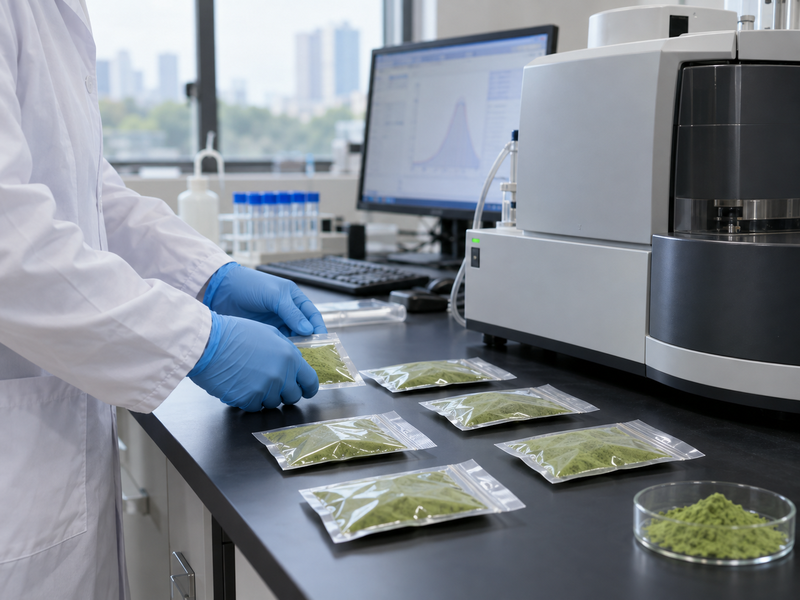
For a volume-weighted distribution, Dv10, Dv50 and Dv90 identify diameters below which ten, fifty and ninety percent of the measured particle volume lies. Dv50 is the volume median; it is not the maximum particle size. Malvern Panalytical’s particle characterization guide explains these percentiles.
Ask the supplier to write the full statistic and unit instead of reporting an unlabeled average. A buyer receiving D50 from one laboratory and a different type of mean from another should pause the comparison until the methods are clear. Keep the plot axes and report legend when forwarding a result to development.
If the supplier reports only a median, explain why the team also wants information about the distribution. The request should follow the application concern rather than a belief that more numbers always improve a specification. A technical reviewer can decide which summaries are useful after examining the full data and the trial results. Purchasing should avoid turning each available statistic into a contractual limit without evidence that the limit controls a relevant product outcome.
3. How do reporting bases change the comparison?
Keep unlike statistics in separate columns
A number-weighted result and a volume-weighted result describe the sample differently. HORIBA distinguishes Dn50, Dv50 and Ds50 for number, volume and surface distributions, and notes that mean, median and mode need not coincide. Its distribution calculation guide explains the terminology.
Create a report intake sheet that preserves the laboratory’s notation. Ask whether the reported value was directly produced by the method or converted by software, and keep the explanation with the data. Avoid relabeling every supplier result as average particle size for convenience. That shortcut can make different measurements appear comparable when the technical team has not established a connection.
| Report field | Buyer record | Action if unclear |
|---|---|---|
| Distribution basis | Number, volume or stated alternative | Ask laboratory to identify it |
| Summary statistic | Full name and notation | Retain original report wording |
| Units | Units on values and axes | Resolve before comparison |
| Calculation method | Laboratory procedure reference | Request technical explanation |
Use a separate comparison column only after the responsible reviewer confirms that the results answer the same question.

4. Which sample preparation details belong in the report?
Ask what happened before measurement
Request the laboratory’s preparation procedure, including whether it measured dry material or a dispersion. Ask how it selected a test portion, what equipment prepared the sample and which treatment settings it recorded. Where liquids or other preparation materials are used, identify them. The buyer needs a method that can be repeated when a shipment result becomes disputed.
Tell the laboratory whether the concern involves the delivered powder’s handling state or another defined material state. Ask how its preparation affects that question. An aggressive preparation chosen for one analytical objective may not resemble the buyer’s normal mixing step. The laboratory should explain the scope of its result rather than leaving purchasing to interpret it as a direct simulation of production.
Agree how the laboratory will document clumps, unusual sample behavior and preparation departures. Keep those observations with the result even when a repeat measurement is performed. The technical team can then decide whether the distribution difference comes from the material, the preparation or an unresolved combination. Do not ask operators to alter preparation settings until a lot meets the desired purchasing number.
5. How should the buyer choose a representative test portion?
Link the result to the material sampled
Define the lot and the purpose of sampling with quality and the laboratory. A supplier’s demonstration jar may be suitable for early development, but it does not automatically represent every container in a commercial delivery. Request the sampling record and identify who selected the material. Keep the source container and sample date with the laboratory submission.
Ask the laboratory how much material it needs for the planned work and any repeat measurements. Reserve separate portions for the buyer and supplier when a comparison is part of the agreement. Handle and pack them under an agreed plan so the parties can review their histories if results diverge.
| Sample type | Appropriate question | Identity needed |
|---|---|---|
| Development sample | Is this candidate worth an application trial? | Sample code and supplier product |
| Identified production lot | Does this lot meet the agreed method? | Lot and sampling record |
| Dispute portion | Can laboratories compare the same material? | Custody, seal and portion identity |
Avoid prescribing a universal number of bags to sample. The quality team should choose a plan suited to the material, delivery and decision, with its limitations documented.
6. How do distribution results connect to beverage performance?
Pair laboratory evidence with the actual recipe
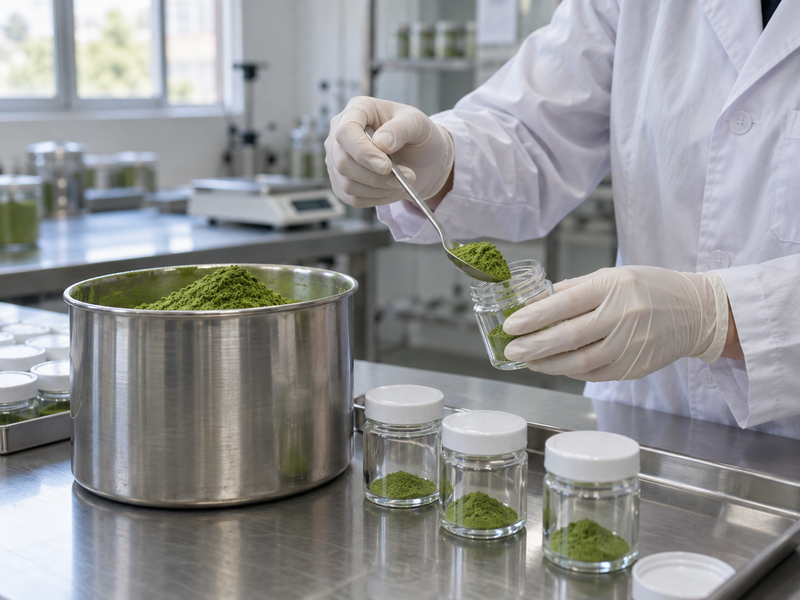
Prepare identified powders in the beverage recipe the business intends to sell. Record base ingredients, matcha dose, addition sequence, mixing equipment and observation times. Describe any perceived particles or visible residue using the team’s agreed terms. A laboratory number becomes more useful when development can compare it with repeatable product observations.
Keep ingredient and process changes separate during the comparison. If the candidate receives a longer mixing step than the reference, record that as a process adjustment and assess whether production can accept it. Do not label the powders interchangeable when one requires an undocumented preparation change. A supplier may help propose an adjustment, but the buyer should approve it in the intended process.
Retain results that challenge the expected relationship. If powders with similar reported values behave differently, ask what other material or method information the investigation needs. If a coarser reported candidate works satisfactorily, examine the evidence before assuming a finer number has greater commercial value. The buying decision should reflect the required drink, service routine and available production controls.
7. What should confectionery or bakery trials record?
Describe the point of addition and evaluation
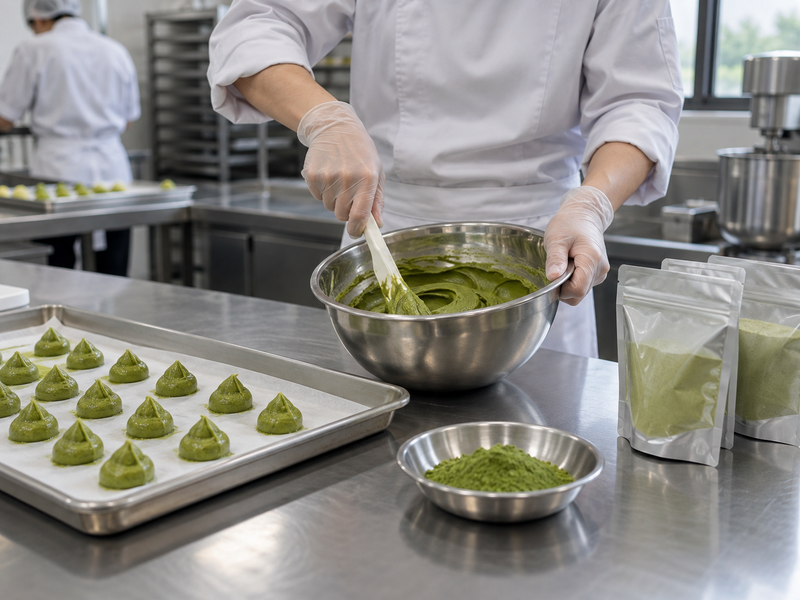
Tell the supplier how matcha enters the process and where development will assess it. A dry blend, a fat-containing filling and a batter are different trial contexts. Record the approved formula and the actual production steps so the team can investigate a difference without guessing whether the ingredient or the process changed.
Choose observations that operators can reproduce. These might include visible uniformity at a defined stage, the need for additional mixing or a sensory comment about the finished texture. Treat them as proposed trial observations, not as guaranteed consequences of a particular particle size. The process team should decide which observations are meaningful for its equipment and food.
| Trial stage | Record | Purchasing implication |
|---|---|---|
| Ingredient addition | Sequence and equipment | Confirms intended use |
| Intermediate product | Defined appearance or handling observation | Identifies process questions |
| Finished product | Coded sensory and visual assessment | Supports application approval |
Keep a failed application result attached to the candidate’s report. A technically neat distribution plot does not cancel a documented problem in the product the buyer must manufacture.
8. How should a particle specification be negotiated?
Approve the method before the limit
Send the supplier the application evidence and explain which distribution features the technical team believes deserve control. Ask whether the proposed method is available for routine lot release and what the supplier can report consistently. A development test performed once at an outside laboratory may need a different commercial arrangement from an established routine check.
Include method identity, sample preparation, reporting basis, required statistics and a rule for results near the boundary. Have the responsible specialist review repeatability and uncertainty before purchasing agrees a tight tolerance. A numerical limit without that review can create repeated disputes while contributing little to product consistency.
Keep the scope narrow enough to administer. The specification may need selected parameters plus periodic distribution review, or another arrangement justified by the application work. Do not copy a universal micron requirement from a glossary or grade description. Use the matcha certificate of analysis guide to organize the report fields and lot connection, then attach the agreed particle method as a controlled technical document.
9. What should happen when laboratories disagree?
Compare records before commissioning more tests
Collect both complete reports, sample histories and preparation procedures. Check whether the laboratories measured portions from the same lot and used comparable methods. Confirm the distribution basis and the meaning of every statistic under discussion. A mismatch in notation is a document issue that further testing may not solve.
If the methods appear comparable, ask the laboratories to propose a joint investigation using agreed portions. Preserve original results and document the reason for new work. Agree who will interpret the comparison and how the commercial stock remains controlled while the issue is open.
| Possible disagreement | Immediate check | Escalation route |
|---|---|---|
| Different D50 values | Basis, units and preparation | Laboratory method review |
| Unexpected large-particle region | Sample and preparation observations | Agreed repeat investigation |
| Report passes but application fails | Recipe and process records | Development and production trial |
Decide whether the contract needs a referee laboratory or a named reference procedure. Purchasing should understand the cost and timing of that route before a delivery is waiting for release.
10. What should the next technical request contain?
Ask for a report that supports a decision
Prepare a request naming the intended food, current process concern and relevant sample identity. Ask for the complete distribution report, method reference, sample preparation and explanation of the reported statistics. Tell the supplier whether the work supports development, a lot release or a dispute so its technical team can scope the response.
Attach the buyer’s application trial plan and request enough identified material to complete it. Keep the instrument report separate from the trial record, then review them together. Ask the supplier to identify any changes in material or method that would require another comparison before routine supply resumes.
For the next candidate, appoint one technical reviewer to reconcile the terminology before samples reach the kitchen or production line. Have that reviewer agree the preparation method with the laboratory, then run the defined application trial. Purchasing can use the resulting evidence to propose a specification that states exactly what will be measured and how the delivered lot will be judged.
FAQ
Q1: Does a stone-milled description establish particle size?
A process description does not supply the lot’s distribution report. Ask for the measurement method and identified sample results, then assess the material in the intended application.
Q2: Is the smallest median always the best purchase?
Choose according to the product requirements and comparable evidence. A median alone does not settle sensory fit, process suitability, price or the quality of the supplier’s reporting.
Q3: Can mesh terminology replace a distribution report?
Ask what the stated mesh claim means and how it was determined. Do not convert it into an instrument-derived distribution without a technical basis agreed by the responsible laboratory.
Q4: Should a café buy its own particle analyzer?
Define the decision and expected use first. An external laboratory and controlled preparation trials may answer the purchasing question; equipment ownership also requires competent operation and method management.
Q5: Can old reports support a new shipment?
They can provide history, but the buyer should understand which lot was measured and what current-lot evidence the agreement requires. Preserve dates and lot identities when presenting historical data.