
A matcha galette des rois can become a costly January special if filling escapes the edge, puff pastry rises unevenly or the green almond layer disappears in a thick slice. A bakery needs a controlled trial before accepting seasonal orders. Weigh the frangipane, protect the lamination, check the seal and count clean portions. The Tashcakes reference recipe combines matcha almond filling with two ready-made pastry discs. The plan below turns that home method into a repeatable bakery test without treating its times or weights as universal specifications.
Contents
- 1. What should the seasonal galette promise?
- 2. How should the first matcha frangipane be weighed?
- 3. Which pastry format protects the layers?
- 4. How much filling belongs inside each disc?
- 5. How can the rim be sealed without crushing it?
- 6. What scoring and venting should be tested?
- 7. How should the bakery judge the bake?
- 8. How can slices remain clean and saleable?
- 9. Which ingredient and seasonal controls matter?
- 10. What belongs in the January production sheet?
1. What should the seasonal galette promise?
Define a sellable slice before the first bake
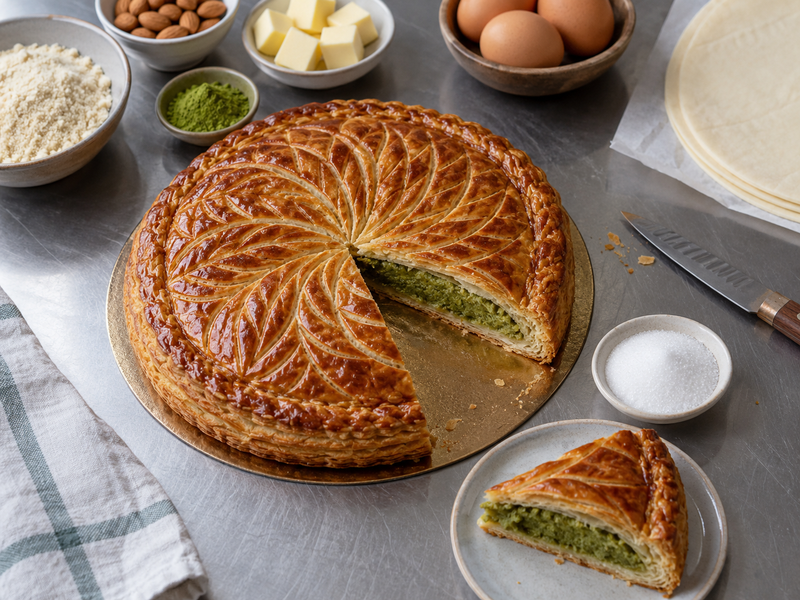
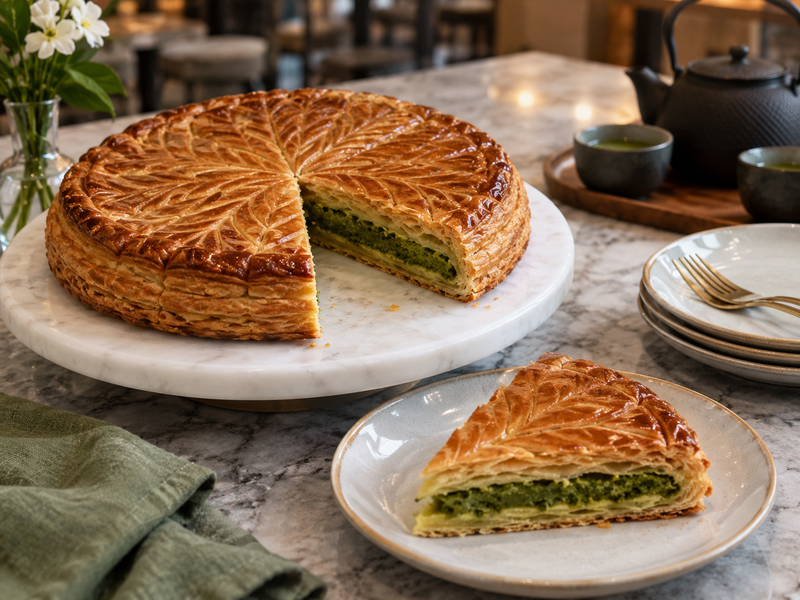
Choose the finished diameter, planned slice count and presentation for the January menu. A whole galette sold by pre-order needs a different carton and handling test from wedges sold in a pastry case. The cut should reveal a clear almond layer with visible matcha color, while the base remains cooked and the rim visibly laminated. Photograph a passing whole galette and a center slice under case lighting. A pastry can look tall from above while its bottom stays damp beneath a heavy filling.
The Tashcakes recipe describes the Epiphany pastry with puff pastry and frangipane, then uses a matcha version of the almond filling. That gives a recognizable product structure. For a commercial special, decide whether to include a hidden fève or nut only after reviewing local food, packaging and customer communication requirements. A bakery can sell the same pastry without a hidden object. Have a tasting panel score almond, tea, sweetness, flake and slice handling. Those observations establish the shop’s target, not a formal standard for galette des rois.
| Finished check | Pilot measure | Reject signal |
|---|---|---|
| Diameter | Cooled centimeters | Uneven outline |
| Rim | Lift and visible layers | Compressed or burst edge |
| Filling | Cut thickness | Hollow or leaking center |
| Portion | Saleable slice count | Crushed point or wet base |
2. How should the first matcha frangipane be weighed?
Build a gram-based filling record
The reference uses butter, sugar, egg, ground almond and sifted matcha, with almond extract and sake. Weigh those components for a pilot rather than relying on spoon volume for the tea. Record butter condition, egg mass, almond meal supplier and the mixed filling’s total weight. A different almond grind or butter temperature changes piping behavior, which then affects the border and bake. If the bakery does not use sake, remove it as a distinct formula variation rather than pretending another liquid is equivalent.
Run two matcha doses at the same filling weight. An initial test could compare 1% and 2% powder against almond meal mass. These are proposed trial points, not published standards. Keep the sugar and pastry constant. Pipe small sample rings or complete small galettes, then taste after full cooling. Photograph the cut face because a vivid raw cream can dull during baking. Ask matcha suppliers for lot-coded samples and ingredient information. Compare powder cost per saleable slice at the tested dose; a higher-cost tea may still be acceptable in a seasonal item if it gives a cleaner flavor after baking.
| Filling entry | Record | Decision use |
|---|---|---|
| Almond meal | Grams and lot | Explains texture |
| Egg and butter | Grams and condition | Tracks pipeability |
| Matcha | Grams per batch | Repeats flavor and color |
| Finished filling | Total grams | Sets deposit per galette |
3. Which pastry format protects the layers?
Handle two discs as measured components
Ready-made all-butter puff pastry, as used in the reference, can speed a seasonal special, but its sheet thickness and dimensions vary by supplier. Record brand, lot, sheet thickness and usable area before cutting. Keep pastry at a handling condition where it bends without cracking yet does not smear fat across the bench. Work with one disc at a time and return unused sheets to the approved storage condition. If the team rolls a sheet thinner, measure the final thickness at several points rather than describing it as “lightly rolled.”
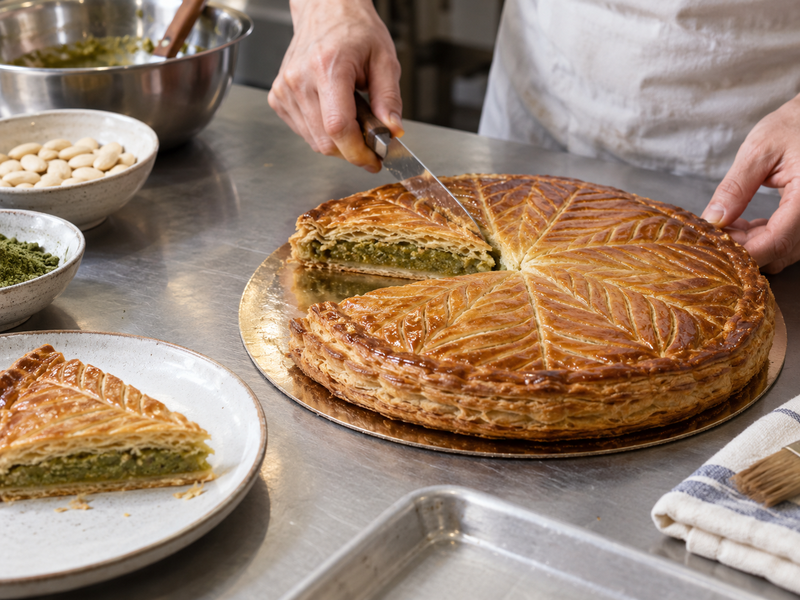
Cut the top and bottom to the same intended diameter, then weigh trim. A distorted disc can pull the seal open even when filling weight is correct. Mark the center and place the bottom disc on the final baking surface before depositing filling; lifting a loaded galette risks stretching the base. The reference uses two roughly eight-inch circles. A bakery may choose another size, but it should test the carton, oven tray and number of saleable slices together. Photograph an unfilled pair of discs so operators can see acceptable roundness and edge condition.
4. How much filling belongs inside each disc?
Set a deposit with a clear border
Pipe a measured spiral of frangipane onto the bottom disc, stopping before the rim. The Tashcakes method leaves a broad water-brushed perimeter around its roughly eight-inch disc. For a bakery test, record both filling grams and unfilled border width in millimeters. Compare a lower and higher deposit on discs with identical diameter and thickness. Weigh filling left in the bag and any paste that escapes onto the tray. More filling may improve the cut photograph yet reduce lift or create a damp base.
Before closing the top, spread the filling to a level thickness without dragging it into the seal. A dome in the center can push the top disc out of alignment. After baking and cooling, cut both versions at the same angle. Measure the almond layer at center and near the inner rim, then score taste and pastry texture. A thin outer filling band can make edge slices seem empty; an overfilled band can leak. Choose a deposit that gives consistent slices across the circle, not only a generous center wedge.
| Deposit trial | Record before bake | Observe after bake |
|---|---|---|
| Lower weight | Filling grams and border | Center thickness and lift |
| Higher weight | Filling grams and border | Leaks and base texture |
| Bag residue | Grams | Actual ingredient usage |
| Tray loss | Grams | Seal or deposit failure |
5. How can the rim be sealed without crushing it?
Keep filling away from the contact surface
Brush the perimeter according to the chosen dough method, then place the top disc without stretching it across the filling. Align edges, press around the filling to remove trapped air and seal the outer rim with controlled pressure. The reference uses water at the perimeter and a scalloped edge. Its decorative approach can be tested in production, but a deep cut into the laminated edge may limit lift. Mark a short trial section for each sealing pattern and compare how the baked edges rise.
Photograph the raw rim before baking. Note any spot where egg wash, filling or extra flour contaminates the joining surfaces. A leak after baking may begin as a small filled gap that was invisible once the top was glazed. If hand sealing varies between workers, use a simple measured guide for border width and pressure location. Test a full batch with the second operator; a method that takes one expert several minutes per galette may fail during a January pre-order rush. Count all opened rims by location and link them to the operator and tray.
6. What scoring and venting should be tested?
Let decoration support a controlled bake
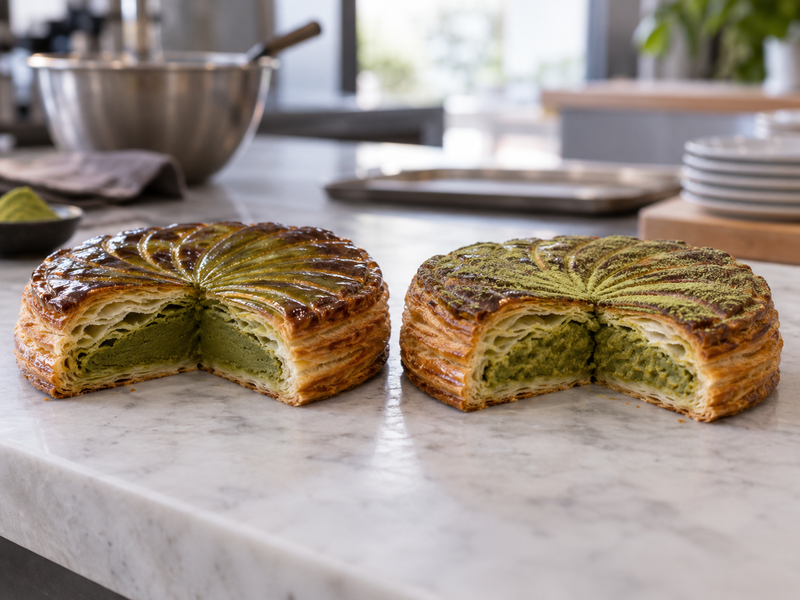
The reference glazes the top and scores a pattern before baking. For a bakery, decide the depth and layout that staff can repeat without cutting through the top sheet. Compare a shallow decorative score with the shop’s usual galette pattern, leaving filling deposit and disc size unchanged. Include an intentional vent method in the trial so expanding steam has a predictable route. Record the number and placement of vents, then photograph the top after baking. A scored line that exposes filling can stain or leak.
Keep egg wash off the cut edge if the chosen pastry method calls for exposed layers. Test one wash layer and two thin layers only if both can be applied without pooling at the rim. Color should be judged alongside base bake and filling set; a deeply golden top does not prove the center is ready. Write down scoring tool, pressure and time per galette. If a decorative pattern costs labor without improving the saleable piece, simplify it. The final pattern should survive packaging and still identify the product in the case.
| Top treatment | Measure | Failure signal |
|---|---|---|
| Score depth | Tool and sample photo | Cuts through pastry |
| Vent placement | Count and position | Random burst elsewhere |
| Wash | Deposit or method | Pooled sealed edge |
| Finished top | Color photo | Patchy or burnt pattern |
7. How should the bakery judge the bake?
Evaluate top, base and filling together
Tashcakes bakes its eight-inch example at 180°C for roughly 25–30 minutes and cools it before slicing. Those numbers describe that recipe, not a bakery standard. Record oven setting, preheat, tray material, load, bake duration and position. If the top browns early, check whether the base and almond layer are ready before removing the tray. The pastry should show lift at the rim and a cooked underside; matcha in the filling may lose brightness as bake time increases, so taste and texture still matter.
Cool every test for a fixed period before cutting. Compare the center and an edge slice for filling texture, base crispness and even lift. If the base is pale while the top is dark, consider tray position or baking surface in the next trial. If filling seeps, compare deposit and seal before extending the bake. Photograph each tray from above and below and annotate the batch code. Full production loads can change oven recovery, so confirm the selected endpoint with the planned number of galettes, not a lone test pastry.
8. How can slices remain clean and saleable?
Cut at a repeatable cooling point
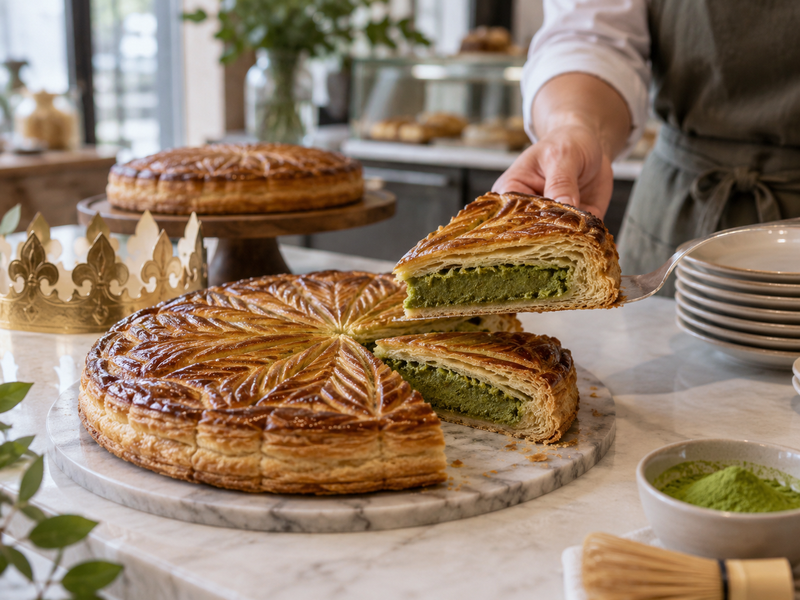
Specify the number of wedges and a cutting pattern before packaging. Cut a fully cooled galette with a sharp blade, using controlled pressure so the top layers do not crush into the filling. Wipe the blade between cuts when almond filling smears. Compare eight and ten slices only if both fit the shop’s portion price and plate. A narrow point can break even when its outer crust is sound. Count every saleable wedge, damaged point and slice with exposed filling loss.
Transfer wedges into the actual service plate or carton. Look for flakes shed during the handoff, a weak base and filling that drags out with the knife. If the whole pastry is sold, rehearse lifting it into the carton and opening it at the counter. Photograph the final arrangement rather than only the baker’s cutting board. Calculate ingredient cost per saleable wedge using real trim and rejects. Seasonal orders can hide waste when every pastry is treated as a beautiful whole; the slice count shows whether the process supports the promised menu portion.
| Slice record | Unit | Use |
|---|---|---|
| Planned versus saleable | Wedges | True yield |
| Trim and broken points | Grams or count | Process improvement |
| Pack damage | Count | Carton choice |
| Portion mass | Grams | Menu consistency |
9. Which ingredient and seasonal controls matter?
Make the January offer operational
Almond, wheat, milk and egg are common ingredients in this pastry. The FDA identifies tree nuts, wheat, milk and egg as major allergens in the United States. Review the actual pastry, almond meal, flavoring, wash and matcha documents for the market where the galette will sell. A hidden nut or fève adds customer communication and operational questions; obtain local advice before including one. Do not assume the traditional feature is suitable for every retailer or packaged product.
Forecast pre-orders and walk-in demand separately. Reserve pastry and almond meal by supplier lot, define a cut-off for orders and record a production buffer based on the observed reject rate. Have the business’s food-safety lead approve handling, storage and service for the final formula. A successful appearance trial cannot establish shelf life. For a limited January offer, a simple production sheet with dates, lot codes and approved substitutions prevents a rushed second week from becoming a different product. Train counter staff on ingredients, portion count and whether any hidden object is present.
10. What belongs in the January production sheet?
Write instructions in the order of work
The final sheet should list pastry supplier, sheet thickness, disc diameter, trim allowance, frangipane formula, matcha grams, deposit weight, clear border, sealing method, vent and score pattern, wash, oven setting, cooling point, cutting pattern and carton. Include photographs of a passing raw seal, whole baked top, underside and center slice. Record batch codes and who approves a changed pastry or matcha lot. Keep allergen and hidden-object decisions visible to the counter team.
Ask a second baker to make a full batch from the sheet. Compare rim lift, leaks, filling thickness, color and saleable slices with the approved pilot. If a new tea powder is offered, bake it in the finished frangipane at the selected dose before buying. Matcha Village can discuss sample and bulk grade options, but the bakery should place an order against its tested flavor and cost target. The last practical gate is a packed, cut and served galette from a normal production load, with its losses included in the seasonal price.
Compare powder options using the matcha powder for baking guide before locking the galette formula.
FAQ
Q1: Can culinary matcha work in galette des rois? Yes. Bake candidate powders in the almond filling at equal dose and judge tea flavor, color and slice cost.
Q2: Why does the edge leak? Check border width, filling weight, clean contact surfaces and the raw seal before changing oven time.
Q3: Does the galette need a hidden fève? That is a product and local compliance decision. A bakery can offer a galette without one.
Q4: How many slices should a bakery promise? Test the intended diameter and count saleable wedges after cooling, cutting and packing.
Q5: Can a home recipe’s bake time scale directly? No. Confirm the endpoint with the shop’s pastry, pan, oven load and filling deposit.