
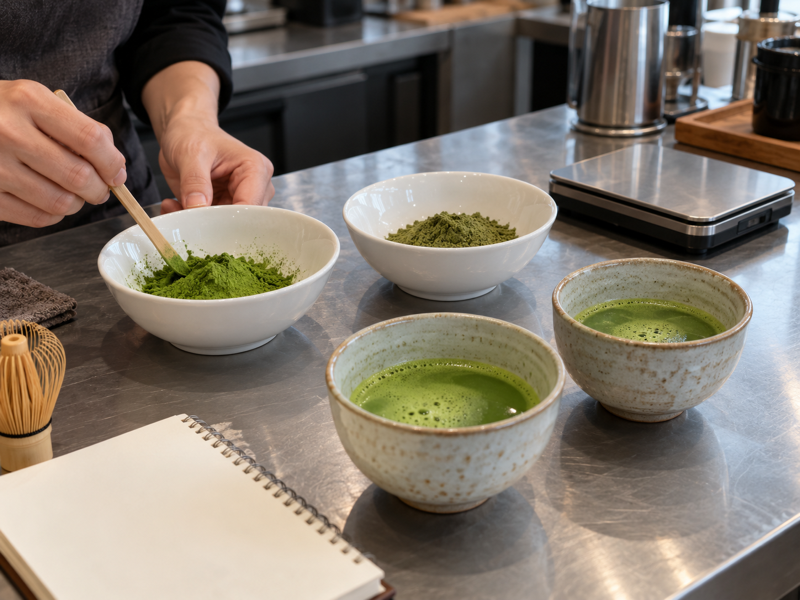
Buying matcha for a cafe starts with the drink you intend to sell. A powder can look excellent in water and disappear under oat milk. Another can produce a strong green cup but leave a dry, bitter finish after ice melts. Both may be sold as “premium.” A café buyer needs samples, a fixed recipe, an objective record, and a supplier who can repeat an approved lot. This guide gives operators a buying test that ties flavor and color to dose, service time, cost per cup, and documentation.
Contents
- 1. What does “matcha for cafe” need to do?
- 2. How should a cafe compare samples fairly?
- 3. Which matcha properties matter in milk?
- 4. How much powder should a recipe use?
- 5. What should a supplier specification show?
- 6. Should the cafe buy ceremonial or culinary grade?
- 7. How should a buyer calculate real cost per cup?
- 8. How can a cafe reduce variation between baristas?
- 9. When should a cafe approve a second source?
- 10. What should a cafe ask for in a sample request?
1. What does “matcha for cafe” need to do?
Foodservice matcha must perform in the actual drink and during the actual shift. For a plain latte, that means tea flavor remains recognizable after milk and sweetener. For a straight tea, it means a smooth cup at the intended dose and water temperature. For a busy counter, it means powder can be measured and dispersed without a long queue or visible clumps. Those jobs can point to different products, even when both are called matcha.
Write a use brief before contacting suppliers. Include cup size, dairy and plant milk SKUs, sweetness, target color, expected weekly volume, packaging preference, and the price range your menu can support. Ask the supplier to nominate samples for that use. A buyer who asks only for the “best grade” receives a label, not a decision. The use brief also prevents the tasting team from changing recipe variables to make a favorite sample win.
| Use case | Primary test | Typical failure |
|---|---|---|
| Straight matcha | Flavor in water | Harshness or graininess |
| Plain latte | Tea through milk | Flavor disappears |
| Sweet flavored drink | Tea after syrup | Only sugar is recognizable |
| Iced service | Color and taste after ice | Dilution flattens the cup |
2. How should a cafe compare samples fairly?
Assign each sample a code and prepare every candidate at the same powder weight, water volume, temperature, vessel, and mixing time. Use an accurate scale rather than a scoop. Taste in water first, then in the café's intended milk. Keep one cup unsweetened so syrup does not hide differences. Serve samples in identical cups and record observations before discussing price or supplier names.
A useful tasting sheet separates aroma, sweetness, umami, bitterness, astringency, color, mouthfeel, and aftertaste. Staff should write what they notice rather than choose “good” or “bad.” For example, “green aroma remains after oat milk, but astringency rises after three minutes” gives the product team something to test. Repeat promising samples on another day. A single tasting can be distorted by preparation errors, fatigue, or a milk carton from a different batch.
3. Which matcha properties matter in milk?
Milk changes the test. Fat and protein soften some edges, while a sweet plant drink can make an already sweet premix feel flat. A dark green powder does not guarantee a balanced latte, and a subtle straight tea may need more powder to register in a large cup. Compare each candidate at a fixed finished drink weight, then adjust dose only after a fair baseline. Record the dose at which tea remains clear without adding excessive bitterness.
Check foam and settling, especially if the drink will be photographed in a transparent cup. Fine particles can collect at the bottom during a normal handoff or delivery wait. Prepare hot and iced versions separately: ice changes dilution and perceived sweetness. Do not hide a problem by turning every sample into a different recipe. If one product needs twice the dose of another, include that fact in both cost and preparation records.
| Observation | Where to check | Follow-up question |
|---|---|---|
| Tea intensity | After milk is added | Is dose practical? |
| Color stability | At pour and after wait | Does the cup still look appetizing? |
| Sediment | Clear cup bottom | Can mixing method control it? |
| Bitterness | Finish after swallowing | Is it powder, dose, or water? |
| Foam | Chosen milk SKU | Does texture match the menu? |
4. How much powder should a recipe use?
Use a measured pilot rather than a universal gram claim. Choose one serving size and prepare three dose levels around the supplier's suggested range. Keep milk and water fixed. Taste each cup shortly after preparation and after the normal customer wait. Select the lowest dose that still delivers the intended tea character, then check whether a higher dose improves the drink enough to justify its cost and bitterness.
Weigh what staff actually use during an uncoached shift. A rounded spoonful can vary by operator, humidity, and how the powder settles. If the final recipe uses a scoop, calibrate the scoop against a scale and spot-check it regularly. For a powder dispenser, test whether it jams or leaves dust. Recipe cost should use the weighed dose plus normal waste, not an idealized laboratory number.
5. What should a supplier specification show?
A usable specification identifies the product, ingredients, lot, storage guidance, packaging size, and any required food safety or regulatory documents for your market. Ask how quality is checked between lots and how a complaint is handled. If the supplier offers flavored or sweetened blends, request the full composition and confirm whether a menu description and allergen statement need to change. “Matcha powder” is not enough information when the bag contains other ingredients.
Check practical supply terms too: minimum order quantity, lead time, shipping conditions, shelf life, and available package sizes. A one-kilogram pouch may fit a small pilot but be awkward for a high-volume chain. A very large opened bag can raise exposure to air and moisture. Ask for a packaging format that matches expected use and storage. Record the approved lot so a future color or taste shift can be compared against evidence.
| Document or term | What to verify | Why it matters |
|---|---|---|
| Ingredient declaration | Matcha alone or a blend | Menu and allergen accuracy |
| Lot identifier | Traceable code on each case | Complaint investigation |
| Storage guidance | Unopened and opened handling | Consistent flavor and color |
| Lead time | Normal and peak periods | Reorder point |
| Complaint process | Sample, credit, replacement | Operational continuity |
6. Should the cafe buy ceremonial or culinary grade?
Grade words are a starting description, not a controlled global buying standard. Different suppliers use them differently. Ask for the product's intended use and taste it in that use. A delicate powder may suit straight tea but vanish in a sweet 16-ounce latte. Another can be less appealing neat yet perform well with milk. The decision belongs to the finished cup and supplier documentation.
Avoid paying for a label that customers cannot detect in your recipe. Equally, avoid choosing the cheapest bag if it forces a high dose or a lot of syrup. Taste at the actual serving price and ask customers what they would reorder. If the café offers both straight tea and flavored lattes, it may need two specifications. That is an operational choice, not a hierarchy of virtue. Store and label both clearly so staff cannot switch them by accident.
7. How should a buyer calculate real cost per cup?
Start with the invoice price of usable powder and the recipe dose. Add freight, import costs when relevant, expected waste, and the cost of a replacement cup when powder clumps or flavor fails. A 10% price difference per kilogram may be small next to dose differences, milk, packaging, and labor. Create the calculation for the chosen drink, not for a theoretical ingredient.
Example: if one candidate needs 3 grams and another needs 4 grams for an equally strong latte, compare those costs directly. The numbers are only an illustration; your own sensory panel must choose the acceptable dose. Then ask whether preparation time differs. A powder that mixes rapidly may save seconds at a busy counter, while one that leaves residue may increase cleaning time. Both effects are real only after you measure them under service conditions.
| Cost line | Calculation | Record source |
|---|---|---|
| Powder | Dose × delivered price per gram | Recipe and invoice |
| Waste | Opened or spilled grams per period | Stock count |
| Milk and flavor | Actual poured amount | Recipe trial |
| Packaging | Cup, lid, sleeve | Supplier quote |
| Labor | Timed preparation | Pilot shift |
8. How can a cafe reduce variation between baristas?
Turn the winning sample into a recipe card with a weighed dose, water amount, mixing order, milk SKU, cup size, ice weight, and visual checks. Use the same tools across shifts. Train staff with a reference cup and let them make several drinks without coaching. If two baristas produce different results, find the variable: spoon size, water temperature, mix time, or overpour.
Store powder away from heat, steam, and frequent opening. Label opened packs with the date and use the supplier's handling instructions. For chains, document the product code and approved substitute. A new lot should be checked against a retained sample in the same recipe before it rolls through every store. Variation can come from the supplier, but it can also come from a changed milk SKU or a poorly calibrated scale.
9. When should a cafe approve a second source?
A second source helps when a product is unavailable, but it is not interchangeable until tested. Run the same straight and milk trials on the backup. Record the dose needed to reach the house flavor and whether color or texture differs. If the backup requires a recipe adjustment, write a separate card and specify who may authorize a switch. The point is to keep an emergency plan from changing the cup silently.
Check documents and logistics for the backup as carefully as for the primary supplier. A small sample can pass while the available package size or lead time fails operationally. Avoid telling staff that one green powder “is close enough.” A recurring customer may notice. If a temporary substitution changes the menu's ingredient claim or allergen information, update customer-facing material before service.
| Approval stage | Evidence | Decision |
|---|---|---|
| Sensory | Blind straight and latte tasting | Accept or reject |
| Recipe | Measured dose and mixing method | Card for each source |
| Documents | Specification and lot traceability | Compliance check |
| Supply | Capacity, lead time, pack format | Reorder rule |
| Store trial | Shift test with regular staff | Release or revise |
10. What should a cafe ask for in a sample request?
Send the supplier a precise brief: intended drinks, milk types, serving size, target sweetness, estimated monthly use, destination market, and required documents. Request at least two suitable samples with product codes and current specifications. Ask how the samples relate to production stock and whether the same material can be supplied at scale. Keep the conversation about performance rather than broad quality adjectives.
After testing, return useful feedback. “Sample B held its tea flavor in oat milk at our target dose, but left sediment after ten minutes” is more actionable than “we prefer B.” Ask for a revised sample only when the change has a defined purpose. Matcha Village can discuss B2B matcha and latte product options, but the café should still sign off on its own cup, written spec, and supply terms before ordering.
FAQ
Q1: Can a cafe use one matcha for every drink?
Yes if it passes every intended recipe. Test straight tea, hot latte, iced latte, and sweet variants separately.
Q2: Is brighter green always better?
No. Color is one attribute. Taste, dose, consistency, and supply terms also affect the finished drink.
Q3: Should samples be tasted with sugar?
Taste without sugar first, then in the recipe that customers will buy. Sweetness can mask faults.
Q4: What is the minimum supplier paperwork?
Ask for a current specification, ingredient declaration, lot identification, storage guidance, and documents required in your market.
Q5: How often should a cafe retest matcha?
Check every new lot against an approved reference when consistency matters, and retest any recipe after a milk or process change.
Related reading: matcha powder for cafes and A Guide to New York City's Matcha Cafes.