
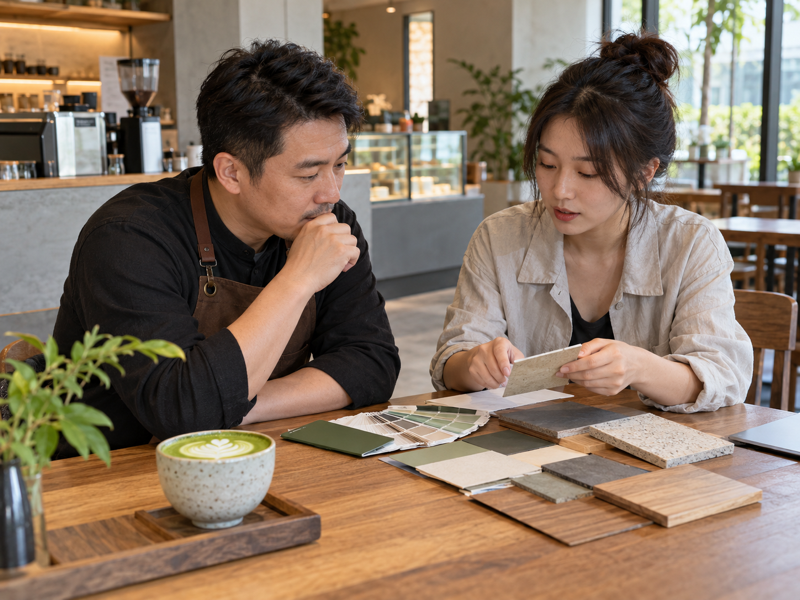
A matcha cafe name appears on more than a sign. People need to say it at the counter, find it on a map, read it on a cup, and remember it when recommending a drink. A clever name that works only in a designer's presentation can fail all four tasks. Operators also need room to add products beyond a single latte and must check whether a name is legally available in the markets where they trade. This guide gives a practical way to shortlist matcha cafe names and test them before printing menus or buying a domain.
Contents
- 1. What job should a matcha cafe name do?
- 2. Should the word matcha appear in the name?
- 3. How can a team generate useful candidates?
- 4. Which names should be removed early?
- 5. How should a shortlist be tested with customers?
- 6. What checks belong in legal and digital review?
- 7. Will the name fit menus, cups, and packaging?
- 8. How can a name support a broader menu?
- 9. What should a naming decision record include?
- 10. When is a name ready to launch?
1. What job should a matcha cafe name do?
A good name helps the right customer recognize and remember the business. It does not need to explain the full concept by itself; the descriptor, menu, and storefront can help. Decide what the name must carry. A neighborhood café may value easy pronunciation and a clear location. A packaged matcha brand with a café may need a name that works on pouches and wholesale invoices. Those are different jobs.
Write a one-sentence positioning statement before brainstorming. For example, “A quick-service tea bar for unsweetened matcha and simple milk drinks near an office district” gives a usable filter. A playful dessert name might be wrong for that plan even if staff like it. The test is whether a customer can recall the name after one visit and whether employees can say it clearly over a noisy counter.
| Naming job | Test | Warning sign |
|---|---|---|
| Remembered | Ask after a short delay | Customers recall only “the green place” |
| Spoken | Order by phone or in a crowd | Staff keep repeating it |
| Found | Search maps and web | Many unrelated close matches |
| Extended | Put it on a cup and pouch | Works only for a single drink |
2. Should the word matcha appear in the name?
Including “matcha” tells a customer what the business serves. It can also make the name less flexible if the café later becomes a broader tea or food brand. Leaving it out may create a more distinctive mark but requires stronger signs, menu language, and search profiles so newcomers understand the offer. Neither approach is automatically better. Test both against the concept and likely future product range.
Make two shortlist columns: names with matcha and names without it. Add a plain descriptor under each candidate, such as “matcha café” or “tea and latte bar.” Ask unfamiliar people what they think each business sells. If a name without matcha repeatedly suggests a florist or beauty studio, it needs clearer context. If a name with matcha feels like every competitor nearby, it needs a more distinctive element. The aim is clarity without becoming generic.
3. How can a team generate useful candidates?
Start with words linked to the actual experience: preparation, color, taste, service pace, neighborhood, and the feeling of the space. Keep a separate list of words you cannot honestly support. “Kyoto” and “Uji” imply a geographic connection that should be verified. A café sourcing from several places should not build its identity around an origin claim it cannot maintain.
Brainstorm in small rounds, then remove candidates that are hard to spell or say. Avoid filling a wall with hundreds of random combinations. Ten names with a reason behind them are more useful than two hundred invented words. Ask who the business is for and what the name will need to look like in small print on a receipt. Names built only for a large logo often collapse when used in a search result or delivery app listing.
| Source of ideas | Useful prompt | Check |
|---|---|---|
| Product | What is distinctive about the cup? | Does the name overpromise origin? |
| Place | What neighborhood cue is real? | Will expansion make it awkward? |
| Service | Fast, quiet, seated, takeaway? | Does the name match the experience? |
| Language | What can customers pronounce? | Does meaning change elsewhere? |
| Brand story | What can staff explain in one line? | Is the story verifiable? |
4. Which names should be removed early?
Eliminate names that are too close to nearby cafés, hard to search, confusing to pronounce, or dependent on a passing joke. A word may be beautiful in one language and awkward in another. Check how it sounds when spoken by people outside the founding team. Avoid unusual spelling solely to obtain a web domain; customers may type the normal spelling and reach someone else.
Also remove names that force a product promise. If the business may serve coffee, a name that says “matcha only” might be limiting. If the café plans to sell matcha from a mainland Chinese manufacturer, a Japanese geographic name could create the wrong impression unless the product origin supports it. A name should survive honest menu descriptions and supplier changes. Brand appeal falls quickly when staff must explain why the packaging says one thing and the ingredient record says another.
5. How should a shortlist be tested with customers?
Show five candidates to people who resemble the intended customers, one at a time and without elaborate mood boards. Ask what they think the business sells, how they would pronounce the name, whether they could spell it after hearing it, and what price or service level they expect. Then wait briefly and ask which names they remember. Record the answers, including misunderstandings.
A small test cannot predict long-term sales, but it can expose avoidable friction. If several people independently misread a word, the issue is real enough to investigate. Compare candidates against the same descriptor and cup image so visual design does not rescue a weak name. The founders' favorite may still win; they should know what extra work it demands. A difficult name requires clearer signage, search listings, and staff pronunciation.
| Question | Good evidence | Action if weak |
|---|---|---|
| What is sold here? | Matcha or tea comes to mind | Add descriptor or change name |
| Can you say it? | One natural pronunciation | Simplify spelling |
| Can you find it? | Search result is identifiable | Check competing uses |
| Can you recall it? | Name survives short delay | Cut decorative words |
| Does it fit price? | Expectation matches offer | Rework tone |
6. What checks belong in legal and digital review?
Before committing, search business registries, trademark databases, domain availability, map listings, and social handles in relevant markets. Similarity matters as much as exact spelling. A name can be risky if a competing food or beverage business uses a close sound or look. These checks are screening steps, not a legal opinion. Ask a qualified adviser to review a serious candidate before making expensive commitments.
Secure practical digital assets only after the shortlist is narrow. The ideal exact-match domain is useful, but a sensible variant may work if it is clear and short. Avoid adding numbers or stray punctuation that customers will forget. Check how the name appears in a mobile search result, delivery app, and map pin. A domain is one part of a business identity; an easy-to-find café listing can matter just as much to local customers.
7. Will the name fit menus, cups, and packaging?
Mock up the shortlist on a real cup, a small label, a menu header, and a delivery receipt. Use black and white first. A name should stay legible before color or illustration helps it. Check whether staff can write it on a cup quickly and whether it is still recognizable from a distance on a storefront. Long phrases may shrink to unreadable type on a seal or pouch.
Packaging raises another issue: the brand name should not be mistaken for the ingredient description. A café may use its own brand on a retail pouch while still needing correct product name, ingredients, origin, and required local disclosures. Those details need a separate label review. Do not make a creative naming decision do the work of regulatory labeling. The supplier's product code and the customer's brand name should remain distinguishable in purchasing records.
| Surface | Space constraint | Practical test |
|---|---|---|
| Storefront | Seen from the street | Read at walking pace |
| Cup | Curved, small area | Read while held |
| Menu | Competes with item names | Scan in five seconds |
| Map listing | Truncated on phone | Recognize key words |
| Retail pouch | Needs product details too | Separate brand and ingredients |
8. How can a name support a broader menu?
Imagine the café two years from opening: matcha lattes, straight tea, hojicha, genmaicha, and perhaps packaged powder. A name that can accommodate that range is useful if expansion is part of the plan. If the business intends to remain a narrow matcha bar, a focused name can be a strength. Decide deliberately rather than following a naming trend.
Test every candidate in a sentence that a buyer or customer might use: “We order from…,” “Meet me at…,” and “This pouch is from….” Some names work socially but sound strange on a wholesale invoice. Others sound formal on a label and stiff in conversation. Matcha Village, for example, uses a broad tea-related name that can sit across B2B powder categories; a new café should make its own choice based on its actual product roadmap.
9. What should a naming decision record include?
Keep a simple decision log. List the chosen name, descriptor, target customer, pronunciation, available digital assets, legal review status, and the reasons other finalists were rejected. This protects the team from reopening the same argument every time a new investor or designer joins. It also gives the menu writer and packaging designer a consistent starting point.
Set a deadline for the decision. Endless naming sessions delay higher-impact work such as recipe testing and staff training. Once a candidate passes the main checks, test it in a short pilot sign or digital landing page if possible. Watch whether customers use the name naturally. A name can be adjusted before a full launch much more easily than after dozens of printed cups and registered accounts.
| Record field | Example evidence | Owner |
|---|---|---|
| Customer fit | Short interview notes | Founder |
| Spoken use | Pronunciation test | Store team |
| Search use | Map and domain review | Marketing |
| Rights review | Adviser and registry check | Legal |
| Application | Cup and menu mockups | Design |
10. When is a name ready to launch?
It is ready when customers can say and find it, the business can use it honestly, and professional rights checks are complete. The decision should also survive a plain black-and-white menu and an ordinary staff conversation. A beautiful logo can follow; it should not be required to explain the name.
Launch with one consistent spelling and descriptor across the storefront, website, map profile, menus, receipts, and supplier-facing material. Give staff a short answer to “What does the name mean?” if the name has a story. Keep the answer factual. Then focus on the experience that gives the name meaning: a clear menu, a reliable cup, and service customers want to repeat.
FAQ
Q1: Should a matcha cafe name be in Japanese?
Only if the meaning, pronunciation, and implied origin fit the business. Check the language with a knowledgeable speaker.
Q2: Is a matching social handle enough to use a name?
No. Check business and trademark records in relevant markets and seek professional advice before committing.
Q3: Can a cafe change its name after opening?
Yes, but signs, listings, cups, and customer memory all need updating. Early testing is cheaper.
Q4: How many candidates should a team test?
A short list of about five lets customers give useful feedback without turning the task into a memory test.
Q5: Does a name need to include “matcha” for search?
No. Clear descriptors, accurate listings, and relevant page content can explain the business, but test whether newcomers understand the offer.
Related reading: matcha powder for cafes and 200+ Café Name Ideas: Cute, Aesthetic and Unique – Loop Fans.