
Matcha food coloring appeals to bakers and beverage developers who want a green ingredient that also tastes like tea. That extra flavor is the reason to test it carefully. A pale mint frosting, a vivid chilled latte and a loaf baked at high heat cannot be judged from the same bowl of wet powder. The right question is whether a specific matcha delivers a useful color and acceptable flavor in the finished product, after normal processing and display. Work through these ten checks before changing a recipe or writing a label claim.
Contents: Goal · Food · Powder · Dose · Heat · Acid · Dispersion · Display · Label · Scale
1. What Green Are You Trying to Create?
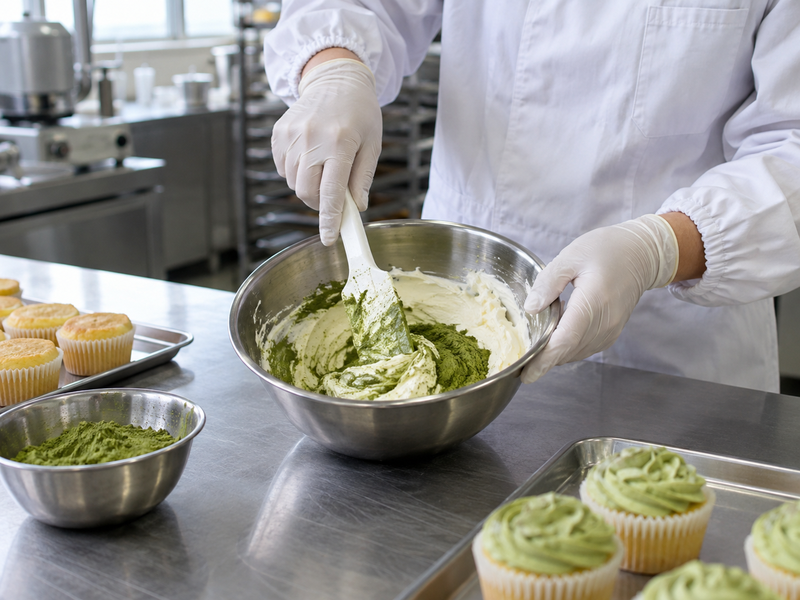
Define the reference in the final food
Put a target photograph or approved sample on the bench. “Bright green” means different things in white chocolate, milk and baked dough. Decide whether the color should read as unmistakably matcha, subtly botanical or simply a pale green accent. Matcha brings its own tea taste, so a product designed to be neutral green may not be a good fit. Compare candidates in the finished formula under the lighting customers will see. A powder can appear luminous in a tasting bowl and muted behind a brown cookie or dark bottle.
Give the team more than one acceptance point
Record color immediately after mixing, after processing and at the end of the intended display period. Use consistent sample size and lighting. Photos are useful if the camera settings and background stay the same; casual phone photos taken in different rooms are poor evidence. Include taste at each point. A more intense matcha dose may reach the chosen shade while making the food bitter. The best candidate meets both targets without forcing an unrealistic recipe change. Keep an uncolored control so the team sees what the matcha actually contributes.
| Product goal | Color check | Flavor check |
|---|---|---|
| Iced drink | After dilution and ice | End of normal serving time |
| Frosting | On the finished cake | With cake sweetness |
| Baked item | After cooling | Crumb and browned edge |
2. Which Food Will Carry the Matcha?
Match the test to the product
Frosting, dough, cream, chocolate, yogurt and drinks have different water, fat, acidity and process conditions. Matcha will not behave like a water-soluble green dye. It is finely milled leaf, so particles remain in the product. A pale dairy base often shows the green clearly; a dark, strongly flavored matrix can bury it. Choose one priority application and test that first. If the same powder must serve several products, keep separate approval notes. Do not approve a powder for bread because it looked good in a cold latte.
Decide whether tea flavor is welcome
For a matcha pastry, tea flavor is part of the appeal. For a lime candy intended to taste only of fruit, the same flavor may be an unwanted side effect. Ask the product team to rank color, tea aroma, sweetness and bitterness. If color is the only purpose and matcha taste cannot be accommodated, another lawful color approach may make more sense. When matcha is used honestly as a tea ingredient, its flavor can give the green appearance a clear product story.
3. Which Powder Should You Screen?
Compare samples blind at equal mass
Request powders suitable for the intended food process. Mix equal weights into a standard small batch and label the samples with codes. Record dry aroma and appearance, but judge color after use. A vivid premium powder can be wasted in a heavily baked product where heat changes its appearance. A foodservice grade with a stronger tea note may perform better in sweet cream. Screen two or three options, then test the best one again with a second lot. This guards against choosing a powder on a single attractive sample.
Ask for the specification
Procurement needs the exact product name, origin information where relevant, particle and sensory expectations, storage conditions and available lot documents. The product should be food grade and suitable for the proposed use. Agree with the supplier on what change would require reapproval. Matcha Village offers B2B matcha grades and blending support through its product range, but the buyer should approve any candidate in its own finished recipe. The supplier cannot predict a bakery’s oven, milk base or shop lighting from a dry powder sample.
| Supplier item | Why request it | Application decision |
|---|---|---|
| Product specification | Defines the ordered powder | Compare lots consistently |
| Sample lot identity | Ties tests to supply | Repeat the chosen result |
| Storage guidance | Protects color and aroma | Plan stock rotation |
| Ingredient declaration | Supports label review | Avoid guessing at claims |
4. How Much Matcha Can the Recipe Take?
Run a small dose ladder
Prepare three versions of the same formula with low, middle and high matcha doses. Keep all other ingredients, mixing time and process conditions fixed. Note color and flavor separately. The highest dose may be the greenest yet leave a dry, bitter finish or change texture. For baked foods, powder also adds dry matter, so a large increase may need a formula adjustment. Do not change water and sugar at the same time as matcha during the first screen.
Evaluate at serving temperature
Cold cream can mute tea aroma, while a warm filling can reveal bitterness. Taste the product as the customer will receive it. For drinks, include ice dilution and the actual cup. For pastry, include the cake or shell rather than tasting a bowl of colored cream alone. Calculate the cost per finished unit at the selected dose. Keep the selected dose in grams, not spoonfuls.
5. What Happens During Heating?
Test the real oven or process
Heat can change both green appearance and tea flavor. A photograph of raw batter says little about a baked loaf. Make a small tray with the target dose and follow the intended bake, cook or pasteurization process. Record the temperature profile and the product’s appearance after cooling. Surface browning may hide color even when the crumb remains green. Slice the product and compare its interior and edge. If the recipe needs a longer bake for food safety or texture, do not shorten it just to protect color; reconsider the application or how the matcha is placed.
Consider where the matcha goes
A post-bake glaze or filling may display matcha more clearly than a dough exposed to full oven heat. That choice changes preparation, shelf life and labeling, so test it as a complete product. For a heat-treated drink, assess the processed and stored bottle, not only the preheat blend. Keep a plain control and an approved reference beside each sample. If the green shifts to olive, tell the team plainly.
6. How Do Other Ingredients Change the Color?
Check the whole recipe
Acidic fruit, cocoa, dairy, fats and sweeteners can all change how green matcha appears and how its flavor reads. Test the actual recipe rather than a convenient water slurry. A white base may make the powder look brighter; a strongly colored ingredient may overwhelm it. Change one ingredient at a time when troubleshooting. If a lemon addition makes a drink look dull, record the dose and mixing order before adjusting. A tea-based green can be more sensitive to the food system than a dedicated color additive, so a stable-looking powder is only the start.
Watch for a flavor tradeoff
Sugar can soften bitterness but may turn a clean tea dessert into an overly sweet one. Fat can round out the taste but also make the green look paler. The best combination should suit the food’s identity, not chase a photograph. Ask a small tasting panel to describe the product without telling them which sample has the most matcha. If they say “sweet milk” rather than “matcha,” the dose or powder may be wrong even if the color looks good. Write down the formula that passed, including ingredient brands where those affect the result.
| Change | Look for | Record |
|---|---|---|
| More acid | Color shift and sharper taste | Final recipe acidity |
| More fat | Paler green and softer tea | Fat source and amount |
| More sugar | Less perceived bitterness | Total sweetness |
7. Can You Mix It Without Streaks?
Wet the powder deliberately
Dry matcha dropped into a thick frosting or cold liquid can form green specks with dry centers. Make a smooth paste or pre-dispersion using a compatible portion of the recipe, then blend it into the rest. Test the method on the equipment production will use. A laboratory high-speed blender may hide problems that appear with a bakery paddle mixer. Scrape the sides and inspect the finished food for streaks, clumps and gritty spots. In a drink, watch the bottom of the cup after a normal wait; tea particles can settle even when the first sip is smooth.
Write a mixing instruction staff can follow
Record addition order, mixing time and any temperature limits. If the recipe needs a special sieve or a second mixing stage, include the labor in the cost. Reproduce the batch on a different day with another operator. If the color depends on someone improvising the paste consistency, the process is not ready. For a distributed product, check whether the filling or pumping step separates particles. Good dispersion is visible as even color, but it also affects mouthfeel and the matcha dose in each unit.
8. Does the Color Hold Through Display?
Observe the time customers will see it
Place the finished food in its real display or package and inspect it at planned intervals. A chilled cake sits under different lighting from a sealed snack pouch. A cafe drink may spend ten minutes on a table; a pastry may remain in a case through service. Record the first point at which the color or tea aroma no longer meets the reference. Protect samples from avoidable light, heat and open air where the actual sales method allows. Do not announce a shelf life from a visual check alone; safety and quality validation are separate work.
Photograph the approved version honestly
Marketing should use a product made with the approved recipe and normal process. A photo of fresh, unheated batter is misleading if the sold cake is muted green. Compare the final product after the intended hold with the image used online. If there is a meaningful difference, adjust the image or the recipe. For multi-site operators, include a simple reference photo and acceptance note in the production guide. That lets a store report a real change rather than relying on memory of a tasting held months earlier.
| Display format | Repeat observation | Possible action |
|---|---|---|
| Open bakery case | Color and surface drying | Shorten display rotation |
| Clear cup | Settling and ice dilution | Revise mixing and service |
| Sealed pack | Light and aroma changes | Review barrier and storage |
9. How Should the Ingredient and Claim Be Reviewed?
Describe what is actually in the food
“Natural green” can sound simple, but ingredient and color claims depend on the formula and the destination market. Matcha is tea powder with flavor and color; that does not authorize every proposed labeling phrase. The FDA Food Labeling Guide addresses how vegetable powders and color-related ingredients may be declared in US foods. The FDA’s color additives information describes the separate regulatory framework for color additives. Have a qualified label reviewer assess the intended use and wording before print. Do not infer a legal classification from a competitor’s package.
Keep evidence for other claims separate
If the package says organic, Japanese origin, no artificial colors or a particular grade, ask what records support each statement. A matcha ingredient specification does not by itself prove the finished food’s organic status. A photograph of green powder does not establish the origin of every shipment. Match the claim to the approved lot and formula. If a bakery changes its base ingredients, review the label again. Precise language is easier to maintain than a broad claim that turns every supplier substitution into a crisis.
10. Can Production Repeat the Result?
Run a production-sized trial
Move from a bowl to the actual mixer, oven, depositor or filling line. Measure the matcha addition and sample units from the beginning, middle and end of the run. Check color, flavor and texture against the approved small batch. Powder distribution can be uneven in a large mix even when the complete formula is correct. Record process time, temperature, equipment and operator notes. If a larger batch looks duller, investigate the process before increasing the matcha dose. More powder could add bitterness without fixing the underlying cause.
Approve a reference and a change rule
Retain a labeled approved sample or controlled photograph and a written specification for the powder and finished food. Set a rule for what happens when a new matcha lot, ingredient brand or process condition appears. Repeat the short color and taste test when those variables change. For a brand launching multiple green products, keep separate application records even if one matcha SKU supplies them all. The best matcha food coloring choice is one the production team can repeat and the customer can recognize after a normal display period.
| Scale-up check | Sample point | Approval record |
|---|---|---|
| Mixing | Beginning and end | Even color, no clumps |
| Processing | After heat or chilling | Target appearance |
| Pack or display | End of intended hold | Flavor and color reference |
FAQ
Q1: Can matcha replace green food coloring in every recipe? No. It adds tea flavor and particles, and its color changes with the food and process. Test the specific finished product.
Q2: Will matcha stay bright green when baked? Results vary with powder, recipe, time and temperature. Judge a cooled baked sample, not raw batter.
Q3: How much matcha should a developer use? Run a measured dose ladder and choose the lowest dose that meets both color and flavor targets in the final food.
Q4: Is a matcha-colored product automatically free of color additives? That depends on all ingredients and the applicable market rules. Review the full formula and proposed label.
Q5: What should the supplier provide? Request a product specification, ingredient information, lot identity, storage guidance and the documents needed for the intended application and claims.