
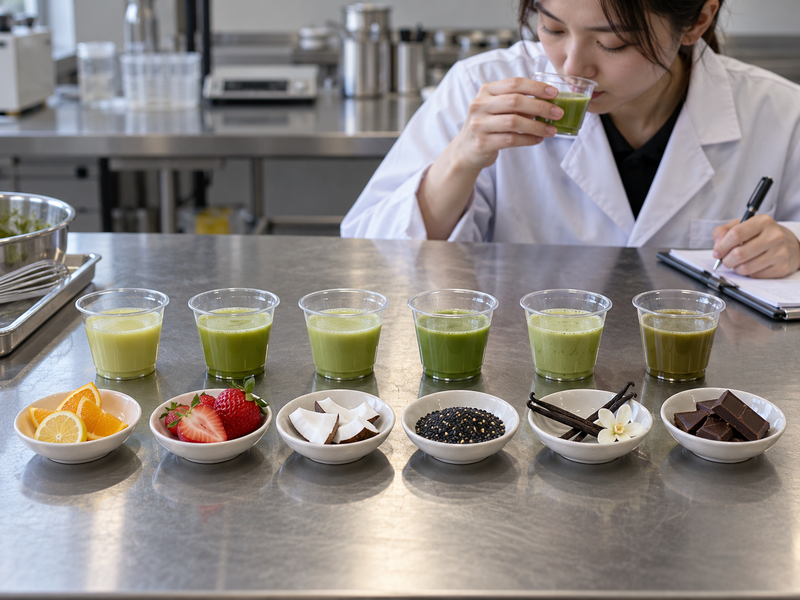
A flavor pairing earns a place on a menu only when matcha remains recognizable in the finished recipe. Fruit, spice, cocoa and nuts can change its color, aroma and finish in different ways. Developers should compare a small controlled set instead of choosing combinations from a trend board.
Contents
- 1. What should the matcha flavor pairings specification actually cover?
- 2. Which powder performs in the buyer's product?
- 3. How should candidate formulas be compared?
- 4. Which preparation and lot checks prevent drift?
- 5. What does a blind tasting reveal?
- 6. How does the powder change after storage?
- 7. Which bulk or retail pack protects it?
- 8. Can the supplier repeat the pilot result?
- 9. Which claims need lot-linked evidence?
- 10. What belongs in the approval record?
1. What should the matcha flavor pairings specification actually cover?
Define the product before approving a sample
Start with the product format, not a list of fashionable ingredients. Strawberry in a cold milk drink behaves differently from strawberry baked into a cookie. State whether matcha should lead, share attention or provide a background note.
A pairing list is only useful when tied to a product. Strawberry can work as a tart layer in a cold drink yet turn jammy in a baked filling. Sesame can add nutty depth but changes allergen review. Write the format, base sweetness and the role matcha should play. Then choose candidate flavors that solve a specific sensory problem rather than filling a trend calendar.
For sourcing teams, the name on a sample bag must connect to a specification and an application. Do not let a loose grade adjective become the buying criterion.
2. Which powder performs in the buyer’s product?
Choose powder against the finished application
Screen pairings against one fixed matcha and base formula. If tea grade, sugar and fat change at the same time, the team cannot tell why a sample wins. Use a small matrix of two or three candidate flavor families.
Build a small pairing matrix with one matcha, one base recipe and candidate flavors at measured doses. For a milk drink, test fruit, nut and spice examples separately rather than blending all three. For a baked product, run the same combinations after heat exposure. Keep sugar level stable so a sweeter option does not win by default. Ask panelists which flavor leads and whether they can still identify matcha.
A matched sample set should include the supplier's proposed commercial lot or a clear statement of how the sample relates to future production.
For a related production decision, see our matcha latte flavor planning guide.
| Candidate | Specific check | Keep if |
|---|---|---|
| Powder | Screen pairings against one fixed matcha and base formula | Tea fits the finished application |
| Formula | Control dose and order of addition | Dose stays practical |
| Tasting | Use descriptive scores: tea visibility, companion-flavor clarity, sweetness, bitterness and aftertaste | Flavor remains clear |
3. How should candidate formulas be compared?
Change one variable at a time
Control dose and order of addition. Citrus acid can dull a matcha drink's color, while cocoa can mask its aroma; nut fat changes mouthfeel. Make these mechanisms part of the trial instead of treating every pairing as a simple flavor drop.
Screen pairings in a small matrix. Use one approved matcha, one base and measured flavor doses. For each candidate, make a control without the added flavor. This reveals whether an ingredient improves the tea or merely covers a weak powder. Keep temperatures consistent. A citrus-matcha drink should also be checked for color change after acid addition, while a cocoa pairing needs a taste test after fat has set.
Write the control's source and batch beside every trial. That single habit stops an apparently better formula from being credited to an unnoticed base change.
4. Which preparation and lot checks prevent drift?
Write a method another operator can repeat
Prepare blind samples at the intended serving temperature. Label codes outside panel view and rotate tasting order. Ask panelists for notes on first sip, middle and finish, not only a single preference vote.
Prepare coded samples in a repeatable order and record when each was made. Citrus added early can affect color differently from citrus added at service; cocoa incorporated into batter behaves differently from a chocolate topping. Use this process record to understand why an attractive flavor pairing fails at scale. When two options are close, repeat them on another day with ordinary staff rather than taking a loud group's first vote.
A simple lot code and a consistent preparation sheet let quality staff compare future shipments without repeating the original sales presentation.
| Process point | Specific check | Record |
|---|---|---|
| Preparation | Control dose and order of addition | Tool and dose |
| Production | Prepare blind samples at the intended serving temperature | Start and end samples |
| Finished unit | Use descriptive scores: tea visibility, companion-flavor clarity, sweetness, bitterness and aftertaste | Sensory result |
5. What does a blind tasting reveal?
Taste the portion a customer receives
Use descriptive scores: tea visibility, companion-flavor clarity, sweetness, bitterness and aftertaste. A popular pairing should still be rejected if the matcha note disappears from a product sold as matcha.
Ask tasters to describe the sequence of flavors in the full serving. Does matcha lead, appear in the middle or remain only as a bitter finish? A winning sample should match the product name. If a fruit puree makes a drink sweeter, do not treat preference as evidence that the pairing is inherently better; retest at matched sweetness. Note disagreements and revisit close candidates after a pause.
Invite purchasing and development to score separately before they reconcile results. A low quote cannot settle a sensory disagreement.
6. How does the powder change after storage?
Use the real shelf or counter conditions
Hold leading samples through the intended service or shelf window. A fruit-matcha drink may separate; a spice note may dominate after storage. Revisit the pairing after the actual process, including freezing or baking if relevant.
Revisit leading combinations after the planned hold. A berry layer may bleed into a matcha layer; a nut flavor may grow heavy when a product warms. Photograph the actual pack and taste the whole portion. The pairing belongs in the finished product, not just in separate tasting cups. If a variant loses matcha identity, its menu name and formula need another look.
A sealed retain of each candidate makes later color or aroma complaints easier to investigate. Store it under the same documented conditions.
| Observation | Specific check | Action |
|---|---|---|
| Storage | Hold leading samples through the intended service or shelf window | Compare with control |
| Pack | Check whether the visual promise matches the flavor | Inspect opened unit |
| Customer portion | Use descriptive scores: tea visibility, companion-flavor clarity, sweetness, bitterness and aftertaste | Taste again |
7. Which bulk or retail pack protects it?
Test the actual selling format
Check whether the visual promise matches the flavor. A pink-green layered drink invites a different expectation from a uniformly blended cup. The pack or menu photograph should depict the form a customer receives.
Visual contrast can help a layered product sell, but it also creates a promise about the flavor the customer will get. Test the cup, wrapper or pastry after normal handling. If a colored layer bleeds or a garnish wilts, consider a simpler build. A clear pack may display attractive colors while offering less light protection, so weigh appearance against the stability of the matcha.
Ask how packs will be opened and resealed by the actual operator. Bulk use can expose powder more often than a retail tasting suggests.
8. Can the supplier repeat the pilot result?
Measure yield and repeatability
Cost each pairing at the final dose, including puree, syrup, inclusions and prep waste. A flavor that wins a bench tasting may require too much costly ingredient to survive commercial production.
Calculate the dose and yield of each companion ingredient, including puree waste, garnish loss and extra prep time. Some flavors require expensive syrups or add allergens that complicate operations. Put sensory score beside cost and service burden. A second-choice pairing may be commercially stronger if ordinary stores can reproduce it and customers can taste both intended notes.
The supplier's capacity claim should be tested against the specific grade and packaging format, not a company-wide tonnage number.
| Pilot measure | Specific check | Commercial use |
|---|---|---|
| Yield | Cost each pairing at the final dose, including puree, syrup, inclusions and prep waste | Cost per saleable unit |
| Loss | Hold leading samples through the intended service or shelf window | Set acceptance limit |
| Supply | Review the allergen and ingredient consequences of nuts, dairy, sesame and flavor systems | Confirm lot evidence |
9. Which claims need lot-linked evidence?
Link claims and batches to documents
Review the allergen and ingredient consequences of nuts, dairy, sesame and flavor systems. Document supplier specifications and approved alternatives before a menu chain scales the concept.
File a current specification, complete ingredient statement, lot-linked test results and origin support for any origin wording. Ask the supplier to explain how a material change will be communicated. The buyer should be able to connect a finished product batch back to the ingredient lot without relying on a salesperson's memory. Check the label for the actual sales market and the complete formula, including carriers and processing aids where relevant.
Records should show the material's actual identity and permitted ingredients. Brochures can support context but cannot replace a lot-linked document.
10. What belongs in the approval record?
Release against a written reference
Choose one lead pairing and one backup, with reasons stated in plain sensory language. Keep the rejected samples' notes; they can prevent a later team from repeating the same weak combination.
Make the launch decision with a physical reference and a short written standard. State the approved formula, supplier code, acceptable sensory range, process limits, pack, selling window and person who can release a later lot. Keep a failed example too; it makes training more concrete than a perfect photograph alone. A small controlled launch can show whether operators and customers experience the product as the development team expected.
The release file should identify a fallback material and the conditions under which that fallback needs a new application trial.
| Release item | Specific check | Owner |
|---|---|---|
| Formula | Choose one lead pairing and one backup, with reasons stated in plain sensory language | Development |
| Supplier | Review the allergen and ingredient consequences of nuts, dairy, sesame and flavor systems | Purchasing |
| Pack | Check whether the visual promise matches the flavor | Quality |
A final production check
Keep the winning pairing's exact dose and a short note explaining why it won. Ask a second developer to recreate it in the actual commercial base, then taste it after the intended process and hold. If the pairing depends on an expensive garnish or unstable color layer, record that burden beside its sensory score. A pairing is ready when ordinary staff can deliver the same two flavors a customer expects from the name.
Further reading
Use ISO/TR 21380:2022 on matcha identity for tea identity and FDA food allergen labeling guidance when the full recipe contains covered ingredients. Apply these sources to the actual product and selling market.
FAQ
Q1: What is matcha flavor pairings in a commercial product?
Start with the product format, not a list of fashionable ingredients. Strawberry in a cold milk drink behaves differently from strawberry baked into a cookie.
Q2: How should a buyer compare matcha for this use?
Screen pairings against one fixed matcha and base formula. If tea grade, sugar and fat change at the same time, the team cannot tell why a sample wins.
Q3: What usually causes the first quality failure?
Hold leading samples through the intended service or shelf window. A fruit-matcha drink may separate; a spice note may dominate after storage.
Q4: Which documents should the supplier provide?
Review the allergen and ingredient consequences of nuts, dairy, sesame and flavor systems. Document supplier specifications and approved alternatives before a menu chain scales the concept.
Q5: When should the formula be approved?
Choose one lead pairing and one backup, with reasons stated in plain sensory language. Keep the rejected samples' notes; they can prevent a later team from repeating the same weak combination.