
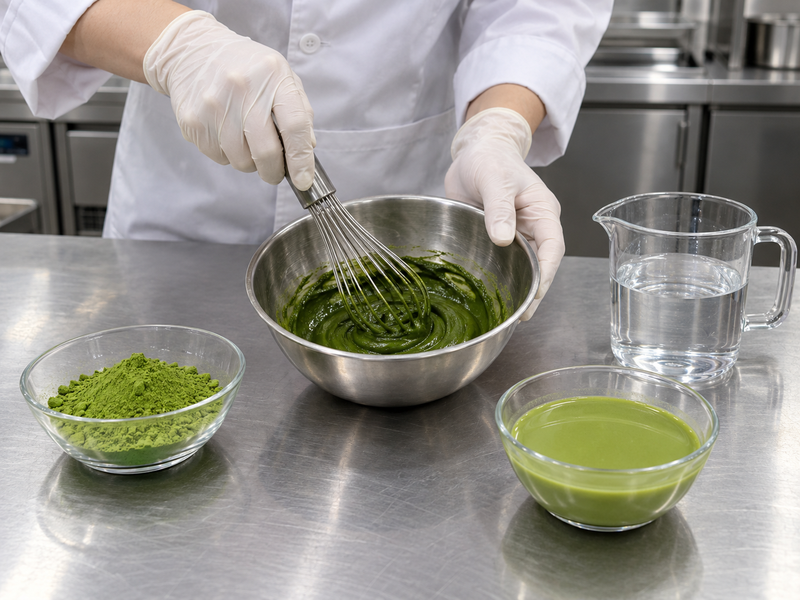
A smooth matcha paste can speed a café rush, but it becomes a different product once powder meets liquid. It may settle, thicken or create extra sanitation work. The useful question is whether normal staff can portion a safe, consistent premix through the intended holding period.
Contents
- 1. What should a matcha paste drink taste like?
- 2. Which matcha fits the served base?
- 3. How do you set a repeatable drink ratio?
- 4. Can baristas make the same cup in a rush?
- 5. What changes between first and last sip?
- 6. How does the drink hold after handoff?
- 7. Does the cup or bottle protect its appearance?
- 8. What does each saleable cup really cost?
- 9. Which ingredients and lots must be traceable?
- 10. What must a service trial pass?
1. What should a matcha paste drink taste like?
Define the product before approving a sample
A matcha paste is a preparation method, not necessarily a shelf-stable ingredient. Define whether staff will make it per cup, per shift or in a controlled manufacturing batch. Each case needs a different hold rule.
Define paste by its job and time frame. A barista might make it per order to prevent clumps, while a chain might prepare a covered batch for a short rush. A packaged retail tube is a separate manufactured food with different validation needs. Put the intended carrier, portion size and storage rule in the brief. Without those details, two teams can use the same word for very different products.
For drinks, define the cup at handoff and after the first few minutes. Both moments affect whether customers recognize the tea.
2. Which matcha fits the served base?
Choose powder against the finished application
Select matcha for the final drink and determine whether it disperses in the chosen liquid. Test water, milk or another approved carrier only if the actual recipe uses it. Sweetened bases can mask clumps in a quick visual check.
Compare two paste ratios in the exact liquid used at service, then make drinks from each at the same total matcha dose. Measure how long staff need to reach a smooth texture. A thicker paste may disperse easily in a blender yet stick to a spoon or dispensing nozzle. Record residue as well as the finished cup, since material left in a container affects real dosage.
A cold sweet base may hide weak matcha, while water tasting can exaggerate astringency. Select powder against the served drink.
For a related production decision, see our matcha mixing methods guide.
| Candidate | Specific check | Keep if |
|---|---|---|
| Powder | Select matcha for the final drink and determine whether it disperses in the chosen liquid | Tea fits the finished application |
| Formula | Weigh powder and liquid rather than relying on spoon measures | Dose stays practical |
| Tasting | Taste a finished drink built from paste against a drink made from fresh powder | Flavor remains clear |
3. How do you set a repeatable drink ratio?
Change one variable at a time
Weigh powder and liquid rather than relying on spoon measures. Add a little liquid first and work the powder into a smooth slurry, then dilute further. Record mixing time and tool so a second operator can repeat the texture.
Make a ratio ladder using weighed matcha and the exact water or milk base. Start with enough liquid to wet all powder, then mix to a smooth consistency before dilution. Test how each paste portions from the tool staff will use. A mixture that slides from a laboratory spatula may cling to a service spoon, leaving part of the dose behind. Record residue and the finished drink's actual matcha weight.
Keep ice, liquid, sweetener and tea weights fixed during screening. One uncontrolled pour can obscure an otherwise useful difference between powders.
4. Can baristas make the same cup in a rush?
Write a method another operator can repeat
Compare paste from the top, middle and bottom of a holding vessel. Powder can settle and make the last cups stronger. If agitation is required, define its frequency and verify that a normal worker will actually perform it.
Prepare a small paste batch with the intended tool and have two operators portion from the beginning and end of the hold. Check whether stirring restores an even mix after settling. If the last drink looks darker, define a mixing step staff can perform safely and quickly. Do not rely on a visual 'green enough' instruction where a weighed portion can be written into the recipe.
Watch each operator make a short sequence of drinks. Service time and cup-to-cup variation matter alongside a single ideal prototype.
| Process point | Specific check | Record |
|---|---|---|
| Preparation | Weigh powder and liquid rather than relying on spoon measures | Tool and dose |
| Production | Compare paste from the top, middle and bottom of a holding vessel | Start and end samples |
| Finished unit | Taste a finished drink built from paste against a drink made from fresh powder | Sensory result |
5. What changes between first and last sip?
Taste the portion a customer receives
Taste a finished drink built from paste against a drink made from fresh powder. Look for bitterness, texture and color differences. A faster service method has little value if it weakens the product.
Compare a drink from fresh paste with one made from dry powder at the same tea dose. Taste texture, bitterness and aroma after stirring. If the paste has held, sample the first and last portion from its container. A visual swirl at the surface cannot show whether the bottom has become concentrated. Use a defined stirring step if normal staff can perform it reliably, and retest the cup.
A panel should stir or drink the cup as customers will. Layered photographs cannot show what happens to flavor after mixing.
6. How does the drink hold after handoff?
Use the real shelf or counter conditions
Set a time and temperature rule with the site's food safety team. The presence of liquid changes the risk profile from dry powder. Do not assume a paste stays safe because dry matcha stores well.
Hold covered samples under the site's approved time and temperature controls, then compare fresh and held pastes in finished drinks. Note thickening, separation, aroma and the ease of cleaning the vessel. A wet premix cannot inherit the storage promise of dry matcha. Any retail tube concept needs separate process validation and package testing rather than an extension of a café prep trial.
Observe settling, dilution and aroma through the likely customer wait. A drink that needs constant agitation may be awkward for service.
| Observation | Specific check | Action |
|---|---|---|
| Storage | Set a time and temperature rule with the site's food safety team | Compare with control |
| Pack | Choose a covered, cleanable container with a portioning method that does not contaminate the remaining paste | Inspect opened unit |
| Customer portion | Taste a finished drink built from paste against a drink made from fresh powder | Taste again |
7. Does the cup or bottle protect its appearance?
Test the actual selling format
Choose a covered, cleanable container with a portioning method that does not contaminate the remaining paste. For a retail tube concept, sanitation, pack integrity and shelf-life validation require a separate manufacturing program.
A covered vessel should be easy to clean and allow a measured portion without repeatedly contaminating the remaining paste. Test the lid, dispensing tool and bench location used during service. Powder around the rim can dry and flake into later servings. For a retail tube, inspect material compatibility and closure under a qualified manufacturing program; a café jar trial is not evidence of tube shelf life.
Test lids, straws and clear cups with the real ice load. A good recipe can still spill, smear or look uneven after handoff.
8. What does each saleable cup really cost?
Measure yield and repeatability
Measure cups per paste batch, discarded residue and operator time. A premix that saves seconds at the counter may create end-of-shift waste if demand is irregular.
Measure drinks per paste batch, cups rejected for clumps, paste left in the vessel and minutes spent cleaning. The saving at handoff may be offset by prep and discard. Try a smaller batch size if sales are uneven. Keep a lot-coded prep log so a complaint about a drink can be traced to both the dry matcha and the premix batch.
Measure discarded premix and unused base at closing. Beverage waste can outweigh a small saving in powder price.
| Pilot measure | Specific check | Commercial use |
|---|---|---|
| Yield | Measure cups per paste batch, discarded residue and operator time | Cost per saleable unit |
| Loss | Set a time and temperature rule with the site's food safety team | Set acceptance limit |
| Supply | Maintain matcha lot identity through the premix batch record and finished drinks | Confirm lot evidence |
9. Which ingredients and lots must be traceable?
Link claims and batches to documents
Maintain matcha lot identity through the premix batch record and finished drinks. Confirm any carrier ingredient and allergen statement. Document cleaning for tools that handle wet matcha.
A supplier file is useful only when it refers to the material delivered. Match ingredient statement, specification and test report to the purchase code and lot on the cartons. Ask for an agreed notice before changes in source, formula or manufacturing site. The finished product team should separately review market-specific ingredient and allergen wording. Test a trace request. Pick one pilot pack and ask where its matcha came from and which finished units received it.
Ingredient and caffeine-relevant information should come from the final formula and documented serving size. Keep tea lot codes on prep records.
10. What must a service trial pass?
Release against a written reference
Release the method after a rush-hour trial with ordinary staff. Keep a photograph of accepted paste texture and a simple rule for remaking a batch that has settled beyond recovery.
The approved version needs a name and a date. Store the physical sample, recipe revision, process sheet, pack artwork and reason for selecting the supplier. State what would trigger a new test: a tea lot change, a different milk or fat, a new sealing film or a shift in serving size. Make approval repeatable. A future buyer should be able to compare a new shipment with the reference rather than reopening the entire concept from memory.
Train staff against one reference cup made with ordinary tools. A recipe that works only in development has not passed its service trial.
| Release item | Specific check | Owner |
|---|---|---|
| Formula | Release the method after a rush-hour trial with ordinary staff | Development |
| Supplier | Maintain matcha lot identity through the premix batch record and finished drinks | Purchasing |
| Pack | Choose a covered, cleanable container with a portioning method that does not contaminate the remaining paste | Quality |
A final production check
A rush-hour test should end with a vessel inspection. Weigh paste remaining, note dried residue on the lid and compare the final drink with the first one made from that batch. If agitation is needed, verify the written method restores the intended tea dose. Record the premix lot and approved hold time. A paste process has earned its place only if it improves service without making traceability or cleaning worse.
Further reading
Use ISO/TR 21380:2022 on matcha identity for matcha identity and FDA food allergen labeling guidance if the final drink or topping contains milk, cereal allergens or another covered ingredient. Set wet-product holding rules with the operating site's food safety team.
FAQ
Q1: What is matcha paste in a commercial product?
A matcha paste is a preparation method, not necessarily a shelf-stable ingredient. Define whether staff will make it per cup, per shift or in a controlled manufacturing batch.
Q2: How should a buyer compare matcha for this use?
Select matcha for the final drink and determine whether it disperses in the chosen liquid. Test water, milk or another approved carrier only if the actual recipe uses it.
Q3: What usually causes the first quality failure?
Set a time and temperature rule with the site's food safety team. The presence of liquid changes the risk profile from dry powder.
Q4: Which documents should the supplier provide?
Maintain matcha lot identity through the premix batch record and finished drinks. Confirm any carrier ingredient and allergen statement.
Q5: When should the formula be approved?
Release the method after a rush-hour trial with ordinary staff. Keep a photograph of accepted paste texture and a simple rule for remaking a batch that has settled beyond recovery.