
A matcha donut has to work as a pastry before its green color can sell it. The crumb should be tender, the tea should still register after baking, and the glaze should survive a normal display period without turning tacky or hiding defects. Love and Lemons’ baked doughnut recipe shows a home-scale version with several finishes. For a bakery, the useful question is how to turn that search interest into a repeatable product: one measured formula, one portion standard and a taste check at the time of sale. The ten checks below cover a baked ring donut; a fried or yeast-raised version needs its own trials.
Contents
- 1. What type of matcha donut are you selling?
- 2. Which matcha should go into the batter?
- 3. How do you set a useful control formula?
- 4. How should dry and wet ingredients be mixed?
- 5. How do you portion the donut pan evenly?
- 6. How do you judge the bake and crumb?
- 7. Which matcha finish holds up best?
- 8. What happens during display and delivery?
- 9. How do you cost and label the product?
- 10. What should the release check include?
1. What type of matcha donut are you selling?
Choose the process before the powder
“Matcha donut” can mean a cake-style ring baked in a pan, a yeast-raised fried donut with green glaze, or a plain donut dusted with tea sugar. These are different products with different equipment, labor and holding behavior. Define the item in a one-sentence brief: for example, a baked cake donut with matcha in the crumb and a thin matcha glaze, sold from the counter on the day of production. That brief tells the team what to test and prevents the garnish from doing all the work.
Make a plain control donut from the same base. It helps identify whether the powder changed texture or whether the original batter was already dense. Taste the control and matcha version side by side after cooling, then again at the planned service time. If the green version tastes like a standard vanilla donut with colored coating, consider whether matcha belongs in the batter, glaze or both. A product can succeed with matcha only in the finish, but describe it honestly. Decide whether its main draw is tea flavor, appearance or a pairing with coffee, and let that choice guide portion size and sweetness.
2. Which matcha should go into the batter?
Test powder after baking, not only in water
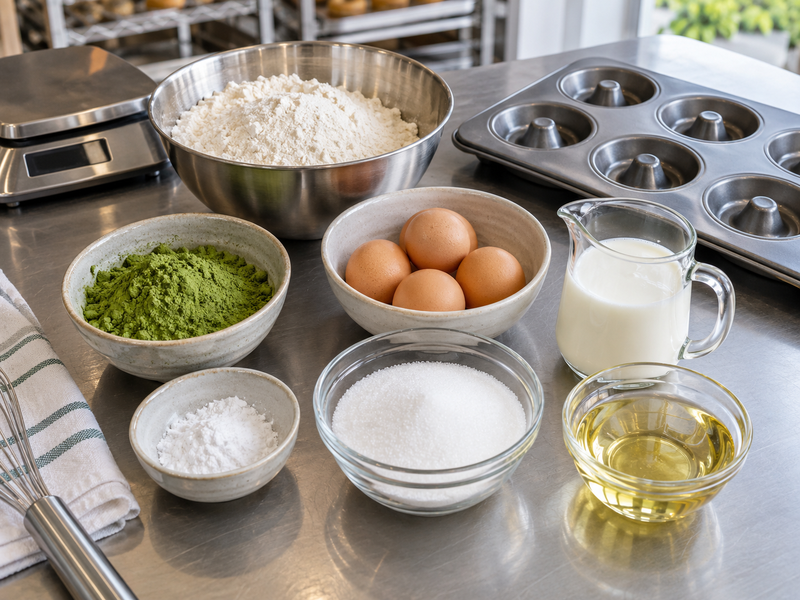
Heat, flour, fat and sugar change how tea tastes. Ask for a current supplier sample, its ingredient statement, lot and storage guidance. Pure matcha and a sweetened green tea mix are not interchangeable: the mix may introduce sugar, milk or other ingredients that alter both the recipe and allergen review. Sift each candidate into the same control formula by weight. Keep the bake and finish identical so the difference you taste can plausibly be attributed to the powder. A water tasting can screen out a harsh sample, but the baked donut is the decision point.
Look past color. A bright raw powder may bake into a muted crumb, while a less vivid sample may deliver clearer tea flavor. Cut a donut in half and taste the center without glaze; then taste a finished piece. Record bitterness, grassy notes, sweetness, aftertaste and how much powder is needed for a recognizable flavor. The Matcha Village grades guide gives language for comparing samples, but the application test should decide the purchase. Avoid implying that a grade name guarantees baking performance.
| Sample check | Record | Why it matters |
|---|---|---|
| Ingredient statement | Pure powder or blend | Formula and allergen control |
| Lot and pack | Supplied sample identity | Reorder consistency |
| Batter dose | Grams per batch | Repeatability and cost |
| Baked crumb | Flavor and color | Actual product quality |
| Finished donut | Tea presence after glaze | Guest experience |
3. How do you set a useful control formula?
Write a baker’s trial, not an approximate recipe
A control formula should identify every ingredient by weight, pan size, portion mass, oven setting and target yield. The Love and Lemons reference uses a flour, egg, milk, oil and leavening base with matcha; it also suggests glaze and sugar finishes. Treat it as an example of the category, then develop your own bakery formula for your equipment. A six-ring pan trial is useful for screening flavors. It is too small to prove that a full production batch will mix and bake the same way.
Record batter weight before and after portioning. If the formula claims six donuts but produces five large rings and one half-filled ring, the yield is not yet controlled. Build a version log: date, ingredient brands, powder lot, operator, pan, oven and changes. Change one variable per test, such as matcha dose or liquid amount. If the crumb becomes dry when matcha is added, do not assume the solution is more sugar; first check whether the added dry powder displaced flour, whether the batter was overmixed or whether the donuts baked too long.
| Formula field | Control entry | Trial observation |
|---|---|---|
| Ingredient weights | Grams for each input | Any substitution |
| Pan and cavity | Model and volume | Release and shape |
| Batter portion | Grams per cavity | Yield variation |
| Oven setting | Temperature and rack | Browning pattern |
| Finished yield | Accepted pieces | Waste to include in cost |
4. How should dry and wet ingredients be mixed?
Prevent green pockets without toughening the crumb
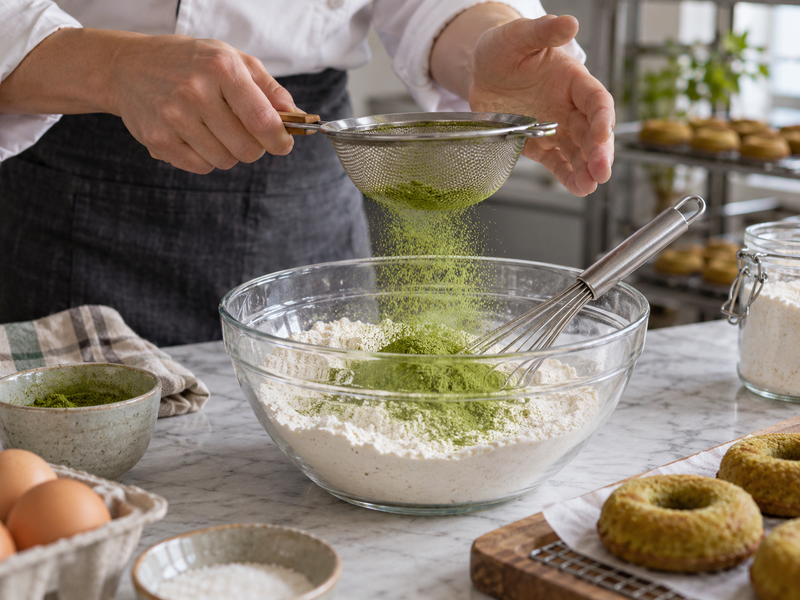
Sift matcha with the dry ingredients so clumps do not enter the finished batter. Blend the wet ingredients separately, then combine them using a method matched to the formula. Stop when the flour is incorporated and the color is even. A few tiny lumps may be less damaging than extended mixing, which can toughen a cake-style donut. The exact endpoint depends on the base recipe, so define it with a batter photo or short kitchen note rather than “mix well.” Record batter temperature if the process is sensitive to a warm room or a long wait before baking.
Watch for a common source of misleading trial results: the first pan is filled immediately, while the second waits as leavening begins to act. The two pans may rise differently even from the same bowl. Portion and bake on a repeatable schedule. If the batter needs to rest, state the duration; if it must be baked promptly, arrange pans and staff before mixing. A spatula scrape of the bowl sides and bottom helps ensure that the last few donuts do not contain the unmixed matcha left near the edge.
5. How do you portion the donut pan evenly?
Use mass to control shape
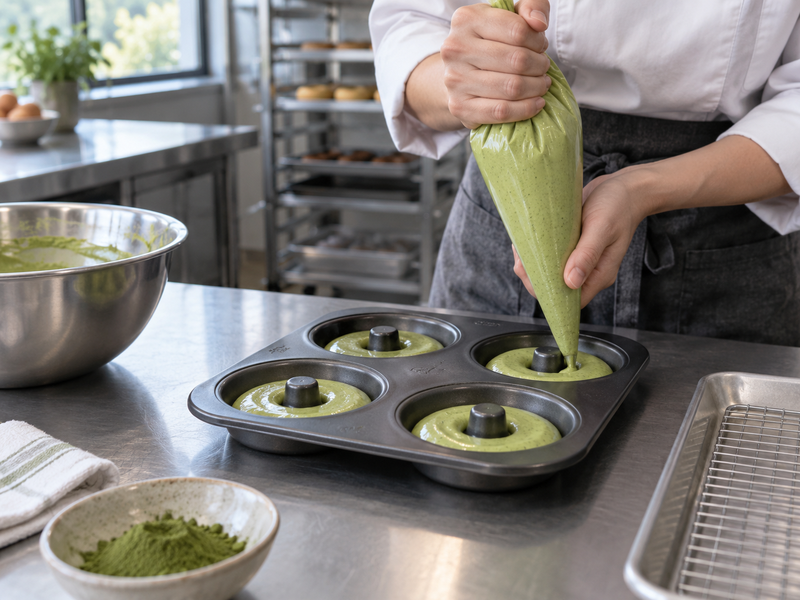
A piping bag or depositor can make a cleaner ring than a spoon, but neither ensures equal portions by itself. Weigh the first filled cavity, check the batter height against the pan’s center post and use that appearance as a guide. Too much batter may close the hole or overflow. Too little can produce a thin ring that dries quickly. Set a target mass and an acceptable range after the first successful bake. Grease or prepare the pan consistently; residue from the previous batch can change release and surface color.
Check the first, middle and last cavities during a larger run. If the batter thickens during portioning, later donuts may be heavier or less level. Weighing every piece during service may be unnecessary, but a spot-check schedule catches drift. Make sure any disposable piping bag and tip size are part of the written method. Staff should know how to avoid air pockets in the bag and how to finish each ring without a mound at the join. Those small details affect appearance more than an extra dusting of powder can repair.
| Portion issue | Likely check | First correction to test |
|---|---|---|
| Hole closes | Batter mass and pan fill | Lower the target mass |
| Lopsided ring | Deposit path | Standardize piping |
| Dry thin ring | Underfilled cavity | Check scale and yield |
| Sticking | Pan preparation | Standardize greasing and cooling |
6. How do you judge the bake and crumb?
Inspect inside as well as outside
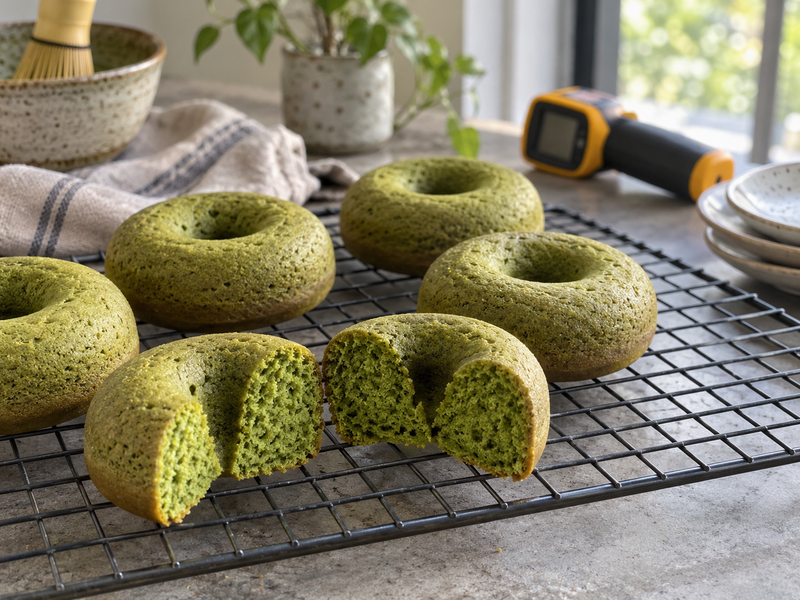
Oven time is a starting point, not proof of a finished donut. Check the first pan at the end of the expected range, then note surface spring, release and the center crumb after cutting one piece. A green crumb can make pale or uneven areas harder to interpret. Compare with a plain control made in the same oven. A donut that looks attractive but has a gummy line at the bottom is not ready for glaze. Record the actual oven setting, rack, pan load and observed bake time rather than transferring a home recipe’s minutes directly to a commercial oven.
Cool on a rack before glazing. Steam trapped by a coating or closed box can soften the surface and weaken the finish. Cut samples from the first and last pans; look for an even crumb, no dry rim and no raw center. Taste them without glaze. A cake donut that passes this test may still fail after display, so retain a few pieces for a later check. Do not use darker exterior color alone as a signal to bake longer: matcha and sugar affect appearance, and a longer bake may dry the crumb before fixing a mixing or portion problem.
7. Which matcha finish holds up best?
Compare glaze, sugar and no coating
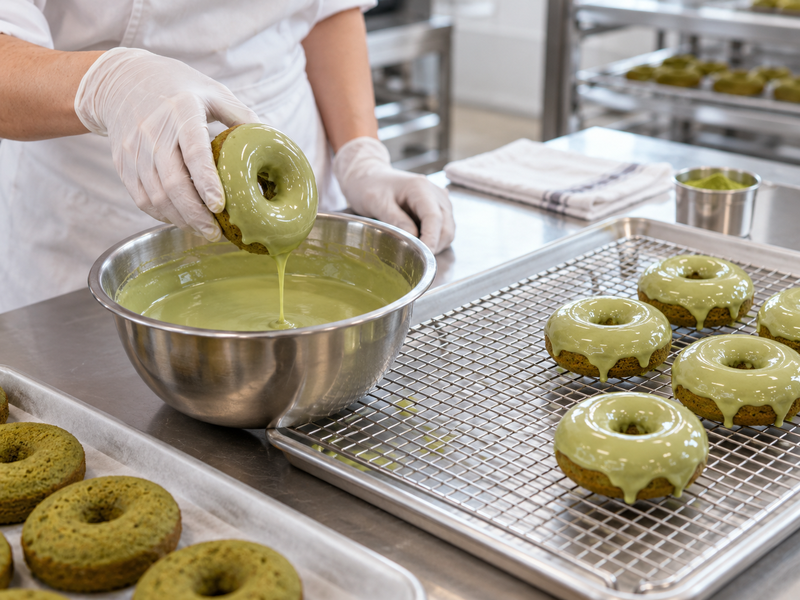
Make three small finishing trials on identical cooled donuts. A thin matcha glaze shows the shape and can carry additional tea flavor. Matcha sugar adds a dry surface but may shed during packaging. A plain donut with a light dusting exposes the crumb most clearly, yet loose powder can taste harsh in a mouthful. The Love and Lemons recipe demonstrates these finish families; choose by your product brief and test at the actual selling time rather than adopting a decorative option by appearance alone.
For glaze, record sugar-to-liquid ratio, matcha mass and dipping depth. Place finished donuts on a rack until the surface reaches the handling condition you want, then test one in the planned box. A glaze that is stable on an open rack may stick to packaging. Compare how the finish tastes alongside the cake, not as a spoonful of glaze. If the glaze is very sweet, increasing matcha in the batter may not restore balance; consider lowering the glaze load first. Keep any recipe change in the version log.
| Finish | Main advantage | Holding question |
|---|---|---|
| Thin matcha glaze | Clear tea cue | Does it set before boxing? |
| Matcha sugar | Fast, dry application | Does it shed or absorb moisture? |
| Light dusting | Shows the crumb | Is the powder pleasant to eat? |
| No finish | Simplest production | Is tea flavor strong enough? |
8. What happens during display and delivery?
Taste at the point of sale
A donut should be evaluated after the same cooling, finishing, packaging and display steps it will face in business. Put samples in an open case, a closed bakery box and any delivery pack you plan to use. Check crumb tenderness, glaze adhesion, surface moisture and appearance at set times. A matcha glaze may look bright at the bench but dull after exposure; a paper bag may rub off sugar. These observations define your quality window. They do not establish a safe shelf life or replace local food handling rules.
Set a practical production rhythm from that window. If the best product is sold the same day, bake a smaller second batch rather than assuming yesterday’s stock is equivalent. If a refrigerated filling or dairy topping is added, redesign the handling plan and seek the applicable cold holding requirements. Plain baked rings and filled donuts are not the same risk profile. Record rejected pieces and returns, because delivery damage and display waste belong in the product cost. A pretty launch photograph cannot tell you whether the last donut in the case still earns its price.
9. How do you cost and label the product?
Cost accepted donuts, then review allergens
Divide the complete batch cost by accepted donuts, not by the planned pan count. Include matcha, base ingredients, finish, packaging, production time, cleaning and the rejected pieces found in the pilot. Matcha cost per kilogram is only one input; a higher-dose powder may cost more per donut even if its bag price looks attractive. Record the cost of extra glaze used to hide uneven surfaces. If a new lot requires more powder to reach the flavor target, update the formula and cost sheet before changing menu price.
Review the actual ingredient labels before printing a display card or packaged label. A typical donut formula may contain wheat, egg and milk; a plant milk or coating can introduce other allergens. In the United States, the FDA’s allergen guidance explains major allergen disclosure for packaged foods and notes that rules for unpackaged bakery goods can vary. Apply the requirements for your market and selling format. Do not infer that a green tea pastry is a health food, or make a nutrient claim from the presence of matcha.
| Cost or label item | Evidence to collect | Owner |
|---|---|---|
| Matcha dose | Batch weighing record | Baker |
| Accepted yield | Count after quality check | Shift lead |
| Finish use | Actual glaze or sugar mass | Baker |
| Pack cost | Purchased unit cost | Buyer |
| Allergen statement | Current ingredient labels | Compliance lead |
10. What should the release check include?
Make the next batch reproducible
Give a baker who did not develop the donut the written formula and watch one production run. The baker should be able to identify the correct powder lot, scale the batter, fill the pan, judge the bake and finish the rings without informal coaching. Check three accepted donuts: first pan, middle run and last pan. Weigh them, cut them and taste them at the planned selling age. Keep a reference photograph of the interior and the finish, but pair it with a written flavor description. A picture cannot record bitterness or a dry aftertaste.
The final card should state the approved ingredients, allergen review, pan, portion mass, bake checks, cooling method, finish recipe, packaging, quality window and rejection signs. Confirm the menu description matches what is sold: baked or fried, matcha in the cake or only in the coating, filled or unfilled. After launch, compare waste and customer feedback with the pilot. If staff repeatedly add more glaze, investigate whether the original finish standard is unrealistic. Update the controlled recipe instead of letting small undocumented fixes produce a different donut every week.
FAQ
Q1. Should matcha go in the donut or just the glaze? Test both and describe the chosen version accurately.
Q2. Does a brighter powder always bake better? No. Compare baked flavor and color at the selling time.
Q3. Can a baked formula be used for a fryer? Fried donuts need separate formula and process checks.
Q4. Why is the center gummy? Check portion mass, mixing and baking before changing the glaze.
Q5. What is the simplest first pilot? Bake a control and two matcha variants, finish identically and taste after display.