
Matcha dango can give a tea shop a compact skewered dessert, but its appeal depends on more than a green coating. The dumplings need a consistent bite, the skewer must hold them securely and the glaze should stay where staff place it. Develop those three details together before extending the product into a takeaway range.
1. Should matcha dango have green dough or a green topping? · 2. How should the rice-flour blend be selected? · 3. What makes a useful dough-development record? · 4. How can staff portion round dumplings efficiently? · 5. What should the cooking and draining trial establish? · 6. How should the matcha glaze be developed? · 7. What makes a skewer comfortable to assemble and eat? · 8. How should holding and takeaway conditions be tested? · 9. What does a sensible cost sheet include? · 10. Which records make the product repeatable across branches?
1. Should matcha dango have green dough or a green topping?
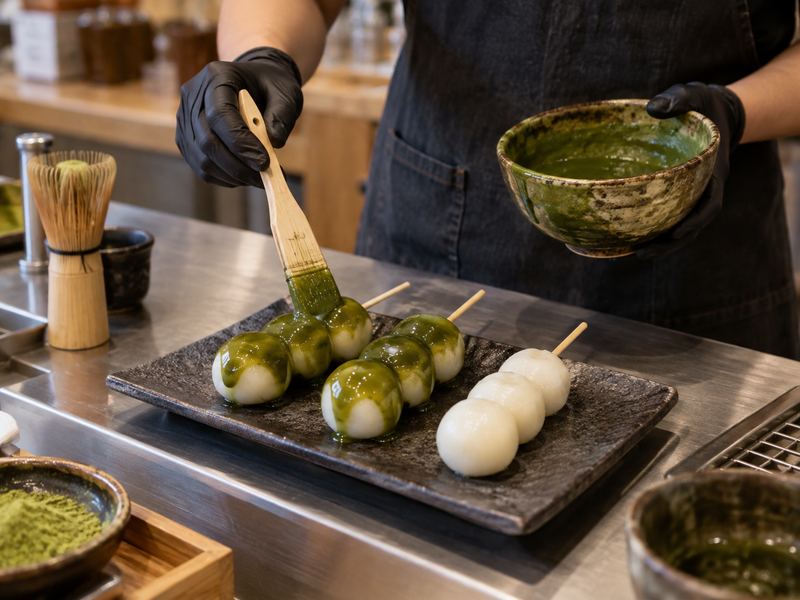
Select one place for the tea
Both directions are possible, but they create different development tasks. Green dough requires the tea to be evaluated through mixing and cooking. A green glaze lets the kitchen establish the rice dumplings separately and adjust tea strength at the finishing stage.
Nio Teas’ matcha dango article describes skewered dumplings finished with a matcha glaze. Its water entry is ambiguous, so it should not be copied as a complete production formula. Use the article for the serving concept and select a fully specified base method for testing.
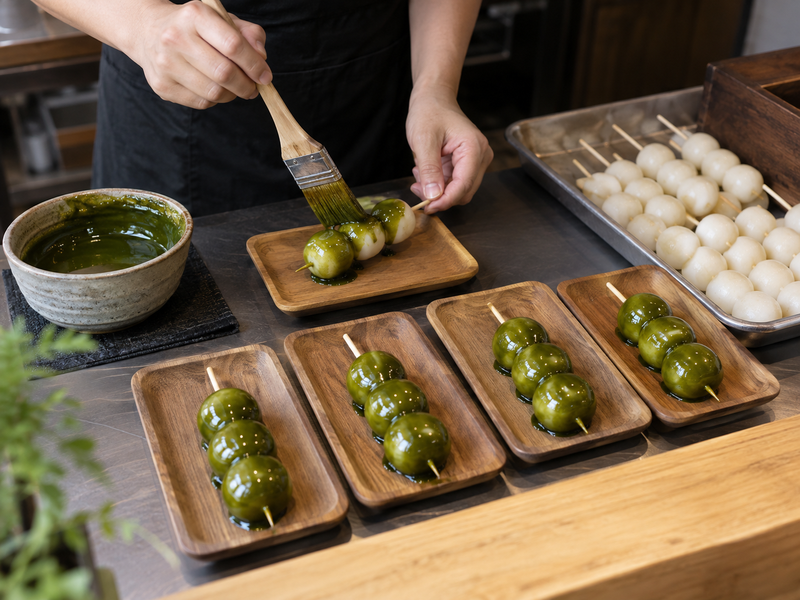
For the first cafe version, propose plain dumplings with a measured green topping. This makes glaze coverage visible and allows an unglazed control from the same cooking batch. Decide whether all dumplings should be coated or whether the green finish should cover only the upper surface.
Photograph the product as customers will receive it. A skewer lifted vertically for a promotional image may behave differently when placed in a narrow takeaway tray. The glaze trial needs to reflect that actual orientation.
2. How should the rice-flour blend be selected?
Keep the flour names on the working sheet
Just One Cookbook’s dango method distinguishes joshinko, made from regular Japanese short-grain rice, from shiratamako, made from glutinous rice. It also discusses premixed dangoko. These names describe different starting materials, so a generic instruction for rice flour leaves too much room for substitution.
Choose a complete method suited to the flour you can source consistently. Record supplier products and the blend used. If a premix is selected, ask for its ingredient information and preparation guidance rather than assuming every bag uses the same blend.
| Flour option | Information to obtain | Trial focus |
|---|---|---|
| Separate flours | Identity of each product | Controlled blending |
| Dango premix | Composition and instructions | Supplier consistency |
| Alternative flour | Exact raw material | New texture trial |
| Replacement supplier | Comparable specification | Repeat the approved bite |
Let purchasing see the finished texture standard. A flour substitution can seem harmless on an order form but alter the product the customer eats.
Keep claims about gluten or other ingredients tied to the full dessert. A soy-containing glaze, for example, needs its own ingredient review.
3. What makes a useful dough-development record?
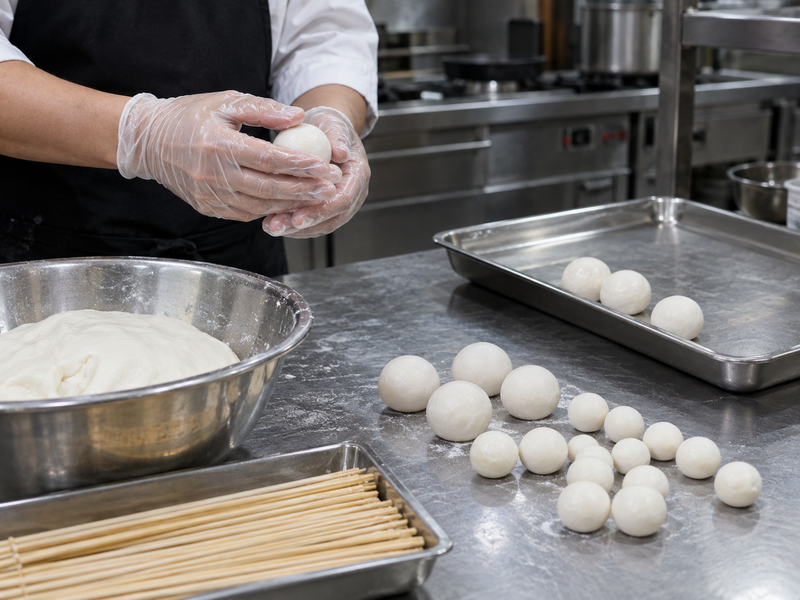
Describe the shapeable dough in practical terms
Follow the selected base method’s water temperature and mixing sequence. Weigh ingredients and record any adjustment. A tactile description can help staff, but it should accompany measured ingredients rather than replace them.
Shape several pieces and examine the surface. Note whether fine cracks appear during rolling, whether dough sticks to the tool or whether a ball flattens while waiting. Keep the waiting conditions consistent so the comparison reflects the dough rather than different exposure.
For a proposed portion exercise, compare 12-gram and 16-gram raw balls using the same formula. These are unvalidated size trials. Cook and serve both before selecting a size, because raw appearance alone does not establish the finished bite or skewer balance.
Keep an unglazed cooked sample from each portion size. The team can then identify whether a firm or sticky impression comes from the dumpling itself.
Once a size is selected, record a photograph beside the actual skewer and tray. A ball that fits comfortably in the hand may be too large for the intended portion or packaging. Resolve that fit before making a large batch of dough.
4. How can staff portion round dumplings efficiently?
Check the beginning and end of each tray
Divide dough in a way that suits the batch size, then weigh representative pieces. A long rope cut by eye may create larger pieces at one end. A scoop can also vary if staff compress it differently. Choose a method that normal operators can repeat.
Roll with enough pressure to close surface imperfections without flattening the shape. Keep the working quantity manageable and protect remaining dough according to the base method. Record if the last pieces become harder to roll than the first.
| Portioning observation | What to compare | Useful response |
|---|---|---|
| Unequal raw weights | First and last pieces | Reset division method |
| Surface cracks | Fresh and waiting dough | Review exposure |
| Flat bottoms | Tray contact and dough state | Adjust handling |
| Slow rolling | Tool and operator sequence | Simplify the setup |
Count pieces per tray and calculate expected skewers before cooking. A planned three-piece skewer requires a multiple that supports complete servings, with any assessment samples accounted for separately.
Retain examples of acceptable shape variation. Staff should know when a slightly imperfect sphere is usable and when a split surface needs correction before it enters the pot.
5. What should the cooking and draining trial establish?
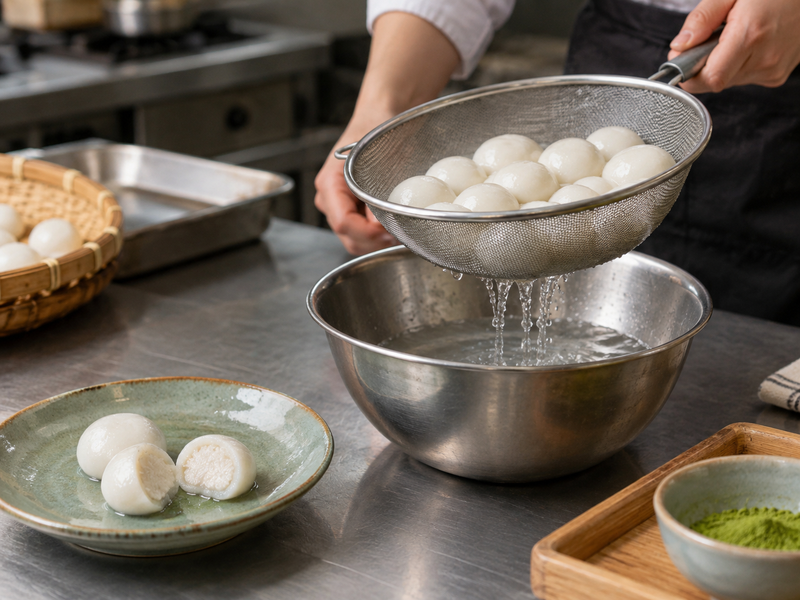
Inspect the dumpling beneath the glaze
Use the complete cooking method chosen for your flour and portion size. Record pot load and starting conditions. Floating can be observed, but the kitchen still needs a validated cooking procedure rather than a universal rule based only on buoyancy.
Check samples after the normal cooling or finishing step in that method. Assess their bite and cut a few open to inspect the center. Keep the plain samples available before any glaze is applied.
Drain consistently before skewering. Excess surface water can complicate glaze coverage and make the serving tray look wet. Record the draining tool and working quantity so one operator does not empty a large pot into a small sieve while another drains in small portions.
Taste dumplings at the planned serving condition. Warm, cooled and chilled samples may provide different eating experiences. Choose the condition your service can reliably deliver and evaluate it directly.
If a batch produces uneven texture, compare raw portion weights and flour records before changing the glaze. A glossy coating may hide visual defects but cannot resolve an inconsistent dumpling underneath.
6. How should the matcha glaze be developed?
Keep tea strength separate from glaze thickness
Start with a glaze base already suitable for the selected dumplings. If it uses starch, follow that base recipe’s dispersion and cooking method. Do not add dry starch or matcha casually to a finished hot sauce and assume the result will repeat.
As an unvalidated screening proposal, compare 0.5, 1 and 1.5 grams of matcha for each 100 grams of prepared glaze base. Keep the base composition and application amount constant. These are tea-level trials, not a finished glaze formula.
| Glaze property | Test on the actual skewer | Question |
|---|---|---|
| Tea intensity | Bite with a full dumpling | Is matcha recognizable? |
| Coverage | Spoon over upper surface | Does it spread evenly? |
| Flow | Place skewer in serving tray | Does it pool underneath? |
| Appearance | Inspect a thin smear | Are powder specks visible? |
If the glaze is too thick or too thin, run a separate base adjustment after selecting the approximate tea strength. Changing both at once makes the tasting difficult to interpret.
Measure the applied glaze by weighing setup skewers before and after finishing. A small difference repeated across a day’s service affects flavor, appearance and ingredient use.
7. What makes a skewer comfortable to assemble and eat?
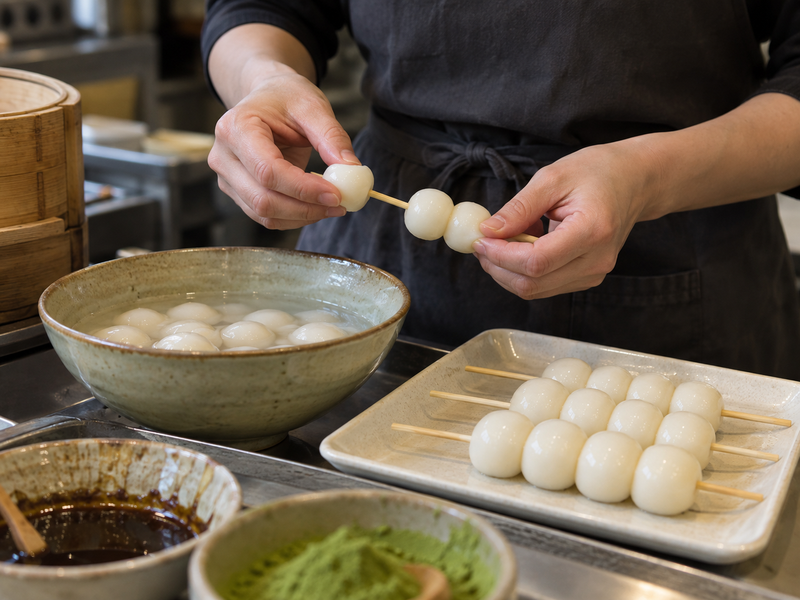
Test the whole serving gesture
Choose skewers intended for food use and inspect their finish before use. The handle needs enough room for the customer and the service team to hold it without touching the dumplings. Test the selected length with the actual tray.
Arrange the cooked pieces evenly without forcing the skewer through them at an awkward angle. Support each dumpling during assembly so pressure does not deform the row. If pieces repeatedly split, record where the split occurs and compare the cooking condition and skewer size.
As a serving trial, compare two- and three-piece portions with the same dumpling size. Those are menu options to evaluate, not fixed traditional requirements. Have staff lift and set down each format using the planned packaging.
Check whether the customer can remove a comfortable bite without the remaining pieces sliding. A beautiful row that is awkward to eat needs redesign before photography.
If the product will be plated rather than held, a short skewer or another presentation may suit the cafe better. Keep the final menu description aligned with the serving format you approve.
8. How should holding and takeaway conditions be tested?
Follow the real service path
Observe one freshly finished skewer, then another after the realistic delay between preparation and eating, all within approved food-safety controls. Note glaze movement, surface wetness and changes in bite. Record the actual delay rather than using phrases such as holds well.
Put takeaway samples inside the chosen closed tray. Lid clearance and contact with neighboring skewers can change the appearance. Include the normal handoff and carrying route in the comparison.
| Service point | What to inspect | Why it affects the customer |
|---|---|---|
| After glazing | Even coverage | Expected first appearance |
| At the pass | Pooling or sticking | Clean handoff |
| Inside the pack | Lid and side contact | Undamaged topping |
| At consumption | Bite and skewer grip | Comfortable eating |
These checks describe quality under tested conditions. They do not establish a commercial shelf life or justify unrestricted ambient holding.
If chilled storage or freezing is planned, evaluate that route as a separate product process. A freshly made skewer cannot demonstrate how the same dough will behave after storage, transport and reheating. Keep each approved service route clearly identified.
9. What does a sensible cost sheet include?
Count complete skewers and glaze residue
Track the number of acceptable cooked dumplings, not merely raw dough weight. Divide usable pieces by the approved pieces-per-skewer and account for the samples cut during quality checks. Record broken or misshapen pieces separately.
For an illustrative example, 93 usable dumplings support 31 three-piece skewers. If six more pieces fail during assembly, only 29 complete skewers remain. Those hypothetical figures show why assembly losses belong in costing; they are not a performance benchmark.
Include skewers, trays, glaze, labor and cleaning. Weigh the glaze left in its container after a pilot run. A small service batch with frequent container changes may use more glaze per sold portion than the theoretical recipe suggests.
For tea sourcing, send Matcha Village the glaze composition and the finished serving condition. The site’s matcha glaze guide provides related formulation questions. Request Chinese matcha samples for your actual glaze rather than choosing solely from a dry-powder photograph or a plain-water tasting.
10. Which records make the product repeatable across branches?
Transfer the dough and service standards together
A branch needs the approved flour products, mixing method, raw portion weight, cooking procedure and glaze specification. It also needs the exact skewer and tray. Leaving those small items unspecified can produce a noticeably different dessert even when the ingredient recipe is unchanged.
Show a plain cooked dumpling, a correctly assembled skewer and the final glazed serving. Include an example of unacceptable pooling or splitting so staff can recognize a problem before serving.
| Branch record | Main user | Confirmation method |
|---|---|---|
| Flour and dough sheet | Prep cook | Ingredient and weight check |
| Cooking instruction | Service cook | Approved process record |
| Glaze application | Finishing staff | Weighed setup skewer |
| Pack photograph | Counter staff | Closed-pack comparison |
Keep the recipe’s source notes separate from the working instruction. The operator needs the version approved by your kitchen, including resolved quantities, rather than an ambiguous webpage printout.
Before adding the dessert to another branch’s menu, have its normal shift prepare a small batch and return observations on plain-dumpling bite, glaze flow and the packed serving.
FAQ
Q1: Does the dough have to contain matcha?
No. A plain dango base with a green tea glaze is a distinct serving option and simplifies the first formulation comparison.
Q2: Can rice flours be swapped freely?
No. Record their identity and use a complete method suited to the selected products. Test replacements before production.
Q3: Why does glaze slide off the dumplings?
Check surface water, glaze consistency and application amount. Evaluate those variables separately before increasing matcha.
Q4: Must every skewer contain three pieces?
No. Choose a portion that fits your dumpling size, customer and packaging, then document it consistently.
Q5: Can the inspiration recipe’s storage advice be used commercially?
No. Validate the actual formulation and service route, including any chilled storage, freezing or reheating.