
A useful matcha concentrate does one job: it lets a cafe make the same drink during a busy afternoon that the developer liked at the tasting table. Matcha is powdered leaf suspended in liquid, so its particles can settle, its green color can change, and a sweetened base may behave differently from an unsweetened one. Start with a serving brief, then work backward to a base that staff can measure, store and mix reliably.
Contents: Use · Powder · Dose · Liquid · Sweetness · Mixing · Storage · Service · Cost · Approval
1. What Job Should the Concentrate Do?
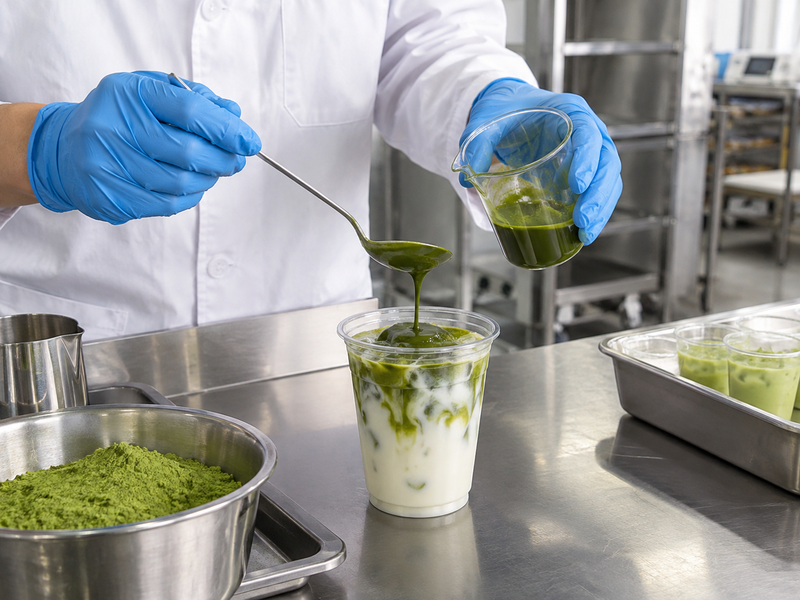
Write the drink before the base
Decide whether the concentrate is for iced lattes, hot lattes, mocktails or a bottled beverage. These are different uses. A base that tastes clean in chilled milk can disappear under citrus or become too bitter when diluted with hot water. Put the finished serving volume, tea taste, sweetness and appearance into a short brief. Include the cup and the liquid that the cafe actually uses. A development team can then judge each base in a finished drink rather than tasting spoonfuls of concentrated matcha and guessing how they will translate.
Set a practical target
Record the intended number of pours from one bottle and the maximum steps allowed at service. If a barista must shake, weigh and filter for every order, the base has not solved the speed problem. If the drink must be unsweetened, leave sugar out of the brief at the beginning; removing it after the formula is approved changes body and perceived bitterness. Keep a simple reference made from freshly whisked powder alongside every pilot. It shows whether the convenience ingredient has preserved the flavor guests came for.
| Intended use | What the base must deliver | Trial drink |
|---|---|---|
| Iced latte | Even tea dose and green color | Base plus usual milk and ice |
| Hot latte | Smooth mixing without clumps | Base plus steamed milk |
| Mocktail | Flavor that survives acid | Base plus actual mixer |
2. Which Matcha Powder Belongs in the Base?
Compare powders at the same dose
Ask for more than one lot or grade and prepare each with the same equipment, liquid and matcha amount. A visually bright dry powder is promising, but the drink decides. Look for aroma after dilution, bitterness at the end of the sip, particle feel and color after a normal wait. A powder that is excellent when drunk plain may be too delicate for a sweetened milk drink. A stronger foodservice grade may perform better and cost less per cup. Evaluate those alternatives blind if possible, labeling the cups with codes rather than prices.
Keep purchase criteria tied to the test
For a commercial base, ask the supplier for the product specification, lot identification and available test documents. Set an acceptable sensory range using the approved sample. This does not mean promising that every harvest looks identical. It means knowing what change requires another trial. Matcha Village can supply matcha grades and blending options for B2B development, but the buyer still needs to approve the selected powder in its own liquid and equipment. Do not switch to a cheaper grade after launch without repeating the finished-drink comparison.
3. How Much Matcha Should One Serving Deliver?
Work backward from the cup
Start with the tea dose that tastes right in one finished cup. Decide how many servings the concentrate should make, then calculate the powder needed for that number of pours. The dose per cup matters more than an impressive sounding percentage on a product sheet. A ten milliliter pour of a thick base and a larger pour of a thinner base can deliver the same matcha mass. Make both versions if dosing accuracy at the counter is uncertain. Staff may reproduce a measured pump volume more easily than a tiny splash from a bottle.
Watch the other ingredients
If the base contains syrup, milk solids or flavors, a nominal matcha percentage tells only part of the story. Keep powder grams, total batch mass and serving yield on one worksheet. Label pilot bottles with a batch code and intended serving size so tastings are traceable.
| Measurement | Record on the batch sheet | Why it matters |
|---|---|---|
| Powder mass | Grams added to the batch | Tea dose and costing |
| Finished base mass | Mass after all additions | Concentration calculation |
| Pour per drink | Weight or calibrated volume | Repeatable service |
| Final cup | Ingredients and fill volume | Actual flavor and color |
4. Which Liquid Makes the Best Pilot Base?
Start simply
Water gives the clearest reading of the matcha itself. Mix a small unsweetened water base first, then test the liquid system required by the final product. A cafe may want a water-based concentrate that works across dairy and plant milks. A bottled ready-to-drink product is a different development job; its processing, packaging and storage need to be assessed as a whole. Avoid assuming that a cafe concentrate can be put into a sealed shelf-stable bottle with the same recipe. The commercial route should be chosen before the team commits to a long production run.
Compare in the real preparation sequence
Water temperature, mineral content and mixing order can all affect the first impression. Wet the matcha into a smooth slurry before adding the remaining liquid; then try the same sequence with the equipment available in production. If the plant uses high-shear mixing and the cafe uses a hand whisk, test both. Observe foam, settling and how easily residue rinses from the vessel. The aim is a method staff can reproduce, rather than the brightest result obtained once under ideal conditions.
5. Should the Concentrate Contain Sweetener?
Choose flexibility or speed deliberately
An unsweetened matcha concentrate lets a cafe use the same base in an iced latte, a low-sugar drink and a flavored special. A sweetened base reduces service steps and can give a familiar taste across sites. Neither option is automatically superior. Ask which menu items will use the product, how much training staff can absorb, and whether the sweetness needs to change for different customers. Prepare both versions with the same tea dose and compare them in the finished cup. Sweetener can make a weak matcha seem acceptable for a moment while hiding the tea aroma the brand wants to sell.
Check the label implications
If sugar, syrup or another sweetener goes into a packaged concentrate, the ingredient statement and nutrition information need to describe that product, not an unsweetened prototype. The FDA’s ingredient guidance explains that ingredients generally appear in descending order by weight on US food labels. Other markets have their own rules. Have the intended label and claims reviewed for the destination market before printing. A cafe’s internal batch sheet may be simpler, but staff still need an accurate allergen and ingredient record for anything added to the base.
| Base design | Operational gain | Tradeoff to test |
|---|---|---|
| Unsweetened | Flexible menu use | Extra sweetening step |
| Lightly sweetened | Fast common recipe | Less room for custom drinks |
| Flavored and sweetened | Single-pour special | More restricted applications |
6. How Will You Keep the Powder Evenly Dispersed?
Watch the bottle, not only the first pour
Matcha particles remain suspended for a time and then may settle. Fill a clear pilot bottle, take a serving immediately, and repeat after the normal time between uses. Compare the top, middle and final pours. If the first customer receives pale liquid and the last gets a thick green layer, a tasting from the freshly mixed tank has missed the problem. Record whether a brief shake restores the base and whether that instruction is realistic at a busy station. Check the mouth of the bottle or pump for blocked powder deposits too.
Change the mixing process before adding complexity
Begin with controlled powder wetting and a repeatable mixing time. If the base still settles too quickly, the development team can consider a different particle or process approach and, where suitable, a stabilizing system. Each ingredient and process change needs its own taste, label and storage review. Do not add a gum simply because the bottle looks more even; the finished latte may become heavy or slimy. Keep photographs of the same bottle at set intervals and serve from it during the evaluation.
7. What Storage Plan Fits the Product?
Treat a fresh cafe batch differently from a retail bottle
A small fresh base held for same-day service and a product shipped to stores have different requirements. Define the production method, container, handling, temperature and intended use period before making a shelf-life claim. A green drink that still tastes acceptable is not, by that fact alone, microbiologically suitable. Work with the responsible food safety team and qualified testing provider for the product and market. Record the preparation time, storage conditions and discard rule on the cafe operating sheet. If the base is sold or transported, build a separate validation plan rather than extending the cafe rule by intuition.
Observe flavor and color in the intended pack
Test the chosen bottle with real opening and closing cycles. A base may look good in a sealed laboratory jar but lose its tea aroma once repeatedly opened at the bar. Sample after realistic handling and compare against the fresh reference. Note exposure to light and the time a container stays on the counter. For private-label projects, agree who owns storage testing, packaging selection and final label approval. This prevents a sample’s attractive first-day appearance from being mistaken for a verified commercial life.
| Scenario | Practical check | Decision owner |
|---|---|---|
| Fresh cafe batch | Handling and discard method | Cafe food safety lead |
| Multi-site chilled base | Distribution and use conditions | Brand and manufacturer |
| Retail ready-to-drink | Validated process and shelf life | Qualified product team |
8. Can Staff Build the Drink Consistently?
Make a station card that fits on one page
Show the concentrate amount, cup size, ice, milk or water amount, mixing order and finishing step. If the base needs shaking, put that instruction before the pour. Use the actual pump, bottle or measuring cup that the shop will buy. Train two people who were not present at the development session and compare their drinks with the reference. Ask staff where the process slows them down and whether cleanup creates an issue during a rush.
Check the last serving
Run an entire bottle through a short simulated service. Measure several pours, including the last one, and taste complete drinks. Watch for sediment, inconsistent pump fills and drips on the station. If the last cup is too strong, improve mixing or the dispensing method before launch. If the equipment is hard to clean, build cleaning into the operating plan and test that it happens under normal staffing.
9. Does the Concentrate Improve the Operation?
Count the whole cost per drink
Powder price is one line. Include sweetener, packaging, labor to mix, waste from expired batches, shipping where relevant and any special equipment. Then compare the cost and preparation time against freshly whisking matcha for each order. A concentrate may justify a higher ingredient cost if it reliably reduces a bottleneck; it may not help a small cafe selling only a few matcha drinks a day. Use measured trials rather than assuming that a bottle always saves money. The useful number is cost per acceptable finished drink, including discarded product.
Decide who replenishes it
For a manufacturer-supplied base, set a reorder point and a lead time that fit the cafe’s sales pattern. For a base mixed in-house, write down batch size, equipment and who checks it. Too large a batch raises waste and storage demands. Too small a batch pulls staff away from service. Review sales after the first week and adjust the batch size using actual orders. A stable recipe can fail commercially because the workflow was designed around a forecast no one revisited.
| Cost line | Include in trial | Common omission |
|---|---|---|
| Ingredients | Matcha, liquid, sweetener | Recipe losses |
| Work | Mixing and cleaning time | Rush-hour interruption |
| Pack | Bottle, cap, label | Partly used stock |
| Waste | Discarded base | Overlarge batches |
10. When Is the Base Ready for a Larger Batch?
Approve a repeatable reference
Make the preferred pilot twice on different days using the written procedure. Compare its appearance and flavor in the target drink and keep a labeled retain sample where the process calls for one. Agree on acceptable tea intensity, sweetness, dispersion and pour weight. A signed-off sample, specification and station card make scale-up less ambiguous. If the powder lot or liquid source changes, decide in advance which checks trigger another tasting. The buyer should receive the same core information with every approved shipment: product identity, lot, handling instructions and agreed quality documents.
Scale in stages
Move from bench cup to service bottle to a small production batch before ordering a large run. Each stage can reveal a new issue: a mixer may foam the base, a filling line may leave sediment, or a new bottle may pour differently. Matcha Village can discuss powder grades and B2B sample requirements through its matcha product range. The commercial decision belongs to the team tasting, measuring and labeling the actual product. Approve only after the larger batch performs like the reference in the cup customers will receive.
FAQ
Q1: Is matcha concentrate the same as brewed green tea? No. Matcha is powdered tea dispersed through the liquid, so the base may need mixing before use and can leave particles at the bottom.
Q2: Can one base work in hot and iced drinks? It can, but test both. Temperature and dilution change aroma, sweetness and how easily the base blends.
Q3: Should a cafe choose sweetened or unsweetened concentrate? Choose against the menu. An unsweetened base offers flexibility; a sweetened one can reduce steps. Compare both in complete drinks.
Q4: How long does a matcha concentrate last? There is no universal period. Storage and use life depend on the full formula, process, pack and handling, and should follow an appropriate validation and food safety plan.
Q5: What should a buyer request from a supplier? Ask for the specification, lot identification, ingredient information, handling instructions and the quality documents agreed for the intended product and market.