
A retailer can assemble a bowl, whisk, and scoop in minutes. Calling that box a Japanese matcha tea ceremony set raises harder questions: which tradition does it represent, what should each tool do, and who can explain its use? The history of chanoyu offers a better starting point than a decorative product photograph. This article traces several changes that shaped tea practice, then turns those lessons into concrete checks for sourcing and presenting utensils.
Senbird Tea’s history overview introduces major figures; the Japan National Tourism Organization describes what visitors may encounter today. Neither source makes every tea school identical.
Contents
- 1. Where did Japanese tea ceremony begin?
- 2. Why did powdered tea become part of the practice?
- 3. How did simplicity influence the tea room?
- 4. Why is Sen no Rikyū discussed so often?
- 5. Do all Japanese tea schools use one method?
- 6. What do the main utensils tell us about design?
- 7. How do host and guest shape the occasion?
- 8. What changes in a modern retail tea set?
- 9. How can businesses avoid misleading heritage claims?
- 10. What should buyers verify before placing an order?
1. Where did Japanese tea ceremony begin?
Follow a development, not a single origin story
Tea arrived in Japan through long exchanges with China and changed considerably over centuries. Monastic practice, elite gatherings, and later approaches to hospitality all contributed to forms now associated with chanoyu. JNTO connects the tradition with Zen Buddhism and notes that tea became more widely consumed over time. That broad history matters when a package claims to reproduce an “unchanged ancient ritual.” It cannot. A contemporary kit contains selected tools for contemporary users, even when those tools resemble objects used in a tea room.
For educators and sellers, a short timeline can be more honest than an invented origin tale: tea entered Japan, powdered tea preparation developed, gatherings acquired distinctive aesthetics, and schools preserved different forms. If a product story names a period, person, or technique, have a knowledgeable reviewer check it before the story reaches a label or event script.
| Historical point | What it helps explain | Safe product implication |
|---|---|---|
| Tea’s arrival and adoption | Practice developed over time | Avoid one-date origin claims |
| Powdered tea preparation | Whisk and bowl gained specific roles | Explain each tool’s function |
| Tea gatherings | Host and guest interaction grew central | Do not reduce practice to equipment |
| Later schools | Forms developed different details | Avoid “one correct ceremony” language |
2. Why did powdered tea become part of the practice?
See how the ingredient changes the equipment
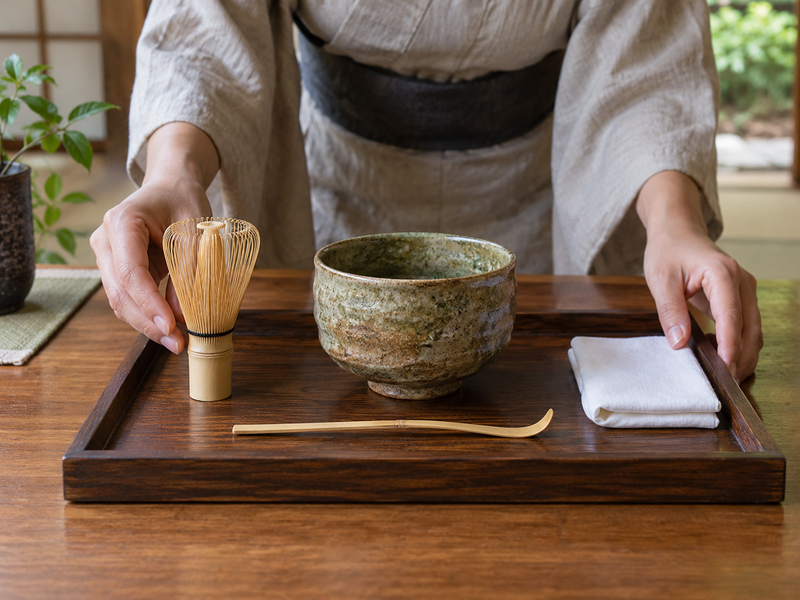
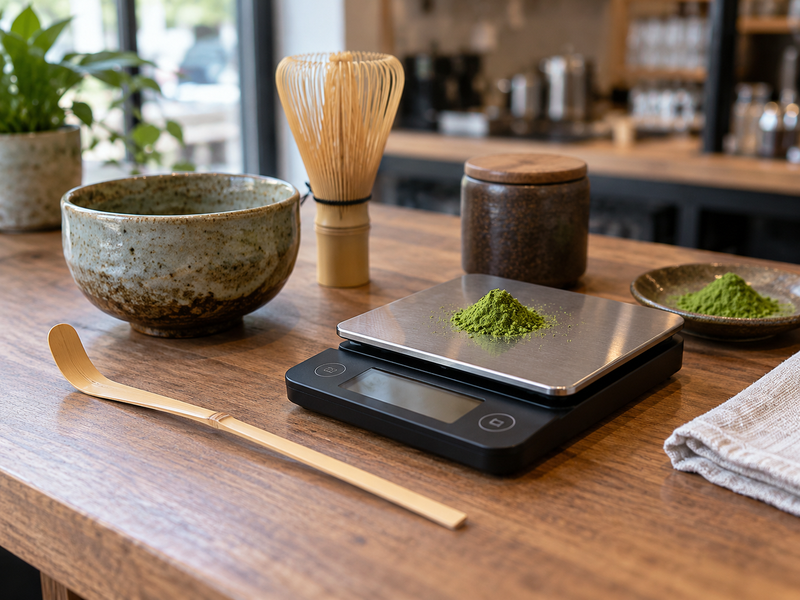
Matcha is finely ground green tea dispersed in water, so preparation involves the powder itself rather than a leaf infusion that is strained away. A bowl offers room to mix and serve. A bamboo whisk helps distribute powder, while a scoop transfers a portion from its container. That physical task explains why the familiar utensils belong together. It does not mean any green powder and three bamboo objects make an appropriate set. For a retail product, check how powder behaves with the supplied whisk and bowl under the printed recipe.
Does the tea clump? Does the bowl give the whisk room? Does the scoop reach the pack without spills? A supplier’s sample should be tested as the customer will use it. A buyer selling unsweetened tea should taste that exact tea without milk or sugar, since a powder that works in a latte may be less pleasant alone.
3. How did simplicity influence the tea room?
Keep aesthetics tied to use
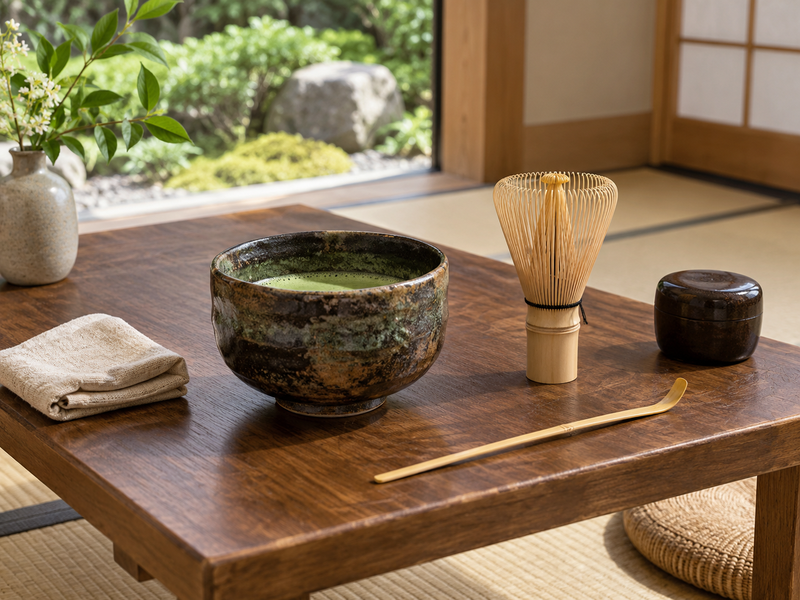
The historical development of wabi-cha favored restraint and close attention to a gathering’s setting. Senbird’s historical account discusses Murata Jukō and later Sen no Rikyū in that development. A rough-textured bowl or muted box color can echo those aesthetics, but copying a visual cue does not transfer the practice itself. For an importer, the lesson is practical: evaluate a vessel in the hand, in use, and after cleaning, not by whether it looks “rustic” in a campaign image.
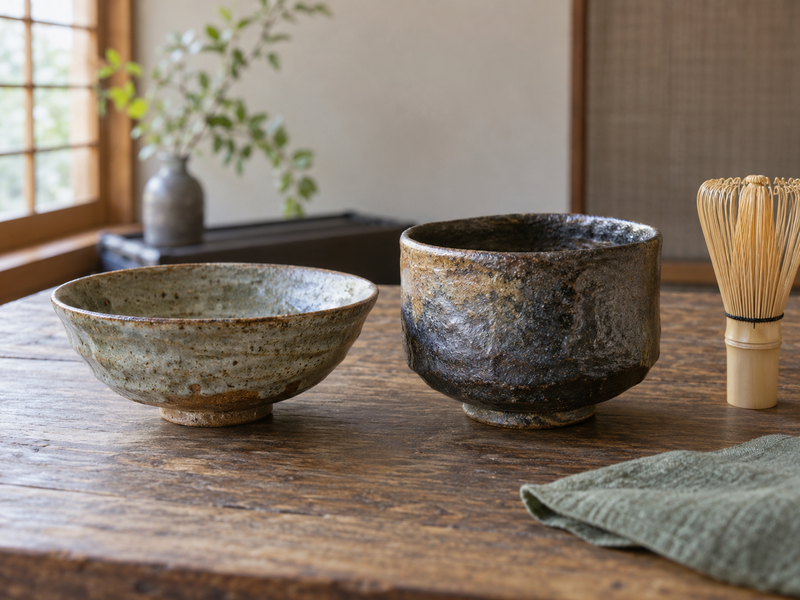
A slightly irregular handmade bowl may be appropriate when provenance is real and each piece can be safely used. A poorly finished mass-produced bowl should not be defended as intentional imperfection. Ask for maker, material, finish, food-contact, and care information. When selling a handmade piece, explain expected variation accurately and show customers a realistic sample rather than one exceptionally photogenic unit.
| Design choice | Historical association | Buyer check |
|---|---|---|
| Understated bowl form | Attention to object and setting | Stable base and comfortable rim |
| Visible handmade variation | Craft process | Document maker and acceptable range |
| Quiet presentation | Focus on guest experience | Legible instructions and secure packing |
| Seasonal selection | Relationship between tea and occasion | Do not claim one design fits every school |
4. Why is Sen no Rikyū discussed so often?
Credit a historical influence without turning it into a slogan
Sen no Rikyū is widely associated with the development of wabi-cha. JNTO names harmony, respect, purity, and tranquility among principles connected with his influence. Those ideas concern conduct and attention, not a checklist that a commercial set can guarantee. A gift box cannot make its purchaser respectful; staff behavior and a considered hosting format can help create that condition. If a brand uses Rikyū’s name in copy, it should explain the limited connection and have the text reviewed.
Do not imply an endorsement by a historical school or claim a mass-market set reproduces his equipment. A useful, modest statement would say that Japanese tea practice has informed the choice of a bowl, whisk, and scoop. Even that statement should be supported by a working preparation guide. Buyers can also direct curious customers toward a teacher or cultural institution for deeper study.
5. Do all Japanese tea schools use one method?
Leave room for trained practice
No. JNTO notes that many schools have differences in their forms, even where broad elements look similar to a visitor. Senbird describes the three Sen family schools, which are often introduced together, but a seller should not compress their differences into a single set of instructions. Bowl handling, preparation, and guest exchange are taught within a living practice. If an event advertises a specific school’s method, identify the teacher or host and let that person review the script. If the product is simply a starter kit, make no school-specific claim.
Explain how to whisk an accessible home cup and invite users to seek formal instruction if they want it. This is also a procurement issue: a tea practitioner may reject a bowl that a home customer likes. Sample approval should therefore involve the intended user rather than a buyer judging solely from catalog dimensions.
| Product or event | Suitable instructional level | Reviewer |
|---|---|---|
| Home starter kit | Tested cup recipe and care notes | Product and food-safety team |
| Guided tasting | Recipe plus brief cultural context | Trained host or cultural adviser |
| School-named workshop | School-specific sequence | Qualified practitioner from that school |
| Formal gathering | Full host and guest preparation | Responsible teacher or host |
6. What do the main utensils tell us about design?
Ask what each shape enables
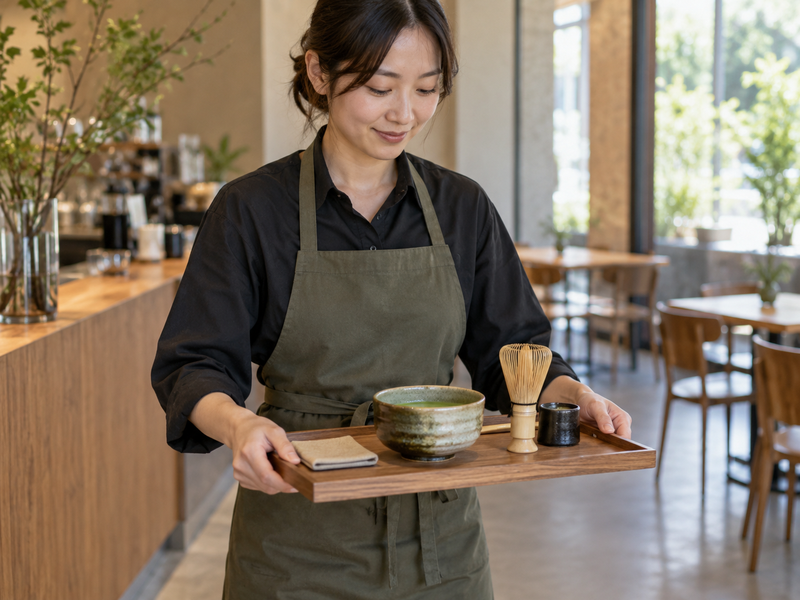
The chawan is made to hold tea and accommodate whisking; the chasen distributes powder through water; the chashaku transfers a measured-looking portion, though its scoop size is not a precise mass measure. A set’s design should help those actions. Test whisk clearance at the recipe’s water level. Inspect the ceramic rim and interior for flaws that affect handling and cleaning. Look at the whisk’s tine condition after a short use trial and ask whether a matching replacement is available.
If a tea container is included, check the opening, closure, and storage note. An ornate lid that cannot be cleaned well causes a problem regardless of its visual appeal. None of these checks require a claim that one bowl profile is universally traditional. They require a real sample and a clear specification for what the customer will receive.
7. How do host and guest shape the occasion?
Make hospitality observable
In a formal tea setting, the host chooses utensils, prepares the space, makes tea, and offers it with attention to guests. Guests respond within the form taught for that occasion. JNTO describes appreciation of the bowl and setting as part of the experience. A retailer need not imitate every gesture, but can still learn from the host’s responsibility. At a public tasting, tell attendees how long the demonstration lasts, whether they will participate, and what they will drink. Make space for questions without demanding that beginners perform unfamiliar gestures.
Watch how staff pass a hot bowl or cup and how they respond when someone declines a taste. Hospitality includes clear information, comfortable access, and permission to ask. A striking tool set cannot make up for rushed service or confusing instructions.
| Host responsibility | Practical commercial equivalent |
|---|---|
| Select utensils for occasion | Test set against actual drink and venue |
| Prepare a welcoming setting | Clean counter, clear seating and access details |
| Make and present tea | Follow a measured, trained service recipe |
| Consider guests | Explain participation without pressure |
8. What changes in a modern retail tea set?
Translate function rather than claiming identity
An export-ready set has demands that a historical tea room did not: shipping protection, multilingual instructions, lot information for included powder, retail labels, and a way to replace broken or worn components. Those requirements are not a betrayal of tradition. They are necessary for a safe, usable product in its actual channel. If a kit includes tea, coordinate powder shelf life with the gift’s expected storage period. If it includes a ceramic bowl, test the protective insert in the complete shipping carton.
If the package contains bamboo, explain drying and storage. The product page should show the exact supplied pieces and avoid staged objects that are not included. A retailer can make an honest connection to Japanese tea preparation while presenting the box as a modern product with contemporary obligations.
9. How can businesses avoid misleading heritage claims?
Check every noun that implies provenance
Words such as Japanese, handmade, school-specific, ceremonial, and artisan each make a different promise. A bamboo whisk shaped like a Japanese chasen does not automatically mean it was made in Japan. Matcha sold for straight drinking does not prove a school endorses it. Document component country of origin separately from a design influence, and confirm how destination-market labeling rules apply before printing packaging. If a brand describes an “authentic ceremony,” it should be able to name the practice and the qualified person responsible. Keep cultural notes sourced and concise.
Avoid sweeping statements about what all Japanese people do. A better habit: write an evidence column beside each proposed claim. If the team cannot fill it, use narrower wording. That approach protects trust with customers and reduces the chance that a source story collapses under a simple buyer question.
| Proposed claim | Evidence needed | Safer wording if evidence is missing |
|---|---|---|
| “Made in Japan” | Origin records for the exact component | State confirmed origin only |
| “Handcrafted” | Maker and process documentation | Describe visible finish without process claim |
| “School-approved” | Written approval and scope | Omit school reference |
| “Ceremony experience” | Qualified host and defined format | “Guided matcha tasting” |
10. What should buyers verify before placing an order?
Turn a cultural story into a product specification
Start with the intended customer: home beginner, tea lover, café trainer, or event host. Then request an assembled sample and prepare tea with it. Record bowl dimensions and stability, whisk condition, scoop fit, packaging protection, cleaning directions, tea lot details, and replacement terms. Match claims on the box against supporting records. At Matcha Village, buyers can discuss powder format, intended recipe, destination market, and possible tea-and-tool combinations, then request current specifications and samples for their own checks.
Do not publish a certification or testing claim until the actual product documentation supports it. Finally, ask one person outside the buying team to follow the draft instructions. Their pauses often reveal more than another round of packaging copy edits. An informed set buyer respects both the customer’s cup and the tradition that inspired the tools.
Final thoughts
Japanese matcha tea ceremony developed through people, schools, spaces, and objects over time. The bowl, whisk, and scoop matter because they support preparation and hosting. A modern seller should verify function and provenance, describe cultural connections precisely, and let trained practitioners speak for their own forms. Request a working sample, review each claim, and give customers a clear path toward further learning. A truthful explanation makes a simple set more useful than a grand but unsupported story.
For a closer look at individual utensils, see our matcha tea ceremony tools guide.
FAQ
Q1. Are all Japanese tea ceremonies identical? No. Schools and occasions differ in their sequences and details. Follow the host’s or teacher’s guidance for a particular gathering.
Q2. Is a three-piece matcha kit a complete ceremony set? It supports basic preparation, but formal practice can involve more utensils, a prepared setting, and school-specific procedure.
Q3. Does “ceremonial grade” prove historical authenticity? No. Judge tea against its specification, intended drink, sensory sample, and documented claims; the phrase alone cannot establish an item’s history.
Q4. Can a retailer explain tea history on a product page? Yes, with sourced, narrow wording. Keep product origin and cultural inspiration separate.
Q5. What should a buyer ask a supplier for? Request assembled samples, component specifications, care guidance, packaging tests, powder records if included, and evidence for every provenance claim.