
Matcha color measurement can help a food manufacturer compare incoming lots, provided both parties measure the same material in the same way. A spreadsheet of green coordinates is difficult to use when sample depth, instrument settings or product preparation differ. Agree a measurement method with the supplier, connect it to an approved application and keep enough detail to investigate a disputed result.
Contents
- 1. Which product state should matcha color measurement describe?
- 2. What do the color coordinates explain?
- 3. Which instrument settings must the supplier report?
- 4. How should the laboratory prepare dry powder?
- 5. How do you define a finished-product color method?
- 6. How should a buyer set an acceptance window?
- 7. How can buyer and supplier laboratories compare results?
- 8. What role should photographs play in remote approval?
- 9. How do you investigate an unexpected color result?
- 10. What belongs in a supplier measurement request?
1. Which product state should matcha color measurement describe?
Name the material before requesting numbers
Put the product state in the test request. Dry powder, a water preparation and a finished drink each need their own preparation and observation instructions. Purchasing should identify which result supports incoming ingredient release and which result supports the finished-product brief. Keep these results in separate fields so a powder reading does not become an implied claim about the color of a bottled beverage.
Ask development where customers will judge appearance. A chocolate manufacturer may care about the cut surface of a filling. A bakery may need separate surface and crumb observations. Select the view relevant to the product, then keep its preparation and timing consistent across candidate lots. This avoids asking the supplier to meet an appearance requirement defined only after processing.
| Material being measured | Preparation record | Purchasing use |
|---|---|---|
| Dry ingredient | Cup, fill and surface preparation | Incoming comparison |
| Controlled dispersion | Recipe and observation time | Ingredient development |
| Finished food | Process, location and product age | Application approval |

2. What do the color coordinates explain?
Keep the interpretation within color
In CIELAB, L describes lightness, while a and b describe chromatic directions. Negative a points toward green and positive a toward red; positive b points toward yellow and negative b* toward blue. Konica Minolta’s color communication guide explains these coordinates. They do not establish taste, organic status or origin.
Ask the laboratory which color space it reports and how it identifies a result. A file labeled Lab without the method details may leave the buyer unsure what was calculated. Keep the instrument’s report and the approved specification together, including units or notation used by the laboratory. Avoid retyping values into a purchasing sheet without retaining the source report.
Use the coordinates to describe an observed difference under the agreed conditions. Do not rank every powder by whichever coordinate appears most attractive. Your product brief may tolerate one kind of change and reject another. Development should explain which observed changes affect the finished food, while quality decides how the ingredient comparison supports the release process.
3. Which instrument settings must the supplier report?
Request a method identity with every result
Create a method cover sheet that names the instrument, measurement mode, relevant geometry, aperture, illuminant and observer settings. Ask the laboratory to identify any settings it considers critical for the supplied material. Keep the method revision on the result so a change is visible when purchasing compares records over time.
CIE Colorimetry covers observers, illuminants, reference standards, viewing conditions and color calculations. Its public description establishes why those conditions belong in a measurement discussion; it does not supply a universal matcha acceptance value.
| Report field | What the buyer needs | Follow-up when absent |
|---|---|---|
| Instrument and mode | A reproducible method identity | Request laboratory procedure reference |
| Measurement conditions | Settings attached to the result | Pause numerical comparison |
| Sample preparation | How material reached the instrument | Obtain preparation instructions |
| Reference identity | Exact target used for comparison | Confirm approved reference revision |
If the supplier uses an external laboratory, request the laboratory’s result rather than a cropped image of its final number. A complete report makes a later method comparison easier.
4. How should the laboratory prepare dry powder?
Make repeated preparations possible
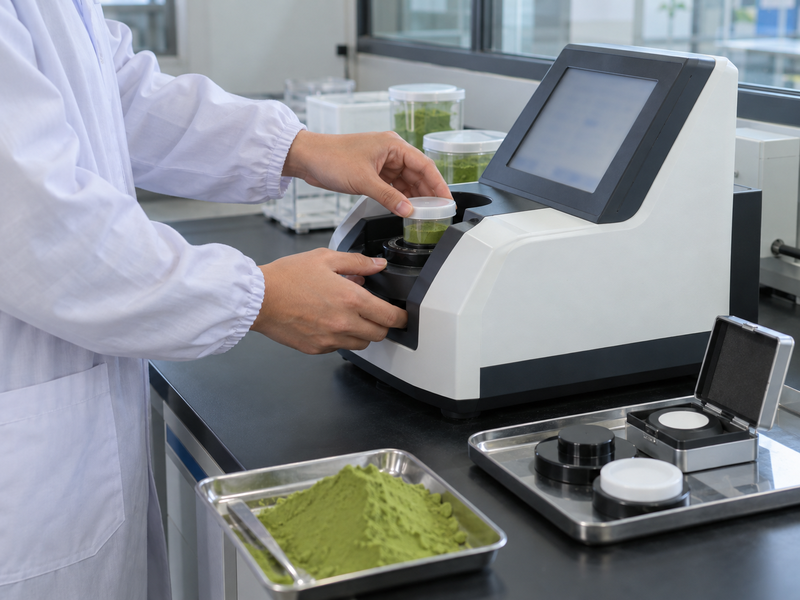
Ask the laboratory to demonstrate its powder presentation method and document the steps. Relevant details may include the sample cup, how powder is transferred, how the surface is prepared and whether the reading passes through a window. Follow the instrument manufacturer’s instructions and the laboratory’s validated procedure. Avoid inventing a universal powder depth for every instrument.
Distinguish repeated readings of one prepared cup from independent preparations. The former can help the laboratory examine instrument behavior; the latter can reveal variation associated with preparing the powder. Let the laboratory choose an appropriate repeatability exercise for your decision and retain the individual results. Buying teams should understand what the repetitions represent before accepting an average.
Record any visible surface problem or contamination of the measurement window. If the laboratory repeats a preparation, preserve the reason and the original result. Do not press, level or redistribute only the sample that looks unusual without following a documented rule. The goal is to make the next operator capable of reproducing the preparation, including when a lot sits near the buyer’s acceptance boundary.
5. How do you define a finished-product color method?
Use the production question to choose the view
Write a separate method for the actual food. Name the formula revision, processing conditions that the trial records, sample location and age at observation. A beverage method also needs a defined vessel and presentation routine. A bakery method should specify the surface or cut face being examined. Record enough detail that the supplier’s application team and your development team can compare like with like.
Keep a photograph of the sampling position as an instruction aid where useful. It should demonstrate how to present the sample, not become the color standard itself. Ask quality how damaged, foamed or visibly uneven samples will be treated, then include that rule in the method before testing commercial candidates.
| Application | Location to define | Record that supports interpretation |
|---|---|---|
| Ready-to-drink beverage | Prepared vessel or approved package view | Mixing and observation timing |
| Filled confectionery | Selected cut surface | Formula and production stage |
| Baked product | Surface or crumb position | Bake record and cooling stage |
Approve the finished-product window through the actual development work. A supplier’s powder specification can support that work without predicting the outcome of every formula.

6. How should a buyer set an acceptance window?
Connect measured differences to approved products
Collect examples from development that the business accepts and examples it would reject for the intended product. Ask the technical team to review the measurements alongside those decisions. The buyer then has a basis for discussing a useful acceptance window with the supplier. A window copied from another company’s powder grade may have little relationship to the buyer’s product or measurement method.
If the specification includes a color-difference calculation, identify the formula, reference and reporting settings. Ask the laboratory how measurement uncertainty and preparation repeatability affect results near the proposed boundary. Keep the numerical decision rule in the approved specification. Do not let a spreadsheet select whichever calculation produces the most favorable answer after a disagreement.
Separate development preference from contractual rejection. A target may describe the desired appearance, while acceptance criteria define what purchasing can receive under the agreement. Explain how deviations will be handled, including whether another application can be considered. A written decision process is necessary when a technically acceptable ingredient still produces a commercially unwanted shade in one finished food.
7. How can buyer and supplier laboratories compare results?
Exchange samples before arguing over values
Arrange a comparison using well-identified portions from the same material, packaged and handled under an agreed plan. Each laboratory should use the documented method and return its preparation notes with the results. Keep the sample dispatch and receipt dates so handling differences remain visible. Choose material suitable for the comparison and agree who will assess its condition on arrival.
Start by comparing methods, then consider results. Different instruments or sample presentation routines may need a technical review before their numbers can share one acceptance window. Ask both laboratories to identify settings that cannot be matched and explain how that affects interpretation.
| Comparison step | Exchange between laboratories | Decision enabled |
|---|---|---|
| Before dispatch | Method sheets and sample identities | Confirm comparable work |
| On receipt | Pack condition and handling notes | Identify compromised portions |
| After measurement | Individual readings and preparation records | Assess agreement and causes |
If the laboratories cannot establish comparability, nominate an agreed referee method or laboratory for disputes. Record that arrangement in the purchase specification before relying on measurements from routine shipments.
8. What role should photographs play in remote approval?
Preserve the original viewing record
Use photographs to show sample identity, presentation and visible condition. Agree lighting, background, camera position and file handling when remote comparison is part of the project. Retain original images and name the sample state shown. A photograph taken on a warehouse pallet cannot be compared meaningfully with a supplier’s carefully lit product image without acknowledging the different conditions.
Avoid using edited marketing images as approval references. Ask the supplier for an unfiltered comparison of the relevant portions under the agreed setup. When a remote reviewer sees a concern, turn it into a request for a controlled examination. A message saying darker than expected should lead to a sample and method discussion, not an immediate claim about origin, processing or safety.
Keep visual observations and instrument readings in separate fields. They may prompt useful questions about one another, but the record should show how each was obtained. If a decision relies on an in-person appearance assessment, identify the approver and the physical reference. The electronic image should document that decision without pretending to reproduce every viewing condition.
9. How do you investigate an unexpected color result?
Check the measurement before assigning a cause
Hold the result with its sample identity and preparation record. Ask whether the reference is the correct revision, whether the instrument checks were satisfactory and whether the sample presentation followed the procedure. Repeat work only under the documented investigation rule. Repeatedly measuring until a favorable value appears leaves the buyer without a defensible release decision.
Next, compare the delivered material with retained portions and review pack history. The matcha storage guide can help frame questions about handling, but the lot investigation needs actual records. Color alone cannot identify when or why a change occurred.
| Finding | Investigation route | Evidence to preserve |
|---|---|---|
| Wrong reference revision | Recalculate or repeat under approved method | Both reference identities |
| Preparation departure | Follow the documented repeat rule | Original and repeat records |
| Confirmed product difference | Technical and commercial disposition | Lot evidence and approval decision |
Tell production which material remains on hold while the investigation proceeds. Keep the operational stock instruction separate from an email discussing possible technical explanations.
10. What belongs in a supplier measurement request?
Send a method package with the sample request
Include the product state, intended application, sample identity requirements and the information expected on each report. Attach your existing method if one is approved. If no method exists, ask the laboratory to propose a development exercise before purchasing agrees numerical acceptance criteria. Allow the technical teams to resolve preparation details without turning an early estimate into a contractual guarantee.
State whether the buyer needs raw coordinates, comparison with a reference, individual readings or a report from an independent laboratory. Explain how the data will be used so the supplier can distinguish routine lot monitoring from a development study. Request notice before a method, instrument or reporting convention changes.
For the next trial, prepare one complete method sheet and identify the approved product example. Send both to the supplier’s technical contact, ask for the matching laboratory procedure and schedule a shared-material comparison. Assign quality to record the agreed method revision before purchasing adds any color acceptance clause to the order.
FAQ
Q1: Is a greener result always commercially preferable?
The answer depends on the finished-product brief. Development should choose the appearance the brand needs and examine it with flavor and process performance, rather than ranking one coordinate in isolation.
Q2: Can two laboratories use different instruments?
They can investigate comparability through a planned method comparison. Keep instrument and preparation details visible, and agree how disputes will be resolved before applying a common acceptance rule.
Q3: Can an older reference remain in use indefinitely?
Give the reference a controlled review and replacement process. Document its condition and handling history; an unexamined old reference can make a new lot appear different for the wrong reason.
Q4: Must every customer receive the same color report?
Customers may have different applications and methods. Identify which report supports each specification, and prevent a powder result from being reused as approval for an unrelated finished product.
Q5: Should purchasing ask for a single pass or fail label?
Request the underlying result and method identity as well. A label without measurements, reference information or a decision rule gives the buyer little evidence when a shipment needs investigation.