
Matcha sensory evaluation helps a purchasing team decide whether an ingredient delivers the intended flavor and texture in a defined product. A useful session begins with a question the team can answer, such as whether a replacement powder changes an established latte. Keep supplier identities hidden, prepare samples consistently and record individual observations before discussing which material to approve.
Contents
- 1. What decision should matcha sensory evaluation answer?
- 2. Who should participate and who should prepare samples?
- 3. How should you prepare comparable matcha samples?
- 4. Which tasting words belong on the evaluation form?
- 5. How do coded samples reduce supplier expectations?
- 6. What conditions make a tasting session easier to interpret?
- 7. How should the team record disagreement?
- 8. When is a difference test appropriate?
- 9. How do sensory results connect to a production trial?
- 10. What should a sensory approval tell purchasing?
1. What decision should matcha sensory evaluation answer?
Choose one question for the session
Supplier selection, recipe development and replacement approval need different answers. During selection, the team may describe several powders and shortlist those that suit a menu. During replacement approval, the team may need to establish whether people perceive a difference from an existing product. Asking participants to perform both jobs on one form can produce comments that purchasing cannot interpret.
Write the decision at the top of the session plan and identify the product state. A plain water preparation can help describe the ingredient, while an oat latte addresses performance in that recipe. Decide whether serving temperature and the time after mixing belong to the question. A powder approved for immediate service may still need a separate evaluation for another preparation routine.
| Purchasing question | Useful session output | Next decision |
|---|---|---|
| Which samples suit a new menu? | Attribute descriptions and application fit | Select development candidates |
| Does a replacement change the drink? | A planned sensory comparison | Review substitution |
| Which version do target customers prefer? | Preference evidence from relevant participants | Choose a product direction |
2. Who should participate and who should prepare samples?
Separate preparation from discussion
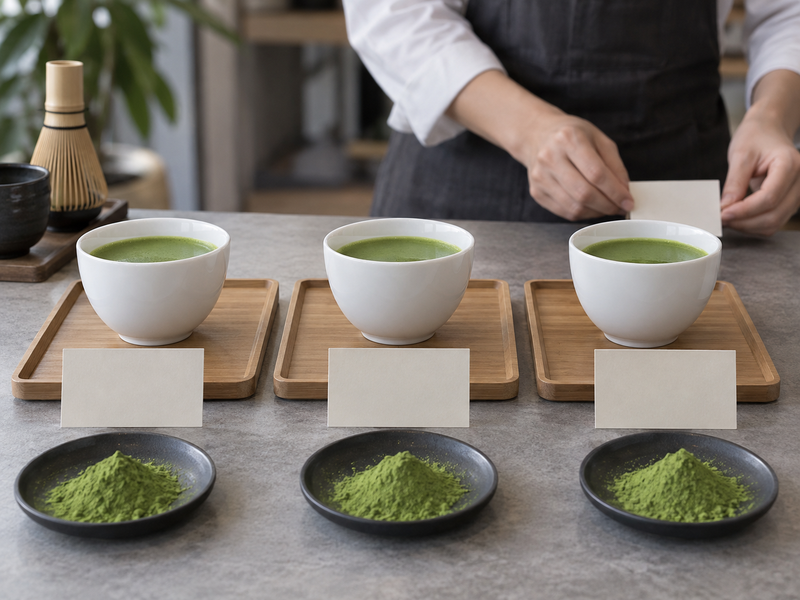
Assign a coordinator who holds the code key and manages preparation. Participants should receive the same instructions without hearing a sales explanation or seeing a supplier price. Keep the purchasing decision-maker involved in defining the question, but prevent that person’s preference from becoming the group’s starting answer.
Choose assessors for the task. Staff who describe ingredient differences need practice using the agreed terms. A customer preference exercise needs people relevant to the intended market and a suitable study design. An internal development panel should not be described as representative consumer research. Ask participants privately whether they can evaluate the supplied ingredients, and provide ingredient and allergen information without revealing supplier identity.
| Role | Responsibility | Avoid during scoring |
|---|---|---|
| Coordinator | Codes, preparation order and timing | Hints about expected quality |
| Assessor | Individual observations | Negotiating a group score |
| Technical owner | Method and interpretation | Changing criteria after results |
Make the session manageable for the people available. If staffing or time prevents a reliable comparison, reduce the question’s scope rather than claiming more certainty from hurried responses.
3. How should you prepare comparable matcha samples?
Control what reaches the cup
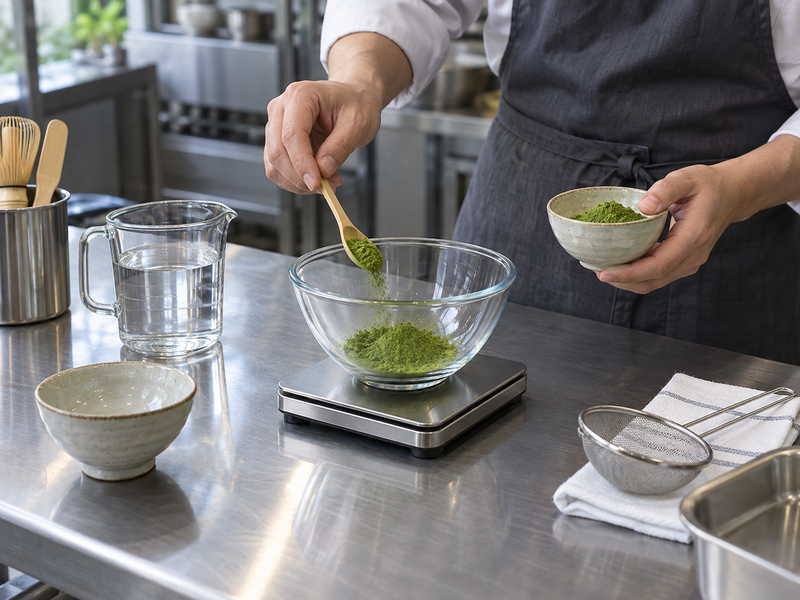
Record the matcha lot, weighed dose, water or base identity, addition sequence and mixing equipment. Match the preparation sheet to the product under review. For a café chain, use the approved service recipe and cups; for a manufacturer, use a development method that the technical team can relate to the production process. Record every departure from that method.
Prepare samples so each participant receives material at the specified stage. If a comparison takes long enough for serving conditions to differ, change the session logistics before interpreting the scores. Keep a preparation log separate from the tasting form so the coordinator can identify a delayed cup without steering the assessor’s response.
Use clean, appropriate utensils and containers, with a documented cleaning routine between preparations. A visible clump, spill or weighing error deserves a replacement preparation when the protocol allows it. Do not fix only the less attractive supplier’s cup while leaving the other untouched. Keep enough sample for a repeat session, and retain the original preparation notes even when a session is excluded for a documented error.
4. Which tasting words belong on the evaluation form?
Agree on meanings before scoring
Use a short vocabulary that describes the product your team buys. Separate aroma, taste, mouthfeel and aftertaste so a participant can report a specific concern. Ask what each term means to the panel and how people will use the scale. Words such as smooth and strong become difficult to compare when one assessor means low bitterness and another means thick texture.
The matcha sensory and metabolite study connected panel observations with instrumental measurements within its study samples. It does not provide universal purchasing cutoffs or establish that an instrument can replace every buyer’s tasting work.
| Form field | Proposed wording | Avoid combining it with |
|---|---|---|
| Aroma | Green, toasted or other defined notes | Overall liking |
| Taste | Bitterness and sweetness perception | Color intensity |
| Mouthfeel | Drying sensation and perceived particles | Supplier grade name |
| Finish | Duration and character after swallowing | Purchase price |
Adapt this vocabulary through practice with your own samples. Leave room for a plain-language observation when the form misses a feature, then decide whether that feature belongs in future sessions.
5. How do coded samples reduce supplier expectations?
Keep the identity key outside the tasting area
Assign neutral sample codes that do not suggest price, grade or preferred status. Keep the key with the coordinator until individual responses are complete. Remove branded containers from the evaluation area and serve each sample in comparable vessels. The aim is to let participants describe what they perceive without using the supplier story as a shortcut.
Plan the order in advance. If every participant always receives the current supplier first, position and identity become linked. A sensory professional can help choose a balanced order for the intended design. Record the actual order supplied to each participant, including any replacement cup, so the analysis uses what happened rather than what was planned.
Visual appearance may be part of the purchasing question, but it can also influence flavor judgments. Decide whether you want a combined product assessment or separate appearance and flavor sessions. Document that choice. Do not describe a session as blind when participants can recognize the sample from its pack, distinctive cup or preparation sequence. A coded session still requires careful handling and neutral instructions.
6. What conditions make a tasting session easier to interpret?
Remove avoidable distractions
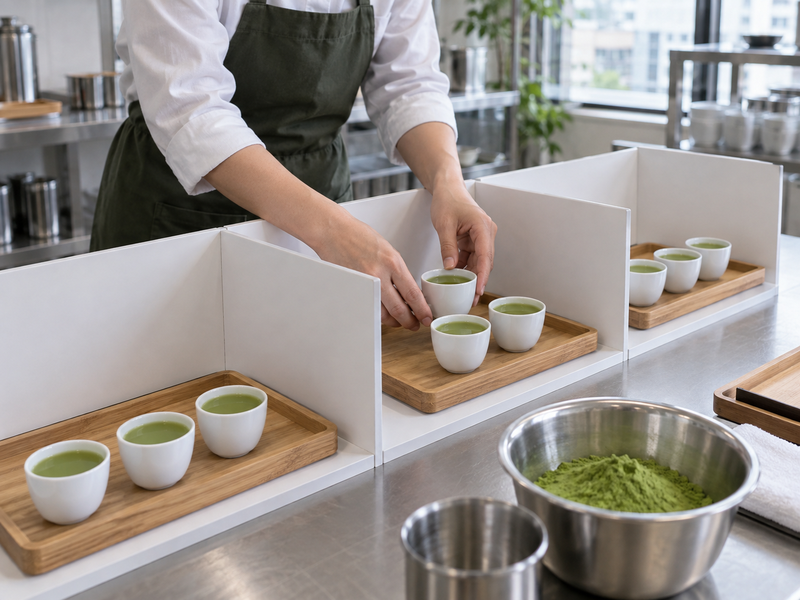
Choose a quiet evaluation area away from active food preparation, fragrance and supplier displays. Give each assessor enough space to complete a form independently. Set a consistent procedure for breaks and any palate-cleansing materials, then use it across the session. The procedure should suit the product and the people participating; copying an arbitrary interval from another food does not validate a matcha protocol.
ISO 8589 addresses the design of sensory test rooms. Its public scope also excludes specialized in-plant inspection facilities, so a buyer should not describe a makeshift factory tasting bench as compliant with that standard merely because it is tidy.
Run a short preparation rehearsal before inviting a larger group. Check whether cups arrive at the planned time, whether the form is readable and whether participants understand the instructions. Record interruptions that might affect a response. If the coordinator spills a sample or the room becomes unsuitable, document the issue and decide whether to reschedule. A smaller well-defined session is easier to interpret than an impressive attendance list with inconsistent conditions.
7. How should the team record disagreement?
Preserve individual observations
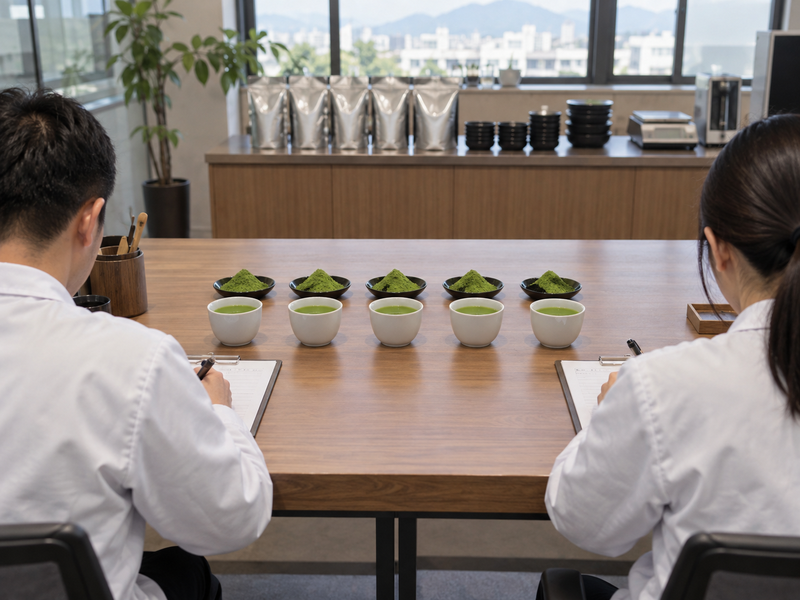
Collect completed forms before discussing the samples. Keep each response attached to the assessor code, serving order and preparation session. When participants disagree, look at the underlying descriptions. One person may dislike the drying finish while another notices the aroma; a single overall score can hide those different reasons.
Summarize patterns without deleting inconvenient comments. Distinguish missing answers from zero intensity and from a participant marking a feature absent. If someone misunderstood a scale, document that issue and decide how the analysis will treat the response. Do not silently edit the original form to match the group discussion.
| Observation pattern | Follow-up question | Record to retain |
|---|---|---|
| Same concern across assessors | Does a repeat session reproduce it? | Individual comments and codes |
| One unusual response | Was preparation or instruction different? | Session deviation record |
| Mixed liking with similar description | Do buyers want different product profiles? | Descriptions separate from preference |
Keep commercial negotiation outside the sensory summary. Purchasing can compare price after the team knows which candidates meet the product brief and what uncertainties remain.
8. When is a difference test appropriate?
Match the method to the claim
If the purchasing question concerns a perceptible change between two products, discuss a formal difference or similarity test with someone competent in sensory study design. Agree the hypothesis, participant requirements and analysis before the samples are served. A casual vote from a few colleagues cannot support a statistical claim of equivalence.
ISO 4120 describes a triangle method for assessing perceptible difference or similarity. Its scope notes limits with strong carryover and explains that the method does not identify the size, direction or responsible attribute of a difference. Use further descriptive work when those details drive the buying decision.
A detected difference also needs a commercial interpretation. It may be acceptable, objectionable or useful for a different menu item. Keep that decision separate from whether a difference was detected. Conversely, a session that fails to establish a difference does not prove that every future lot will be identical. Record the materials, conditions and scope so the report cannot be reused for an unrelated formula or shipment.
9. How do sensory results connect to a production trial?
Carry the approved question onto the line
After a candidate performs well in the bench recipe, ask production to identify the conditions that the bench did not represent. Those might include a different mixing system, a longer transfer sequence or a different serving format. Choose the observations that could alter the sensory approval, then plan the production trial with the same sample identity controls.
Compare the finished product at the agreed point rather than describing the raw powder as approved for every use. A beverage maker may need product from the start and later stages of a run. A café group may need confirmation that its normal operators can follow the approved preparation method. The trial plan should explain why those samples were chosen.
| Trial evidence | Sensory question | Approval attachment |
|---|---|---|
| Bench recipe | Does the candidate fit the brief? | Coded session summary |
| Production preparation | Does the normal process change perception? | Process and sample records |
| Intended service format | Does the served product remain acceptable? | Application-specific decision |
The matcha storage guide can support the separate discussion about holding ingredients between evaluation and use.
10. What should a sensory approval tell purchasing?
Write a decision that can be used again
Identify the supplier product, lot, application and recipe revision in the approval. State the evaluation question, the conclusion the evidence supports and any unresolved conditions. Avoid a broad label such as best matcha when the team compared a limited set of samples for one drink. A future buyer needs to know whether the approval permits a purchase, a further trial or a controlled substitution.
Attach the preparation method, code key after unblinding, original responses and decision notes. Keep the sensory lead’s interpretation separate from the purchasing recommendation when cost or supply considerations affect the final choice. That separation helps colleagues understand why the business selected a material that was not everyone’s favorite.
Before sending the next sample request, ask development to choose the evaluation question and the product recipe. Appoint the coordinator, reserve material for repeat work and arrange the room. Send suppliers a request for identified saleable lots, then issue the tasting plan to participants without supplier names or pricing information.
FAQ
Q1: Can photographs replace an appearance session?
They can document a sample under stated conditions. Camera processing, lighting and screens complicate remote comparison, so agree how photographs will be used and preserve the original files.
Q2: Should a supplier’s representative join the scoring discussion?
Invite technical input when defining preparation, but collect independent buyer responses before discussing identities. The supplier can review the method and respond to the resulting technical questions afterward.
Q3: Can one person approve a sample?
A business can assign approval authority to one qualified person. Describe that evidence accurately as an individual assessment; do not present it as a panel finding or consumer preference study.
Q4: Is a high overall score enough for purchasing?
Check the underlying product requirements. A strong average can conceal an unacceptable attribute or a preparation problem, so retain the individual observations and any mandatory acceptance conditions.
Q5: How should multilingual panels handle descriptors?
Agree definitions and translations before the session, then keep the same vocabulary on every form. Record terms that participants interpret differently and clarify them during training rather than during scoring.