
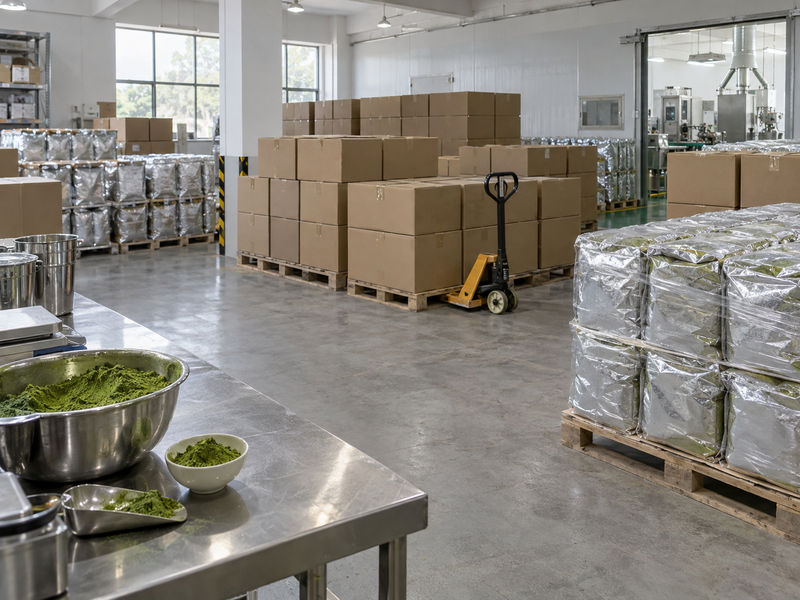
A wholesale matcha distributor does more than place a carton between a factory and a café. It may finance stock, break pallets into cases, hold local inventory, manage import paperwork and deliver to many small accounts. It may also add another handoff where powder ages, bags are damaged or lot records disappear. Buyers should judge the service they receive against the cost and control they would have with direct sourcing. The right distributor for a national chain may be wrong for a single shop.
This guide is for cafés, foodservice groups, brands and ingredient resellers comparing distribution partners. It separates supplier quality from distribution quality. A distributor can sell an excellent powder but fail to keep it available; another can deliver quickly but obscure the original production lot. Matcha Village’s manufacturing perspective is that the commercial channel should preserve the product’s identity and condition all the way to the user.
1. What service should a distributor provide?
List the jobs the buyer actually needs. These may include local stock, small case quantities, multi-site delivery, credit terms, sales support, technical samples, import coordination and complaint handling. Do not pay for a service that the business does not use. A chain with its own central warehouse may want a pallet supplier; an independent café may value a distributor that delivers a few sealed bags with other ingredients each week. Ask who owns stock at each point and who is responsible when a bag arrives damaged.
Separate the distributor’s role from the manufacturer’s. The factory controls production, product specification and many quality records. The distributor controls receiving, storage, picking and onward delivery. A good partner can retrieve factory evidence promptly and explain its own handling. If the answer to every technical question is “we will ask the factory,” agree on a response process and timing. That makes the intermediary useful rather than a delay.
| Service | Buyer value | Proof to request |
|---|---|---|
| Local inventory | Shorter replenishment | Stock and reorder policy |
| Small case delivery | Less cash tied in powder | Pack and freight terms |
| Lot documentation | Customer and quality response | Sample trace record |
| Multi-site drops | Consistent supply across stores | Coverage and service levels |
2. How does the distributor identify the powder it sells?
Ask for the manufacturer’s product code, composition, specification and approved reference sample. A distributor may carry several matcha grades with similar packaging. Confirm that the quoted SKU is the sampled one and that any private label or house brand can be traced to a defined production product. If the distributor blends or repacks powder, it becomes responsible for additional controls. The buyer should know who performs that work and how the original lots map to the new code.
Compare a commercial delivery with the retained sample in the actual drink or food. Do not assume that the same green bag always contains the same formula. Ask how product changes are communicated and whether substitutions require buyer approval. A distributor facing a stockout may offer another grade in good faith; without a controlled trial, that can change flavor, color, label claims or cost. State the substitution rule in the account agreement.
3. How old is the stock when it reaches the buyer?
Request pack or manufacturing date and the remaining dated life at delivery. A product can be legally within its marked period yet leave too little time for a café with slow turnover. Ask whether the distributor rotates stock by expiry, whether separate lots can be selected, and how returns are handled. If the business receives a mixed-lot case, its service staff may unknowingly change powder mid-shift. Inner packs should carry enough identification to prevent that confusion.
Agree on a minimum remaining-life requirement that fits the buyer’s use rate. Do not copy a number from another company’s contract without checking your own turnover and product evidence. A distributor should be able to show the date and lot of the stock it offers before shipment. Review storage conditions at its warehouse, especially if the powder sits through a hot season or near strong odors. The bulk shelf-life article explains why dated life must be tied to the actual pack and conditions.
| Stock question | Useful record | Buyer decision |
|---|---|---|
| Which lot ships? | Lot-level pick list | Accept planned lot |
| How much life remains? | Pack and best-by dates | Fit to expected use |
| Where was it held? | Warehouse zone and conditions | Investigate exposure |
| Is stock mixed? | Case-level lot map | Protect consistency |
4. Can the distributor trace a customer complaint?
Run a small trace exercise. Give the distributor an inner-pack lot code and ask it to identify the manufacturer’s lot, receipt date, pallet location, outbound order and other customers who received the same lot. It need not disclose confidential customer names to you, but it should demonstrate the system’s logic and speed. If it repacks, ask for the new code mapping. A warehouse that tracks only the SKU cannot isolate a quality issue to one production lot.
Test your own side too. A café chain should know which stores received the questioned cases. A brand should map ingredient lots into finished products. Agree on who receives a complaint, what evidence is needed and when the manufacturer is contacted. A photo of a green drink is rarely enough; preserve the bag, code, order date and recipe. The distributor is valuable when it connects these records instead of passing messages without context.
5. What distribution coverage is really needed?
Map the locations, order sizes and delivery frequency before asking for nationwide service. A distributor may have strong coverage in one region and rely on parcel carriers elsewhere. Compare expected transit times to each store, case damage rates and delivery-day reliability. A multi-site buyer may prefer one contract but should not assume every site receives the same service. Run a pilot to a busy urban store and a remote location if both matter to the business.
Discuss seasonal peaks and promotions. If matcha sales rise in summer, when must the buyer forecast to keep local stock? Ask whether the distributor reserves stock for named accounts and what happens if a shipment from the manufacturer is delayed. A backup plan might use approved alternate stock, a larger buffer or a second distributor. It should not involve unapproved powder arriving at stores under the same menu name.
| Delivery test | Record | Pass question |
|---|---|---|
| Urban site | Order-to-ready time | Does it fit service stock? |
| Remote site | Carrier and damage | Is pack still sound? |
| Peak week | Fill rate by SKU | Can forecast be met? |
| Urgent replacement | Response and alternative | Is approved product available? |
6. How should distributor prices be compared?
Compare delivered, usable product. A factory-direct quote may be lower per kilogram but require import work, larger minimums, longer transit and a warehouse. A distributor’s higher unit price may cover those tasks and allow smaller purchases. Add freight, duties where applicable, financing, storage, damage, testing and staff time. Then use the tested powder dose to calculate cost per accepted cup or finished food unit. The relevant comparison changes with buyer scale.
Ask for a clear price schedule: case breaks, pallet tiers, delivery minimums, fuel or handling charges, and normal reorder terms. A limited introductory deal can hide the true operating cost. If the distributor offers a different powder than the manufacturer, do not compare solely on price; run the same product trial. Avoid the reverse mistake of paying a premium for “local service” that your business never calls on. Price should be tied to the service and risk transferred.
| Cost bucket | Direct supply | Distributor supply |
|---|---|---|
| Ingredient | Factory quote | Resale quote |
| Freight and import | Buyer may manage | May be included |
| Inventory carrying | Buyer warehouse | Distributor stock service |
| Small drop delivery | Buyer arranges | Distributor route or parcel |
7. Which documents should the distributor hold?
The buyer may need product specifications, ingredient declarations, lot-specific analysis, relevant certificates and shipping records. The exact list depends on destination market and customer requirements. Ask how quickly the distributor can retrieve a missing record, whether documents are checked at receiving, and how versions are controlled. A certificate copied from a website may not cover the offered product or current period. The distributor should be able to show the chain from manufacturer’s document to the lot it sold.
For private-label or repacked powder, responsibilities expand to labeling and pack approval. A distributor that acts as an importer may also have local regulatory duties; confirm these with qualified counsel rather than relying on a generic sales statement. Store the records in your own system as well. If a distributor changes platforms or staff, the buyer still needs evidence for product already sold.
8. How does a distributor handle damaged or off-spec stock?
Ask to see its hold and disposition process. A torn outer box with intact inner bags may need inspection and repacking; a leaking foil pouch should not be quietly taped shut and sent to a café. The distributor should segregate questionable stock, retain lot evidence, notify the manufacturer when appropriate and document the final decision. The buyer needs a route to report defects and receive an approved replacement without losing the original investigation trail.
Test the process with a realistic scenario before a long contract: a case arrives wet, or a drink made from the new lot tastes different from the approved reference. Who is called? What photographs and samples are kept? How quickly is unaffected stock confirmed? A distributor’s answer tells you more than a general promise of “quality service.” It should know where its responsibility begins and where the manufacturer’s investigation is needed.
| Problem | Distributor action | Buyer evidence |
|---|---|---|
| Damaged carton | Inspect inner units and hold affected cases | Photos and delivery note |
| Leaking pouch | Quarantine unit and trace lot | Bag and code |
| Flavor drift | Contact manufacturer with retained sample | Fixed recipe comparison |
| Missing document | Hold release or provide verified record | Requirement and lot number |
9. What should a pilot order measure?
Order the normal product and pack, not a special hand-carried sample. Send it through the distributor’s ordinary warehouse and delivery route. Check arrival time, case condition, remaining life, documents and lot trace. Then make the standard drink or production trial. Record the time needed to resolve a small question, such as a missing label field. The trial should test the channel, not only the matcha powder.
For a chain, include at least two store types. A central-city café with daily deliveries can hide a problem that a weekly rural route exposes. Ask store staff whether the pack fits storage and whether the powder matches the approved cup. If the pilot fails, diagnose whether the issue is ingredient, pack, warehouse or carrier before changing suppliers. A clear root cause protects the next decision from repeating the same mistake.
10. When should a buyer use a distributor rather than source directly?
Use a distributor when its inventory, smaller drops, local service or import capability has value greater than its added cost and handoff risk. Source directly when the buyer can manage volume, customs, warehouse and quality control, and when the manufacturer can support the agreed service. Some growing brands use both: direct supply for a central production line and distribution for small cafés. Keep product specifications aligned so the customer does not receive different cups under one brand.
The best wholesale matcha distributor preserves the approved powder and makes replenishment easier to manage. Matcha Village can discuss direct bulk supply and channel partnerships through its B2B contact page. Bring a map of destinations, expected case sizes and service requirements. That lets the economics of distribution be tested against a real supply plan instead of a generic wholesale promise.
FAQ
Q1. Is a distributor the same as a matcha manufacturer?
Not necessarily. A distributor may buy, hold and resell powder made by another company.
Q2. Can a distributor change the powder during a shortage?
Only under the buyer’s approved substitution and labeling process. Test any proposed alternative.
Q3. What is the most useful inventory record?
A lot-level link from manufacturer’s pack through warehouse pick to the buyer’s delivery.
Q4. Is a higher distributor price always worse?
No. Compare delivered usable cost and the value of local stock, small drops and service.
Q5. What should a pilot reveal?
It should prove pack condition, document flow, traceability, delivery performance and the finished product.