
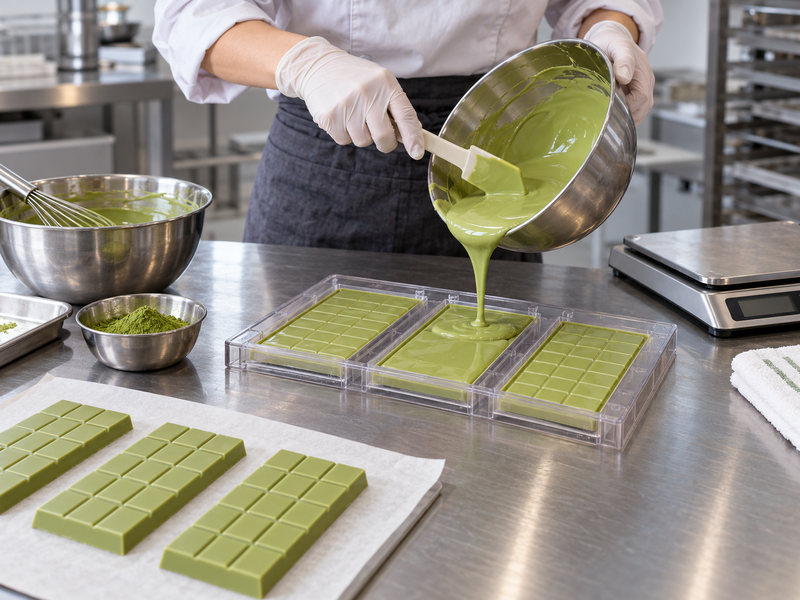
A matcha chocolate bar can snap beautifully on packing day and bloom on the retail shelf. Tea flavor can also disappear behind sugar and cocoa butter. Confectionery teams should judge the bar after tempering, wrapping and normal handling, then calculate cost per bar that can actually be sold.
Contents
- 1. What should matcha chocolate bars deliver to the customer?
- 2. Which tea works in the sweet base?
- 3. How should the coating or center be formulated?
- 4. Where can mixing and setting go wrong?
- 5. Does the full piece taste like matcha?
- 6. What changes during the shelf trial?
- 7. Which wrapper protects the finished piece?
- 8. How much saleable product does a run yield?
- 9. Which ingredient and allergen records are needed?
- 10. What should the packed reference show?
1. What should matcha chocolate bars deliver to the customer?
Define the product before approving a sample
Decide whether the product is white chocolate with matcha, a dark chocolate bar with a matcha layer, or a flavored compound coating. Those are different formulas and labeling positions. A bright green prototype can still be commercially weak if the tea disappears behind sugar.
The sales promise must identify the chocolate system. Matcha stirred into white chocolate behaves differently from a green filling wrapped in dark chocolate. A compound coating can also look similar while changing taste, texture and label wording. Put the intended cross-section in the brief: solid bar, filled bar or layered bar. Then ask tasters to judge that form after full set. A marketing photograph of melted chocolate cannot stand in for a wrapped, tempered product.
For sweets, color and flavor must survive sugar, fat and handling. Define the bite and the packed appearance together, not as separate design tasks.
2. Which tea works in the sweet base?
Choose powder against the finished application
Taste candidate powders inside the actual fat and sugar system. Water tasting alone favors grades whose delicate notes can vanish in chocolate. Start with a small controlled dose series and compare bitterness, color and price per finished bar rather than price per kilogram of powder.
Make a three-bar pilot with one chocolate base and three measured matcha levels. Record viscosity, deposit weight, set time and whether the bar releases from the mold without marking. Taste equal-sized pieces after full crystallization. If the strongest bar turns chalky, reducing powder may help more than adding extra sugar. The bar that wins should remain recognizable after a normal bite, not only when the panel smells the wrapper.
The cheapest dry powder may require a dose that raises bitterness or leaves loose green dust. Test it inside the real sweet system.
For a related production decision, see our matcha for chocolate manufacturing guide.
| Candidate | Specific check | Keep if |
|---|---|---|
| Powder | Taste candidate powders inside the actual fat and sugar system | Tea fits the finished application |
| Formula | Premix matcha with a compatible portion of fat or a small batch of melted chocolate to reduce… | Dose stays practical |
| Tasting | Break a finished bar and taste a piece from each end | Flavor remains clear |
3. How should the coating or center be formulated?
Change one variable at a time
Premix matcha with a compatible portion of fat or a small batch of melted chocolate to reduce visible specks. Keep water out of the chocolate handling step. Check whether powder fineness changes mouthfeel and whether mixing time raises temperature more than the tempering process allows.
Use a controlled fat-based premix when the powder leaves visible green specks. Record whether the premix changes viscosity enough to affect deposit weight. In a layered bar, measure the thickness of each layer; the same matcha mass spread thinly across a large bar may taste faint, while a concentrated center can become bitter. Keep one control bar without matcha so the team can describe what the tea truly adds.
Keep sample masses small and repeatable so a failed batch teaches something. The same sugar concentration and piece size make tea-dose comparisons meaningful.
4. Where can mixing and setting go wrong?
Write a method another operator can repeat
Run the normal temper curve for the chocolate system and verify it with a small set test. Pour bars from the beginning and end of the run. Uneven distribution can make later molds darker or more bitter while a bench sample remains attractive.
During the pilot run, compare pieces poured from the first, middle and last portion of the holding bowl. Matcha particles can settle or cling to equipment, changing color and bitterness across the run. Inspect mold corners and the cut edge for streaks. If a change in mixing speed solves distribution but damages temper, the formulation team needs a different dispersion step rather than a faster mixer setting.
Note temperature, residence time and equipment contact. Confectionery failures often arise after a lovely hand-poured bench sample moves to a warmer line.
| Process point | Specific check | Record |
|---|---|---|
| Preparation | Premix matcha with a compatible portion of fat or a small batch of melted chocolate to reduce… | Tool and dose |
| Production | Run the normal temper curve for the chocolate system and verify it with a small set test | Start and end samples |
| Finished unit | Break a finished bar and taste a piece from each end | Sensory result |
5. Does the full piece taste like matcha?
Taste the portion a customer receives
Break a finished bar and taste a piece from each end. Note snap, melt, tea onset and aftertaste. A bar may smell strongly of matcha before the cocoa butter melts but taste faint once eaten. Compare its cut face as well as its top surface.
Give panelists a piece broken from each end of the bar. Ask them to note initial snap, melt, tea onset and the aftertaste left by cocoa butter. Taste after the wrapper has been removed for a short, consistent interval; aroma can escape quickly. If the bar smells of matcha but tastes mostly sweet, test a different powder or fat-sugar balance before increasing the headline dose. Include the bar's cut face in the sensory record.
Taste a whole serving, including its edge or coating. A decorative green surface may hide a center whose flavor does not support the label.
6. What changes during the shelf trial?
Use the real shelf or counter conditions
Challenge finished bars with the expected shipping and display conditions. Watch for fat bloom, surface dulling and wrapper scuffing. Do not promise a shelf life from a two-day countertop trial; use the planned pack and an appropriate stability program.
Pack bars in the proposed wrapper and place them in conditions representing warehouse, transit and retail display. Inspect snap, surface shine, visible bloom and aroma on a pre-set schedule. Photograph the same face under the same light. Taste a bar taken from the warmest expected point and one from the control group. A chocolate that survives a cold lab shelf but scuffs in shipping needs a packaging or handling fix.
Humidity and oxygen can change a packed sweet in different ways. Challenge the final formula under the expected route before stating a sale window.
| Observation | Specific check | Action |
|---|---|---|
| Storage | Challenge finished bars with the expected shipping and display conditions | Compare with control |
| Pack | Choose a light and moisture barrier that protects the color without trapping warmth during packing | Inspect opened unit |
| Customer portion | Break a finished bar and taste a piece from each end | Taste again |
7. Which wrapper protects the finished piece?
Test the actual selling format
Choose a light and moisture barrier that protects the color without trapping warmth during packing. Check bar fit and sealing on the production wrapper. A tight wrapper can mark a soft surface; excess headspace can allow movement and breakage.
Wrap pilot bars on the intended equipment and inspect the contact points. A bar with a soft or uneven surface may pick up wrapper marks that were absent from a hand-filled sample. Compare the proposed film's light barrier and seal performance during a real display trial. Open a carton after handling and count chipped corners. A green bar sold as premium loses value when the first thing a customer sees is a dusty or bloomed surface.
The wrapper should prevent abrasion and moisture pickup without creating seal contamination from powder or fat. Inspect packed units after handling.
8. How much saleable product does a run yield?
Measure yield and repeatability
Measure bar weight, mold release, breakage and rework on a pilot run. If a higher tea dose increases viscosity or slows depositing, include throughput in the cost calculation. Set a visual acceptance example for small natural color variation.
Count intact wrapped bars, bars broken at demolding and bars rejected at packing. Include chocolate left in the deposit system and tea powder lost in premixing. If a premium matcha permits a lower dose with better flavor, its higher kilogram cost may still produce a similar cost per good bar. A pricing decision should use those recorded units and a market-ready wrapper, not the weight of the raw ingredients alone.
Record fines, breakage and pieces rejected for appearance. Those units change the economics of matcha more than a small difference in powder price.
| Pilot measure | Specific check | Commercial use |
|---|---|---|
| Yield | Measure bar weight, mold release, breakage and rework on a pilot run | Cost per saleable unit |
| Loss | Challenge finished bars with the expected shipping and display conditions | Set acceptance limit |
| Supply | The ingredient file should cover tea identity, supplier lot, chocolate composition and every relevant allergen | Confirm lot evidence |
9. Which ingredient and allergen records are needed?
Link claims and batches to documents
The ingredient file should cover tea identity, supplier lot, chocolate composition and every relevant allergen. Milk, soy and nuts may enter through the chocolate line. Review the final label for the sale market and retain evidence behind any origin or quality claim.
A supplier file is useful only when it refers to the material delivered. Match ingredient statement, specification and test report to the purchase code and lot on the cartons. Ask for an agreed notice before changes in source, formula or manufacturing site. The finished product team should separately review market-specific ingredient and allergen wording. Test a trace request. Pick one pilot pack and ask where its matcha came from and which finished units received it.
Sugar, milk, nuts and other confectionery ingredients can drive allergen review. Matcha identity and all shared-line risks belong in the file.
10. What should the packed reference show?
Release against a written reference
Select a formula by tasting packed bars after their expected transit, not only warm pieces from the line. The approved sample should carry the actual wrapper, batch code and a record of the temper and tea dose.
The approved version needs a name and a date. Store the physical sample, recipe revision, process sheet, pack artwork and reason for selecting the supplier. State what would trigger a new test: a tea lot change, a different milk or fat, a new sealing film or a shift in serving size. Make approval repeatable. A future buyer should be able to compare a new shipment with the reference rather than reopening the entire concept from memory.
Keep a packed reference, not only a tray photograph. It lets the next operator compare a commercial unit with the approved product.
| Release item | Specific check | Owner |
|---|---|---|
| Formula | Select a formula by tasting packed bars after their expected transit, not only warm pieces from the… | Development |
| Supplier | The ingredient file should cover tea identity, supplier lot, chocolate composition and every relevant allergen | Purchasing |
| Pack | Choose a light and moisture barrier that protects the color without trapping warmth during packing | Quality |
A final production check
Ask a second production team to temper, mold and wrap a short run using the approved procedure. Compare the first and final bars after the same storage interval, including their snap, surface and tea finish. If a bar looks good but leaves powdery grit or develops bloom, document whether the fix belongs in formulation, tempering or packaging. Only a wrapped reference from the successful run should guide the commercial order.
Further reading
Use ISO/TR 21380:2022 on matcha identity to frame matcha identity, FDA food allergen labeling guidance for the exact ingredient system, and FDA water activity technical guide when the product's validated shelf-life work depends on moisture.
FAQ
Q1: What is matcha chocolate bars in a commercial product?
Decide whether the product is white chocolate with matcha, a dark chocolate bar with a matcha layer, or a flavored compound coating. Those are different formulas and labeling positions.
Q2: How should a buyer compare matcha for this use?
Taste candidate powders inside the actual fat and sugar system. Water tasting alone favors grades whose delicate notes can vanish in chocolate.
Q3: What usually causes the first quality failure?
Challenge finished bars with the expected shipping and display conditions. Watch for fat bloom, surface dulling and wrapper scuffing.
Q4: Which documents should the supplier provide?
The ingredient file should cover tea identity, supplier lot, chocolate composition and every relevant allergen. Milk, soy and nuts may enter through the chocolate line.
Q5: When should the formula be approved?
Select a formula by tasting packed bars after their expected transit, not only warm pieces from the line. The approved sample should carry the actual wrapper, batch code and a record of the temper and tea dose.