
Matcha powder for chocolate manufacturers should be approved in the actual confectionery system, with the powder, base chocolate and processing route identified together. A matcha that makes an attractive drink may produce a different flavor, appearance or handling result in a bar, shell or filling. The purchasing specification needs to describe the finished product that development and production accepted.
For a confectionery ingredient buyer, the task is to select a powder that meets the product brief without creating an unexamined change in the manufacturing process. These proposed trials are development methods, not validated formulas or universal dose recommendations.
Contents: 1. What should the chocolate product brief define? | 2. What data should accompany matcha powder for chocolate manufacturers? | 3. How do you compare color without confusing the base chocolate? | 4. How should flavor trials be designed? | 5. How should flow and texture be evaluated? | 6. What should change-control cover during incorporation? | 7. How do packaging and display enter ingredient approval? | 8. Which quality questions need a separate decision? | 9. How should the factory trial connect to a purchasing specification? | 10. What should the buyer request before scaling production?
1. What should the chocolate product brief define?
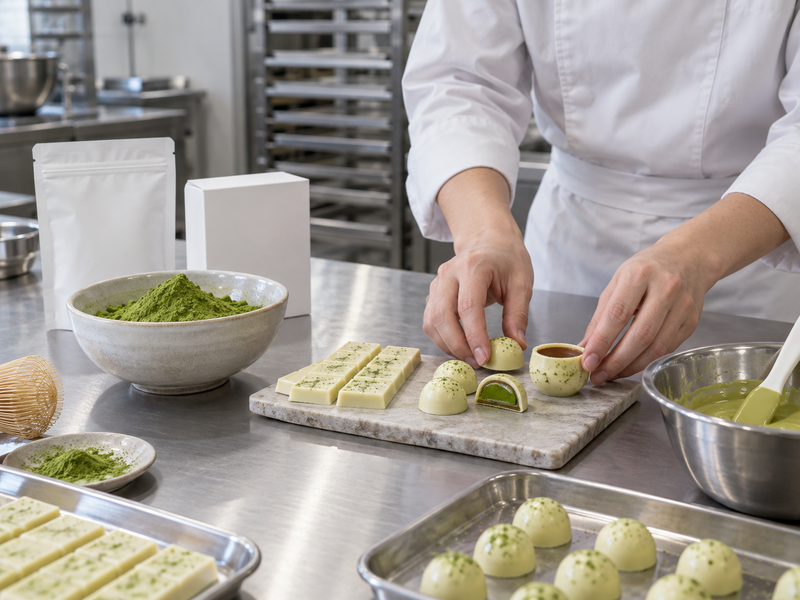
Separate bars, shells and fillings
Identify whether matcha enters a solid chocolate mass, a compound coating, a fat-based filling, a water-containing center or a surface decoration. Keep those applications separate during approval. A powder accepted for dusting may not have been evaluated for the texture or flow required in a molded shell.
| Product format | Buyer defines | Trial output |
|---|---|---|
| Solid bar | Base chocolate and target profile | Finished bar comparison |
| Molded shell | Mold geometry and process | Fill and shell observations |
| Filling | Full ingredient system | Texture and stability review |
| Surface dust | Application and display conditions | Coverage and appearance |
Write a clear sensory target using the finished confection. Decide whether the product should taste primarily of tea, chocolate or a deliberate balance. Set appearance expectations in the actual base rather than matching a photograph of dry green powder.
Identify the development, production, quality and packaging reviewers before requesting samples. Each should name the evidence required for approval. The commercial buyer can then ask suppliers for candidates that fit one defined task instead of requesting an unspecified best grade.
2. What data should accompany matcha powder for chocolate manufacturers?
Ask questions that support the process trial
Request the product identity, composition, lot, proposed application, storage instructions and available particle and moisture information. Ask how measurements were made and how the supplier reports them. A value without units, method or sample identity cannot support a dependable comparison between candidate powders.
Japan Matcha Agent’s confectionery article identifies particle characteristics, moisture and application trials as questions for chocolate buyers. Use those as questions to resolve with the supplier and your technical team. The article’s suggested trial periods and processing advice do not validate your finished product.
Keep pure matcha and blends on separate sample lists. If a supplier proposes a carrier, sweetener or other added ingredient, ask how it changes composition and the intended product declaration. Record sample storage and opening conditions so an unsuitable handling step does not become an unexplained trial result. Reserve enough material for repeat testing and retain an identified sample according to your quality procedure.
3. How do you compare color without confusing the base chocolate?
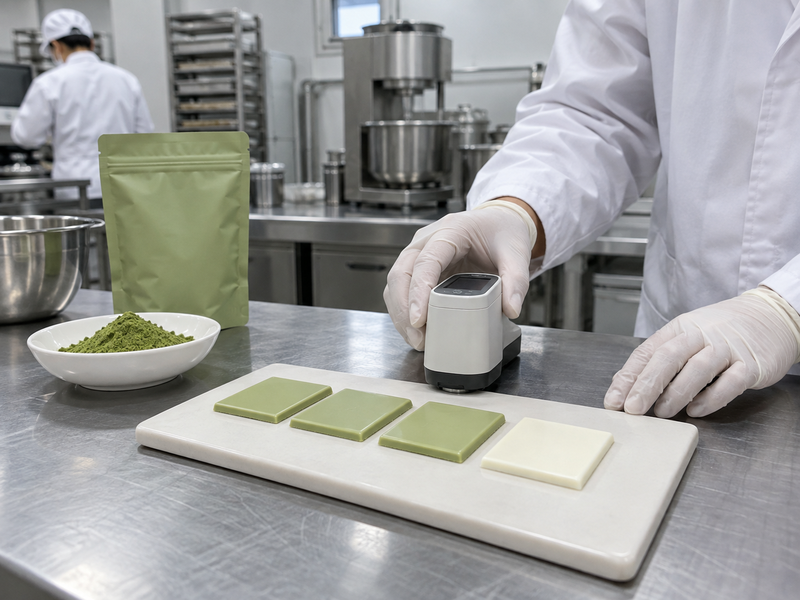
Hold the base and lighting constant
Use the same identified chocolate or coating base for a powder comparison. Make a control without matcha and keep the process and piece geometry consistent. Record the base’s color and composition reference, because a change in the base can alter the finished appearance even when the matcha stays the same.
| Comparison field | Keep fixed | Record |
|---|---|---|
| Base | Product code and lot | Supplier specification |
| Powder dose | Defined trial level | Actual weighed amount |
| Piece | Mold and thickness | Surface and cut section |
| Observation | Lighting and background | Dated photographs |
Review the finished sample after the agreed setting process. Avoid approving color only while the mass is warm in a bowl. If instrumental color measurement is part of your specification, let the technical team define the instrument, geometry and reporting method.
Ask reviewers to distinguish appearance preference from a claim about ingredient safety or origin. A vivid sample may fit the design brief, but it does not answer those separate questions. Save the approved finished-product reference with its preparation record and define when that reference must be renewed.
4. How should flavor trials be designed?
Use a controlled dose series
Select trial doses with the development team and identify them as experimental levels. Keep the base, piece size, mixing route and tasting conditions consistent. A dose series can show whether a candidate reaches the intended tea profile before another attribute becomes unacceptable. It should not be presented as a ready commercial recipe until the complete product has been reviewed.
Have tasters record the initial flavor, the finish and any texture observation separately. Ask them to compare coded pieces before seeing supplier names or prices. If a filling or inclusion is part of the product, test the assembled confection after the plain mass comparison, because the combined eating experience decides acceptance.
Do not correct an unfavorable result with unrecorded sugar or fat additions. Such changes create a different formula and make supplier comparison difficult. Save them as separate development trials with their own composition and cost. Purchasing should receive the candidate code and approved dose range only after the product owner has accepted the intended formulation and the production team has reviewed its manufacturability.
5. How should flow and texture be evaluated?
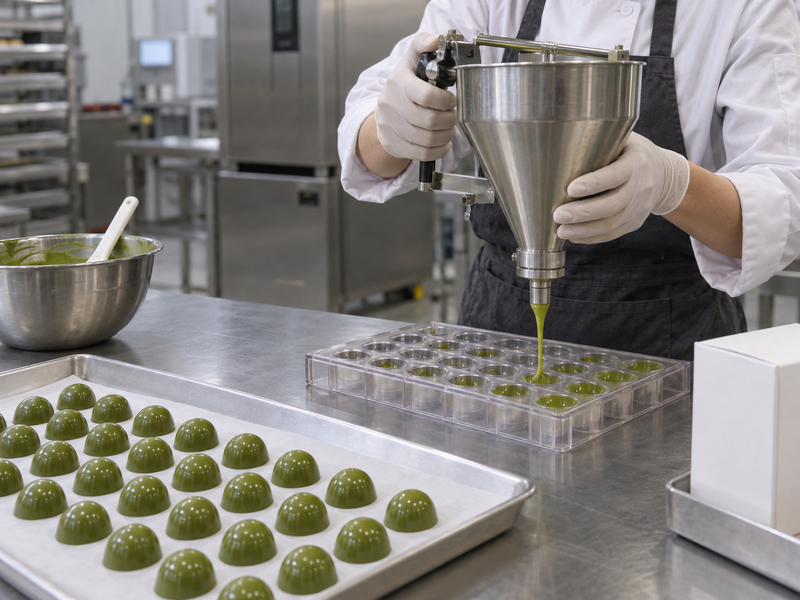
Measure the task the line must perform
Choose observations that relate to your process: filling mold details, depositing a consistent amount, forming a shell or coating an inclusion. Callebaut’s guidance on fluidity links chocolate selection to the intended molding application. Adding matcha requires your own trial of the resulting mass and equipment.
| Process task | Trial observation | Follow-up question |
|---|---|---|
| Depositing | Fill consistency | Does the method need adjustment? |
| Molding | Detail and trapped air | Does the mass suit the mold? |
| Enrobing | Coverage and pickup | Is coating weight acceptable? |
| Eating | Perceived grittiness | Does particle evidence explain it? |
If your factory uses instrumental viscosity or particle measurements, specify the test conditions and compare like methods. Avoid replacing a measured distribution with an advertised mesh claim. Ask the supplier to explain what its reported value describes.
Keep the process trial record beside the sensory record. A pleasing flavor that requires an impractical line adjustment may need further development. Conversely, a smooth process does not establish that the finished texture meets the customer brief.
6. What should change-control cover during incorporation?
Record the point of addition
Write the actual sequence used to introduce matcha, including the base condition, mixing equipment, addition point and relevant time or temperature records. Use settings approved for your chocolate and process; do not borrow a generic temperature from a matcha article. Identify any difference between the bench trial and the intended production line.
Discuss a proposed change in sequence with the process owner before testing it. Adding powder earlier or later can alter the work it experiences, but the direction and size of the effect need validation in your system. Save both the reason for the change and the observed result, rather than rewriting the successful method as if it had always been planned.
For cocoa-butter chocolate, Callebaut’s tempering explanation describes the role of crystallization in setting and finished appearance. Have the chocolate specialist review the process after matcha is introduced. A compound coating may use another process, so keep product identities and instructions separate when moving between bases.
7. How do packaging and display enter ingredient approval?
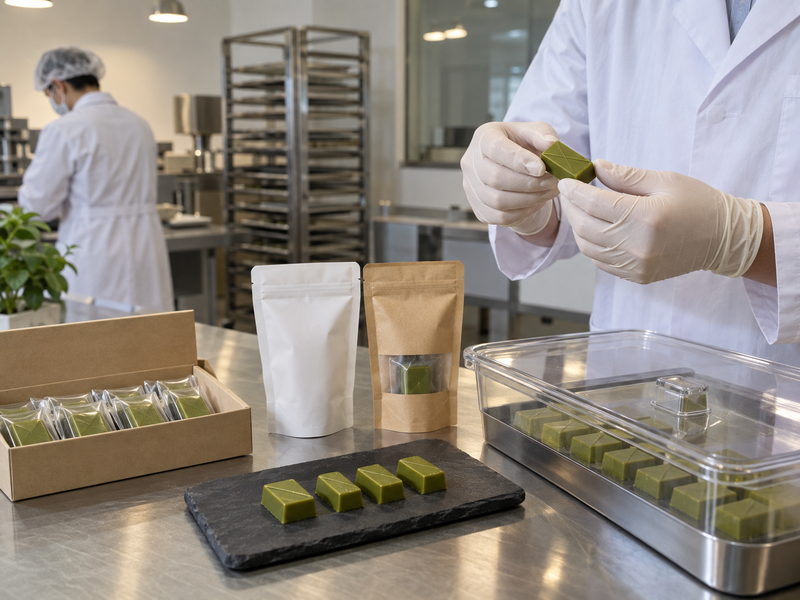
Test the confection as it will be sold
Place trial products in the intended primary and secondary packaging. Define storage and display conditions that represent the proposed distribution and retail use. Have the technical team choose observation points and acceptance criteria based on the product and validation plan, rather than assuming that a dry-powder shelf life transfers to chocolate.
| Trial condition | What to document | What it can answer |
|---|---|---|
| Intended wrapper | Material and closure | Pack-product suitability |
| Retail display | Light and temperature record | Appearance during display |
| Transport trial | Route and handling | Physical condition |
| Retained control | Defined storage | Comparison with exposed samples |
Inspect the surface and cut section separately where useful. A dusted product and a fully enclosed matcha layer have different exposure, so record where the powder sits in the confection. Keep photographs and sensory notes tied to the same sample identifiers.
If a problem appears, investigate the base, process, packaging and storage history before attributing it solely to matcha. Ingredient approval should state the validated application and pack conditions. A new transparent window or display arrangement may require additional review.
8. Which quality questions need a separate decision?
Keep sensory acceptance distinct from release
Ask quality staff to define the supplier evidence and lot checks relevant to the ingredient and finished application. Review the product specification, composition, lot analysis and traceability. Where certificates are claimed, confirm the actual site and product scope. Do not use a pleasant tasting or a clean-looking powder as a replacement for these reviews.
Water-containing fillings need their own product-safety and shelf-life assessment. A powder’s documented condition does not establish the suitability of a ganache or other finished center after processing. Have the responsible technical specialist evaluate the complete formula, method, packaging and intended distribution before making a commercial shelf-life statement.
The existing matcha chocolate discussion can support application planning, while the purchasing file should identify the precise ingredient and production version approved here. Record unresolved quality questions as release conditions. If a supplier cannot provide a requested test or method, discuss an appropriate alternative with quality and the laboratory before accepting a report that answers a different question.
9. How should the factory trial connect to a purchasing specification?
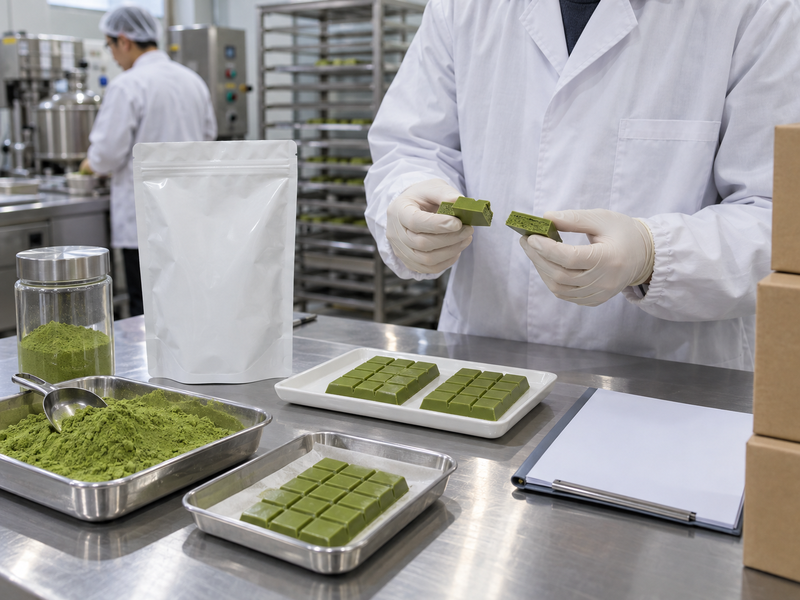
Translate accepted results into order fields
After the factory trial, record the product code, acceptable application result, measurement methods, packaging and required lot documents. Avoid copying every bench observation into a rigid incoming specification. Choose fields that the supplier and buyer can measure or review consistently and that relate to the product’s performance.
| Specification field | Supporting trial | Order implication |
|---|---|---|
| Powder identity | Approved candidate | No unapproved substitution |
| Particle information | Texture and process review | Agreed reporting method |
| Pack format | Handling trial | Approved inner unit |
| Change notice | Defined production route | Buyer review before change |
Identify which attributes are checked on every lot and which are reviewed through periodic or change-based verification under your quality plan. Do not invent a universal testing frequency. Agree the reason and responsibility for each check.
Keep the accepted finished-product sample and production record available for comparison when a new lot arrives. If the supplier changes a source, blend, mill or pack, assess whether the existing evidence still supports the application before confirming that the product code remains acceptable.
10. What should the buyer request before scaling production?
Close the remaining differences
List the differences between the accepted trial and the proposed commercial run: batch size, equipment, addition route, packing date, distribution conditions and available lot evidence. Assign each difference to a reviewer. Scaling should proceed only when the responsible teams have accepted the planned route and any remaining conditions are visible in the order.
Request a quotation for the actual product code and packing format used in the approval. State the required quantity, destination, documentation and change-notification conditions. Keep experimental alternatives separate so a supplier does not quote an earlier candidate that was less expensive but never approved.
Prepare a confectionery sample brief with the base product, application, proposed process and observations your team will measure. Send it to the supplier with the requested particle and moisture information, then book the bench comparison and factory trial with named technical reviewers before committing to routine supply.
FAQ
Q1: Is a drinking grade automatically suitable for chocolate?
No application can be approved from a grade name alone. Compare the candidate in the intended base and process, then review the finished confection and manufacturing evidence.
Q2: Can the factory use a water slurry to add matcha?
Only if that addition is part of a formulation and process approved by the chocolate specialist. A method suitable for a drink or filling should not be transferred casually to a chocolate mass.
Q3: Can one test approve both a bar and a filling?
Treat them as separate applications when their formulas or processes differ. Shared ingredient evidence can be reused, but the finished-product validation needs to cover each use.
Q4: Should the buyer specify a universal particle size?
Set a requirement from the intended texture and process, supported by an agreed method. A number copied from another supplier may describe a different measurement or product.
Q5: How should leftover trial powder be handled?
Keep its identity and storage history. Use it only within the approved trial or quality procedure, and do not silently combine it with routine production stock.