
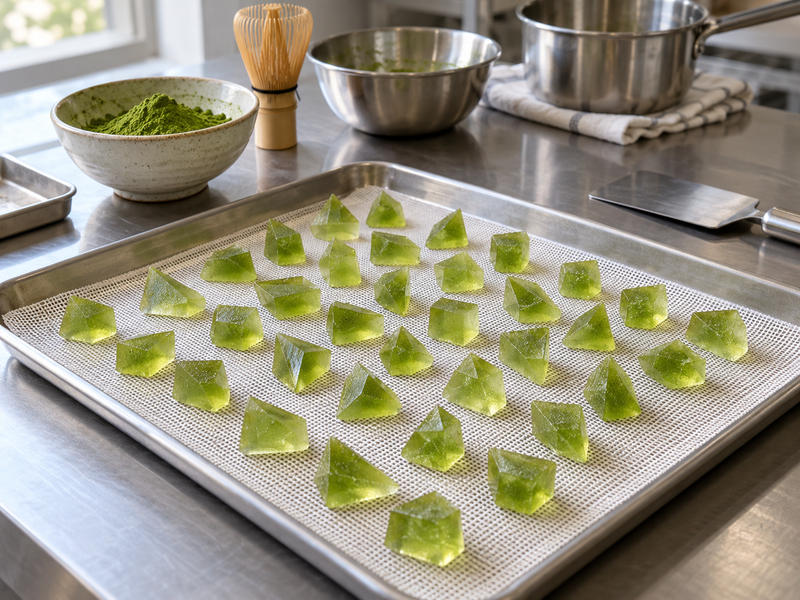
Matcha crystal candy depends on a dry, crisp outer layer and a tender interior. A bright tray is a weak launch test if the pieces turn sticky inside a pouch. Candy manufacturers need to control the agar set, drying and package together while keeping the tea note clear.
Contents
- 1. What should matcha crystal candy deliver to the customer?
- 2. Which tea works in the sweet base?
- 3. How should the coating or center be formulated?
- 4. Where can mixing and setting go wrong?
- 5. Does the full piece taste like matcha?
- 6. What changes during the shelf trial?
- 7. Which wrapper protects the finished piece?
- 8. How much saleable product does a run yield?
- 9. Which ingredient and allergen records are needed?
- 10. What should the packed reference show?
1. What should matcha crystal candy deliver to the customer?
Define the product before approving a sample
Kohakutou-style candy has a set interior and a dried outer layer. Matcha complicates both appearance and flavor because particles can settle before the gel sets. Decide whether the final product is a clear crystal with a faint green tint or an opaque tea candy before setting the formula.
Define the visual target in edible terms: a translucent shell, an opaque tea center or a uniform pale-green crystal. Matcha particles can make a crystal candy cloudy, which may be desirable if the product is sold on tea flavor rather than glass-like clarity. Keep sample photographs under one light source and taste the same pieces. The brief should state the desired shell bite and interior texture so drying is judged against a product, not an abstract appearance.
For sweets, color and flavor must survive sugar, fat and handling. Define the bite and the packed appearance together, not as separate design tasks.
2. Which tea works in the sweet base?
Choose powder against the finished application
Choose matcha for flavor after sugar dilution rather than for the brightest dry-powder color. Compare a low, medium and high tea dose in one base syrup. Bitter notes can grow as the outer layer dries and the candy becomes more concentrated.
Cast one syrup into equal-depth trays and change only the matcha level. Mark each tray with a neutral code and use the same cut size. Check whether tea sediment gathers at the bottom before the gel sets. A translucent look may require less powder than a strongly flavored candy, so let the product brief settle that tradeoff. Taste after drying rather than in warm syrup, when sweetness can conceal a harsh tea finish.
The cheapest dry powder may require a dose that raises bitterness or leaves loose green dust. Test it inside the real sweet system.
For a related production decision, see our matcha candy development guide.
| Candidate | Specific check | Keep if |
|---|---|---|
| Powder | Choose matcha for flavor after sugar dilution rather than for the brightest dry-powder color | Tea fits the finished application |
| Formula | Disperse the matcha separately before adding it to a warm agar-sugar mix | Dose stays practical |
| Tasting | Taste interior and surface separately | Flavor remains clear |
3. How should the coating or center be formulated?
Change one variable at a time
Disperse the matcha separately before adding it to a warm agar-sugar mix. Record temperature and mixing time. If powder floats or clumps, revise dispersion first; adding more pigment or tea will not fix an uneven batch.
Before adding matcha, validate the basic agar and sugar system at a fixed casting depth. Then disperse matcha into a small portion and fold it into the full batch at a repeatable temperature. Pour equal trays and note whether tea settles before setting. A larger kitchen batch may stay warm longer than a small saucepan test, changing both distribution and color. Record that residence time so the next trial has a clear cause to investigate.
Keep sample masses small and repeatable so a failed batch teaches something. The same sugar concentration and piece size make tea-dose comparisons meaningful.
4. Where can mixing and setting go wrong?
Write a method another operator can repeat
Cast equal-depth slabs and cut them to a consistent size. Pieces with different thicknesses will dry at different rates, so a random handful cannot establish a reliable process. Record how much each tray weighs before and after drying.
Place cut pieces on labeled rack positions and weigh a sample from the top, center and bottom of the drying space. Record room conditions and turning steps if the process uses them. If one position remains tacky, simply drying the whole batch longer may make other pieces too hard. Fix airflow or loading pattern, then repeat. The release method should tell operators how to recognize the desired shell without squeezing every piece by hand.
Note temperature, residence time and equipment contact. Confectionery failures often arise after a lovely hand-poured bench sample moves to a warmer line.
| Process point | Specific check | Record |
|---|---|---|
| Preparation | Disperse the matcha separately before adding it to a warm agar-sugar mix | Tool and dose |
| Production | Cast equal-depth slabs and cut them to a consistent size | Start and end samples |
| Finished unit | Taste interior and surface separately | Sensory result |
5. Does the full piece taste like matcha?
Taste the portion a customer receives
Taste interior and surface separately. A crisp outer bite with a tender center is different from a completely dried hard candy. Let sensory staff compare color, sweetness and tea finish after the same drying interval.
Taste a piece from each rack position after the same drying period. Compare outer crunch, interior chew and the bitter finish that appears once sugar has dissolved in the mouth. A piece that looks dry can still cling to teeth; another can be so hard that the tea flavor never develops. Ask the panel to describe the bite before rating sweetness or appearance. Keep a sealed sample for a second tasting after packing.
Taste a whole serving, including its edge or coating. A decorative green surface may hide a center whose flavor does not support the label.
6. What changes during the shelf trial?
Use the real shelf or counter conditions
Measure water activity or another validated stability indicator for the actual formula and package. Surface feel alone cannot show whether the product will stay crisp through storage. Run the trial across the intended humidity range and sample more than one tray position.
After the surface has formed, seal pieces in the actual pouch and compare them with an unwrapped control. Inspect the candy at the proposed sale points for surface stickiness, sugar crystallization and color change. Use a qualified measurement such as water activity where the product's stability program calls for it. A shiny candy on an open rack does not demonstrate that the same piece will keep its shell inside a humid gift box.
Humidity and oxygen can change a packed sweet in different ways. Challenge the final formula under the expected route before stating a sale window.
| Observation | Specific check | Action |
|---|---|---|
| Storage | Measure water activity or another validated stability indicator for the actual formula and package | Compare with control |
| Pack | Use a pack that limits moisture pickup and protects angular pieces from abrasion | Inspect opened unit |
| Customer portion | Taste interior and surface separately | Taste again |
7. Which wrapper protects the finished piece?
Test the actual selling format
Use a pack that limits moisture pickup and protects angular pieces from abrasion. Test the actual fill weight and shipping carton. Powdery fragments can make a clear window look dirty even when the pieces remain edible.
Choose a pouch that protects the dried shell from humid air and angular pieces from abrasion. Fill it at the proposed count and weight, then move a carton through a normal handling trial. Loose shards can collect at the bottom and make a clear window look unclean. If the pack traps moisture from incompletely dried pieces, a stronger film will not rescue the process. Fix the drying endpoint before revising packaging.
The wrapper should prevent abrasion and moisture pickup without creating seal contamination from powder or fat. Inspect packed units after handling.
8. How much saleable product does a run yield?
Measure yield and repeatability
Scale casting and drying in stages. Airflow that works on a single tray may leave the center of a stacked rack tacky. Map rack positions, rotating only if that is part of the final written procedure.
Weigh packed candy after removing broken shards and powdery pieces. Include tray liners, drying-room use and pouch breakage in the pilot cost. Crystal shapes can be intentionally irregular, but fill weight and the percentage of unacceptable pieces still need a standard. If a clearer candy sells better yet carries less tea flavor, test that choice with the intended customer before raising dose again.
Record fines, breakage and pieces rejected for appearance. Those units change the economics of matcha more than a small difference in powder price.
| Pilot measure | Specific check | Commercial use |
|---|---|---|
| Yield | Scale casting and drying in stages | Cost per saleable unit |
| Loss | Measure water activity or another validated stability indicator for the actual formula and package | Set acceptance limit |
| Supply | Document agar source, color and flavor ingredients, matcha lot and any shared-line allergens | Confirm lot evidence |
9. Which ingredient and allergen records are needed?
Link claims and batches to documents
Document agar source, color and flavor ingredients, matcha lot and any shared-line allergens. An edible 'crystal' description should not become an unsupported natural-color or health claim. Check applicable label rules before printing gift cartons.
File a current specification, complete ingredient statement, lot-linked test results and origin support for any origin wording. Ask the supplier to explain how a material change will be communicated. The buyer should be able to connect a finished product batch back to the ingredient lot without relying on a salesperson's memory. Check the label for the actual sales market and the complete formula, including carriers and processing aids where relevant.
Sugar, milk, nuts and other confectionery ingredients can drive allergen review. Matcha identity and all shared-line risks belong in the file.
10. What should the packed reference show?
Release against a written reference
Approve the candy after a packed stability trial and a cut-piece review. Keep photographs of acceptable shell appearance and a reference pack from the pilot lot, including any natural variation in translucency.
Make the launch decision with a physical reference and a short written standard. State the approved formula, supplier code, acceptable sensory range, process limits, pack, selling window and person who can release a later lot. Keep a failed example too; it makes training more concrete than a perfect photograph alone. A small controlled launch can show whether operators and customers experience the product as the development team expected.
Keep a packed reference, not only a tray photograph. It lets the next operator compare a commercial unit with the approved product.
| Release item | Specific check | Owner |
|---|---|---|
| Formula | Approve the candy after a packed stability trial and a cut-piece review | Development |
| Supplier | Document agar source, color and flavor ingredients, matcha lot and any shared-line allergens | Purchasing |
| Pack | Use a pack that limits moisture pickup and protects angular pieces from abrasion | Quality |
A final production check
Release a pilot pouch only after its pieces have completed the intended drying cycle and survived a humidity challenge in the final film. Open a pack from a carton bottom, not just the display sample, and count broken or sticky crystals. Keep one accepted piece cut open so staff can see the desired shell and center. A written endpoint protects the next batch better than a photograph of a bright green tray.
Further reading
Use ISO/TR 21380:2022 on matcha identity to frame matcha identity, FDA food allergen labeling guidance for the exact ingredient system, and FDA water activity technical guide when the product's validated shelf-life work depends on moisture.
FAQ
Q1: What is matcha crystal candy in a commercial product?
Kohakutou-style candy has a set interior and a dried outer layer. Matcha complicates both appearance and flavor because particles can settle before the gel sets.
Q2: How should a buyer compare matcha for this use?
Choose matcha for flavor after sugar dilution rather than for the brightest dry-powder color. Compare a low, medium and high tea dose in one base syrup.
Q3: What usually causes the first quality failure?
Measure water activity or another validated stability indicator for the actual formula and package. Surface feel alone cannot show whether the product will stay crisp through storage.
Q4: Which documents should the supplier provide?
Document agar source, color and flavor ingredients, matcha lot and any shared-line allergens. An edible 'crystal' description should not become an unsupported natural-color or health claim.
Q5: When should the formula be approved?
Approve the candy after a packed stability trial and a cut-piece review. Keep photographs of acceptable shell appearance and a reference pack from the pilot lot, including any natural variation in translucency.