
Matcha cheesecake bars suit a cafe counter when every portion has a clean edge, a supportive crust and a recognizable tea flavor. The challenge is keeping those qualities consistent across the pan. A center piece and an edge piece can behave differently, and a beautiful swirl can leave some customers with far less tea than others.
Develop the pan layout, tea distribution and cutting method together. The suggested trials in this guide are development ideas, not validated commercial recipes. Begin with an approved cheesecake base and retain its established cooking and cooling controls while comparing the matcha addition.
Style · Base · Tea · Crust · Pan · Bake · Cut · Pack · Cost · Buy
1. Should matcha cheesecake bars be swirled or fully green?
Decide how much variation the product allows
A swirl exposes both plain and tea cheesecake, which can make the product easy to recognize. A fully blended filling gives each cut portion a more uniform tea dose. Choose the style according to the product promise and the team’s ability to repeat the deposit pattern.
The Jade Leaf cheesecake bar recipe uses a graham cracker crust and a matcha swirl. It provides a reference for that format. A wholesale bakery still needs to define how much tea mixture enters each area of the pan and how the slab will be divided.
| Style | Useful feature | Control needed |
|---|---|---|
| Fully blended | Similar tea distribution | Even powder dispersion |
| Swirled | Visible plain and green contrast | Repeatable deposit map |
| Two layers | Clear tea layer | Layer weights and adhesion |
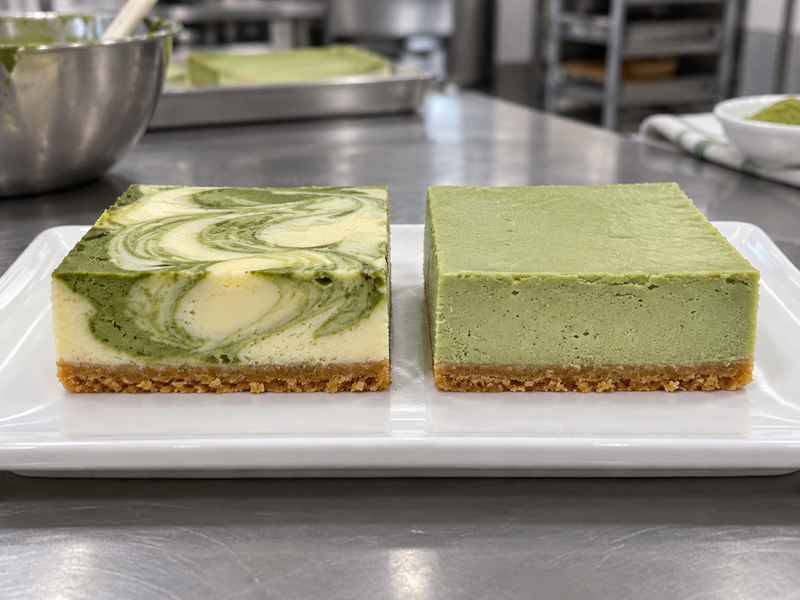
Lay the intended cutting grid over the swirl pattern during development. Each saleable rectangle should contain the agreed balance. Avoid approving a central hero slice while leaving the corner pieces nearly plain; customers buy individual bars, not the whole pan photograph.
2. Which base ingredients should stay fixed?
Record the exact cream cheese and crumb products
Cream cheese, sour cream, eggs and sugar define the base that carries the tea. Use the same commercial items throughout the first comparison. Products sold under the same broad ingredient name can differ in composition and handling, so retain pack labels and item codes with the trial sheet.
Prepare the ingredients under the kitchen’s approved procedure before mixing. Scrape the bowl and inspect for cream cheese lumps before introducing tea. A pale lump in a green filling can be mistaken for poor matcha dispersion when it began in the base.
The King Arthur vanilla bean cheesecake bar recipe offers a second practical reference for a bar format. Use a complete base method rather than assembling an untested recipe from the crust of one source and the filling of another.
Fix the crumb source too. Biscuit sweetness, particle size and fat content affect the base beneath the cheesecake. If purchasing changes from whole biscuits to ready-made crumbs, measure and test the replacement. Record any added flavor such as vanilla or citrus, because it can change how the tasting team judges the tea.
3. How can you trial the matcha dose?
Compare equal filling weights
For a fully blended version, prepare equal portions of an approved plain filling and compare the proposed levels below. These are original small-trial suggestions. They do not establish a final recipe, baking schedule or safe process.
| Sample | Plain filling | Proposed tea addition | Question |
|---|---|---|---|
| A | 250 g | 2.5 g | Is the tea clear enough? |
| B | 250 g | 3.75 g | Does the balance improve? |
| C | 250 g | 5 g | Does bitterness become excessive? |
Sift the powder and mix it through a small portion of filling before combining with the remainder. Avoid adding water casually to make a paste; extra liquid changes the trial. If the method requires liquid, account for it consistently in the formula.
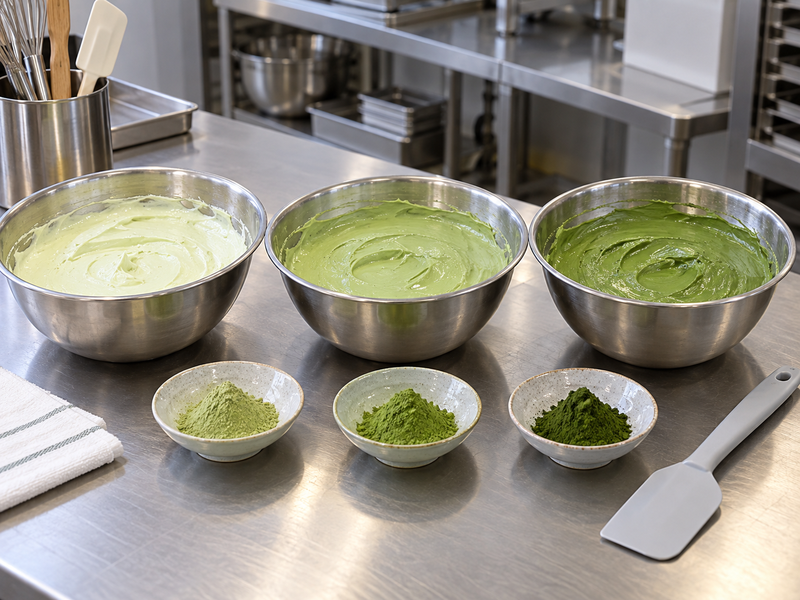
For a swirl, calculate tea against the green portion and record that portion’s share of the total filling. A strong green mixture used sparingly can produce a different eating result from a milder mixture spread throughout. Weigh both parts, then test cut pieces from several positions after the same baking and cooling process.
4. What makes the crust easy to cut?
Check support without making a hard base
A crust should support the bar when lifted and cut comfortably with the serving utensil. Test that behavior at the intended serving condition. A base that cuts neatly while warm may feel hard after chilling, while a loosely packed crumb layer may shed during packing.
Weigh the crust mixture per pan and spread it to a recorded depth. Use a flat tool to compact it evenly, taking care around corners. If staff press harder at the edge than the center, the resulting cut can vary even when the crumb formula stays the same.
| Crust observation | First variable to review |
|---|---|
| Loose crumbs under every bar | Binding and compaction |
| Hard edge strip | Uneven pressure or bake exposure |
| Greasy paper | Fat balance and ingredient identity |
| Base separates from filling | Surface and assembly process |
Run crust adjustments independently from tea-dose trials. Changing butter, crumb size and matcha together leaves little useful evidence when one version performs better. Keep a plain cheesecake control if the kitchen is also adopting a new biscuit supplier. The tea ingredient should not become the default explanation for every new defect.
5. How do pan size and depth affect the trial?
Scale by the intended slab geometry
Record the pan’s internal dimensions and the weight of filling deposited. Pan labels can be approximate, and sloped sides reduce the usable base area. Measure the actual pan used in production, then mark its identity on the work instruction.
When moving to a larger pan, preserve the planned filling depth as a starting comparison. Multiplying the ingredients without checking area can create a deeper slab that cooks and cools differently. A larger pan also changes handling and the number of pieces lost to edge trimming.
| Pan record | Use in the trial |
|---|---|
| Internal base dimensions | Calculate usable area |
| Crust weight | Compare base thickness |
| Filling weight | Control slab depth |
| Liner arrangement | Check release and corner shape |
| Cutting grid | Forecast portion count |
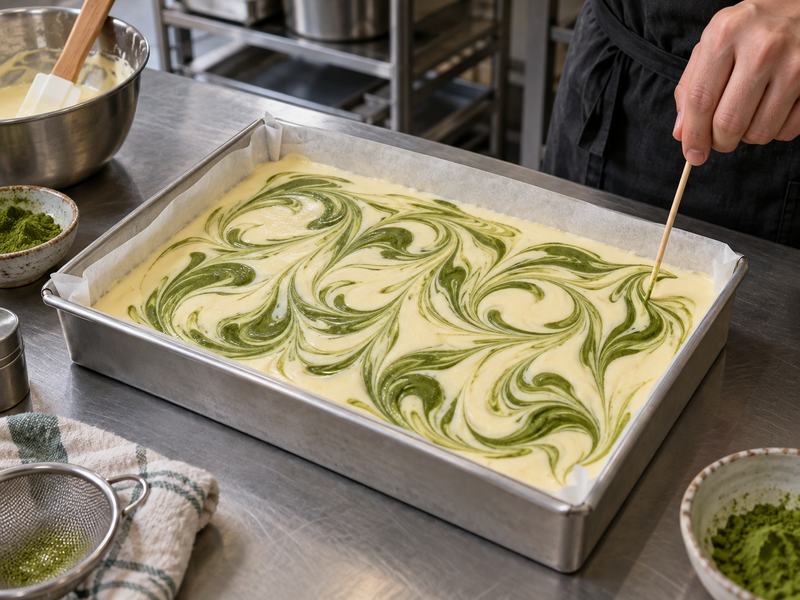
For a swirl, photograph the deposited pattern before baking and the final grid after cutting. Staff can then repeat a simple sequence of rows or dollops without trying to reproduce an artistic pattern from memory. Keep the amount of stirring consistent enough to preserve visible contrast.
6. What should bakers record during baking and cooling?
Separate appearance from process approval
Record the oven, pan location, load and actual recipe procedure used. Observe surface color, cracking and the difference between center and edge pieces. Do not rely on green color as the only indicator of doneness. Matcha changes the appearance of a familiar plain base.
Use the validated cooking endpoint and cooling procedure established for your product. The FDA Food Code resource provides a model reference for US retail food operations, while the adopted local rules and your particular process determine the requirements. The responsible food safety person should review any larger pan or deeper fill.
Place trial identifiers where they remain attached to the batch during cooling. A handwritten note left near the oven can become separated from the product. Keep the formula version, tea lot and bake record together until evaluation is finished.
Assess texture only after the agreed cooling stage. Cutting one sample early and another later produces an unfair comparison of firmness and edge quality. Reserve portions from both center and edge, then taste them under the same conditions. A smooth surface does not establish a safe shelf life.
7. How can you get consistent portions?
Use a measured grid and a repeatable knife method
Measure the usable slab after release, including any edge trim required by the product specification. Mark equal divisions before cutting. If the business sells by count at a fixed price, check several portion weights rather than assuming equal-looking rectangles are equivalent.
Clean the cutting tool between cuts according to the kitchen procedure. A buildup of cheesecake on the blade can drag green filling across a pale swirl and leave ragged edges. Decide whether a straight knife, wire cutter or other approved tool suits the intended volume.
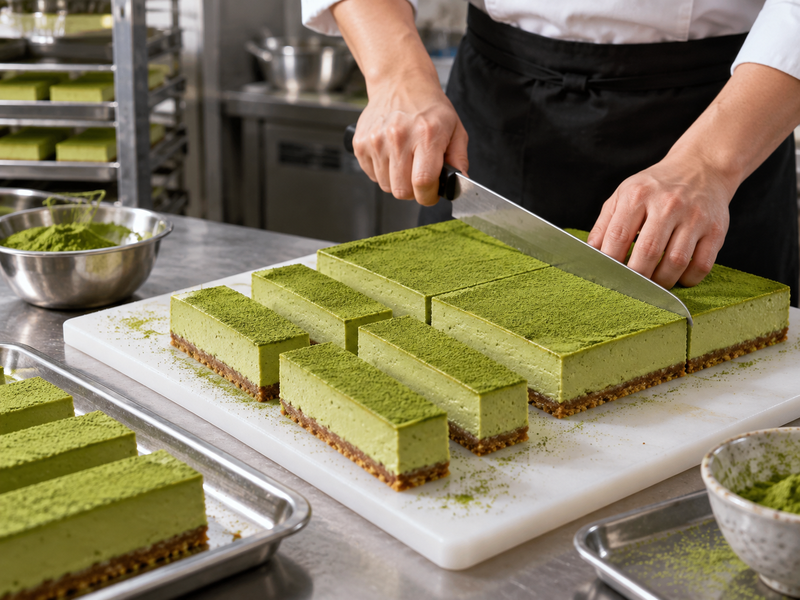
Weigh an edge piece and a center piece during the trial. If the difference is large, review the pan shape, surface leveling and trimming policy. A more accurate scale at the packing station cannot correct a slab that was deposited unevenly.
Photograph the acceptable cut face and the maximum allowed smearing. A clear visual standard helps packers reject genuine defects without discarding harmless variation in the swirl. Keep decorative toppings off the cutting area until the team has established a reliable portioning method.
8. Which packaging checks matter for cafe bars?
Test the bar with the customer’s fork
Place a finished bar in the actual container and try to remove it. The base should support lifting, and the lid should clear any topping. A pack that protects the bar in transit can still frustrate customers if its corners trap the fork or its liner tears under the crust.
For wholesale trays, test separation between pieces. Bare sides can smear when neighboring bars touch. Dividers or individual supports may improve handling, but their cost and packing time belong in the trial rather than being added after the selling price is set.
| Package detail | Check with finished bars |
|---|---|
| Lid clearance | No contact with the surface |
| Liner | Releases without tearing the base |
| Side spacing | Pieces do not smear together |
| Fork access | Customer can cut comfortably |
| Case stacking | Lower packs keep their shape |
Ask the supplier for food-contact documentation and suitability for your storage conditions. Use the intended delivery route in the quality trial. Keep packaging observations separate from the food safety assessment; an undamaged lid does not establish the product’s microbiological condition.
9. How do you cost trim and unsold portions?
Track the slab through packing
A theoretical grid may promise twenty bars while the final specification yields fewer after trimming. Calculate ingredient cost against the number of acceptable packed portions. Weigh trim separately and record its approved disposition. Do not assume it can be sold or reused without a defined process.
Tea cost depends on both dose and distribution. A swirled version can use less matcha than a fully green one, but only a measured formula will show the difference. Include any tea used in toppings or decorative dusting in the calculation.
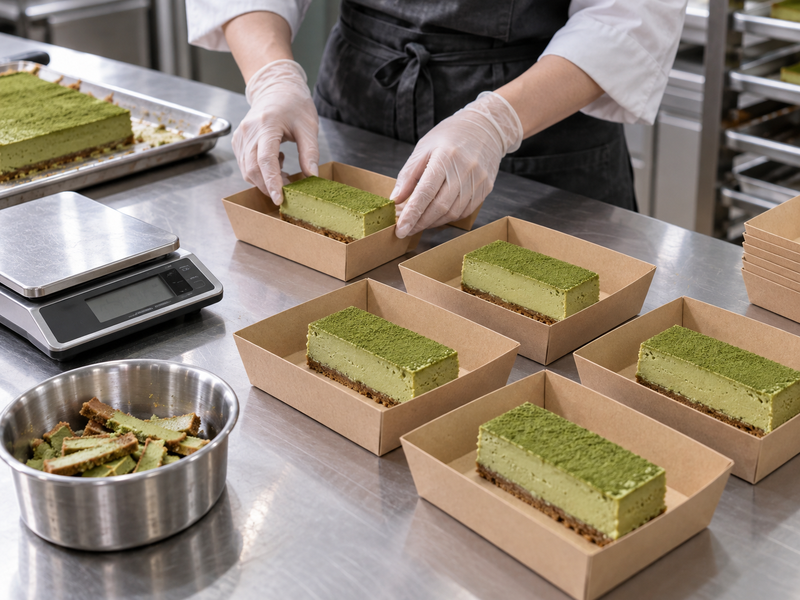
Track unsold portions by production day and sales channel. Overproduction may cost more than a modest ingredient price difference. Start with a conservative launch quantity and review demand before committing to large finished-product batches.
For buyers comparing several baked applications, the Matcha Village madeleine guide provides another format for organizing an ingredient trial. Cheesecake requires its own approval because the tea is judged in a moist dairy filling rather than a small baked sponge.
10. What should a commercial ingredient brief contain?
Send the supplier a realistic application description
Describe whether the matcha enters all the filling or only a swirl. Share the proposed dose, cream cheese system and expected serving condition. A supplier selecting samples for a strongly flavored baked crumb may choose differently from one selecting for a mild chilled filling.
Request the ingredient declaration, item code, lot traceability and documents required by the market. Confirm whether the offered product is pure tea or a sweetened blend. A blend may change sugar and other solids, so treat it as a separate formula option rather than a direct replacement.
Repeat the preferred trial with a second lot and a second operator. Keep the same pan and cutting grid. If the result changes, investigate the recorded ingredient and process differences before adjusting several variables at once.
Build the final production sheet around the approved slab: pan identity, crust and filling weights, tea dose, swirl method, process controls, portion grid and pack. Prepare one full pan under normal kitchen conditions and have production, purchasing and counter staff approve pieces from both the center and the edges.
FAQ
Q1: Can matcha be added to a no-bake cheesecake?
Yes, but use a suitable no-bake base and treat it as a separate product. Its setting system and handling requirements differ from a baked filling. The dose trials here can inform flavor screening, but they do not validate that new formula.
Q2: Why do some bars contain very little green swirl?
The deposit pattern may not align with the cutting grid. Weigh the green mixture, distribute it across the planned portions and use a repeatable swirl sequence. Inspect corner and edge pieces before approving the appearance of the whole slab.
Q3: Should a darker powder be used for a stronger color?
Choose from application samples rather than color names. Compare equal doses in the actual filling after processing. Record the resulting color and tea flavor separately, since a deeper appearance does not guarantee a more pleasant taste.
Q4: Can the bars be frozen for distribution?
That needs a specific freeze, transport and thaw trial with appropriate food safety review. Check filling texture, crust moisture, surface condensation and packaging after the planned process. This guide does not provide a frozen shelf life or release a distribution method.
Q5: What should a cafe record in its first test?
Record the tea item and lot, filling dose, pan dimensions, deposited weights, process used, finished portion count and cut-piece observations. Those details let the next trial answer a defined question instead of repeating the first batch from memory.