
Water changes a matcha drink and the equipment used to make it. A café can buy an expensive filter and still face chlorine taste, scale or weak flow because it never defined the source-water problem. The practical route is to test incoming water, set a treatment objective, compare drinks blind and maintain the chosen unit. Anzzio’s coffee and matcha filtration article makes the case for matching a system to the site. This buyer guide turns that principle into records a café can use.
Contents
- 1. What problem should matcha cafe water filtration solve?
- 2. What should a café learn about its incoming water?
- 3. Which filter claims matter for the site?
- 4. How should matcha flavor be compared?
- 5. How should scale and equipment needs be evaluated?
- 6. What flow and capacity does the bar need?
- 7. How should installation and hygiene be planned?
- 8. What cartridge maintenance should staff record?
- 9. How can buyers compare total operating cost?
- 10. What belongs in the filter purchase brief?
1. What problem should matcha cafe water filtration solve?
Choose an objective before a cartridge
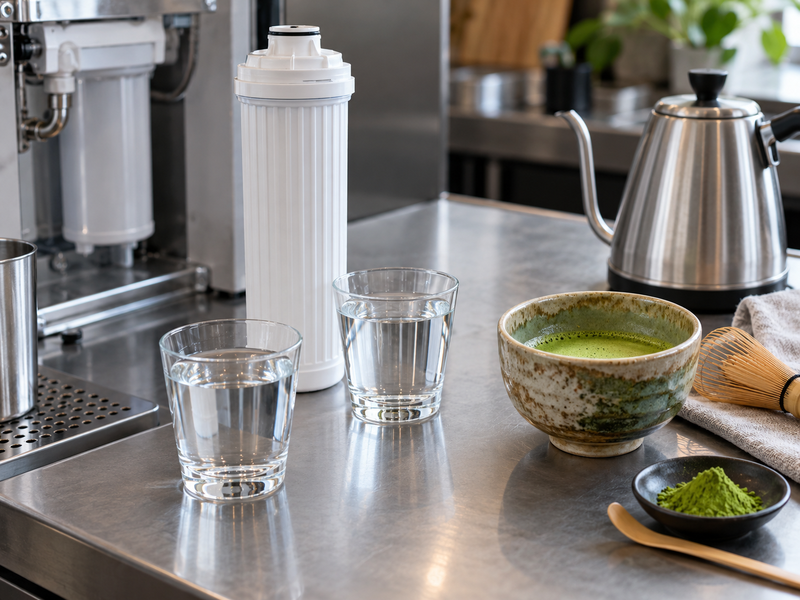
One site may need better taste at the whisking tap; another may be protecting a boiler from deposits. A third may have a water safety concern that requires professional assessment. These are different problems. The CDC’s water-filter guidance says filters differ in what they remove and should be chosen against a known concern. Do not treat a pleasant-tasting cup as proof of safety. Write a one-sentence objective for each water outlet: drinking water, matcha preparation, steam equipment and ice may have different use patterns.
Start with what staff observe. Log off-tastes, visible scale, slow flow, cartridge age and changes after local water work. Note whether issues affect every drink or only matcha. A bad matcha lot, dirty whisk or old milk can mimic a water problem. Make two plain matcha drinks with the same powder and preparation, changing only the water source. If the difference repeats under a blind tasting, filtration deserves a closer test; if it does not, investigate the recipe or equipment before buying hardware.
| Observed problem | Evidence to gather | Likely next step |
|---|---|---|
| Off-taste | Water and drink tasting notes | Check water report and treatment claim |
| Scale | Equipment inspection and water test | Discuss equipment-specific treatment |
| Low flow | Peak service volume and pressure | Size system for service |
| Safety concern | Qualified water test | Follow local water authority advice |
2. What should a café learn about its incoming water?
Combine utility information with a site sample
Ask the water utility for its current report. In the US, the EPA explains Consumer Confidence Reports, which summarize annual community-water-system quality information. A report describes the supplied system, not every change inside a particular building. Sample the actual tap used for drinks when a decision depends on local plumbing or observed taste. If water comes from a private source, use a qualified test suited to that source and local requirements.
Record the context of each test. Note date, outlet, whether the line was flushed, any recent plumbing work and the method used. A handheld TDS meter can track a reading, but it does not identify every contaminant or certify safety. Ask a qualified vendor which measurements answer the proposed treatment question. If a store network spans multiple utilities, group sites by source conditions instead of assuming one cartridge specification fits every café. Repeat measurements after a major water change and when a complaint appears.
| Water record | Source | Use in decision |
|---|---|---|
| Utility report | Water supplier | Background and stated quality |
| Tap sample | Café outlet | Local treatment decision |
| Taste log | Trained staff | Beverage impact |
| Equipment history | Maintenance team | Scale and service cost |
3. Which filter claims matter for the site?
Read the exact reduction claim
A filter label may list a standard but not the particular substance a buyer wants reduced. NSF’s standards guide distinguishes aesthetic claims under NSF/ANSI 42 from health-effect contaminant claims under NSF/ANSI 53 and warns that certification does not cover every possible contaminant. Check the model number and certified claim against the vendor documentation. For commercial equipment, confirm suitability for the specified flow, pressure and installation conditions as well.
Ask what the system cannot do. Carbon taste filtration, softening and reverse osmosis change water differently. A café may need a combination, but each added stage brings maintenance. Require the vendor to explain the treatment path from inlet to outlet and what happens when a cartridge reaches its stated capacity. If the concern is water safety, use qualified testing and relevant authorities; do not rely on the drink tasting panel. Choose the smallest system that demonstrably meets the site’s defined objectives.
4. How should matcha flavor be compared?
Run a controlled cup test
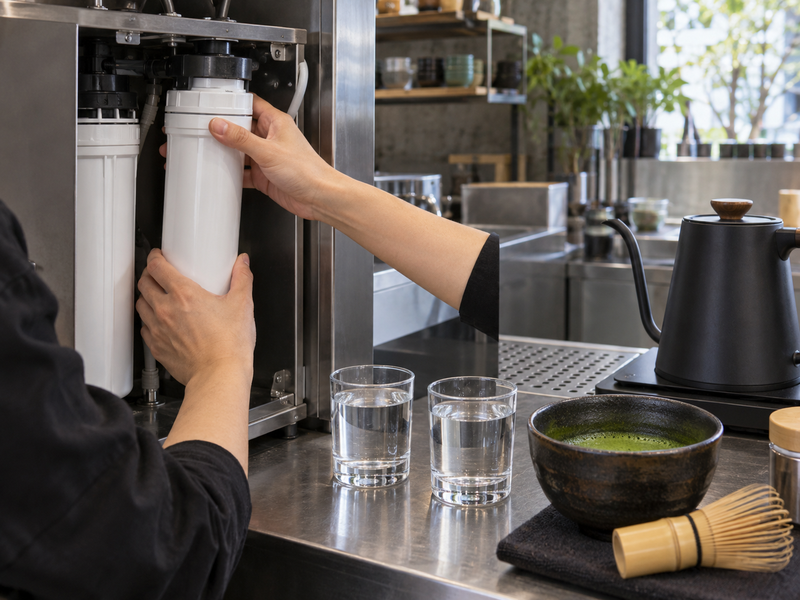
Prepare matcha with source water and candidate treated waters at the same measured temperature, powder dose, water volume and whisking time. Use coded cups and ask tasters to rank tea clarity, bitterness, off-taste and mouthfeel. Test a straight matcha cup before a sweetened latte, because milk and syrup can hide water differences. Repeat on another day using the same powder lot. A single favorite cup from one barista is a weak basis for a multi-store equipment purchase.
Check the complete menu. A filter that pleases straight-matcha tasters should also be tried in the café’s highest-volume latte and iced drink. Note whether a treated water changes foam, dilution or perceived sweetness. Keep the results with matcha preparation guidance so staff do not confuse water treatment with a change in water temperature. If tasters cannot distinguish options under a fair test, capacity and maintenance may decide the purchase more than subtle flavor claims.
| Cup test | Hold constant | Record |
|---|---|---|
| Plain matcha | Powder, dose and temperature | Tea and off-taste score |
| Milk drink | Milk and recipe | Flavor after mixing |
| Iced drink | Ice and cup size | Dilution and finish |
| Repeat day | Powder lot and method | Consistency of preference |
5. How should scale and equipment needs be evaluated?
Separate beverage taste from machine protection
Scale risk depends on water chemistry and equipment use. Ask the equipment maker what water characteristics its machine requires and what maintenance records support warranty decisions. A filter marketed for taste may not manage hardness in the way a boiler or steam system needs. Conversely, aggressive treatment can change the cup enough to require recipe retesting. Keep equipment protection and beverage flavor as two acceptance lines on the same project, with different owners signing them off.
Inspect before specifying. Record the existing scale pattern, descaling frequency, service interruptions and affected machines. If one unit is failing while others on the same feed are sound, a local equipment issue may be involved. Ask a qualified technician to interpret the water analysis and propose treatment compatible with the machines. Trial the final treated water in matcha drinks before a full network rollout. The goal is a stable operating condition, not the lowest meter number a salesperson can show.
6. What flow and capacity does the bar need?
Size for the busiest hour
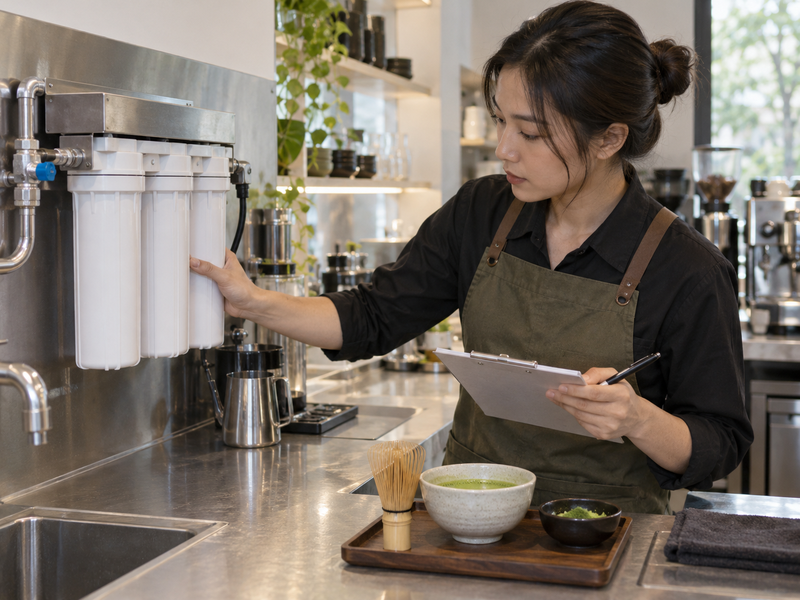
Count cups, ice use and equipment draw during a peak period. Convert that into expected water volume and note simultaneous use. A system that performs well in a quiet tasting may slow a busy matcha bar when an ice maker and hot-water tap run together. Ask vendors for rated flow under the site’s actual pressure, cartridge capacity under stated source-water conditions and pressure-drop information. Verify where the filter will be installed and whether staff can reach it for replacement.
Test a service simulation. Run the tap during a mock rush and time filling a standard vessel. Watch whether flow weakens as another machine draws water. A queue caused by a small filter can erase any benefit from a faster whisking station. For multiple stores, collect peak-use data from a high-volume and a low-volume site; one cartridge size may not be economical for both. Put an expected replacement interval in the bid, then confirm it against observed use after installation.
| Sizing input | How to record it | Buying implication |
|---|---|---|
| Peak water draw | Cups and equipment use | Required flow |
| Inlet pressure | Technician measurement | System compatibility |
| Available space | Photo and dimensions | Service access |
| Source condition | Qualified test | Cartridge capacity estimate |
7. How should installation and hygiene be planned?
Map the plumbing route and service access
Draw the inlet, treatment stages, outlet and any bypass on a simple plan. Mark which taps receive treated water; a café can accidentally test one outlet and serve from another. Use a qualified installer and follow equipment, plumbing and local requirements. Confirm that backflow controls, fittings and drinking-water-contact parts suit the location. Before staff make drinks, flush or commission the system using the manufacturer’s instructions and record who performed the work.
Plan a cleaning handoff. The filter housing, adjacent lines and dispensing points need a named owner. The CDC notes that filters require maintenance and neglected units can allow germs to grow. Train staff to report leaks, unusual taste, pressure drops and missed replacement dates. Keep the area accessible; a cartridge hidden behind heavy stock will be changed late. After installation, repeat the controlled matcha tasting and record the baseline reading that future checks will compare.
8. What cartridge maintenance should staff record?
Use a log that triggers action
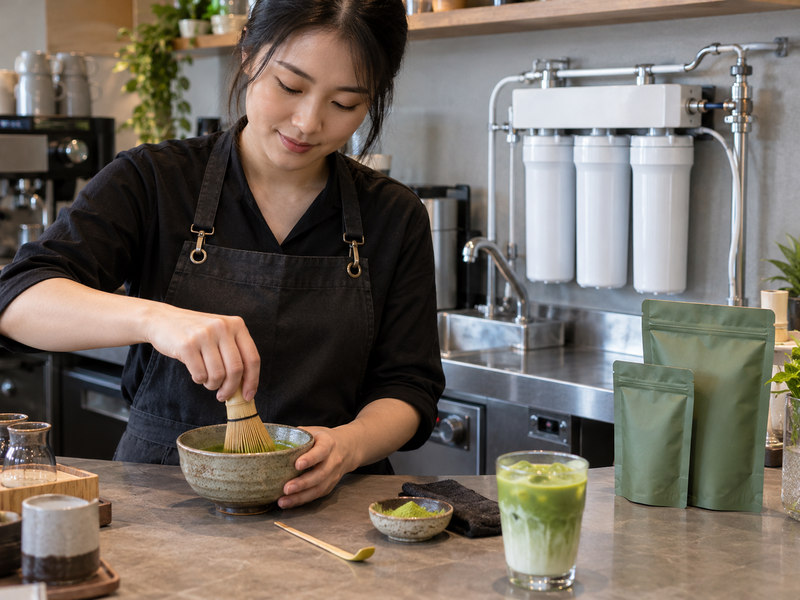
Write down installation date, cartridge model, lot if available, rated capacity, observed water use, replacement threshold and responsible person. Follow the manufacturer’s interval and any site-specific treatment advice. A calendar-only reminder may be insufficient at a high-volume café, while a volume-only rule can overlook periods of low use. Record both time and estimated throughput. If a water quality complaint appears, compare the complaint date with cartridge age, source-water changes and cleaning records.
Give staff a stop-and-report rule. A leak, unexpected pressure drop or unusual odor should reach the manager and service provider promptly. Do not ask a barista to improvise a cartridge swap without training or to serve water from an uncertain line. Keep spare cartridges of the exact approved model and record each change. After replacement, carry out the manufacturer’s commissioning steps and taste a plain matcha control. A maintenance log has value only when someone reads it and acts before service quality slips.
| Log field | Example entry type | Trigger |
|---|---|---|
| Install date | Calendar date | Time limit |
| Throughput | Meter or estimated liters | Capacity limit |
| Outlet check | Flow and taste notes | Investigation |
| Change record | Cartridge model and staff | Traceability |
9. How can buyers compare total operating cost?
Price the system over its use period
Compare purchase and installation cost, replacement cartridges, testing, technician visits, water waste if applicable and downtime. Divide the estimated cost by expected treated-water volume or drinks, stating assumptions. A lower-priced filter with a short cartridge life can cost more at a busy site than a larger unit. Conversely, an oversized system may sit unused and complicate maintenance. Request a clear cartridge price and supply lead time before approving the hardware.
Cost the current problem too. Use real maintenance invoices, drink remakes and staff time where available. Avoid claiming a filter will save a fixed amount without a local baseline. Run a pilot at one representative store, then compare actual cartridge life, flow and taste with the vendor’s proposal. If the pilot differs materially, revise the network budget before ordering twenty units. A buyer can then justify the choice using observed service data rather than broad promises about “perfect water.”
10. What belongs in the filter purchase brief?
State water, drink and equipment requirements
Give each bidder the same site-water information, current complaints, peak-use estimate, pressure reading, equipment requirements and installation photos. Ask for the exact model, documented claims, cartridge schedule, commissioning method, service access needs and total cost estimate. Require a pilot plan with acceptance criteria for cup taste, flow and maintenance. A sample cartridge without a stated operating plan is not enough for a busy café.
Keep the decision reviewable. After the pilot, attach the blind tasting results, technician sign-off, installation drawing and first maintenance log to the purchase decision. If the café changes its source water, machine or drink program, revisit the filter specification. The best system is the one whose claims match the measured problem and whose upkeep the team can perform consistently. Record that match before expanding to more stores.
FAQ
Q1: What is matcha cafe water filtration?
It is a treatment system selected for the water used in matcha drinks and related café equipment, based on a defined source-water need.
Q2: Can a TDS meter tell whether water is safe?
No. It measures a limited electrical property and cannot identify every contaminant. Use appropriate testing for safety concerns.
Q3: Does a filter certification cover all contaminants?
No. Check the exact model and certified reduction claim against the measured concern.
Q4: How often should cartridges be replaced?
Follow the manufacturer’s instructions and the site’s time, volume and water-condition records.
Q5: Should every café in a chain use the same filter?
Only if source water, equipment and demand are comparable. Pilot representative sites before standardizing.