
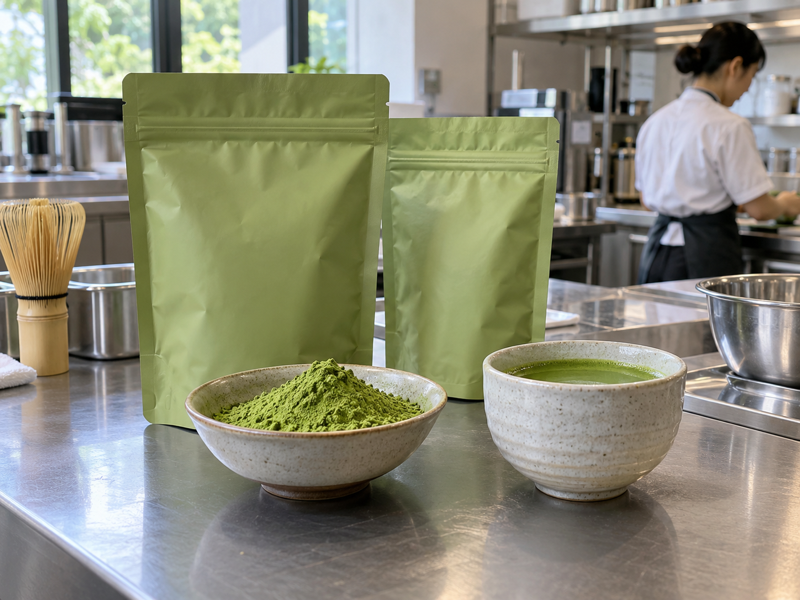
“Matcha cafe powder” can mean pure ground tea, a sweetened drink mix, or a product sold under a foodservice label. A buyer needs to know which one is in the bag before approving a recipe or a menu claim. The specification sheet, sample, packaging, and lot record all matter. This guide focuses on the powder as an ingredient: how to read its details, test it in service, and control changes from one delivery to the next.
Contents
- 1. What is the product actually made of?
- 2. Which details belong on a supplier sheet?
- 3. How should a powder sample be judged?
- 4. What does color tell a buyer?
- 5. How should texture and dispersion be checked?
- 6. How should packaging protect the powder?
- 7. What should lot traceability enable?
- 8. How should a buyer compare price?
- 9. What supplier questions protect continuity?
- 10. When is a powder ready for approval?
1. What is the product actually made of?
Ask for the full ingredient declaration. Pure matcha powder and a latte blend with sugar, milk solids, or flavorings are different products even if both make a green drink. The composition affects sweetness, allergens, dose, price comparison, and what the café can tell customers. Do not rely on the front of a pouch or a grade name alone.
Match the product to the menu. A café offering unsweetened straight matcha needs a powder that supports that claim. A sweet blend may fit a dessert-style latte if the customer-facing description is accurate. If the shop sells retail pouches, the retail label has its own requirements. Keep the supplier code visible in purchasing records so staff do not substitute a similar-looking bag during a rush.
| Product question | Document | Operational consequence |
|---|---|---|
| Pure or blended? | Ingredient statement | Menu language |
| Added sugar? | Composition | Recipe sweetness |
| Milk component? | Allergen detail | Customer disclosure |
| Flavor added? | Specification | Sensory and claims |
| Product code? | Pack and invoice | Stock control |
2. Which details belong on a supplier sheet?
A useful sheet identifies product name and code, ingredients, intended use, lot format, packaging, storage conditions, shelf life, and contact for quality questions. Ask for documents required by the market where the café operates. If the supplier claims an origin or production method, request evidence that applies to the specific product and lot. A generic brochure is weaker than a current product record.
Review version and date. A sheet from several formulations ago may not describe the bag being delivered now. Agree on notice before material changes. Keep the approved sheet with recipe cards and receiving records. If the product changes, taste it in the same cup and review any menu or label statement affected. A good supplier relationship makes those updates clear rather than leaving store managers to discover them through complaints.
3. How should a powder sample be judged?
Taste the powder in water and in the intended milk drinks. Fix dose, liquid amount, temperature, cup, and mixing method. Record aroma, bitterness, texture, color, clumps, and aftertaste. Check hot and iced service separately. A sample that looks vivid on a spoon can turn dull under milk or taste weak after ice melts. A bitter straight cup may still work in a flavored drink, but name that use honestly.
Include a second day and another operator. A single cup prepared by an expert does not show whether regular staff can repeat it. Inspect the cup after a normal wait for sediment or separation. Compare finalists at the dose that yields an acceptable drink, not only at equal grams. Keep the test record so a later lot can be checked against an approved reference.
| Test | Fixed controls | Record |
|---|---|---|
| Water | Dose and temperature | Tea flavor |
| Hot latte | Milk SKU and volume | Foam and bitterness |
| Iced latte | Ice weight and wait | Dilution and color |
| Service | Regular staff and tools | Time and clumps |
| New lot | Reference recipe | Change from approval |
4. What does color tell a buyer?
Color is useful as one sensory attribute, especially when a café sells drinks in clear cups. It does not prove origin, grade, purity, or flavor by itself. Evaluate powder and finished drink under consistent light. A colored lamp, different milk, or photo filter can mislead. Record how the cup looks at handoff and after the time customers normally wait.
If color changes between deliveries, check the actual lot, storage, dose, water, milk, and preparation before assigning a cause. Keep a retained sample from the approved lot when appropriate. A supplier may be able to explain variation with product records, but the café should still decide whether the new lot meets its menu standard. The customer's cup is the final test.
5. How should texture and dispersion be checked?
Mix the powder with the tools staff will use. Note whether dry pockets remain, whether sifting is needed, and whether particles settle. A powder may be finely milled yet still clump if stored near moisture. Test in the real water temperature and sequence. Adding powder directly to cold milk can behave differently from dispersing it in a small water base first.
Set a practical pass condition: smooth enough for the chosen drink after a defined mixing time, without an unacceptable ring or grit after a normal wait. If the powder needs a long special method, include that labor in the buying decision. Test cleaning too; a sticky blend may cost time between orders. Texture is both a customer experience and a service variable.
| Texture issue | Check | Possible response |
|---|---|---|
| Dry clumps | Storage and mixing order | Change sequence |
| Grit | Product and dose | Test alternative |
| Settling | Wait and vessel | Adjust method |
| Excess foam | Tool speed | Revise mixing |
| Residue | Cleaning cycle | Add duplicate tools |
6. How should packaging protect the powder?
Ask for packaging that matches the café's volume and storage. A very large opened bag may be awkward at a small counter. A tiny pack may raise cost and create waste at a high-volume bar. Check seal, light exposure, moisture protection, and how staff will reseal or transfer the ingredient according to the supplier's guidance and local food handling rules.
Set a receiving routine. Confirm product code, quantity, lot, date, and pack integrity before stock is opened. Store cases in the specified conditions, away from heat and moisture. Label opened packs with the date and use the approved rotation method. A beautiful sample can decline through poor handling after delivery, so storage is part of the product specification.
7. What should lot traceability enable?
Every delivered case should be linked to a lot or batch identifier that the café can record. If a customer reports an unusual taste or staff notice a color shift, the store can identify which lot was used. The supplier can then investigate the same material. Without a lot record, an issue becomes a vague argument about “the matcha” and may affect every store unnecessarily.
For multi-site chains, record which locations received each lot and when it entered service. Keep a sample or photo of the approved cup where useful. If a lot does not meet the standard, set it aside and follow the supplier's complaint process. Document the final decision. The purpose is quick, proportionate action, not paperwork for its own sake.
| Record | Where captured | Use |
|---|---|---|
| Supplier code | Purchase order | Correct item |
| Lot | Receiving log | Trace issue |
| Open date | Container label | Rotation |
| Recipe version | Station card | Explain use |
| Complaint | Quality log | Supplier response |
8. How should a buyer compare price?
Use delivered cost per gram and the accepted dose per cup. Add waste from spills, clumps, or discarded batches. A cheaper bag may need more powder for the same flavor; a higher-priced powder may be economical if the dose is lower. Include shipping, duties where relevant, and minimum order quantity. Cash tied up in slow-moving stock matters to a small café.
Compare at the recipe and menu level. If a blend includes sugar, remove the separate syrup cost from that option but check whether sweetness can be adjusted. If a product mixes faster, time the difference during a realistic shift. Do not assume a tiny speed gain will pay for a large price premium without measuring volume. Keep price quotes dated and review them when a new lot or contract begins.
9. What supplier questions protect continuity?
Ask how the supplier handles production capacity, lead time, order cutoffs, shortages, and quality complaints. Request a process for approving a new lot or formulation. Confirm who can provide technical guidance when the powder behaves differently in milk or water. A supplier should be able to discuss the specific product, not only send a sales brochure.
Agree on what constitutes a substitution. A product with a similar name may have different ingredients or performance. If a backup source is needed, test it in every advertised drink and create a separate card if the dose changes. Matcha Village can be evaluated as a B2B supplier through its samples and documentation; the buyer remains responsible for checking the finished cup and local requirements.
| Supplier issue | Question | Store plan |
|---|---|---|
| Late shipment | How much notice? | Safety stock |
| New formulation | When are buyers told? | Retest |
| Quality complaint | What evidence is needed? | Hold lot |
| Shortage | Is substitute available? | Approve separately |
| Pack change | Does storage change? | Update process |
10. When is a powder ready for approval?
Approve the exact product when its composition supports the menu, it passes sensory and service trials, its documentation fits the market, and supply terms fit expected volume. Record product code, lot, accepted dose, preparation method, pack size, and reference cup. Train staff on storage and the right container. A purchase order should point to that approval record.
Review the approval after a meaningful change in powder, milk, cup size, equipment, or customer feedback. Avoid silently adjusting syrup to cover a weaker lot. A café powder is suitable when it continues to make the promised drink under normal staff hands, not only when a sample looks impressive in a meeting.
Create an approval sheet for each powder instead of storing only a supplier brochure. The sheet can pair the product code and current specification with the exact drinks tested, accepted dose, mixing method, reference cup, lot, delivered price, and documents checked for the market. Add a decision owner and review date. When a new lot arrives, staff can compare it with the approved sample rather than relying on memory. If the bag changes size or the supplier revises a claim, the buyer can see which recipes and labels need review. Keep complaint records with the same code. This small record protects both buyer and supplier: each can discuss a specific material, cup, and observed issue. It also makes a second-source test faster because the standard of comparison has already been written down.
At receiving, make the visual check before opening any new case for service. If a bag or code differs from the approved record, hold it until the buyer confirms the change. This small pause is easier than tracing dozens of cups after a substitute enters the bar.
FAQ
Q1: Is cafe-grade matcha a regulated grade?
Do not assume so. Ask each supplier what its label means and test the specific product.
Q2: Can a sweetened blend be called plain matcha?
Menu wording should reflect the full ingredient composition and applicable rules.
Q3: Does a brighter powder always taste better?
No. Color should be judged alongside flavor, texture, dose, and consistency.
Q4: What should be checked on delivery?
Product code, quantity, lot, date, pack condition, and any relevant storage condition.
Q5: How should a new lot be approved?
Compare it with the reference sample in the same approved recipe and document any difference.
Related reading: best bulk matcha powder and Matcha Powder and How to Pick a Great One.