
The best bulk matcha powder for a café latte may disappoint a brand selling plain matcha tins. A buyer needs an answer tied to use, volume, and an approved quality range, not a universal ranking. This guide sets out a comparison method for commercial samples: screen the documentation, taste blind, measure process yield, and check whether the supplier can repeat the result. We use the viewpoint of an ingredient supplier working with food and beverage buyers rather than a consumer taste-test list.
1. What makes the best bulk matcha powder for a product?
Best means a powder meets the finished product’s sensory, technical, safety, and commercial requirements at an acceptable total cost. It does not mean the highest price, brightest dry color, or most prestigious grade label. A matcha that shines in a water tasting may disappear in a chocolate filling. A powder that gives strong flavor in a latte could be too assertive for plain-water customers. Set the decision criteria before inviting samples so each candidate has the same job.
Write the application, recipe dose, expected annual volume, pack size, price target, and quality requirements on a one-page brief. Separate mandatory gates from preferences. Market-specific food safety documents may be mandatory; a particular shade of green may be a preference if customers cannot see it after processing. Ask each supplier to nominate one or two products for the stated use. This narrows the field and gives suppliers a fair chance to explain what their samples are designed to do.
2. Which candidates should pass the first screening?
Check the identity and composition of each offer before tasting. Is it plain matcha, a sweetened blend, or a latte premix? Are the quoted product, sample, and specification linked by the same code? Ask for ingredient statement, lot number, pack format, storage advice, and the documents your quality team requires. Rejecting a sample at this stage can save weeks of recipe work if the supplier cannot provide the necessary record or quantity.
Make the screening criteria fit the project. A private-label retail tin may need a specific claim supported by current documents. A bakery may care more about heat behavior and consistent supply. Do not treat broad company certificates as proof for every lot and every claim. Record what is missing and give a supplier a chance to supply a current document when appropriate. A good candidate is one you can test, trace, purchase, and legally describe in the intended market.
| Gate | Evidence | Action if unclear |
|---|---|---|
| Ingredient identity | Complete statement | Clarify before tasting |
| Sample traceability | Product code and lot | Request linked sample |
| Market documents | Required current records | Quality review |
| Supply fit | Pack, MOQ, lead time | Check pilot and scale volumes |
3. How should a team organize the sample round?
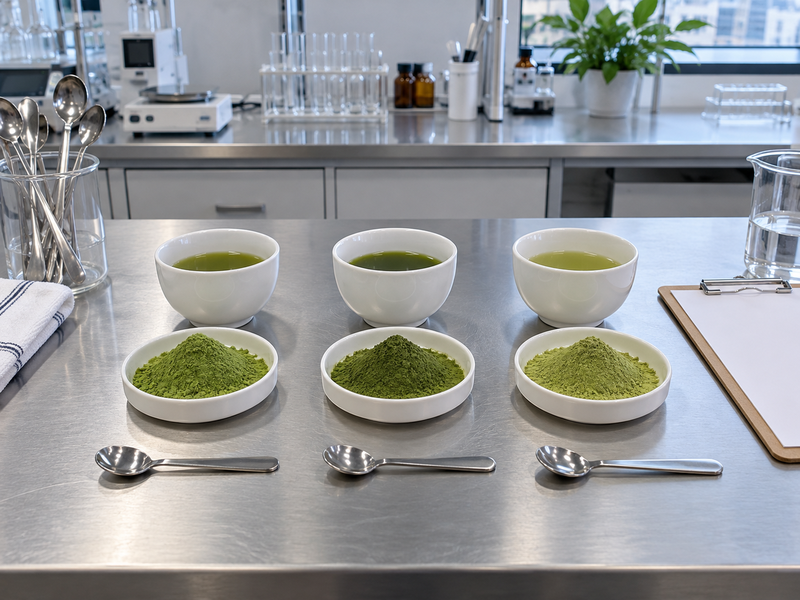
Use blind sample codes and a simple log. Record arrival date, lot, pack condition, and how each sample was stored. Keep the unopened samples under similar conditions and open them near the same test date. This reduces noise from age and handling. Ask for enough powder to run water tasting, the intended recipe, and a small process trial. One small sachet may allow a first impression but not a buying decision.
Choose a current product as a control if one exists. Prepare every candidate with the same equipment and measured recipe. Do not change a powder’s dose mid-test because its first cup seems weak; record the result at the fixed dose, then run a second dose trial. That sequence shows whether the candidate is genuinely efficient or simply needs more grams. Keep sealed retain samples of finalists. When a commercial lot arrives, those retains give the quality team a direct reference.
4. What should a blind sensory panel record?
Give tasters coded cups and a clear scoring sheet. In water, assess aroma, tea taste, bitterness, texture, color, and finish. In the finished application, assess how much matcha remains perceptible after milk, sugar, acid, fat, or heat. Ask panelists for concrete descriptions rather than “premium” or “good.” “Smooth on the first sip but drying after two minutes” is useful. “High quality” does not tell a supplier what to change.
Rotate cup order so the same candidate is not always tasted first. Include enough time between samples to reduce fatigue. Repeat the leading candidates on another day, preferably prepared by a different trained person. If your audience includes café staff or retail customers, use a small representative panel after the technical round. A purchasing team should not choose on color alone if the product promise centers on flavor. Nor should it reject a useful bakery ingredient because it is less delicate in a plain tea cup.
| Measure | Plain-water test | Finished-product test |
|---|---|---|
| Aroma | Dry and prepared | Survives base ingredients? |
| Flavor | Tea, bitter, sweet notes | Recognizable at sale? |
| Texture | Grit and suspension | Acceptable mouthfeel? |
| Appearance | Color under fixed light | Visible in real pack or cup? |
5. Which application tests separate close candidates?
Run a test that recreates the operation, not only a bench whisk. A café should use its actual blender or whisk, cup, milk, ice, and service wait. A bakery should test batter mixing, bake conditions, and color after cooling. A beverage manufacturer should examine dispersion, sediment, and the proposed process in a controlled pilot. These tests reveal differences a tasting bowl cannot show. Matcha particles remain in suspension rather than dissolving like sugar, so texture and separation deserve attention.
Change one variable at a time. Start at the standard dose for all candidates, then adjust the finalists if the recipe allows. Photograph products under consistent light and record preparation time and waste. The winner may be a powder that gives slightly less intense dry color but mixes faster and produces fewer rejected cups. Tie every trial result to the sample lot and process record so the supplier can reproduce the product that passed.
6. How does process yield change the price comparison?
Compare landed cost per sellable unit. Powder price per kilogram is one input; actual dose, dispensing loss, clumping, rejected product, and open-pack waste determine the rest. In a café, weigh ten portions from the real scoop or dispenser. In a factory, measure powder entering the batch and the amount lost to transfer, dust collection, or rejected product. A low-priced candidate that creates more waste can be more expensive in use.
Put each finalist through the same cost sheet. If one powder needs a higher dose to reach the sensory target, update the cost at that accepted dose. Include pack size relative to throughput. A small plant opening a large bag may discard more aged powder than a larger factory. Freight and duty, when applicable, belong in landed cost. Avoid invented market price ranges; use the quotes and yields from your own purchasing process.
| Input | Buyer calculation | Check |
|---|---|---|
| Powder dose | Accepted grams × landed price | Use tested recipe |
| Process loss | Purchased less usable grams | Measure pilot yield |
| Rejected units | Cost of remakes or scrap | Track during trial |
| Open-pack waste | Discarded grams by pack | Compare with turnover |
7. What quality evidence should support the winner?
Ask the quality team to review the supplier’s specification, lot-specific analysis, traceability, and tests required for your market. Set acceptance limits for the product you will buy, not for a vague category. If organic or other claims appear on the finished pack, verify the specific product and supply chain support them. A blind tasting result cannot replace microbiological or contaminant review. Conversely, a complete document set cannot prove that the powder tastes right in your recipe.
Establish a reference sample and a process for comparing later lots. Natural agricultural materials vary, so the aim is an acceptable range and a clear decision if a lot falls outside it. Store the sample under supplier guidance and document when it was opened. Ask how the supplier notifies customers of source, process, or formulation changes. The selected powder is only “best” while the delivered product remains within the tested range.
8. How should supplier reliability enter the choice?
Confirm that the supplier can deliver the approved product in the required pack and quantity, with predictable lead times and relevant documents. Ask for realistic minimum orders at pilot and scale stages. Discuss what happens during a seasonal supply constraint and how a replacement lot is proposed. A strong sample with uncertain continuity can be a poor fit for a chain launch or a private-label product that cannot change flavor quickly.
Communication quality is testable. Did the supplier answer specific questions, link documents to the sample lot, and explain the intended grade without overclaiming? Could it provide an application suggestion grounded in your actual recipe? Matcha Village offers multiple matcha grades and B2B formats in its company materials; the buyer still needs a quote for the exact tested powder. Keep commercial claims in writing so the product team and purchasing team evaluate the same offer.
Check the receiving experience as part of supplier evaluation. Request a sample in the pack format proposed for orders, then inspect seal quality, lot marking, and how easily staff can transfer powder without waste. If the commercial pack differs from the sample pouch, include that difference in the pilot. Packaging can change usable yield even when the matcha itself is identical. Ask who will answer a quality question after delivery, not only who sends the initial quote.
9. Can a scorecard make the decision clearer?
Yes, if the weights reflect the product. Assign mandatory pass/fail gates for safety documentation and supply feasibility. Then weight sensory, application performance, cost, and service reliability according to the business case. A plain matcha brand may give sensory more weight than a bakery ingredient buyer. A chain may place stronger emphasis on lot consistency and lead time. Decide the weights before seeing supplier prices to prevent a preferred vendor from shaping the rules.
Use comments beside scores. A numerical total can hide a critical failure, such as excellent color but poor cold dispersion. Review the leading candidates with the people who will use the powder: product development, quality, operations, and purchasing. If two candidates are close, run a focused follow-up trial on the deciding attribute instead of debating an abstract score. Keep the scorecard with the approval record for future replacement decisions.
| Criterion | Type | Evidence |
|---|---|---|
| Market and safety documents | Pass/fail | Quality approval |
| Finished-product sensory | Weighted score | Blind panel |
| Process performance | Weighted score | Pilot trial |
| Cost and continuity | Weighted score | Quote and supply plan |
10. When is a bulk powder purchase ready?
Approve a product code and lot after the mandatory documents pass, the application trial meets its target, and the landed cost fits the model. Record the tested dose, pack format, supplier quote, lead time, and accepted sensory reference. If the selected supplier cannot fill the initial volume from the tested product, retest the proposed substitute before placing a launch order. A small commercial pilot is useful when only bench tests have been run.
Set a new-lot review and re-order point before inventory runs low. That makes the choice repeatable rather than a one-time tasting event. The best bulk matcha powder is the one that gives your product the promised experience at a measurable cost and can be supplied with evidence the business trusts. If your brief changes, run the comparison again; the winner for one application need not win another.
| Item | Record | Next review |
|---|---|---|
| Recipe | Accepted dose and process | Formula change |
| Quality | Spec, lot, retain sample | New source or lot drift |
| Commercial | Landed cost and pack | Price or volume change |
| Supply | Lead time and change rule | Forecast revision |
Frequently asked questions
Q1: Is the most expensive matcha the best bulk choice?
No. Compare approved sensory performance and cost per finished unit.
Q2: Can color alone rank powders?
No. Taste, dispersion, documents, and supply fit matter as well.
Q3: Should a latte buyer taste matcha in water?
Yes, to understand the ingredient; final approval should use the latte recipe.
Q4: How many suppliers should a team sample?
Enough to compare qualified options, then narrow the field using your mandatory gates.
Q5: Does one approved sample cover every future lot?
No. Use it as a reference and review later lots against an accepted range.
Send your application brief and target volume to Matcha Village to request a documented candidate. Your own trial will determine whether it is the best bulk matcha powder for that product.