
How much matcha do cafes use? The right dose depends on the cup, milk, and powder. How much matcha cafes use per cup depends on the powder, drink size, milk, sweetness, and the flavor the shop promises. There is no single gram amount that works for straight tea, an iced large latte, and a fruit drink. A practical answer comes from a controlled dose trial, followed by a calculation of weekly use and cost. This guide shows the method and the arithmetic. Any numbers used as examples are illustrative starting points and must be validated with the actual product and recipe.
Contents
- 1. Why is there no universal matcha dose?
- 2. How should a dose ladder be set up?
- 3. Should hot and iced cups use the same amount?
- 4. How does milk change the dose?
- 5. How does sweetness affect dose selection?
- 6. Why should a cafe weigh instead of scoop?
- 7. How is powder use forecast from sales?
- 8. How does dose affect cost and pricing?
- 9. How should batch preparation be counted?
- 10. When should the dose be changed?
1. Why is there no universal matcha dose?
Powders differ in flavor strength, particle behavior, and how they taste with milk. Cups differ in finished volume and ice. A 250 mL hot latte and a 450 mL iced drink do not become equivalent because both contain one scoop. Sweetener can hide tea; a strongly flavored syrup can require a different base. The buyer must define the sensory target before choosing a dose.
Start with the supplier's preparation guidance and a fixed recipe. Hold all other ingredients constant while varying powder. Taste blind where possible. Record when the matcha becomes recognizable, balanced, and then too bitter or gritty. That curve gives the café an acceptable range. Staff can then test whether the chosen amount is easy to measure and affordable at the intended price.
| Variable | Effect to test | Keep fixed during dose trial |
|---|---|---|
| Powder | Flavor and texture | Product lot |
| Cup size | Concentration | Finished volume |
| Milk | Tea visibility | Exact SKU |
| Sweetener | Perceived bitterness | Measured amount |
| Ice | Dilution | Weight and wait |
2. How should a dose ladder be set up?
Choose one drink and one cup size. Prepare three or four samples at increasing powder weights around the supplier's suggested use. Use the same water amount, temperature, milk, ice, sweetener, and mixing time. Code the cups so tasters do not know which has more powder. Ask them to describe tea intensity, bitterness, texture, and willingness to buy the cup at the proposed price.
Do not change powder and milk together. If a higher dose tastes harsh, adjusting milk at the same time will hide the cause. Repeat the best two candidates on another day with regular staff. Taste at pour and after a normal customer wait. Choose the lowest dose that meets the house standard, then consider whether a stronger version deserves its own menu item or modifier.
3. Should hot and iced cups use the same amount?
They might, but they need separate tests. Ice adds volume and melts, changing strength over time. A hot latte loses heat and shifts aroma rather than dilution from ice. Set the iced cup's ice weight and actual liquid volume before deciding whether to raise the powder dose or reduce base water. Taste after a few minutes, not only at handoff.
Keep cup sizes honest. A large cup with much more milk may need more matcha to taste like the smaller version, which changes cost and caffeine content. Do not scale a recipe solely by cup volume without sensory checks. Write a card for each size and format. If a large size cannot deliver the house flavor at a workable price, it may be better to offer one size.
| Format | Primary change | Required check |
|---|---|---|
| Small hot | Less milk | Heat and strength |
| Large hot | More milk | Tea still present |
| Small iced | Ice melt | Five-minute taste |
| Large iced | Greater dilution | Dose and price |
| Delivery iced | Longer wait | Travel test |
4. How does milk change the dose?
Milk can soften bitterness and mute tea aroma. A sweet plant drink may make a given matcha dose seem lighter than in water, while another milk may bring a flavor that competes with the tea. Test the exact SKU used in service. If the café advertises dairy and plant options, each should have an approved recipe. One default dose may work across them, but the result needs evidence.
Taste the matcha base before and after milk. If the base is good and the latte is weak, check milk volume and sweetness before automatically doubling powder. If a different milk requires a dose adjustment, consider whether the cost and menu price can support it. A modifier should not silently make the drink weaker or more bitter. Record the decision in staff training.
5. How does sweetness affect dose selection?
Sugar and flavors can mask bitterness but also flatten tea. A dose chosen for a plain latte may vanish under a strong strawberry syrup. Rather than adding powder until the drink looks green, test the amount of syrup and the matcha base together. A lower sweetness level might reveal the tea without raising cost or astringency.
Build the flavored recipe from an approved plain cup. Add the flavor in measured increments and taste. If the matcha note remains absent at a reasonable sweetness, a different powder may work better than a very high dose. Keep menu descriptions honest: a dessert drink can be enjoyable even if tea is subtle, but customers should not expect the same tea intensity as a straight cup.
| Observation | Possible cause | Trial |
|---|---|---|
| Weak tea | Too much milk | Fix finished volume |
| Weak with syrup | Flavor masks tea | Reduce syrup |
| Bitter finish | Dose too high | Lower dose |
| Gritty cup | Dispersion or powder | Change method |
| Color fades | Recipe or hold | Test after wait |
6. Why should a cafe weigh instead of scoop?
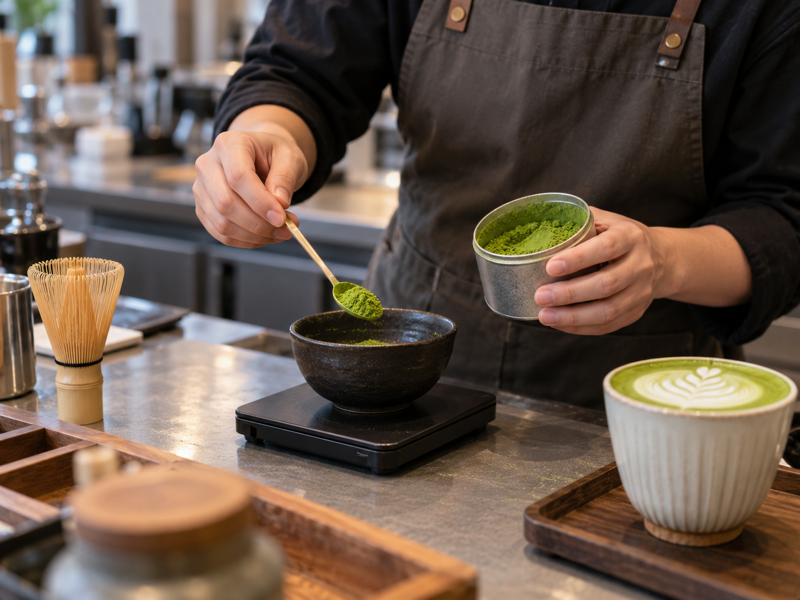
A scoop measures volume, which changes with packing, powder texture, and how staff fill it. A scale measures mass directly. During development, weigh every sample. During service, a calibrated scoop may be faster if it produces a tight enough range. Check several scoops from different staff and at different points in the bag. Record the actual mean and variation.
If a shop uses a dispenser or pre-portioned sachet, test it too. A sachet can simplify dosing but adds packaging and may be less flexible across sizes. A dispenser can drift or clog. Compare speed, accuracy, cost, and waste under a mock rush. The best dosing method is the one that keeps the approved cup consistent in ordinary staff hands.
7. How is powder use forecast from sales?
Multiply expected cups of each recipe by grams of matcha in that recipe. Add a measured allowance for spills, remakes, sampling, and prepared base that must be discarded. Then divide by usable grams per pack and round up to the supplier's order unit. This gives a purchasing estimate, not a fixed truth. Update it with actual sales mix and stock counts.
For illustration, a café selling 100 cups at 3 grams and 50 cups at 4 grams uses 500 grams in those drinks before waste. If waste adds 25 grams, the period uses 525 grams. These example figures are arithmetic, not a recommended dose or demand forecast. Replace each input with the café's approved recipe and real stock movement.
| Forecast line | Formula | Data source |
|---|---|---|
| Core latte use | Cups × grams | POS and card |
| Large latte use | Cups × grams | POS and card |
| Straight tea use | Cups × grams | POS and card |
| Waste | Measured grams | Stock log |
| Order quantity | Total ÷ pack size | Supplier terms |
8. How does dose affect cost and pricing?
Powder cost per cup is the approved dose multiplied by delivered price per gram. Add milk, syrup, cup, lid, labor, and normal waste to understand the full drink. Compare two powders at the dose that produces an acceptable cup. A cheaper bag may require more grams; a costly bag may need fewer. The sensory test decides whether either cup is good enough.
Run sensitivity checks. What happens if powder price rises, a large size becomes popular, or staff overfill scoops? Set a tolerance for ingredient use and review actual yield per pack. Do not cut dose to protect margin without tasting the result. A price change, size adjustment, or different ingredient may be more honest than a quietly weaker cup.
9. How should batch preparation be counted?
If the café makes a matcha base in batches, record total powder, liquid, expected portions, actual portions poured, and leftover volume. A batch may settle or be discarded before all portions sell. Cost per cup should include that loss. Check first and last pours for comparable strength; if they differ, the number of theoretical servings in the recipe is misleading.
Follow appropriate food safety rules for holding and discard. Do not infer a safe time from taste or color alone. Keep a batch log with lot, time made, and staff member where needed. A busy store may accept some controlled waste in exchange for faster service, but it should be measured. A slower store may be better off mixing to order.
| Batch measure | Why it matters | Action if off |
|---|---|---|
| Powder charged | Recipe strength | Verify scale |
| Base yield | Portion estimate | Check mixing |
| Portions sold | Real output | Review demand |
| Leftover | Waste cost | Reduce batch size |
| Last-cup taste | Settling | Change method |
10. When should the dose be changed?
Revisit dose when powder, milk, cup size, syrup, ice, water, or mixing tool changes, or when complaints reveal weak or bitter drinks. Retest with the same structured ladder. Keep the old recipe as a control. Record why the new amount was chosen and what it changes in cost and ingredient information.
Train staff before the new card goes live. Update point-of-sale modifiers, purchasing forecast, and any prepared-batch formula. Remove old cards from the station. Monitor the next few shifts for powder yield and customer reaction. A dose is approved when it serves the intended flavor in the real cup and regular staff can measure it consistently.
An operator worksheet can keep the dose decision from drifting. Record the chosen grams for each size, the actual powder used over a week, and cups sold by recipe. Calculate expected use from sales, then compare it with the opening and closing stock count. A gap may reflect free samples, spills, batch discard, unrecorded remakes, or overfilled scoops. Ask staff what happened before assuming the powder is missing.
Repeat the check after a new lot or milk SKU arrives, because the team may compensate for a flavor change by adding extra matcha without updating the card. If the accepted dose moves upward, retaste the cup and recalculate price. A precise forecast should also show order lead time and a safe stock level. The answer to “how much” is therefore both a sensory decision per cup and an inventory measure across the shift.
FAQ
Q1: Is 2 grams enough for every latte?
No single number suits every powder, cup, milk, or flavor. Run a dose trial in the finished drink.
Q2: Should a large cup get the same scoop as a small cup?
Only if tasting shows it works. Larger liquid volume often changes perceived strength.
Q3: Can a café measure powder by spoon?
A spoon can be calibrated, but verify several real portions by scale and watch variation.
Q4: How do I estimate monthly powder needs?
Multiply each item's expected sales by its approved dose, add measured waste, and account for pack size and lead time.
Q5: What if customers say the latte tastes weak?
Check actual dose, milk volume, ice, syrup, and mixing before changing the powder or recipe.
Related reading: matcha wholesale cost and Batch Matcha for Cafes.