
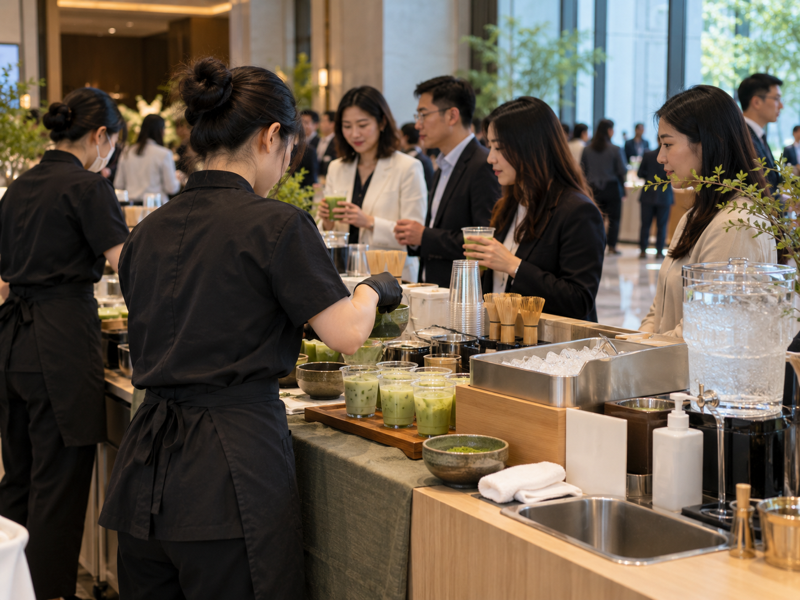
Matcha bar catering compresses a café into a temporary service area with a fixed start time. Guests may arrive in a wave, ice can disappear faster than forecast, and the venue may provide less power or water than the proposal implied. A green drink in a branded cup is the visible part. The working plan covers menu, capacity, food handling, transport, staffing, and contingencies. This guide gives event operators and buyers a way to specify the service before a contract is signed.
Contents
- 1. What does a matcha bar catering package include?
- 2. How should the event menu be limited?
- 3. How many drinks can the bar serve?
- 4. What venue details need a site check?
- 5. How should ingredients and ice be forecast?
- 6. What preparation can be done before arrival?
- 7. How should the bar handle branding requests?
- 8. What staffing plan protects service quality?
- 9. What should the contingency plan cover?
- 10. How should the event be reviewed afterward?
1. What does a matcha bar catering package include?
Define the service in writing: number of guests, service hours, menu, cup size, expected drinks per guest, staffing, equipment, setup and breakdown time, and who provides power, water, ice, and waste removal. Specify whether the bar is staffed, self-service, or a simple bottled drink delivery. These formats have different capacity and safety requirements.
Ask what the client values. A corporate meeting may need quick, quiet service. A brand event may value a visible preparation moment and customized cups. A wedding may need a nonalcoholic option that works alongside another bar. The menu and layout should reflect that purpose. A broad package description can lead to an expensive mismatch on event day.
| Package element | Client decision | Operator plan |
|---|---|---|
| Guest count | Expected attendance | Stock and capacity |
| Service window | Arrival pattern | Staffing |
| Menu | Plain and flavored options | Recipe cards |
| Venue | Power, water, access | Site survey |
| Branding | Cups or display | Proof and lead time |
2. How should the event menu be limited?
A short menu protects speed. Start with a plain iced matcha latte, a tea-forward option, and perhaps one signature flavor. Add hot service only if equipment, power, and guest expectations support it. Every extra milk, syrup, and topping adds stock and decisions at the cart. A line of guests is not a good place to discover that a layered drink takes twice as long as expected.
Test every drink in the event cup with a lid. Taste after a normal wait and, if drinks will be carried, after a short walk. Use measured recipes and clear allergen information. If the menu includes coffee or sweetened premix, say so. Set a policy for substitutions in advance. A limited, accurate menu often serves guests better than a long board of drinks that cannot be made at event pace.
3. How many drinks can the bar serve?
Time the full cycle: order, dose, mix, milk or water, ice, lid, handoff, and cleaning. Test with the planned team and equipment. One demonstration cup does not reveal throughput when fifty guests approach after a presentation. Build a service model around the arrival wave, not only total attendance. Consider whether pre-ordering or a second station is needed.
Set a realistic capacity range and a contingency for demand above it. A focused menu can reduce decisions, while pre-measured ingredients may help if they are handled safely and traceably. Do not promise a cup count based on theoretical machine speed. Include replenishment trips, staff breaks, and cleaning in the schedule. The best package is one the team can deliver without a long, uncertain queue.
| Capacity input | Measurement | Risk if omitted |
|---|---|---|
| Average cycle | Timed mock service | Overpromised output |
| Arrival wave | Event agenda | Sudden line |
| Staff count | Assigned roles | Shared-task bottleneck |
| Refill time | Ice and milk runs | Bar stops |
| Cleanup | Tools per cycle | Quality drift |
4. What venue details need a site check?
Confirm access times, loading route, elevator or stairs, cart dimensions, power circuits, water access, handwashing, cold storage, ice delivery, waste route, and weather exposure. Ask for a floor plan and, when practical, visit the site. An outlet on a brochure does not tell you whether it is on a circuit shared with another vendor. A sunny outdoor corner can change ice and food handling needs.
Coordinate with the venue and local authority on applicable foodservice rules. Some events require permits, insured vendors, or specific water and sanitation arrangements. Do not assume that a pop-up at one venue has the same requirements at another. Put responsibilities in the contract: who supplies each utility, who checks it, and what alternative is available if it fails.
5. How should ingredients and ice be forecast?
Use the menu mix and approved dose to calculate powder, milk, syrup, cups, lids, and ice. Add a measured contingency for attendance uncertainty and normal spills, balanced against safe storage and waste. For example, powder need equals forecast cups by recipe multiplied by grams per cup, plus an allowance based on prior events. Do not use one universal “matcha per guest” number.
Ice deserves a separate plan for warm or outdoor events. Weigh ice per cup and estimate peak hourly use, then identify a safe refill source and a staff member responsible for watching the level. Keep dairy and plant milks under required conditions. A cart can carry enough powder for the day and still stop because it has no cold milk or matching lids.
| Stock item | Forecast basis | Backup |
|---|---|---|
| Matcha | Cups × approved dose | Sealed spare pack |
| Milk | Cups × pour volume | Chilled reserve |
| Ice | Cups × ice weight | Refill arrangement |
| Cups/lids | Drinks plus remakes | Matched spare cases |
| Syrup | Signature mix | Measured extra bottle |
6. What preparation can be done before arrival?
Prepack tools, cups, approved ingredients, signage, and cleaning supplies using a checklist. Ingredients may be portioned or prepared ahead only under a validated process that protects quality and meets local food handling rules. A matcha liquid base needs a defined mix, hold, transport, and discard procedure. Taste first and last pours in a trial because powder can settle.
Prepare a station map and staff roles. One person may take orders and hand off, another mix, and another replenish during a high-volume event. For a small event, roles can combine, but the team should know who watches ice and who resolves a guest issue. Rehearse packing and setup so the event does not begin with a search for a power adapter or clean whisk.
7. How should the bar handle branding requests?
A client may request custom cups, a color theme, or a named signature drink. Confirm artwork deadlines and proof physical materials before printing. Keep drink descriptions accurate even when the event theme is playful. If a cup carries a client logo, the operator still needs ingredient and allergen answers. Avoid putting unverified health or origin claims on a menu board.
Photograph a real trial cup in the event packaging. Colored lighting and outdoor heat can change appearance. If a layered drink is promoted, test how it looks after guests carry it. The branding should fit the service without delaying every order. A custom garnish that adds thirty seconds to each cup can create a queue that becomes the most memorable part of the activation.
| Custom request | Production check | Service effect |
|---|---|---|
| Printed cup | Proof and fit | No recipe change |
| Custom flavor | Sensory and allergen | Extra step |
| Layered look | Travel test | Possible stir instruction |
| Menu board | Legible details | Faster choice |
| Photo moment | Placement | Keep queue clear |
8. What staffing plan protects service quality?
Assign staff by task, not just headcount. A barista who mixes continuously may need another person to handle payments, guest questions, and refills. Train every worker on the recipe, sanitation, allergens, and remake rule. Make sure a supervisor can pause service if cold storage fails or an ingredient lot seems wrong. A polished event demands ordinary foodservice discipline.
Schedule breaks and coverage. A four-hour event includes setup, a rush, quieter periods, and breakdown. Staff may be tempted to skip cleaning during the rush; duplicate tools and clear roles can help. Test service with the planned team before the event. An unfamiliar temporary worker should not learn the dose while guests are already waiting.
9. What should the contingency plan cover?
List likely failures: late access, power loss, no water, ice shortage, milk warming, rain, delayed ingredients, broken mixing tool, and more guests than planned. For each, name the decision owner and practical response. Some issues allow a smaller menu; others require stopping service until safe conditions return. Put critical venue obligations in writing so the operator is not left improvising at the door.
Carry spares for low-cost items that can stop the bar: scale, mixing tool, cords, cups, lids, and cleaning supplies. Confirm backup ice and chilled storage. Protect ingredient lots and transport temperatures. A contingency plan is useful only if the team knows it and the venue has agreed to any required access or utility.
| Failure | Early signal | Response owner |
|---|---|---|
| Ice running low | Bin check each period | Floater |
| Power issue | Setup test fails | Lead and venue |
| Long queue | Ticket time rises | Service lead |
| Ingredient fault | Taste or lot concern | Quality lead |
| Weather shift | Exposure changes | Event lead |
10. How should the event be reviewed afterward?
Record drinks served by item, actual peak rate, unused stock, remakes, guest comments, and any delay. Compare them with the proposal. If the bar had a long line, determine whether the cause was guest arrival, menu complexity, equipment, or staffing. If a signature drink was rarely chosen, it may not deserve a place in the next package. Share a concise factual report with the client when appropriate.
Update the checklist and pricing from real data. A venue that required an extra ice run should be planned differently next time. A cup that leaked during transport should be replaced before another booking. Matcha bar catering works when the team can deliver the promised drink at the promised moment, then learn from what actually happened on site.
A final event rehearsal should cover load-in to load-out, not just drink making. Pack the cart as it will travel and have the team unload, connect equipment, arrange supplies, and complete a safe-service check against a clock. Place practice orders in the pattern the client's agenda suggests: perhaps a quiet start followed by a sharp break between sessions. Watch how quickly ice, milk, and cups are refilled and whether a guest can read the menu while the line moves.
Run one fault scenario, such as a failed power outlet or missing case of lids, and have the lead call the backup plan. Photograph the packed equipment after rehearsal so the team can reset it at the venue. These steps expose hidden labor in setup and breakdown, which belongs in the quote as much as powder and cups do.
Confirm a contact name and phone number for venue access, utilities, and emergency decisions. Give the service lead authority to simplify the menu when a safe ingredient or piece of equipment fails. The client should know that plan in advance, so a necessary change is understood as controlled service rather than a surprise.
FAQ
Q1: Can a matcha cart serve a large event alone?
Only if timed service capacity matches the event's arrival pattern and menu. Test before promising a count.
Q2: Should the event offer both hot and iced drinks?
Offer both only when equipment, power, staffing, and demand support them.
Q3: How is ice planned?
Use approved ice weight per drink, expected menu mix, peak orders, and a confirmed refill source.
Q4: Can matcha base be made before the event?
Only under a validated safe process with clear transport, hold, settling, and discard checks.
Q5: What should be in the event contract?
Guest assumptions, service window, menu, staffing, utilities, access, stock responsibilities, branding, and contingency terms.
Related reading: matcha powder for cafes and How a Matcha Bar Outperformed Two Alcohol Bars at TikTok's Beauty Influencer Event in Los Angeles.