
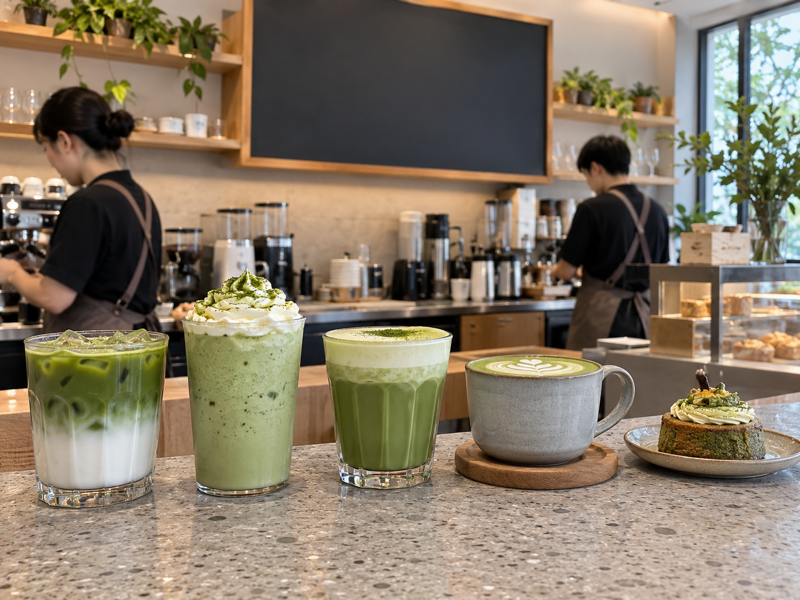
Matcha cafe menu ideas are useful only when baristas can execute them at the counter. A matcha cafe menu is an operating document that customers see. It sets expectations at the register and tells the bar what ingredients, equipment, and time each order will require. A crowded menu can hide a strong plain latte behind six similar flavored cups.
A sparse menu can fail if it gives newcomers no way to understand matcha. This guide focuses on menu architecture: what to include, how to describe and price it, and when to remove an item. Recipe development is handled separately, but the menu should never promise a drink staff cannot repeat.
Contents
- 1. What should a matcha menu help customers decide?
- 2. How many core drinks should appear?
- 3. How should the menu separate tea from dessert drinks?
- 4. Which sizes make operational sense?
- 5. How should menu prices be set?
- 6. What role should modifiers play?
- 7. How can desserts fit the drink menu?
- 8. How should a seasonal item be introduced?
- 9. What should the printed and digital menu show?
- 10. When should an item be removed?
1. What should a matcha menu help customers decide?
The menu should answer three questions quickly: what the drink tastes like, how it is served, and what it costs. Put core options in a visible order: straight matcha, plain latte, flavored drinks, and perhaps desserts. Use size and sweetness information where it changes the decision. If a customer must ask whether a drink contains coffee, milk, or added sugar, the description needs work.
Observe a test counter. Time how long customers take to choose and note recurring questions. A long decision time may come from too many similar options or unclear names. A short menu can still support choice through a few tested milk or sweetness modifiers. The aim is a clear path for a first-time buyer and a fast reorder for a regular.
| Customer question | Menu answer | Operational benefit |
|---|---|---|
| Is it sweet? | Clear default sweetness | Fewer remakes |
| Is there milk? | Base and alternatives | Allergen clarity |
| Is there coffee? | Explicit ingredient | Accurate expectation |
| What size? | Volume or cup size | Consistent pricing |
| What is signature? | One or two highlighted items | Faster choice |
2. How many core drinks should appear?
Start with a small range that covers distinct jobs. A straight tea gives a tea-forward option. Hot and iced lattes cover familiar formats. One signature drink gives the café a point of difference. More items can follow if paid demand and service capacity justify them. A menu with ten different fruit syrups may look broad but tie up cash in ingredients that move slowly.
Use a menu map before designing graphics. For each item, list the customer it serves, ingredients, preparation steps, price, and likely sales period. Remove duplicates that differ only by a minor topping. The team can bring back a limited flavor later. A short menu is easier to train, replenish, and improve because each item generates enough observations to judge it.
3. How should the menu separate tea from dessert drinks?
Group by the experience a customer expects. A plain unsweetened matcha and a sweet strawberry latte do not need to sit under a single undifferentiated heading. The menu can use “tea-forward,” “milk drinks,” and “flavored” as plain language categories if those labels fit the actual offer. Explain sweetness instead of assuming all matcha drinks are naturally bitter or naturally healthy.
Keep ingredient descriptions honest. If a drink uses sweetened matcha premix, describe it accordingly and review allergen information. If a flavored item includes coffee, name the coffee. Avoid implying that green color alone makes a dessert drink a wellness product. Customers can enjoy a sweet cup without a health claim. Accuracy helps the team answer questions and reduces disappointment after purchase.
| Menu lane | Customer expectation | Product control |
|---|---|---|
| Straight matcha | Tea flavor | Powder and water |
| Plain latte | Matcha plus milk | Dose and milk SKU |
| Flavored latte | Matcha plus named flavor | Syrup weight |
| Coffee-matcha | Tea and coffee | Both ingredient doses |
| Dessert | Food with matcha | Shelf life and allergens |
4. Which sizes make operational sense?
A size should be a distinct recipe, not extra milk poured into the same matcha base. Larger cups can dilute flavor and change margin. Test every size at a fixed finished weight and matcha dose. Check whether the larger drink still tastes like tea after ice melts. If not, revise the recipe or drop the size. A second size also needs another cup, lid, price, and point-of-sale entry.
Keep the choice manageable. Some cafés may do better with one carefully calibrated size than three inconsistent ones. For hot drinks, consider what the customer can comfortably finish before temperature and texture change. For iced drinks, account for ice weight and real liquid volume. Describe sizes consistently across the menu and delivery channels so a customer does not receive a cup that feels unexpectedly small.
5. How should menu prices be set?
Cost each recipe with weighed powder, milk, syrup, packaging, normal waste, and realistic labor time. Add the store's fixed costs through a separate model. Then compare the resulting price with local alternatives and the value customers perceive. A low ingredient cost does not make a drink profitable if its preparation blocks a busy bar. A high price is difficult to defend if the cup tastes weak.
Use price ladders that make sense. A plain latte, flavored latte, and premium straight tea may warrant different prices because ingredients and service differ. Show modifier charges clearly. Test whether a popular substitute, such as oat milk, still works economically at the posted upcharge. Review prices when supplier quotes change, but check the recipe first; overpour and waste may be a larger problem than the ingredient's invoice price.
| Price input | Source | Review trigger |
|---|---|---|
| Matcha dose | Weighed recipe | New powder or size |
| Milk and syrup | Invoice and pour | SKU change |
| Packaging | Supplier quote | New cup or lid |
| Service time | Timed shift | New step |
| Local acceptance | Paid pilot | Low conversion |
6. What role should modifiers play?
Offer modifiers that staff can make consistently and that customers understand. Milk choice, sweetness level, and an extra matcha dose can be useful if each has a tested recipe and clear price. A free-form “customize anything” promise creates combinations that may curdle, settle, or taste unbalanced. It also slows the register while staff negotiate each order.
Build allowed modifiers into the point-of-sale system. Train staff on combinations that do not work, and give a polite alternative. Record modifier sales. If almost everyone asks for less sweet, adjust the default. If an extra topping is rarely ordered and spoils, remove it. Useful choice comes from tested options, not an unlimited list of possible changes.
7. How can desserts fit the drink menu?
Desserts should support the drink experience and earn the space they use. A matcha roll cake, biscuit, or soft-serve item may raise basket value, but each needs production capacity, storage, shelf-life control, allergen information, and a waste plan. A dessert that tastes great in development can be a poor fit if it requires a separate kitchen and sells only on weekends.
Test pairings with actual drinks. A sweet cake beside a sweet latte may feel heavy, while a tea-forward drink can balance it. Offer a simple pairing suggestion if staff can explain it. Track dessert attachment rate and end-of-day waste. If the dessert comes from a partner bakery, verify delivery schedule, ingredient information, and how product quality changes during display.
| Dessert decision | Question | Evidence |
|---|---|---|
| Make or buy | Is kitchen capacity available? | Prep trial and quote |
| Pairing | Which drink works? | Tasting |
| Shelf life | How long is it good? | Supplier or validated recipe |
| Allergen | What must be disclosed? | Ingredient record |
| Waste | How much is unsold? | Daily count |
8. How should a seasonal item be introduced?
Give a seasonal item a defined launch window and a reason to exist. It may use fruit at its best, suit warmer weather, or test a new serving format. Do not add it only because another café posted a photograph. Run a small paid trial, set a sales target, and estimate new stock and waste. Use a temporary menu insert or digital panel until the item proves itself.
Prepare the service card and staff training before promotion. A launch that drives demand to an untested station can produce slow tickets and inconsistent cups. Track the new item's sales without losing sight of the core menu: it may shift existing customers rather than bring new ones. At the end of the window, keep, revise, or retire it based on demand, margin, and service performance.
9. What should the printed and digital menu show?
Both versions need consistent names, descriptions, sizes, prices, and availability. A delivery menu may need stronger packaging and clearer temperature expectations than an in-store board. Keep photographs true to the normal cup. If a layered drink separates after travel, show the delivered state or describe the need to stir. Do not use an image that promises a glass when delivery arrives in an opaque cup.
Make the board legible from the queue. Test it with people who have not seen the concept deck. Can they find an unsweetened option, a dairy-free option, and the price? Check small mobile screens too. Menu design should reduce questions while leaving room for staff to speak naturally. An attractive board that requires a long explanation for every item is not serving the counter.
| Channel | Customer need | Menu check |
|---|---|---|
| Counter board | Fast scan | Clear categories and prices |
| Table menu | More detail | Ingredients and pairings |
| Mobile ordering | Small screen | Short names, accurate photos |
| Delivery app | Travel expectation | Packaging and temperature |
| Retail shelf | Product distinction | Café drink vs powder |
10. When should an item be removed?
Review item sales, contribution, preparation time, remakes, and waste over a fair period. An item may sell slowly but serve a valuable customer need, such as an unsweetened or dairy-free option. Another may sell well yet create costly queues and spoilage. Make the decision from the full picture rather than sales rank alone.
Talk with staff before cutting. They may know that a drink is hard to explain or that the recipe card needs a small fix. Test that fix briefly. If performance stays weak, remove the item and update every channel, stock order, and training card together. A menu earns trust when customers can order what is printed and get the same good cup on the next visit.
A menu review works best as a scheduled decision. Print sales, contribution, prep time, remake, and waste records for each item, then watch a peak shift before changing the board. A low-selling straight tea may still support a tea-led brand and satisfy a small loyal audience; its value cannot be judged by volume alone. A popular specialty drink may need simplification if it blocks the bar.
Test any proposed change in the point-of-sale system and with staff before updating printed and digital menus. Check all customer-facing channels on the same day so the café does not advertise an unavailable cup. Keep a short record of why an item was added, revised, or removed. This prevents the menu from expanding through small, unreviewed exceptions that slowly consume stock space and training time.
FAQ
Q1: Should a matcha cafe list every possible flavor?
No. List a focused set that staff can prepare and stock reliably.
Q2: Is one cup size acceptable?
Yes. One well-calibrated size may be clearer and more consistent than several weak variations.
Q3: How should sweetness be described?
State whether the standard recipe is unsweetened, lightly sweetened, or sweet, and offer only tested adjustments.
Q4: Can a dessert be added without a kitchen?
Possibly, through a qualified supplier, if storage, shelf life, labeling, and waste work for the store.
Q5: What should trigger a menu review?
Supplier changes, repeated customer confusion, remakes, slow service, poor sell-through, or excessive waste.
Related reading: best matcha for lattes and Introducing Matcha to your Café Menu.