
A matcha bulk ingredient for supplements must work in a manufacturing process, not only taste good as tea. Fine powder can behave differently in a capsule filler, a stick-pack line, and a drink mix. A purchasing team also needs lot identity, agreed tests, storage instructions, and a change-control path. This guide sets out a qualification sequence for brands and contract manufacturers: define the finished format, screen samples on the real equipment, write an ingredient specification, and review each lot before release. The FDA’s dietary supplement CGMP guidance describes why component identity and specifications matter in U.S. supplement manufacturing. Applicable rules and product classification must be reviewed for each market.
Contents
- 1. What finished format will contain the matcha?
- 2. Which ingredient identity should the buyer request?
- 3. How should samples be screened for manufacturing?
- 4. What powder-flow questions matter on the line?
- 5. How should a blend or serving be evaluated?
- 6. Which lot documents and tests are needed?
- 7. How should caffeine information be handled?
- 8. What storage and packaging protect the ingredient?
- 9. Who reviews claims and market requirements?
- 10. What belongs in a repeat-supply agreement?
1. What finished format will contain the matcha?
Define the product before calling suppliers
State whether the buyer plans capsules, tablets, stick packs, sachets, or a loose powder blend. The intended format changes which physical properties matter. A capsule line cares about consistent fill and powder movement. A drink mix also needs acceptable dispersion, flavor, and appearance in the intended liquid. A tablet concept requires an entirely different development trial; a supplier’s generic “fine powder” description cannot establish compression behavior. Send a short brief with the format, tentative ingredient amount, other components, packaging method, and proposed market.
Keep the proposed supplement position separate from the ingredient’s culinary reputation. Matcha sold for beverages may be a useful starting candidate, but it has not automatically passed the receiving, processing, and finished-product checks required by a supplement manufacturer. The FDA’s supplement CGMP guide addresses specifications and quality controls for covered U.S. operations. A manufacturer should have its quality and regulatory teams review the finished-product plan before promising a launch date or printing any claims.
| Finished format | Ingredient trial | Failure to watch |
|---|---|---|
| Capsule | Fill consistency on selected machine | Bridging or variable fill |
| Stick pack | Feeding and seal-area cleanliness | Powder loss or poor seal |
| Loose blend | Mixing and reconstitution | Segregation or visible clumps |
| Tablet concept | Development and compression work | Assuming tea-powder behavior predicts tablets |
2. Which ingredient identity should the buyer request?
Name the material behind the marketing label
Ask for the supplier’s formal product name, botanical identity, plant part and processing description, full ingredient statement, origin information, product code, and sample lot. “Matcha” on a quotation may refer to straight tea powder or a formulated mix; those are different raw materials. State whether any carriers, sweeteners, flavors, or processing aids are present. The buyer’s quality team should determine the identity verification appropriate to its market and manufacturing system. Do not infer identity from color alone.
Keep a retained sample linked to its documents. If the supplier uses a grade name, define what that grade means in measurable or reviewable terms instead of treating “ceremonial” as a regulatory specification. A change in harvest source, milling, or blended composition may alter line behavior even if the sales name stays the same. Ask how the supplier communicates such changes and whether the quote covers the exact material sampled. The FDA guidance explains component identity and specifications for U.S. dietary supplement makers, while the actual acceptance plan must be set by the responsible manufacturer.
| Identity field | Supplier evidence | Buyer decision |
|---|---|---|
| Formal material name | Product specification | Match to formula record |
| Composition | Full ingredient statement | Straight powder or formulated mix? |
| Sample link | Product code and lot | Is quoted stock comparable? |
| Change notice | Written supplier process | What requires requalification? |
3. How should samples be screened for manufacturing?
Run a staged trial, not one tasting
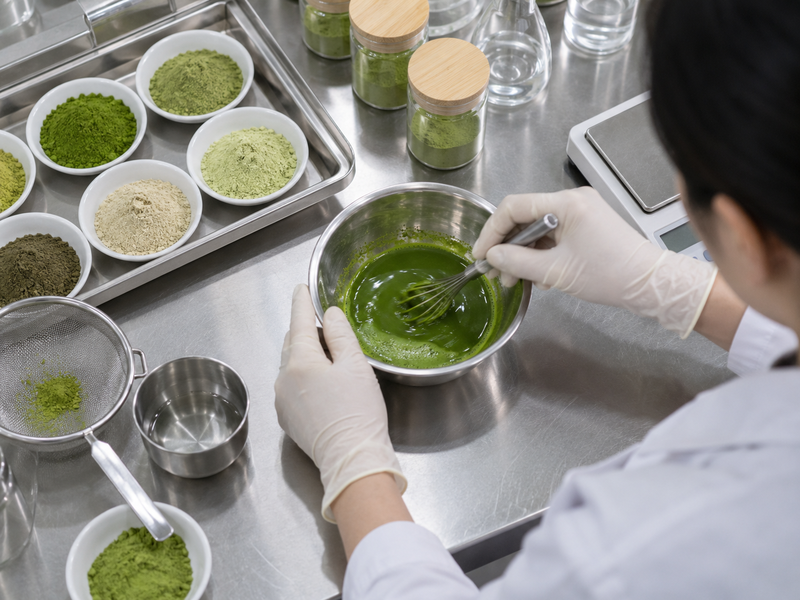
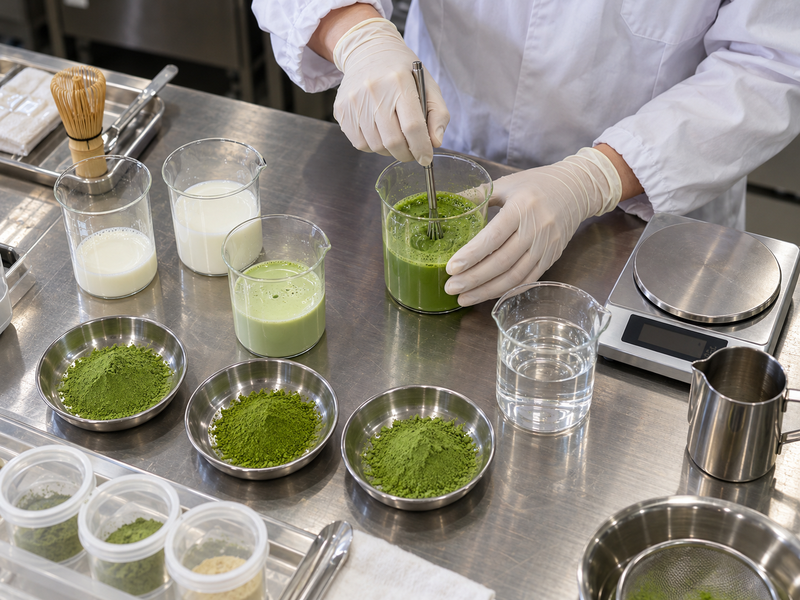
Receive candidate samples in their proposed packaging, record their lots, and inspect condition before use. Start with the quality team’s required identity and document review. Then run a bench test for the intended formula, followed by a pilot on representative equipment. Note powder movement, dust, clumping, fill weight variation, mixing behavior, and finished-product appearance. For a drink mix, prepare the finished serving in the stated liquid and container. Keep one variable changed at a time so a different excipient does not hide a matcha difference.
Set acceptance criteria before the trial. A sample that appears vivid green but repeatedly interrupts a filler is not production-ready. Nor does a successful capsule fill prove the powder will disperse well in a sachet drink. The matcha powder-flow study indexed by CiNii investigated how flow behavior varies with particle size and milling method. It supports testing physical handling, not assuming all finely milled matcha behaves identically. The buyer’s own equipment trial determines whether a proposed material works in its process.

4. What powder-flow questions matter on the line?
Ask operators where the process stops
Observe the powder in the actual hopper, transfer vessel, feed system, and filling head. Does it bridge, cling to surfaces, create excess dust, or change fill weight as the hopper level drops? Record equipment settings, run duration, environmental conditions, and any intervention. A single smooth minute at low speed does not represent a full production shift. If an excipient or process change is proposed to improve flow, test the full formulation again and record its effect on the ingredient statement and finished product.
Particle size alone cannot answer the handling question. The published matcha flowability research examined differences across samples and milling methods; a manufacturer must still evaluate its own machinery and blend. Ask the supplier for any available physical-property data, including the method used, but do not treat a number without a test method as a guaranteed line result. Quality, development, and operations should agree on what constitutes a passing pilot run before purchasing a production lot.
| Trial point | Record | Possible response |
|---|---|---|
| Transfer | Loss, dust, adhesion | Adjust handling or pack |
| Hopper | Bridging and refill pattern | Reassess feed process |
| Fill | Weight variation over time | Review formulation and settings |
| Cleanup | Residue and time | Include in operating cost |
5. How should a blend or serving be evaluated?
Test the full formula after processing
For a flavored powder or stick-pack drink, measure the matcha contribution in the complete formula rather than tasting it alone. Prepare the serving as a customer would: stated dose, liquid volume, temperature, mixing method, and wait time. Check color, flavor, texture, settling, and pack opening. For a capsule or tablet, evaluate fill, appearance, package integrity, and any other finished-format properties selected by development and quality teams. A claim about a serving should never be inferred from the raw ingredient’s color or a supplier brochure.
Keep process and sensory records linked to the candidate lot. If a manufacturer changes an excipient, package film, or dose, repeat the relevant checks. Research on matcha beverage properties found measurable differences among powders, but it does not validate a specific commercial supplement recipe. Price comparison should use the ingredient amount in the approved finished product plus processing loss, not merely the lowest quoted kilogram price. A high-dose proposal may alter taste, fill volume, and cost at the same time.
6. Which lot documents and tests are needed?
Build a specification with the quality team
Ask quality staff to define identity, composition, purity, microbiological and chemical criteria where relevant, packaging integrity, and any other risk-based requirement for the intended market. Specify the method, acceptance criteria, sampling approach, and who reviews each result. Request a lot-specific certificate or record only for tests the supplier actually performs and can substantiate. A generic certificate from a different lot does not release an arriving shipment. Keep the original supplier label and lot code linked to the production batch using the ingredient.
The FDA’s dietary supplement CGMP guide describes component and finished-product specifications for covered U.S. manufacturers. It does not give a universal test list or acceptance limit for every matcha product. A manufacturer should determine its own controls based on applicable rules, risk assessment, formula, and process. Do not advertise an ingredient as “supplement compliant” because one test passed. Qualification is a documented system, and the finished product remains the responsible manufacturer’s decision.
| Document or test | Purpose | Review point |
|---|---|---|
| Product specification | Defines supplied material | Before supplier approval |
| Lot-specific record | Shows tested lot results | At receiving and release |
| Packaging and label | Preserves identity and handling | On each delivery |
| Change notification | Flags process or source changes | Before repeat order |
7. How should caffeine information be handled?
Measure the intended ingredient contribution
Matcha contains caffeine, so a supplement developer should request product-specific caffeine information where it affects formula, labeling, or internal limits. A published chemical analysis of one matcha sample measured caffeine, but that single result is not a specification for every supplier lot. Agree on the analytical method and acceptable range if the finished product needs one. Convert the measured ingredient value into the proposed serving using the actual matcha mass, then account for other caffeine-containing components in the formula.
Do not copy a “typical matcha caffeine per cup” number into capsule or stick-pack artwork. The dose and product differ, and the final label must be reviewed under the destination market’s rules. Ask the supplier to notify buyers of changes that could affect a defined caffeine range. Development can then decide whether a new lot requires formula or label review. This is a composition-control question, not a reason to promise stimulation, focus, or performance benefits. A measured value is useful for accurate design and communication even when no caffeine claim is made.

8. What storage and packaging protect the ingredient?
Protect each lot through manufacturing
Ask the supplier for conditions tied to its sealed commercial pack and date marking. Store the delivered ingredient in a clean, dry, protected location that follows those instructions, then control the opened material during dispensing. Matcha’s fine powder can be exposed repeatedly if a large bag sits open beside a line. Trial the proposed inner-pack size against one production run and the hold time between runs. Keep opening date, lot, and remaining quantity in the issue record.
Studies of matcha storage temperature and light and water activity measured quality changes under experimental conditions. They support exposure control without establishing a shelf-life guarantee for the buyer’s pack. The FDA CGMP guidance also addresses appropriate holding conditions for covered supplement operations. A manufacturer should verify how the ingredient behaves through its own storage, dispensing, blend, and finished-pack process, including any time spent in a partly filled hopper.
| Stage | Exposure question | Control record |
|---|---|---|
| Sealed warehouse stock | Meets supplier condition? | Lot and location |
| Opened ingredient | How long and how often open? | Issue and closure log |
| Processing hold | Powder in hopper or vessel? | Batch record |
| Finished pack | Does package protect tested formula? | Stability plan |
9. Who reviews claims and market requirements?
Keep ingredient sourcing out of claim approval
The product owner and qualified regulatory advisers should classify the finished product in every destination market, review label and advertising language, and determine what evidence is required. A matcha ingredient supplier can provide identity and composition records; it cannot approve a brand’s disease, energy, weight, or wellness promises. In the United States, the FDA’s structure/function claim guidance sets out requirements for certain supplement statements, while the FTC’s health-products guidance addresses substantiation of advertising messages.
Consider the total presentation, not isolated words. A photograph, product name, or class of claims may suggest an effect even when a sentence avoids a direct promise. A study on matcha’s composition does not prove that a finished supplement delivers a clinical outcome at its proposed dose. Keep draft claims out of procurement specifications unless regulatory reviewers have checked them. The buyer can request data the supplier actually has, including ingredient identity and lot-specific composition, and leave finished-product marketing decisions to the brand’s accountable team.
10. What belongs in a repeat-supply agreement?
Reorder the material that passed the pilot
Record the approved product code, reference sample, specification revision, inner-pack size, minimum order, lead time, documentation, change notice, remaining dated life at receipt, and receiving contact. Define how a rejected or questionable lot will be held and reviewed. Ask whether the supplier can repeat the sampled material and what changes in harvest, processing, or source will trigger notification. A second shipment should not quietly use a new powder under an old sales name.
Compare two or more production lots in the approved process before relying on long-term continuity. Track fill behavior, scrap, ingredient usage, finished-product observations, and document accuracy. Keep a qualified alternative only if it has passed the same identity and line trials. Matcha Village buyers can provide their intended format, equipment constraints, target market, pack size, and projected volumes to request a specific ingredient proposal. The responsible manufacturer must still decide whether each incoming lot and final product meets its own specification and applicable requirements.
Include the lot and pack checks in our matcha incoming inspection guide when writing the manufacturer’s receiving procedure.
FAQ
Q1. Is culinary-grade matcha automatically suitable for a supplement line? No. The manufacturer must assess identity, documents, physical behavior, formula fit, and applicable market requirements.
Q2. Does a fine particle size guarantee good capsule filling? No. Run a pilot on the intended equipment and record flow and fill variation.
Q3. Can a supplier’s certificate release the finished supplement? No. Supplier records inform incoming review; the finished-product manufacturer controls its own release decision.
Q4. Can a matcha composition study support a health claim? A composition result alone does not establish a finished-product effect. Qualified reviewers must assess any proposed claim and evidence.
Q5. What should buyers send with a sample request? Provide finished format, target market, tentative formula role, equipment constraints, pack preference, and records the quality team needs.
Approve the line trial before placing a production order
Shortlist materials by identity and documents, run the selected powders through the actual formula and equipment, and write the passing specification. Keep the pilot record with the first purchase order. That gives receiving, production, and quality teams the same product to check when a pallet arrives.