
How much matcha do coffee shops use? There is no reliable answer based on shop size alone. A café needs its own drink count, weighed recipe dose, menu mix and opening hours. A store selling 30 matcha drinks daily at 2 grams each uses about 1.8 kilograms in a 30-day month before waste. Change the dose to 3 grams and the same sales volume needs 2.7 kilograms. That difference affects purchasing, shelf life and cash tied up in stock.
This guide gives operators a way to calculate usage from the cup backward. The example numbers are planning assumptions, not an industry standard or a supplier’s recommended recipe. Matcha Village sells to business buyers; we use these calculations when a buyer needs to compare pack formats and reorder schedules. Test the drink first, then substitute your own sales data.
1. What counts as matcha usage in a coffee shop?
Separate powder served from powder purchased
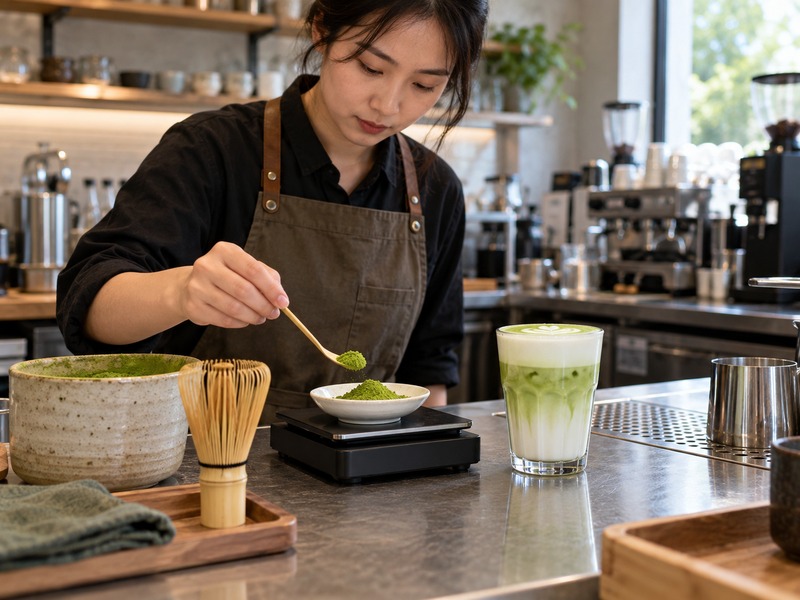
Start with the grams that reach a paid cup. A shop also uses matcha for training, tasting, spills, remakes and opened packs that lose acceptable flavor. Those grams belong in purchasing demand but should not be added to the recipe dose. If a drink calls for 2 grams, keep describing it as a 2-gram drink even when purchasing averages 2.15 grams per sale. The extra 0.15 gram is a process problem or planned allowance; the distinction tells a manager where to act.
Keep dry powder distinct from prepared concentrate. A batch containing 100 grams of powder and 900 grams of water weighs a kilogram, but it does not represent a kilogram of matcha consumption. Inventory counts should stay in dry-powder grams. If staff use scoops, weigh ten normal scoops and calculate the average; a volume scoop is sensitive to packing and powder texture. A recipe that exists only as “one scoop” is too vague for an accurate forecast.
| Measure | Calculation | Use |
|---|---|---|
| Recipe powder | Approved grams per drink × drinks sold | Expected served volume |
| Operating loss | Measured discarded powder and remakes | Waste control |
| Purchased powder | Recipe powder + operating loss + planned tests | Order forecast |
| Prepared concentrate | Powder plus water | Service prep only |
2. How much matcha should go into one coffee-shop drink?
Set the dose by a controlled cup test
There is no universal café dose. A small, unsweetened drink and a large iced latte ask different things of the powder. Choose a candidate dose, then make the drink using the actual milk, syrup, cup and ice used in service. Weigh the powder and the liquid. Ask several tasters to compare cups without seeing the dose. The accepted version becomes the recipe, with a permitted measuring tolerance staff can hit on a busy shift. A dose selected from a supplier’s brochure is a starting point for the trial, not the final purchasing number.
Consider a 12-ounce hot latte trial at 2, 2.5 and 3 grams. If 2.5 grams delivers the desired flavor and 3 grams is only marginally stronger, the cost difference grows over thousands of cups. If syrup hides the 2-gram version, repeat the test for iced service because melting ice changes concentration. Record each approved drink separately; do not apply one dose to every menu line. The purpose is a consistent cup.
3. How does menu mix change monthly matcha demand?
Count each menu item before averaging
The average dose follows what customers actually buy. Suppose a café sells a 2-gram hot latte, a 2.5-gram iced latte and a 3-gram signature drink. An arithmetic average of the three recipes is 2.5 grams, but that figure is wrong if the iced latte accounts for most sales. Multiply each item’s dose by its expected unit sales, add the grams and then divide by total matcha drinks. The weighted average changes when weather, promotion or menu placement changes. It should be updated from till data rather than treated as a permanent product property.
For a 30-day planning month, imagine 450 hot lattes, 750 iced lattes and 150 signature drinks. The cups use 900, 1,875 and 450 grams respectively. Total served powder is 3,225 grams across 1,350 drinks, or about 2.39 grams per drink. A 2.5-kilogram order would leave the shop short before waste. Another café with the same sales could need less powder if its menu shifts toward smaller drinks. Use the point-of-sale export, not a memory of the busiest Saturday.
| Illustrative item | Sales in 30 days | Powder per cup | Served powder |
|---|---|---|---|
| Hot latte | 450 | 2.0 g | 900 g |
| Iced latte | 750 | 2.5 g | 1,875 g |
| Signature drink | 150 | 3.0 g | 450 g |
| Total | 1,350 | 2.39 g weighted average | 3,225 g |
4. How much matcha do coffee shops use in a month?
Use a sales range rather than one optimistic number
Build three scenarios from recent transactions. Take at least several ordinary weeks, separating weekdays from weekends if trade differs. Exclude a one-off event unless another is booked for the forecast month. Multiply expected units by the approved dose for each drink. A low case shows the stock you can use without strain; a base case informs the normal order; a high case shows whether the supplier can replenish in time. New shops can start with a short pilot and update weekly. A launch forecast is a hypothesis, not sales history.
Iced drinks may dominate warm months while hot drinks rise later. A promotion can add sales and change the average dose. Record the cause of each forecast change so procurement can see whether it is recurring. If sales data are limited, count matcha drinks for two weeks and keep the estimate conservative. A small commercial pilot tests demand and the supplier’s repeat-lot performance before a large commitment.
5. What allowance should a café make for waste and remakes?
Measure losses before adding a buffer
A flat percentage is only a temporary placeholder. Begin by recording opening stock, receipts, closing stock and grams theoretically served. The difference includes remakes, spills, sampling, stock-count errors and any powder discarded after poor handling. Investigate the largest causes. If one barista routinely overfills a scoop, changing to a scale or measured dispenser may save more than negotiating a lower kilogram price. If staff open a 1-kilogram bag at each quiet branch, smaller sealed packs may cut avoidable oxidation and disposal.
For the illustrative 3,225-gram month, a provisional 5% operating allowance adds about 161 grams, giving 3,386 grams before safety stock. That 5% is an example for arithmetic, not a claim about typical café loss. Review the actual variance after the first month and change the allowance accordingly. Keep tasting and training powder in a separate log; it is not waste if planned. A shop with good controls may run lower, while a launch with new staff may run higher. An unexplained allowance that grows every month hides a service issue.
| Illustrative component | Calculation | Powder |
|---|---|---|
| Expected servings | From menu mix | 3,225 g |
| Temporary loss allowance | 3,225 g × 5% | 161 g |
| Expected withdrawal | Servings plus allowance | 3,386 g |
| Safety stock | Calculated from lead time | Added separately |
6. When should the shop reorder matcha?
Turn lead time into a stock trigger
Reorder before the last bag is opened. Calculate average powder withdrawal per trading day, including the measured loss allowance. Multiply by the supplier’s normal lead time in days, then add safety stock for variation in demand and delivery. If the example shop withdraws 3,386 grams in 30 days, average demand is about 113 grams daily. A 14-day replenishment cycle requires roughly 1,580 grams just to cover expected use while waiting. A further buffer should reflect the shop’s actual sales swings and whether the supplier holds local stock.
Separate order placement from usable stock. Production, quality release, export documents, transit, customs and receiving checks all take time. Ask the supplier for a realistic order-to-release history. If a lot fails a receiving check, safety stock may have to cover a replacement. For a chain, calculate the trigger centrally and at each branch. SCORE’s inventory guide explains how lead time and safety stock affect reorder points. Review the trigger when the menu or lead time changes.
7. How should a multi-site coffee business plan branch usage?
Keep local demand visible under central buying
One chain-wide average can conceal a weak branch forecast. A commuter site may sell hot drinks in the morning; a shopping-centre kiosk may sell iced drinks all afternoon. Both may have the same total cups and different powder needs. Keep each branch’s units by menu item, recipe version, opening inventory and transfer records. Purchase centrally if that improves price or control, but set replenishment quantities from local withdrawal. A stock transfer should move a coded, sealed unit whenever possible so the receiving branch can trace the lot.
Compare measured usage against theoretical servings branch by branch. A large positive variance may come from a promotion, inconsistent scoops, remakes or missing stock entries. A negative variance can signal a recipe that staff do not follow. Before changing an order size, check whether the variance repeats and whether till categories match what baristas make. Report cups sold, expected grams, actual grams withdrawn, difference and explanation. It gives operations a way to improve service while procurement protects supply.
| Branch signal | Possible cause | Check |
|---|---|---|
| High withdrawal, normal sales | Overdose, remakes, sampling | Observe prep and count waste |
| Low withdrawal, normal sales | Underdose or count error | Weigh served recipes |
| Stockouts despite central stock | Transfer or reorder delay | Review branch trigger |
| Frequent opened-bag disposal | Pack too large for site | Trial smaller sealed units |
8. How should opened matcha stock be handled?
Make pack size part of the calculation
Unopened shelf life does not describe a bag in daily service. Air, moisture, heat and light can change matcha after opening. Follow the supplier’s product-specific handling guidance, record opening dates and use a clean, dry utensil. Close the inner pack between preparations. If a branch uses only 50 grams a day, a large pack may stay open much longer than one at a busy flagship. That difference can make a lower price per kilogram more expensive in usable servings. Test pack formats with ordinary service before setting a chain-wide standard.
A branch should know which lot is open and which sealed stock comes next. Apply first-expiring-first-out where the product and date coding allow it. Do not pour a new lot into a container holding old powder without recording the change; that loses traceability if a quality question appears. Central stores should track case and inner-bag quantities separately. A good purchasing forecast can still fail when stock records count an opened half-bag as a full sealed kilogram. The receiving process and daily handling rules make the forecast real.
9. What information should a matcha supplier receive before quoting?
Send a brief that ties volume to an approved drink
“We need four kilograms a month” is not a complete buying brief. Tell the supplier whether the powder will be used in milk drinks, unsweetened service, bakery items or a blend. Give approximate monthly withdrawal, branch count, preferred inner-pack size, delivery market, needed documents and the date stock must be usable. Request a production-lot sample and test it in the actual recipes. A supplier can then quote the right grade, pack and minimum order rather than guessing from the word “café.” Keep the product code on the order so repeat deliveries match the trial.
Ask for price tiers at pilot and steady volumes, realistic lead time, an agreed specification and lot-specific quality paperwork. A distributor may suit a small shop that values nearby inventory; a direct manufacturer may suit a larger chain able to forecast and manage imports. Compare landed cost per accepted cup, not the quoted kilogram alone. If the pack creates avoidable opened-stock waste, include that loss in the comparison. Matcha Village’s specification sheet guide lists the fields a buyer can agree before a commercial order.
| Brief field | Why the supplier needs it |
|---|---|
| Approved recipes and target cup | Choose a suitable grade |
| Monthly powder range | Quote a realistic volume tier |
| Branch consumption and pack size | Avoid slow opened stock |
| Destination and delivery date | Estimate landed cost and lead time |
| Specification and records | Match quality release to the order |
10. Which usage numbers should the manager review each month?
Connect inventory variance to the cup and the order
Review a small set of numbers consistently. Track matcha drinks sold by recipe, theoretical powder use, actual stock withdrawal, loss in grams, opening days per bag, stockouts and received lead time. If the drink dose or cup size changes, mark the change date. An unexplained rise in powder use could be demand growth, a heavier dose, more remakes or an inventory-count problem. A single purchase total cannot distinguish them. Managers should discuss material variances with baristas before changing the supplier forecast.
Use the results to set the next order and adjust training. If an iced promotion lifts sales, raise the forecast before the next delivery. If cups require more powder after a new lot arrives, repeat the controlled test and check the lot documents. Do not quietly increase every recipe to compensate for an unapproved change. Review weekly during launch; a stable chain may move to monthly review. Bring your recipe doses, sales range and pack needs to a supplier quote. Then the answer to how much matcha coffee shops use becomes measurable for your own shop.
Frequently asked questions
Q1: How much matcha does a small coffee shop need each month?
Multiply sold drinks by the weighed dose for each recipe, then add measured losses. For example, 30 drinks daily at 2 grams across 30 days require 1.8 kilograms for servings before waste and safety stock.
Q2: Should every matcha drink use the same dose?
No. Test each cup size and recipe with its actual milk, sweetener and ice. Record the approved grams for each menu item.
Q3: Can a café forecast purchases from sales revenue?
Revenue alone hides differences in price and recipe dose. Use unit sales by menu item and stock withdrawal in dry-powder grams.
Q4: How much extra matcha should a shop order for waste?
Measure remakes, spills, sampling and opened-pack disposal. Use a temporary allowance only until real variance data are available.
Q5: Does a lower kilogram price always lower drink cost?
No. Compare the tested dose and the amount of powder the shop can use while a pack remains acceptable. A cheaper large bag may create more waste at a quiet branch.