
A matcha bowl is both a preparation tool and, in some cafés, the vessel handed to a guest. A bowl that looks striking on a shelf may be awkward to whisk in, difficult to clean or unstable on a crowded service counter. Musubi Kiln’s guide to matcha bowls describes chawan shapes and materials from a tableware perspective. For a business, the useful selection method is a working trial: put the intended whisk, water dose and matcha in each candidate, then check preparation, food-contact suitability, cleaning, breakage risk and replacement supply. Here is a practical way to buy bowls that fit the service you actually run.
Contents
- 1. What job must the matcha bowl do?
- 2. Which shape gives the whisk room?
- 3. How should size and weight be checked?
- 4. Which materials suit daily service?
- 5. How do you verify food-contact suitability?
- 6. How should the bowl work with your whisk?
- 7. What makes a bowl comfortable to serve?
- 8. Can staff clean and store it reliably?
- 9. What is the real cost of a bowl fleet?
- 10. How should a café run a bowl trial?
1. What job must the matcha bowl do?
Separate preparation from presentation
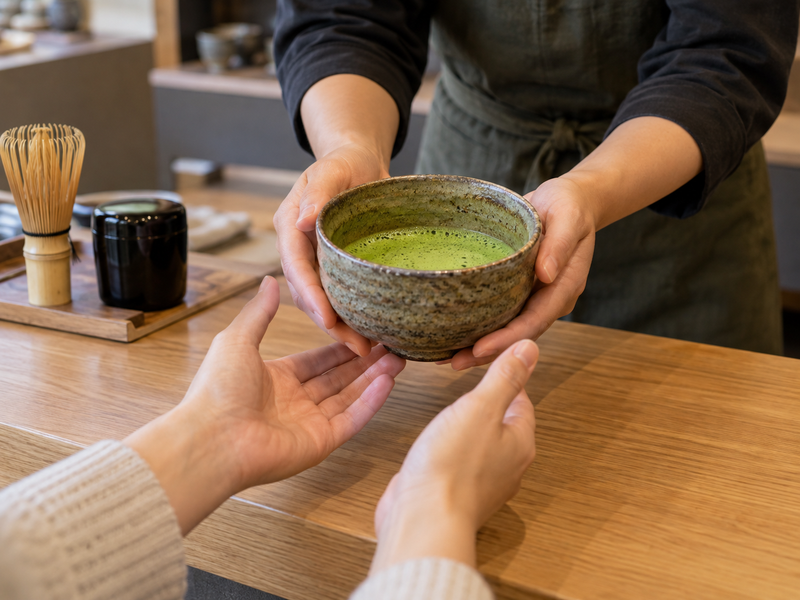
A bowl used only behind the counter can prioritize whisking space, stability and cleaning speed. A bowl served to a guest also needs a comfortable rim, manageable weight and an appearance that suits the menu. Those roles can be filled by the same product, but they do not have to be. Some cafés prepare a concentrated matcha in one bowl and pour it into a glass for a latte. Others sell a whisked bowl of tea as the experience itself. Decide which workflow you have before comparing ceramics.
Write down the actual powder and liquid dose, whisk type and serving temperature. Put a candidate on the real counter, next to the tools used on a normal shift. Watch whether the barista has room to whisk without hitting a milk pitcher or spill tray. If the bowl will be carried to a table, test that route with a filled vessel. A product description that says “matcha bowl” does not establish its usable capacity, food-contact suitability or fit with your service. A short role statement will prevent a decorative purchase from becoming a poor production tool.
2. Which shape gives the whisk room?
Compare the interior, not just the rim
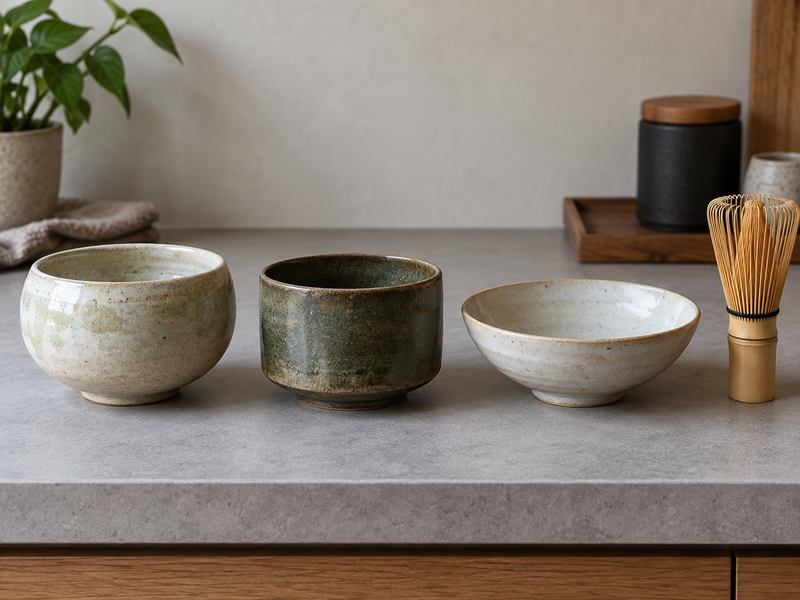
The Musubi Kiln guide distinguishes a tall cylindrical shape, a rounded shape and a broad shallow shape. A tall bowl can contain splashes, but narrow sides may limit whisk movement. A shallow bowl gives a broad working area but can spill if staff use the same vigorous motion near the rim. A rounded bowl is often a useful first candidate because the whisk can move across a curved interior. These are trial hypotheses, not a ranking that holds for every handmade piece.
Look inside the bowl. A wide mouth with a sharply narrowing base may leave less whisking room than the rim suggests. Test the intended water dose: enough depth should remain for the whisk to move without striking the bottom or throwing liquid over the edge. Film a short preparation of each candidate and compare splashing, powder left on the wall and the time needed to reach an even suspension. If one barista finds a bowl easy and another struggles, the training burden matters too.
| Bowl shape | Potential benefit | Trial risk |
|---|---|---|
| Rounded | Comfortable whisk path | Check actual interior width |
| Tall straight side | Contains liquid | Narrow base can restrict whisk |
| Broad shallow | Open working area | Spills near rim |
| Decorative irregular | Distinct presentation | Uneven whisk and cleaning contact |
3. How should size and weight be checked?
Measure the working volume
A maker’s stated capacity may mean the bowl filled nearly to the rim, which is not a useful whisking volume. Pour in the exact liquid amount used for your tea service, add the powder and note the remaining headroom. Check where the whisk tips land and whether the hand can move at a natural angle. A large bowl may be comfortable at the counter but too heavy or wide for one-handed service. A very small bowl may look elegant while forcing staff to whisk slowly to avoid spills.
Weigh each empty bowl, then weigh it with the prepared tea. Ask staff to carry it from the preparation point to the customer handoff and set it down on the intended tray or saucer. Comfort is a practical observation: does a server need two hands, does the base slide, and can a guest lift it without gripping a hot wall? Record diameter, height, mass and working volume on the selection sheet. Those measurements make reordering easier when handmade bowls vary slightly between batches.
| Measurement | How to test | Why it matters |
|---|---|---|
| Working volume | Fill to recipe level | Whisking headroom |
| Interior width | Move actual whisk | Tool clearance |
| Empty and full mass | Weigh and carry | Staff and guest handling |
| Base footprint | Set on service tray | Stability |
4. Which materials suit daily service?
Check handling characteristics, not a style label
Ceramic bowls may be made from stoneware or porcelain, with different wall thicknesses and finishes. The Musubi Kiln article also discusses glass and lacquerware. For a café, compare the specific product rather than declaring one material universally best. A smooth glazed interior may be easy to inspect and clean; a textured interior may be attractive but demand more attention around the whisk contact area. Glass shows the tea clearly, but the slick surface and breakage behavior need a working trial.
Ask the supplier what temperatures, cleaning methods and equipment the bowl is intended to withstand. Do not assume a handmade piece is dishwasher-safe, microwave-safe or suitable for repeated hot-water service without the maker’s directions. Inspect the rim for chips and the glaze for crazing or rough points on arrival. A bowl that is attractive but needs delicate hand care may still be right for a premium seated service; it may be a poor match for a high-volume takeaway bar. The cost of the cleaning method belongs in the choice.
5. How do you verify food-contact suitability?
Buy service ware, not a decorative object
The most important purchase check is whether the bowl is intended for food and drink contact in the market where you operate. Ask the supplier for a product description and any relevant compliance information for the exact item. Do not use a piece marked “not for food use” simply because its shape is appealing. The U.S. FDA’s advice on traditional pottery warns that certain improperly made or decorative ceramics can release lead and advises against using pieces that cannot be shown safe for food. Applicable standards and documentation differ by market.
Avoid an unsupported “lead-free” promise in your purchasing note unless the supplier provides the basis for it. A visual inspection cannot certify that a glaze is safe. Ask how food-contact claims are supported, retain the documents with the purchase record and check that the delivered model matches the one evaluated. If a bowl is antique, heavily damaged or sold primarily as ornament, keep it out of drink service until its suitability is established. This is a procurement gate, not an aesthetic preference.
| Supplier evidence | Question to ask | Action if unclear |
|---|---|---|
| Intended use | Is this exact model for food? | Do not put into service |
| Material and finish | What touches the drink? | Request details |
| Compliance information | Which market and test basis? | Verify before purchase |
| Care directions | What cleaning and heat are allowed? | Test approved method |
6. How should the bowl work with your whisk?
Test the pair as a system
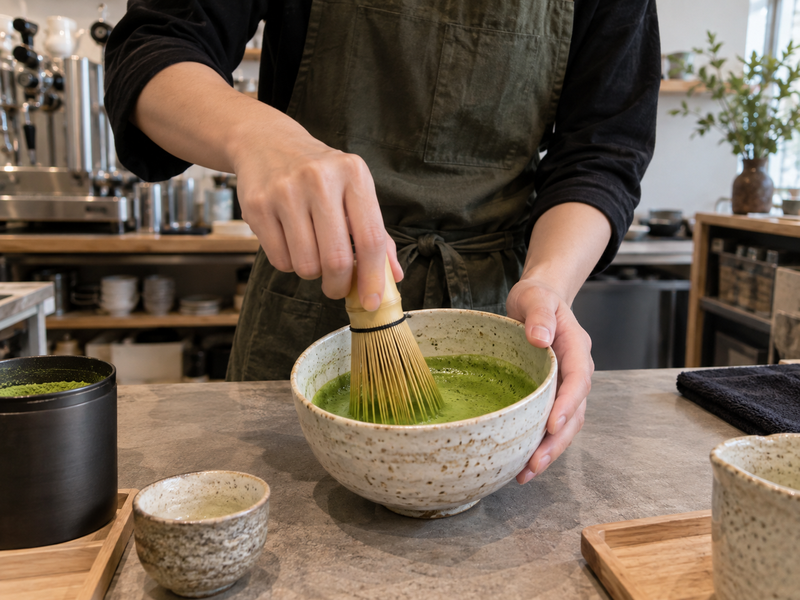
A bamboo whisk has a certain diameter and flexibility. The bowl interior determines whether it can move freely and whether the tips meet a smooth surface. Bring the actual whisk used in service to the bowl trial. Add the normal powder and water dose, then whisk as staff would during a rush. Watch for dry powder on the upper wall, whisk tips catching on a textured patch and liquid striking the rim. A broad interior can help, but a poor water dose or rushed wetting step can still leave clumps.
Run the same recipe and whisk in every candidate. Count visible clumps and note the time to an even drink. Do not claim the bowl alone caused a particular foam level if staff changed their motion between samples. Let several staff members test the finalists; a bowl that needs a specialist technique may slow training. Decide whether the bowl will also accommodate an electric frother or only the bamboo whisk. If the café uses both methods, check each separately for scratching, splash and cleanability under the maker’s care instructions.
For the staff technique itself, use our guide to whisking matcha alongside the bowl trial.
7. What makes a bowl comfortable to serve?
Consider hands, lips and the counter
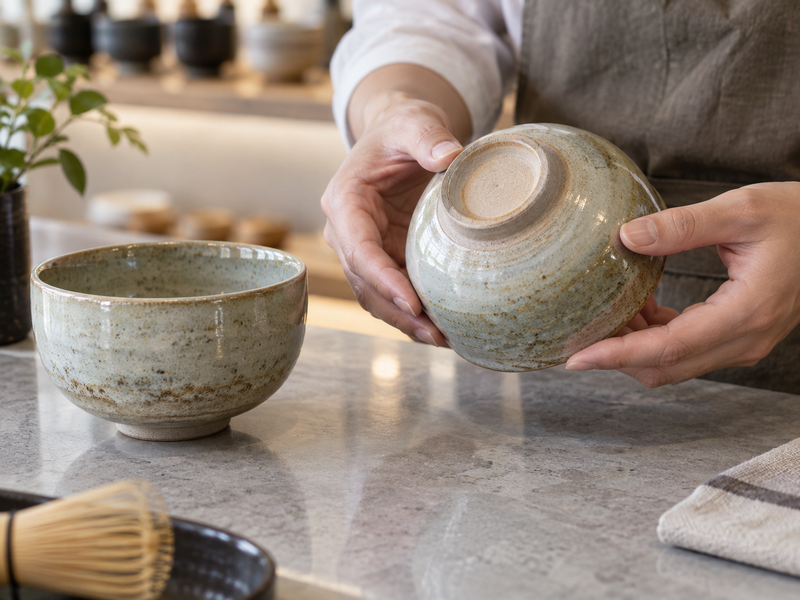
The rim should feel comfortable and be free of rough spots. The base should sit securely on the service surface or tray. Staff need to be able to pick up a hot filled bowl without an awkward grip, and a guest should be able to set it down without rocking. Run the service route with water at the normal serving temperature while following ordinary safe handling practice. A ceramic wall can feel hotter than expected; handle design and serving method matter more than a photograph of the bowl.
Check presentation under the café’s lighting. A dark interior may make the green tea less visible, which can be appropriate for a particular style but is a conscious choice. A white interior can show the color clearly and expose residue or chips sooner. If the bowl is part of a premium service, decide how it pairs with a tray, sweet or whisk presentation. Do not let visual appeal override hygiene, stability and food-contact evidence. A guest’s experience includes whether the bowl can be held and set down easily.
8. Can staff clean and store it reliably?
Trial the full turnaround
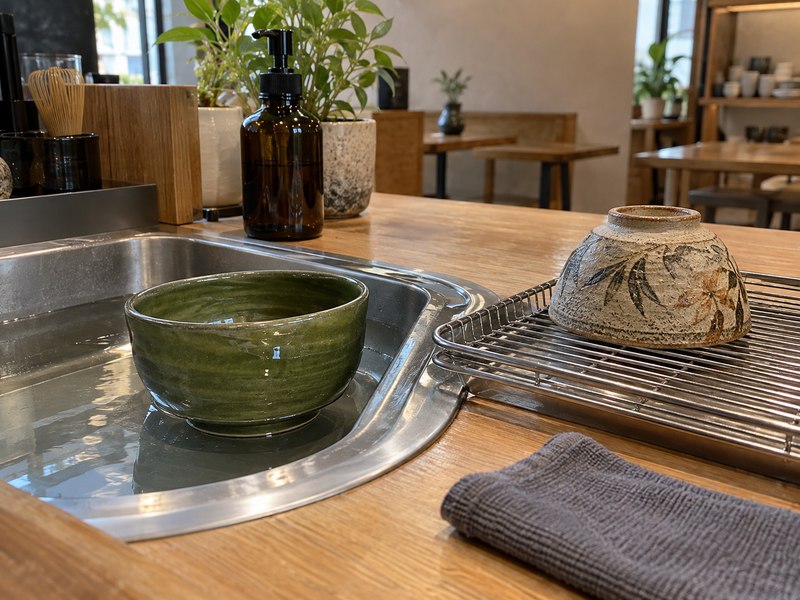
Preparation does not end when the tea is served. Observe a normal wash, rinse, drying and storage cycle using the supplier’s care directions and the café’s sanitation procedure. A rough interior may retain green powder in recesses. A delicate exterior finish may be damaged by stacking or contact with metal equipment. A broad bowl may take more shelf space than expected. Record the time to return one bowl to a ready state and the space required for a full shift’s inventory.
Check bowls after repeated use in a pilot. Look for chips, cracks, loose glaze, stains and a roughened whisk contact area. Remove damaged ware according to your food safety program; a chipped rim is unpleasant for a guest and can be harder to clean. Do not assume a sanitizer or dishwasher cycle is safe for a craft piece without the maker’s guidance. If handwashing is required, calculate staffing and storage consequences. A lower purchase price can disappear quickly if the bowl slows every service turn.
| Turnaround step | Observe | Possible issue |
|---|---|---|
| Washing | Residue removal | Textured interior |
| Drying | Time and drainage | Trapped water |
| Stacking | Contact points | Chips or scratches |
| Storage | Shelf footprint | Insufficient working stock |
9. What is the real cost of a bowl fleet?
Include replacement and service capacity
Calculate the number of bowls needed at peak demand: bowls in use, waiting to be washed, drying and held as reserve. A single expensive bowl may work for a tasting event; a café selling many whisked servings needs a repeatable supply. Include unit price, freight, breakage allowance, washing labor and shelf space. Ask whether the maker can provide matching replacements or whether every reorder will look and feel different. Variation can be welcome in a curated tea service but troublesome for a standardized chain.
Compare a small set of robust daily bowls with a few special pieces reserved for seated service. This lets the business value craft without making every high-volume transaction depend on a fragile object. Track chips and breakage during the pilot rather than assuming a rate. If the chosen design requires a special whisk or tray, add those costs. The cheapest bowl is not necessarily the least expensive service system; the right comparison is cost per reliably served bowl of tea.
| Fleet cost | Count or measure | Review point |
|---|---|---|
| Bowls in service | Peak simultaneous use | Enough for orders |
| Bowls in cleaning | Wash and dry cycle | Turnaround time |
| Reserve stock | Pilot damage | Replacement access |
| Labor | Handling minutes | Cost per serving |
10. How should a café run a bowl trial?
Score the same work in each candidate
Select two or three food-contact-appropriate models. Prepare the same matcha dose in each with the same whisk and water. Have at least two staff members test whisking, pouring or direct service, carrying, washing and storage. Record working volume, weight, splashes, clumps, hand comfort, cleaning time and any damage. The Musubi Kiln guide provides vocabulary for comparing shape and bowl parts; the café trial establishes whether those shapes work on your counter.
Retain the supplier evidence and selected model code with the purchase record. Give staff a short handling standard: preparation volume, acceptable whisk contact, carrying method, wash method and rejection signs. Recheck the model after a few weeks of ordinary service. If staff avoid a bowl because it is slow to clean or unstable on the tray, revisit the purchase even if it looked best during the first tasting. The final choice should make good matcha easier to prepare and comfortable to serve.
FAQ
Q1. What shape is easiest for a beginner? Start with a rounded bowl that has a broad usable interior, then test it with your whisk and recipe.
Q2. Does a larger bowl always work better? No. Check whisk clearance alongside weight, headroom, serving comfort and storage space.
Q3. Can a decorative ceramic bowl serve tea? Only if its food-contact suitability for the intended market and use is established.
Q4. Are all matcha bowls dishwasher-safe? Do not assume so. Follow the specific maker’s care directions and your sanitation procedure.
Q5. How many bowls should a café buy? Estimate peak bowls in use, washing and drying, then add a reserve based on the service trial.