
Learning how to whisk matcha starts with a simple point: the powder must be dispersed evenly enough that the full bowl tastes good, not just the first sip. A striking foam cap can hide dry pockets, and a fast demonstration may not translate to a café shift. Sugimoto Tea’s guide to whisking matcha explains a traditional preparation route. For a shop, training should also specify dose, water, bowl, tool condition and a pass standard that more than one employee can meet.
For: café trainers, tea bars, hospitality teams and ingredient buyers. Decision: whether the preparation method gives a smooth, balanced bowl at normal service speed.
1. What does a well-whisked bowl look and taste like?
Judge the full bowl
Set a sensory target before teaching hand movement. The liquid should be uniform, the tea flavor clear, and the texture free of obvious dry clumps. A fine foam may be desirable for a particular style, but it is not the only quality measure. Taste from the first sip to the last. If the last mouthful is gritty or very strong, the powder was not dispersed evenly or the serving waited too long. Photograph an accepted bowl under normal light and keep the recipe beside it.
Use a repeatable standard. Define powder grams, water amount, serving temperature, bowl and expected preparation time. Allow for reasonable variation in foam appearance while holding flavor and texture standards. A training score that rewards only a tall foam cap can lead staff to over-whisk or ignore clumps. A good bowl should make sense to the guest who drinks it, not only to the person watching the whisk.
| Quality cue | What it can tell you | What it cannot prove |
|---|---|---|
| Even green | Likely better dispersion | Origin or grade |
| Fine foam | Useful whisking control | Good flavor by itself |
| Smooth last sip | Full-bowl consistency | Food safety alone |
2. How much powder and water should be used?
Weigh a training recipe
Choose a powder-to-water ratio for the intended drink and write it in grams or milliliters. A scoop varies with how tightly powder is packed, so a scale helps during development and staff training. Make a small dose ladder with one tea and one bowl, then taste each version. A café serving a plain bowl may use a different target from a concentrated base for lattes. Do not copy a ratio from a video without testing it in the actual product and cup size.
Keep the denominator clear. If staff later add milk, ice or syrup, the tea dose should be judged in the final cup as well as the bowl. A weak matcha base may look foamy but disappear in a large latte. A strong base may be appropriate for milk yet unpleasant as a stand-alone serving. Record separate recipes where the use differs. Cost the grams of tea per sold drink so the training standard and margin are aligned.
3. Should the powder be sifted?
Test the chosen tea and tool
Sifting can break up dry clumps before they meet water. It is especially useful when an opened powder has compacted or when the shop’s whisking route leaves visible specks. Use a clean, suitable sieve and weigh the powder before or after sifting according to the recipe, then keep that method consistent. Compare sifted and unsifted bowls made by ordinary staff. If sifting improves the last sip without slowing service too much, include it in the standard.
Do not use sifting to hide poor storage. Follow the supplier’s pack and opening guidance. Powder repeatedly exposed to moisture or heat may need a storage correction, not only a finer sieve. Check how much powder remains in the sifter and include that loss in the recipe and cleaning routine. A clogged tool can introduce delay during a rush. The goal is a smooth bowl with a method the team can maintain, not a ceremonial-looking step added for photographs.
| Sifting result | Decision | Follow-up |
|---|---|---|
| Fewer clumps | Include in method | Set cleaning routine |
| No meaningful change | Consider omitting | Confirm across staff |
| Heavy retained powder | Investigate | Tool, storage or tea |
4. What water temperature should the team use?
Test taste and handling together
Water that is too hot for the tea can make the cup taste harsh and create a handling issue. Water that is too cool may make the powder harder to disperse with a given method. Choose a practical range using the tea supplier’s guidance and controlled tasting. Use the shop’s actual water source and equipment during trials. Write a measurable cue staff can repeat, such as a kettle setting or a checked service tap, rather than “warm water.”
Observe the whole shift. A water dispenser may vary between opening and peak service. Check whether the method still produces a balanced bowl under normal conditions. If the tea is whisked for an iced drink, decide whether it is first dispersed with warmer water and then chilled or prepared by a separate cold route. Test the final drink after ice dilution. The best water setting is the one that works for taste, texture and workflow in the actual venue.
5. How should the bamboo whisk move?
Use a light, quick motion
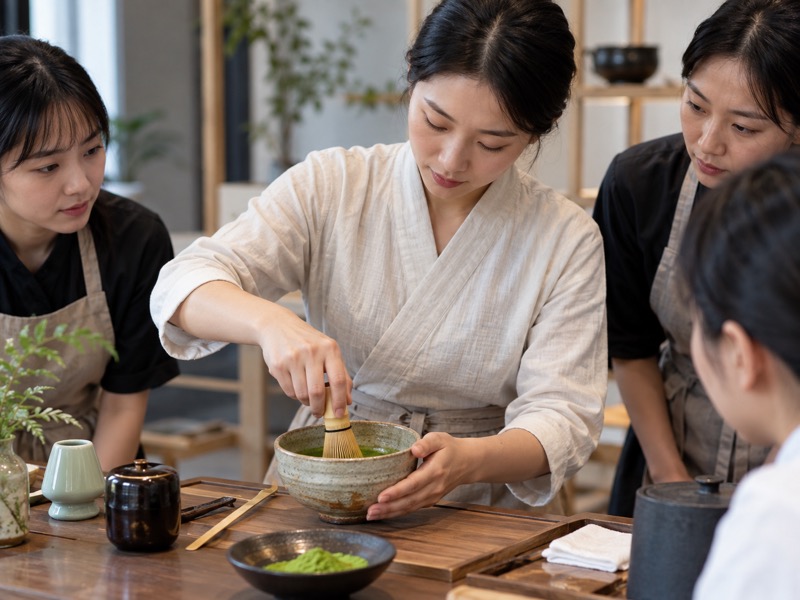
Hold the whisk so its tines can move through the liquid without being crushed against the bowl. Work briskly back and forth through the tea rather than slowly stirring in broad circles. In a suitable bowl, that motion helps disperse powder and can build fine foam. Demonstrate the movement and let trainees feel the difference between a light whisk and a heavy push. The precise hand path is easier to learn by watching a trained person than by memorizing a slogan.
Correct the result, not the style. Staff hands differ. If two people produce the same smooth, balanced bowl at service speed, they do not need identical wrist angles. Check the bowl’s bottom and rim for dry powder after practice. If foam is weak, first inspect dose, water, bowl depth and whisk condition before demanding more speed. A damaged whisk can make a good technique look poor.
| Motion issue | Visible result | Coaching cue |
|---|---|---|
| Slow circular stir | Few fine bubbles | Shorter back-and-forth path |
| Heavy pressure | Worn tines, uneven mix | Lift the whisk slightly |
| Surface only | Powder at bottom | Mix through liquid depth |
6. Which bowl and whisk should be used?
Fit the tools to the volume
A bowl with enough width and depth gives the whisk room to move without splashing. The selected whisk should be clean, sound and suitable for the serving style. Test the actual bowl used in service, not only a large training bowl. A deep narrow cup can make the same motion awkward and leave dry powder at the bottom. If a café sells takeaway drinks, it may prepare matcha in a separate bowl or mixing vessel before transferring it.
Inspect the tool daily. Follow the maker’s care guidance for rinsing and drying a bamboo whisk. Bent or broken tines can affect the motion and may become a physical hazard. Keep replacement tools available. If the business uses an electric frother instead, validate that separate method and cleaning route rather than calling it equivalent by default. Choose tools on the finished cup and service reliability, not only on appearance.
7. How long may a whisked bowl wait?
Serve promptly when possible
Matcha remains a suspension and can settle. Time a freshly whisked bowl at the counter, during a normal handoff and after a longer delay. Taste and inspect each. A visible foam cap may fade while the tea beneath remains acceptable; in other cases, the last sip becomes uneven. Set a service expectation from the trial. For a café, whisking to order may be simpler than trying to hold completed bowls. If a pre-mixed tea base is considered, use a separate hold and food-safety validation.
Avoid false fixes. Adding more powder will not repair sediment caused by long standing. A quick stir at handoff may restore some uniformity, but it should be part of an approved routine, not an improvisation after a drink has sat too long. Train servers to know when to remake a bowl. The quality standard belongs at the moment the guest receives it.
8. How should staff be trained and assessed?
Practice consecutive bowls
Give each trainee the same tea, dose, water, bowl and whisk. Demonstrate once, then let them make several bowls without interruption. Weigh ingredients and time each preparation. Inspect the surface and bottom, and taste the first and last samples. Review the pattern of results rather than praising the single best bowl. This shows whether the method survives normal fatigue and pace. A short video can help recall the motion, but the written recipe and pass standard should remain the source of truth.
Coach one cause at a time. If bowls are weak, check dose. If they are clumpy, check sifting and initial wetting. If foam is poor but taste is good, inspect whisk and bowl before changing the tea. Keep feedback concrete: “dry powder remained near the rim” is more useful than “whisk better.” Repeat the test when a new tea lot or tool is introduced.
| Training measure | Why it matters | Sample check |
|---|---|---|
| Dose | Flavor and cost | Weighed bowls |
| Time | Service fit | Consecutive runs |
| Last sip | Dispersion | Full-bowl tasting |
9. What should the buyer ask about matcha?
Buy for the prepared cup
Request identified samples, specifications, pack size, storage guidance, lot traceability and lead time. Compare powders using the same whisking method and dose. A powder that makes easy foam may not have the best flavor; a tea with strong aroma may require more care to disperse. Taste blind where possible and record the accepted reference bowl. A supplier’s grade description can help narrow candidates but does not replace the service trial.
Include operating cost. Calculate powder per bowl, sifting loss, tool replacement, staff time and remakes. A cheaper tea that produces more rejected bowls may not save money. Fit the pack size to weekly use so powder is not left open beyond the supplier’s recommended handling period. When a new lot arrives, repeat a short standard-bowl check before it reaches customers.
10. What pilot proves the method works?
Make matcha during actual service
Run the proposed method with several employees across opening and rush periods. Record dose, water setting, preparation time, clumps, foam, taste and remakes. Include the actual serving cup and transfer step. Have a guest-facing employee carry the bowl the normal distance before tasting. If the product is a latte base, taste the final latte too. A method that works only in a quiet training room needs adjustment before the menu relies on it.
Approve the practical route. Keep the tea code and lot standard, powder and water amounts, tool, movement demonstration, service time, reference photo and retest triggers together. The next action is a short supervised shift pilot. Learning how to whisk matcha is complete when ordinary staff can make a smooth, balanced bowl repeatedly at the pace the shop needs.
| Pilot point | Pass question | Evidence |
|---|---|---|
| Opening | Is the first bowl in spec? | Weighed taste test |
| Rush | Can staff repeat it? | Timed bowls |
| Handoff | Does it stay uniform? | Full-bowl tasting |
| New lot | Does method still work? | Reference comparison |
A repeatable whisking station also needs the matcha whisk cleaning guide.
Reference: How to Whisk Matcha is a preparation reference. The service and buying checks above are independent.
FAQ
Q1: Must matcha be sifted before whisking? Test the chosen tea; sifting is useful when it reduces clumps enough to justify the step.
Q2: Why is the last sip stronger? Powder may be poorly dispersed or may have settled during a delay.
Q3: Does more foam mean better matcha? No. Taste and full-bowl texture matter too.
Q4: Can an electric frother replace a bamboo whisk? It can be tested as a separate method with its own result and cleaning standard.
Q5: What should a café record? Tea dose, water method, tools, preparation time and the accepted finished-bowl standard.