
Matcha beverage formulation starts with a powder that remains as fine leaf particles in a liquid. That fact affects mouthfeel, sediment, color, processing and what a customer sees at the bottom of a bottle. A successful cafe recipe is useful evidence, but it does not establish that a packaged drink will survive a filling line or a sale period. These ten steps help a beverage team define the product, compare powders and design the pilot tests needed before commercial release.
Contents: Brief · Powder · Base · Dose · Dispersion · Flavor · Process · Stability · Pack · Release
1. What Beverage Are You Actually Making?
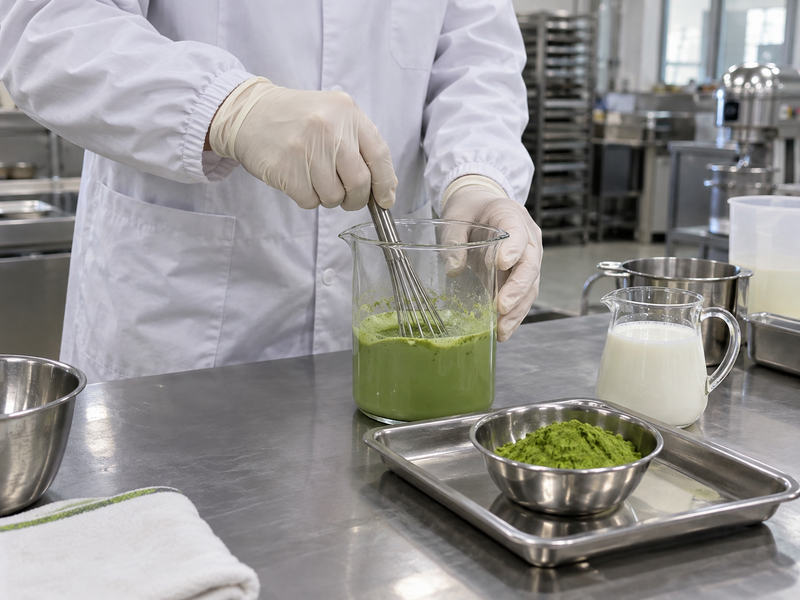
Put the sales route in the brief
A made-to-order cafe latte, chilled bottled drink, shelf-stable can and powdered premix need different formulas and process plans. Choose one format, serving size and distribution route first. State whether matcha leads the flavor or supports fruit, milk or another tea. Define sweetness, expected green shade, acceptable sediment and intended drinking temperature. A product brief should also name the destination markets and any label claims that require evidence. Without that brief, a developer can optimize the wrong sample in a laboratory cup.
Make a reference serve. Mix a small drink using the proposed ingredients and let the team describe it in ordinary words. Is it tea-forward, milky, tart or dessert-like? Note where the customer will encounter it: poured over ice, opened from a can or mixed from a sachet. That context affects what “smooth” and “fresh” mean. A clean brief gives purchasing, operations and quality a common target before a supplier sends ten unrelated matcha samples.
2. Which Matcha Powder Fits the Formula?
Compare powders after processing and dilution
Request lot-linked powders with specifications and relevant quality records. Test each at the same dose in the same base, using the mixing process closest to production. A powder that tastes delicate in plain water may disappear in sweet oat milk. A stronger one may keep flavor but bring visible sediment in a clear bottle. Record color, aroma, particle feel and cost per serving. Grade names help a supplier organize its range; they do not replace a finished-drink trial.
Test the next lot too. A year-round beverage needs a repeatable ingredient. Keep the approved sample and document which characteristics matter most. When a new lot arrives, compare it in the drink at the same dose and process. If marketing makes an origin or organic claim, the purchasing record must support it for the actual material and destination market. Do not let a beautiful pilot depend on a one-time tea sample that cannot be supplied at launch volume.
| Powder question | Finished-drink evidence |
|---|---|
| Does flavor survive the base? | Blind tasting at intended temperature |
| Does powder disperse? | Visual and mouthfeel check |
| Is color acceptable? | Packaged sample over storage |
| Can supply repeat? | Lot and capacity discussion |
3. How Does the Liquid Base Change the Tea?
Trial one base at a time
Water, dairy milk and plant-based alternatives have different sweetness, fat, protein and flavor. Matcha may feel smooth in one and chalky in another. Set one standard formula for each base rather than swapping liquids casually. If a drink includes fruit, test it after the plain base so the team understands what the fruit changes. A clear water drink exposes particles and color. A milk drink can conceal sediment but may dull the tea. Neither is automatically easier to commercialize.
Watch interactions in the pack. A bench blend can look even at filling and separate later. Make pilot samples in the actual container and inspect at planned intervals. If a plant base settles or curdles, the team needs to identify whether the cause is the base, acid, processing or matcha before adding more ingredients. A product developer should keep a control without matcha. It can reveal a defect that would have happened anyway.
4. How Much Matcha Belongs in a Serving?
Set flavor and cost together
Make a dose ladder with the base and other ingredients held constant. Taste a full serving at its intended temperature and after realistic waiting time. More powder can give stronger tea flavor and greener color, but it also raises cost, sediment and potential bitterness. Calculate grams per finished unit and cost per unit using the dose that actually tastes right. For a concentrate or premix, calculate the matcha amount after the customer prepares it as directed, not only in the container sold.
Connect dose to claims. If the brand wants to state caffeine or nutrition information, use reliable data for the finished product and have qualified staff review the sale market’s requirements. The phrase “contains matcha” is not a license to imply a particular health effect. Powder distribution across a fill run should also be checked so a stated serving amount represents what customers receive. A narrow, measurable dose range is easier to control than a dramatic recipe that requires constant adjustment.
| Dose trial | Fixed conditions | Decision |
|---|---|---|
| Lower | Same base and process | Is tea recognizable? |
| Middle | Same base and process | Flavor and cost balance |
| Higher | Same base and process | Bitterness and sediment |
5. How Will the Powder Be Dispersed?
Wet matcha before full dilution
Dry powder added to a large cold tank can make clumps. A controlled preblend with a compatible liquid may help particles wet before the main mix. The process should state addition order, mixing equipment, time and product temperature. Pull samples from different points in the vessel and through the filling run. A smooth sample taken beside the mixer does not prove that the final bottles carry the same powder dose. Remember that matcha is a suspension, not a fully dissolved ingredient.
Check the equipment. High shear may disperse particles but also add air or change the base. A gentle method may preserve texture while leaving visible powder pockets. Trial both on line-relevant equipment and inspect cleaning afterward. A powder that accumulates in valves can create inconsistent fill quality and downtime. Process engineering should work with product development rather than being asked to reproduce a hand-whisked cup after the formula is fixed.
6. How Do You Balance Sweetness and Acid?
Let matcha remain identifiable
Sweetener can soften astringency, while fruit or citrus can give a drink a bright finish. Too much of either hides tea. Build a plain reference, then change one flavor variable at a time. Record ingredient weights and taste after the product has reached its normal drinking temperature. Acid may affect green appearance and the behavior of dairy or plant bases. Qualified process staff should evaluate acidity within the final food-safety design; flavor preference alone cannot set a safe commercial process.
Taste through storage. A freshly mixed beverage may be balanced and become sharp, flat or dull later. Keep sensory notes at several points in the planned life. If a fruit addition makes the drink unstable, remove it in a control trial before changing the matcha grade. A clear cause is more valuable than a formula with many corrective ingredients and no one who understands why they are there.
| Change | Hold fixed | Watch |
|---|---|---|
| Sweetener | Powder and base | Tea visibility and aftertaste |
| Acid | Powder and sweetness | Color and flavor |
| Fruit | Approved base | Separation and sediment |
7. What Will Processing Do to the Drink?
Test the process the factory will actually use
A bottled or canned matcha drink may undergo heating, homogenization, filtration or other steps depending on the product. Those steps can alter flavor, color, particle behavior and safety. A kitchen recipe should therefore be treated as a concept, not a finished commercial formula. Qualified food-safety and process specialists must design and validate the method for the exact ingredients, container and distribution route. Developers should supply a clear sensory target and compare pre- and post-process samples.
Keep a process control. Run a version without matcha or with an established powder where useful. If the finished drink tastes cooked or looks olive, determine which step causes the change. Test one adjustment at a time. Do not lower a required process intensity solely for a brighter color. A product that looks attractive but lacks an appropriately validated safety process is not a commercial solution.
8. How Will You Measure Physical Stability?
Define acceptable movement in the container
Some settling may be compatible with a drink that tells customers to shake gently. A hard layer or obvious separation may be unacceptable. Fill the intended package and inspect top, side and bottom at planned time points and temperatures. Record color, sediment depth, redispersibility, foam and mouthfeel. Use photographs taken under consistent light, but also inspect physical samples; phone cameras can distort green tones. A clear bottle reveals issues earlier than an opaque can, which does not remove the issue itself.
Sample the full run. Compare early, middle and late fills. If later units contain more powder, the tank or fill line needs a different mixing plan. A bench sample from a small blender can be misleading. Stability work should cover the product’s intended distribution conditions and be tied to the final pack. If the formula changes, review whether prior data still support the new version.
| Stability measure | Why it matters |
|---|---|
| Sediment | Visual quality and dose uniformity |
| Color | Customer expectation |
| Foam | Fill and serving behavior |
| Taste | Tea quality through sale period |
9. Which Package Fits the Product?
Choose after the formula and route are clear
Glass, can, plastic bottle and sachet each bring different filling, light and customer-use questions. Test the actual material and closure with the finished drink. A transparent pack can show attractive green but exposes settling and color change. An opaque pack may better protect appearance from light, yet the drink must still be pleasant when poured. Headspace and closure performance belong in a qualified packaging trial. Do not select a package based only on a brand mockup.
Open a transported unit. Send pilot packs through normal distribution and inspect leaks, pressure, sediment, color and flavor. Check label legibility and whether the serving instruction matches the drink’s behavior. A “shake well” instruction should be tested: does a gentle shake restore an even drink without creating excessive foam? The best pack is the one that preserves the approved product and lets customers use it as promised.
10. What Must Be Approved Before Launch?
Align purchasing, production, quality and marketing
Keep one versioned file with powder specification, supplier and lot, formula by weight, mixing and processing steps, package, physical and sensory targets, validated safety and shelf-life evidence, nutrition and claim review, and cost per saleable unit. A second production team should be able to repeat an intermediate batch using that file. Sample the first and last units and compare them with the approved reference after storage. If they differ, the team needs a documented change and another trial.
Approve the customer’s drink. A bottle that leaves the line is not yet the product a customer consumes. Open it after its normal journey and taste the full serving. If matcha flavor, color and texture still fit the brief, the development work has produced a viable formula. If the last sip is grit or the tea has vanished, fix that before scaling the order. Matcha beverage formulation succeeds when the whole system, not a single powder sample, works together.
| Launch file | Owner |
|---|---|
| Powder and supply | Purchasing |
| Formula and process | Product and operations |
| Safety and shelf life | Quality |
| Pack performance | Packaging team |
| Claims and nutrition | Regulatory and marketing teams |
FAQ
Q1: Does matcha dissolve in beverages? No. It remains suspended as fine leaf particles, so dispersion and sediment need testing.
Q2: Can a cafe recipe be bottled unchanged? A packaged drink needs its own process, safety, pack and shelf-life validation.
Q3: Is a brighter matcha powder always better? No. Taste and stability in the finished base matter alongside color.
Q4: Can one formula work with dairy and oat milk? Each base should be tested separately because flavor, texture and process behavior differ.
Q5: What should a matcha supplier provide? Request lot-linked samples, a specification, relevant quality records and repeatable commercial supply.
For a menu-scale overview, see matcha drinks. The SERP reference formulation article discusses packaged beverages; a finished product still needs validation on its own line and route.