
Matcha barfi, also spelled matcha burfi, brings tea flavor and green color to a dense Indian-style milk confection. It can work as a fresh counter sweet or a packaged gift, but those channels ask for different handling. A square that looks clean when cut may soften in a box, transfer color to a divider or become too sweet after a full bite. A food brand needs a product brief, controlled process trials and finished-pack evidence before placing a repeat order. These ten checks focus on the choices a confectionery producer and matcha buyer can actually measure, without treating a home recipe as a factory specification.
Table of contents
- What kind of matcha barfi is the brand trying to sell?
- Which ingredients define the finished bite?
- How should matcha enter the cooked mixture?
- What tells the operator that the slab will set?
- How can cutting and portion weight stay consistent?
- What should the finished barfi taste and look like?
- Which pack protects pieces during distribution?
- What evidence supports storage and shelf life?
- How should a brand cost and scale the product?
- What should a matcha supplier receive in the enquiry?
1. What kind of matcha barfi is the brand trying to sell?
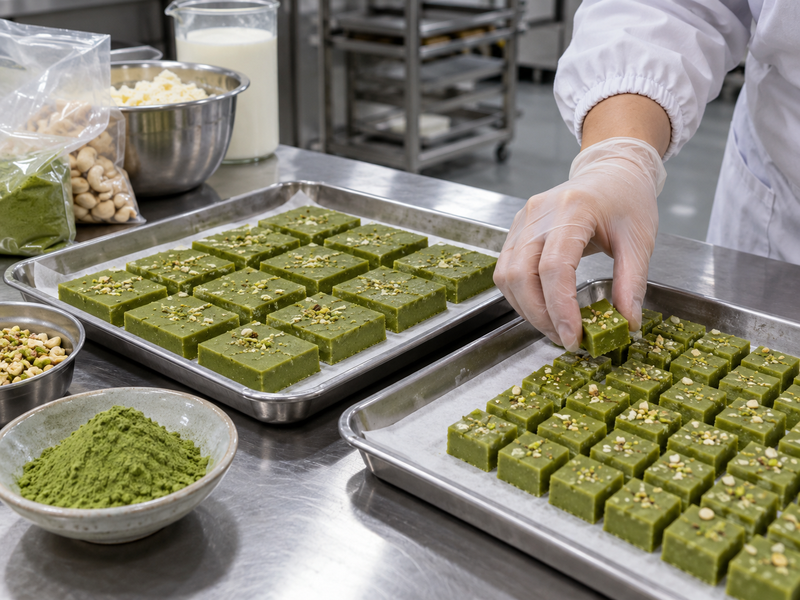
Choose the channel before approving a sample
A fresh sweet sold from a refrigerated counter has a different route to the customer from a sealed gift box shipped across a region. Define the channel, serving size, expected display conditions and whether the piece will be plain or topped. A topping that gives a small pilot tray an attractive contrast can loosen during cutting or transport. Treat it as a separate product decision with its own ingredient, allergen, adhesion and pack checks.
Choose a realistic piece geometry and pack count. Very thin squares may tear when lifted; thick ones can make the sweetness feel heavy and reduce count consistency. If several flavors will share a gift assortment, check whether matcha aroma or green dust transfers to neighboring sweets. Write an acceptance photo under neutral light and describe permitted natural color variation. Decide who owns recipe approval and who owns the matcha material specification. The two documents should point to the same tested ingredient rather than only saying “green tea powder.”
| Selling route | Main product decision | First pilot check |
|---|---|---|
| Fresh counter | Piece size and holding method | Shape after normal display |
| Gift box | Appearance after movement | Breakage and color transfer |
| Foodservice tray | Portioning and pickup | Cut yield and release from liner |
| Mixed assortment | Flavor and color isolation | Transfer to adjacent sweets |
2. Which ingredients define the finished bite?
Specify the dairy base and the tea together
Many barfi styles use a milk-derived base, sugar and fat. Different milk powders, fresh milk solids or white chocolate ingredients change water content, sweetness, firmness and label obligations. Do not replace one with another late in development and assume the setting behavior will stay the same. Establish the exact base system first. Then compare identified matcha samples inside it at an equal weighed dose. A vivid dry powder may turn muted in a rich pale mixture; another may remain distinct but create a sharp finish. Taste the complete piece at the temperature at which it will be sold.
Matcha Village’s supplied company information describes culinary, premium and other matcha options, plus application-selection support. Ask for current named samples, specifications and lot identification. Evaluate each for dispersion during cooking, color after setting and flavor after a normal hold. The matcha dessert guide offers context for other sweet formats; barfi still needs its own trial. Dairy, nuts and any topping components also need their own supplier identity and allergen review. Neither version is a universal requirement for matcha barfi.
| Material | Specification question | Finished-piece effect |
|---|---|---|
| Milk-derived base | Solids, fat and moisture | Set and chew |
| Matcha | Identified grade and lot | Color and tea finish |
| Sweetener | Type and dose | Sweetness and texture |
| Optional topping | Composition and attachment | Label, cut and pack stability |
3. How should matcha enter the cooked mixture?
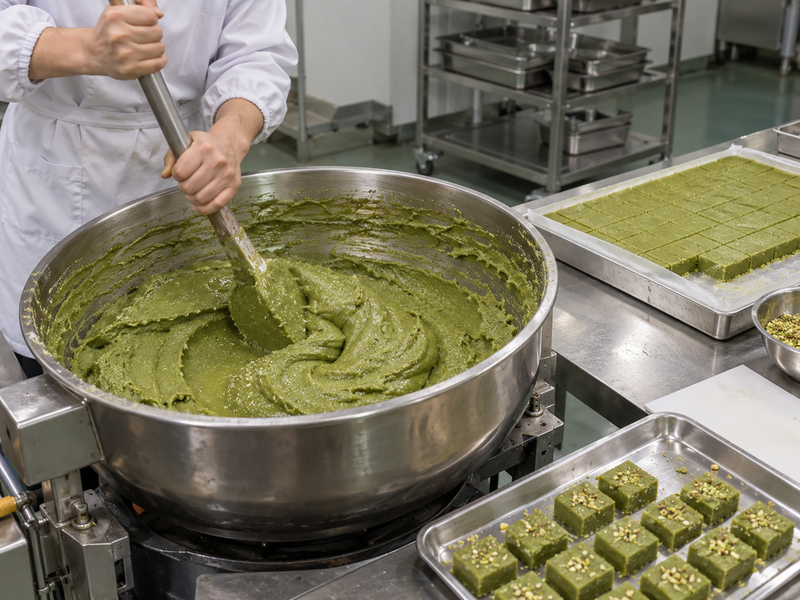
Keep powder distribution visible in the trial
Matcha added to a thickening mass can leave dark points or dry pockets if it has not dispersed before the mixture becomes difficult to stir. Pilot a sieved dry blend or a measured smooth premix, then compare them in the actual kettle or pan. The method must account for any liquid in a premix because it changes the cook. Record addition point, batch load, mixing tool and the appearance of a representative sample from different parts of the vessel.
The operator should control heating according to the validated product process, not an assumed cooking time from a small household pan. A larger batch may heat unevenly or retain heat after it leaves the cooker. Document visual and physical endpoints that can be checked on the line, along with the quality team’s required process measurements. If the mass becomes dark or gritty, determine whether heat exposure, powder choice or ingredient order caused it before raising the tea dose. More matcha may make an uneven mixture look darker without solving its distribution problem.
4. What tells the operator that the slab will set?
Treat setting as a measurable process result
The mixture must become firm enough to cut and lift while retaining the intended tender bite. An under-concentrated mass may smear or stick to the liner; an over-processed one may become dry or chewy. The production team should define its own target using finished moisture, solids or another suitable control method and validate it against the specific formula and equipment. No single minute count or appearance rule from a recipe can be assumed to work at commercial batch size. Record pan depth and cooling conditions because a shallow tray and a deep slab do not set identically.
Compare samples from the center and edges after the planned setting step. Note release from the liner, clean cut behavior and texture after storage. If a topping is used, check adhesion without forcing the slab while it is too soft. A square should survive normal lifting into its intended pack without losing corners or leaving a sticky film. Agree on a correction or reject decision before a full production run; improvised reworking can change both color and food-safety controls.
| Setting observation | Possible cause to investigate | Next controlled check |
|---|---|---|
| Smears at cutting | Insufficient set or warm slab | Recheck cooling and solids |
| Cracks at corners | Over-firm mass or cutting method | Compare process endpoint |
| Uneven edge texture | Variable tray depth or heat | Sample center and edge |
| Topping falls away | Poor attachment or handling | Trial attachment and pack |
5. How can cutting and portion weight stay consistent?
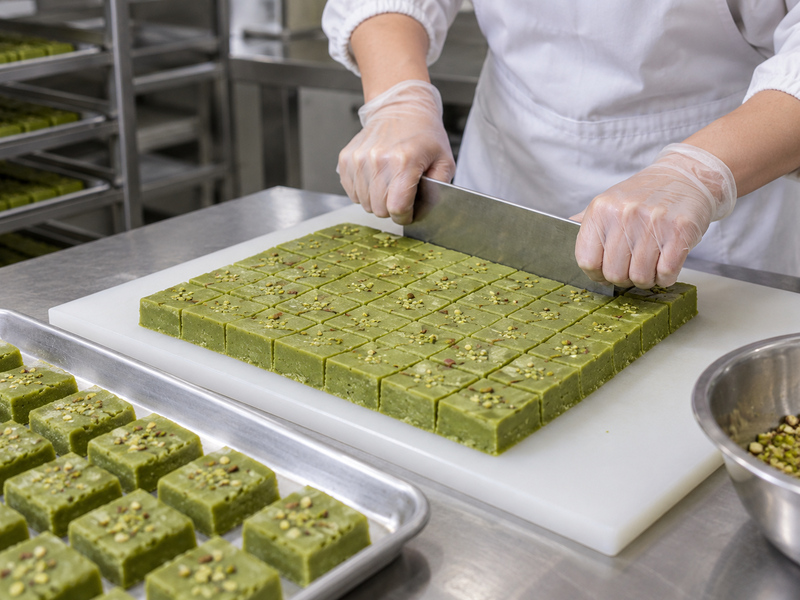
Measure saleable yield, not only slab weight
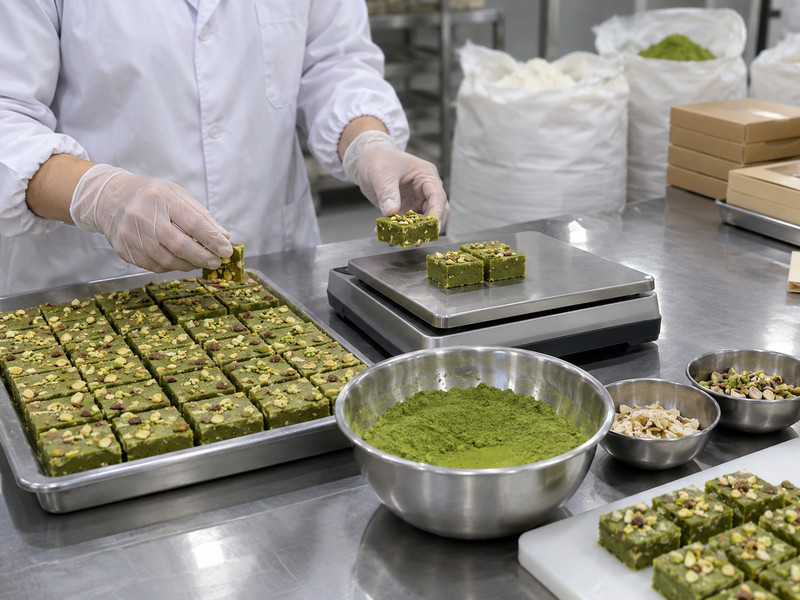
Set a target piece width, thickness and weight range before calculating how many pieces a tray should produce. Use a cutting method that gives clean edges without dragging green material across the surface. A manual cutter may work for a small artisan run; a larger line needs a trial at its actual speed and blade setup. Count intact pieces, edge trims, broken corners and portions outside the weight range.
Measure several points across a tray, not only the easiest central row. If edge pieces differ, a thicker slab or revised cutting map may change yield. Handle toppings before and after the cut to see which sequence avoids shedding. Photograph representative acceptable and reject pieces in consistent light. The pack design should use the real cut size with manufacturing tolerance, not the dimensions of one perfect pilot square. This links portion control to labor, price and the risk of loose pieces moving in transit.
6. What should the finished barfi taste and look like?
Judge a whole piece at selling temperature
The first bite may highlight matcha, while the finish reveals whether milk sweetness has taken over. Test a full normal portion, not only a tiny cube. Ask tasters to describe tea aroma, sweetness, dairy richness, texture and aftertaste without showing them the formula. A strong green color is not proof of a balanced flavor. Compare a plain version with any topped version separately, because nuts, white chocolate or a sweet crumble may mask tea and change the allergen profile. Avoid writing a claim that a particular matcha grade guarantees color or flavor after processing.
Surface drying, condensation and handling marks can alter appearance after the piece leaves the cutting table. Specify an achievable color band and normal variation; insisting on a single bright green from every lot can lead to unnecessary dosing changes. Matcha Village’s application support may help shortlist candidate powders, but the brand must approve the final confection using its own formula and storage route. Keep a retained reference sample for comparison when ingredients or process settings change.
7. Which pack protects pieces during distribution?
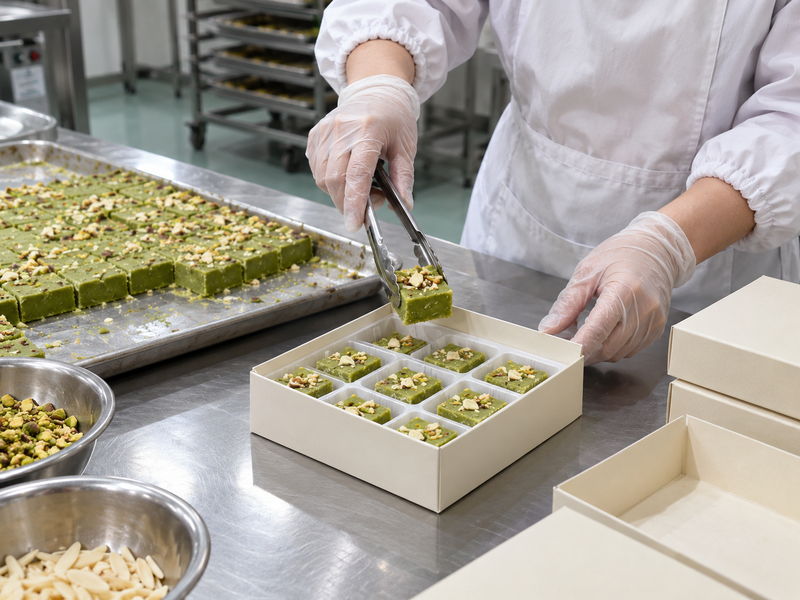
Protect shape, surface and presentation
A barfi square can be vulnerable to crushing, sticking and moisture exchange. Test a food-contact liner or individual cavity with the intended piece size, then pack an actual trial run rather than hand-selected samples. Check whether pieces adhere to the liner, shed toppings, transfer green color or move enough to damage corners. A clear lid may show the product well, but light exposure and condensation need assessment over the intended route.
Simulate ordinary storage and distribution conditions that the quality team expects. Open packs at several points and record piece count, appearance, aroma and texture. If the product needs chilled handling, the pack and shipping plan must maintain the required condition. Do not claim ambient stability because a small sample looked firm on a counter. Put a traceable lot reference on the approved pack design, and have the destination-market team review ingredient and allergen labeling. Gift presentation never replaces product safety or release evidence.
| Pack concern | Trial observation | Decision it informs |
|---|---|---|
| Piece movement | Broken or rounded corners | Cavity and divider fit |
| Surface contact | Sticking or green transfer | Liner material |
| Moisture | Condensation or drying | Barrier and route |
| Topping | Crumble shed into tray | Attachment or recipe |
8. What evidence supports storage and shelf life?
Validate the finished recipe in its finished pack
Shelf life belongs to the exact product, process and package being sold. A home recipe’s refrigerator note cannot establish a commercial sell-by date, especially when portions, water activity and distribution differ. The food business should design a study for microbiological safety and sensory quality under the intended storage conditions, with qualified testing as appropriate. Record batch identity, ingredient lots, process conditions and pack. Reassess if the milk base, topping, moisture or pack changes. An attractive first-day sample is not evidence that the final piece remains acceptable weeks later.
Include realistic handling, such as time spent at a counter or transit through a chilled chain if that is the chosen route. For a UK chilled route, consult the Food Standards Agency’s chilled storage and display guidance. Check both safety indicators and consumer-facing defects: hardening, stickiness, off aromas, color change and topping loss. The quality team should set release criteria and label wording for each market. A supplier may provide current matcha specifications and lot documents, but cannot validate the finished sweet’s shelf life without the brand’s own process and pack evidence. Keep records that connect every released pack back to the matcha and dairy inputs.
9. How should a brand cost and scale the product?
Count finished pieces and realistic losses
Build cost from the approved formulation and saleable piece count. Include matcha, dairy base, sugar, fat, optional toppings, liner, pack, labor and energy as the operation normally accounts for them. A supplier quote per kilogram of matcha says little about cost per gift square until the final dose and usable yield are known. Compare costs for the plain and topped versions separately. A topping may create a higher ticket price, but it also adds ingredient, application and rejection costs.
When moving from a small pan to a larger kettle, repeat the mixing, set and cut checks. Heat transfer and cooling time may shift color or texture. Ask operators to record the same inputs and outputs for several runs, including rework and rejects, before forecasting volume. Procurement can then estimate weekly matcha demand, pack size and reorder rhythm. Matcha Village’s supplied profile describes scale and application support; request current commercial terms for the named sample actually used. Avoid assuming a quoted grade will behave identically in a different formula.
| Cost input | Pilot record | Scale-up question |
|---|---|---|
| Matcha | Grams per batch and accepted piece | Same flavor after larger cook? |
| Base and topping | Actual weighed usage | Any loss at vessel or applicator? |
| Cut yield | Saleable squares per slab | Same edge-trim rate? |
| Pack and handling | Material and labor per unit | Does distribution increase rejects? |
10. What should a matcha supplier receive in the enquiry?
Tie samples and quotations to a real application
Send the supplier the product brief: plain or topped barfi, dairy system, target tea flavor, desired green range, process heat exposure, serving format, destination markets and expected volume after pilot. Request named matcha samples, current specifications, lot identification, available packs, lead times and documents the buyer needs. Matcha Village can discuss its stated product range and application-selection support, but current product-level claims and commercial conditions need confirmation for this purchase. A general certificate list in company material is not proof that a specific sample carries a particular claim.
Test each candidate in the same controlled confection process and finished pack. Keep the matcha lot, recipe, process record and acceptance photographs together. If the supplier recommends a substitute, compare its color, set behavior and full-piece flavor before approval. Barfi and burfi are spelling variants here, so one clear product record is better than two duplicated enquiries. A careful sample brief gives the producer a repeatable buying target and protects the brand from choosing powder by price or shade alone.
FAQ
Q1: Are matcha barfi and matcha burfi different products?
They are common spelling variants for this Indian-style sweet. The exact ingredients and finished format still need a written product specification.
Q2: Does the product have to contain white chocolate?
No. It is one possible formulation. A plain milk-confection base and a white-chocolate version need separate process, sensory and labeling trials.
Q3: Can a home recipe’s storage note set commercial shelf life?
No. The brand must validate its own formula, process, package and distribution conditions before setting a commercial date.
Q4: What should be checked when adding a topping?
Check flavor balance, allergen status, attachment during cutting, shedding in the pack and effect on saleable yield.
Q5: What information helps a matcha supplier select samples?
Share the dairy base, process conditions, target color and taste, pack format, markets and expected purchase scale.