
Matcha toffee is a solid confection with a break, a butter or fat note and a tea finish. It has little in common operationally with a pourable matcha caramel sauce. A retail bag must survive packing and transit; a café garnish must break into pieces that remain attractive on the plate. Both need a tea flavor that reaches the customer after cooking, coating and storage. This guide gives Matcha Village buyers a way to define the finished piece, test matcha candidates and brief a confectionery production partner. The operator must validate its own formula, process, safety controls and market claims.
Table of contents
- What should the finished toffee piece do?
- Which toffee architecture fits the sales route?
- Where should matcha enter the confection?
- How should sweetness and tea bitterness be balanced?
- What must a batch cooking trial record?
- How can a team judge coating and piece consistency?
- What changes when toffee is scaled and cut?
- Which package protects the saleable piece?
- How do yield and breakage affect unit cost?
- What belongs in the matcha and product brief?
1. What should the finished toffee piece do?
Define the bite before the ingredient grade
Write a target for snap, chew, thickness, piece size and the amount of tea flavor left after swallowing. A toffee that breaks sharply can be attractive in a gift bag but awkward as a cake garnish if it splinters into tiny crumbs. A softer bite may suit an individually wrapped sweet yet stick to the wrapper on a warm sales route. These are finished-product decisions, not descriptions of the dry matcha powder.
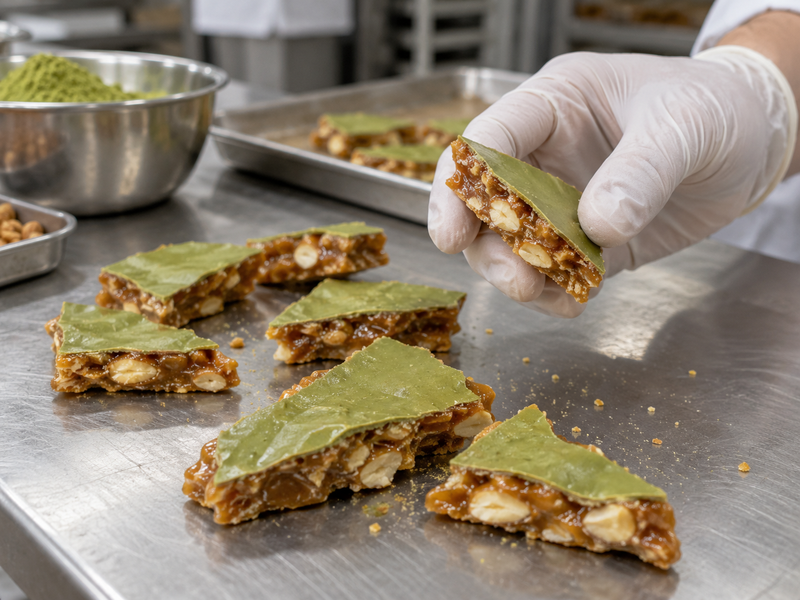
Set a serving condition for evaluation. Taste a piece after the planned packing and distribution interval, not only when it has just cooled on a tray. Photograph the cross-section and surface under neutral light; note whether the green is in a coating, within the candy or both. Break ten pieces from different parts of a trial sheet and compare size, edge quality and the share that becomes fines. The approved reference should show what a customer or dessert kitchen will actually receive. It also gives purchasing a reason to reject a seemingly inexpensive ingredient that performs poorly in the confection.
2. Which toffee architecture fits the sales route?
Compare a tea layer with tea in the candy
There are several credible ways to make a product recognizable as matcha toffee. A cooked toffee base can carry a matcha-containing coating; another concept distributes matcha within the cooked mass; a third uses a thin tea layer and a separate finishing inclusion. Those designs do not expose matcha to identical conditions. Direct cooking can change flavor or color, while a coating introduces adhesion and smearing questions. Choose one architecture for the first controlled comparison rather than changing both tea placement and candy recipe at once.
The sales route should guide the choice. A bakery may want irregular pieces for decoration, while a branded retail pack needs predictable weight, clean handling and a clear ingredient statement. Ask a co-manufacturer whether its equipment can deposit, cool, cut and coat the proposed geometry. Check the finished product for separation between layers after transit and for crumbs inside the pack. A supplier’s general matcha grade description cannot establish that either architecture will work in the operator’s plant.
| Product route | Tea placement to trial | Main finished-piece question |
|---|---|---|
| Café garnish | Surface layer | Does it stay attached after breaking? |
| Retail bag | Coating or internal distribution | How many pieces survive transport? |
| Wrapped single | Internal or stable layer | Does it release cleanly from the wrap? |
| Dessert inclusion | Small cut pieces | Does it keep its intended bite in service? |
3. Where should matcha enter the confection?
Protect the intended flavor through the actual sequence
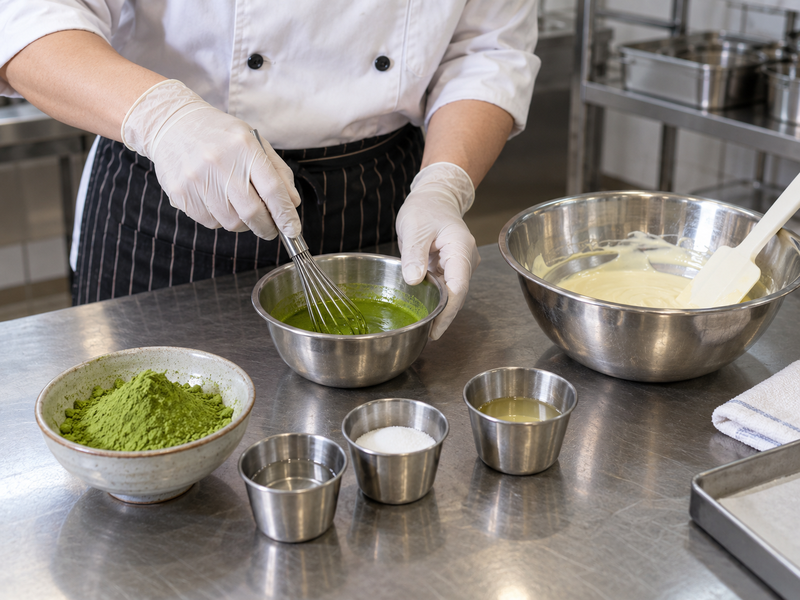
Matcha can look bright in a bowl and taste flat in a finished sweet. Heat exposure, a high-sugar base, fat content and the time before packing all change how the consumer perceives it. Prepare a trial map that states the exact point where tea enters, whether it is pre-dispersed, how it is mixed and how long the mixture waits before forming or coating. Then taste from each relevant production stage. This reveals whether a weak result comes from the powder, its dose or a process step.
When trialing a coating, make a small, repeatable dispersion so dry matcha does not form dark spots. Record the coating’s composition and application temperature under the confectioner’s own process controls. For matcha added to the candy mass, take a retained sample before and after cooking and compare with the finished piece. No single grade or insertion point is automatically correct for every formula. An ingredient trial should end with an approved finished candy, a specified mixing sequence and a reason for the matcha choice.
4. How should sweetness and tea bitterness be balanced?
Taste the whole piece at equal size
Toffee brings concentrated sweetness and a cooked flavor. Matcha can provide a welcome bitter edge, but it can also seem dusty or harsh when too much powder is pushed into a small piece. Compare candidate doses by finished-piece weight, and keep the candy base, coating thickness and service temperature fixed. Place samples in a blinded order if practical. Ask tasters to record the first impression, tea note after a few seconds and the aftertaste, not just whether a piece looks green.
If a coating contains white chocolate or another sweet carrier, test whether its sweetness overwhelms the tea. A salt adjustment may change the perception of both butter and matcha, so it belongs in its own trial rather than being altered invisibly between samples. Record any allergen-bearing ingredients in the concept. The best choice is a finished taste target the business can repeat at the intended price, not the highest matcha percentage or the deepest green surface.
| Trial variable | Hold constant | Record at tasting |
|---|---|---|
| Matcha dose | Piece weight and base | Tea clarity, bitterness, color |
| Coating thickness | Matcha blend | Sweetness and layer balance |
| Salt level | Tea and coating | Cooked flavor and finish |
| Service condition | Formula and piece size | Snap, aroma and perceived sweetness |
5. What must a batch cooking trial record?
Link observable endpoints to the equipment
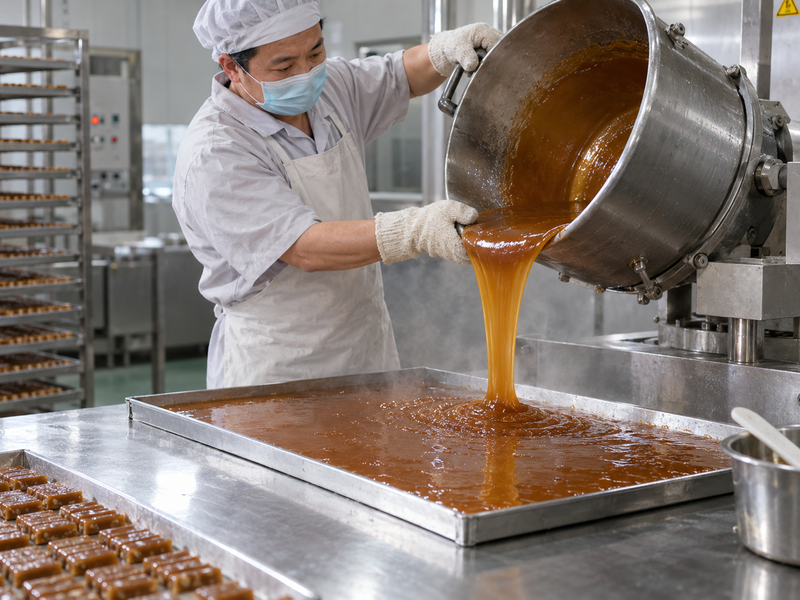
Toffee cooking is sensitive to vessel geometry, batch size, heat input and agitation. A home recipe’s timing is not a validated production setting. The manufacturer should document measured inputs, equipment, heating profile, mixing method, observed endpoint, pour or deposit method and cooling route. It should also set operator instructions for a batch that appears separated, scorched or outside its approved process window. Hot sugar presents a burn hazard; site procedures and trained staff must govern the operation.
Inspect more than one point in the formed sheet or deposited run. An edge may be thinner than the center, and a coating can set differently over each. Retain pieces from the start, middle and end of a batch for later comparison. The technical team should decide which measurements predict the approved snap and handling quality in its own line, then confirm them over repeat runs. This is more useful than publishing a universal cooking temperature or promising identical results from a different kettle.
6. How can a team judge coating and piece consistency?
Sample from the tray and the pack
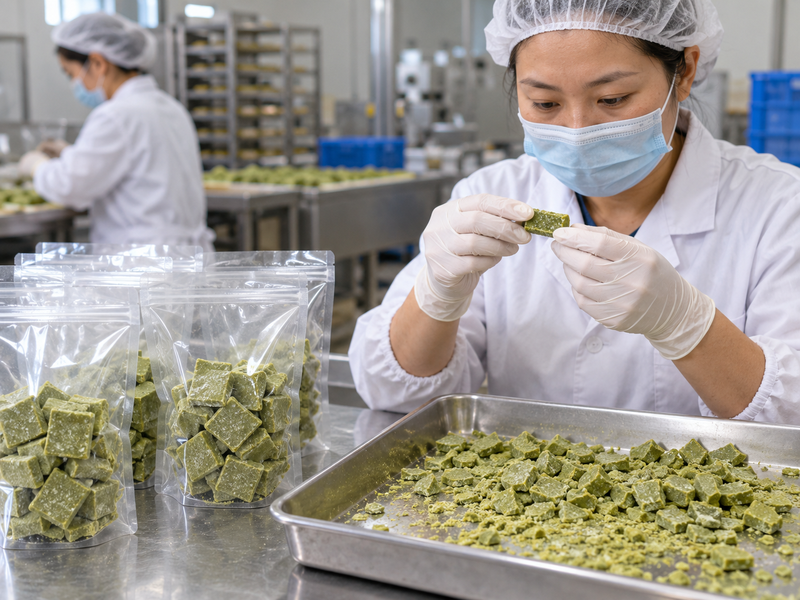
Examine the coated face, the underside and the broken edge. Look for dark matcha clumps, bare patches, streaks, fatty bloom, coating that lifts away and pieces that have absorbed moisture. A beautiful tray photograph is insufficient if the layer rubs off inside the final bag. Define how many pieces to inspect, where they come from and which defects make a unit unsaleable. Compare a sample from the start and end of a production run as well as pieces after the planned handling route.
Keep the same light and background for color comparison. Matcha’s appearance can differ between a thin coating and a thicker pool, so compare comparable piece locations. For taste, use pieces of similar mass and include a non-matcha control if the team needs to isolate the tea contribution. Log the matcha lot, candy batch and coating batch together. When a complaint arrives, those records make it possible to investigate a specific stage rather than blaming every green ingredient in the formula.
| Inspection point | Acceptable evidence to define | Possible action on failure |
|---|---|---|
| Top face | Even planned coverage | Adjust application method |
| Broken edge | Layer remains attached | Review cooling and adhesion |
| Pack interior | Limited fines and rub-off | Revisit geometry or pack |
| Tasting piece | Clear tea note without dustiness | Revise dose or dispersion |
7. What changes when toffee is scaled and cut?
Track the pieces that cannot be sold
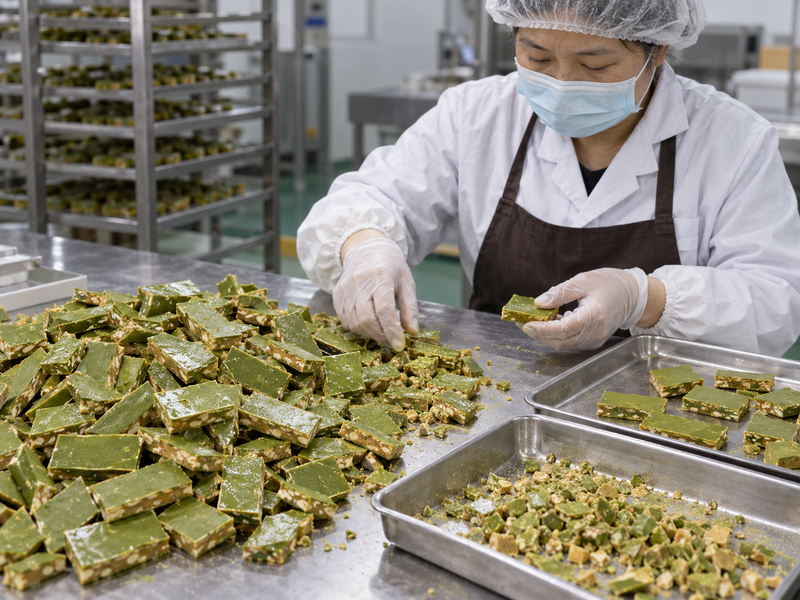
Scaling changes how fast a sheet cools, how much handling it needs and what fraction breaks outside the target size. The production trial should measure sheet thickness at several positions, weight of good pieces, weight of undersized crumbs and any coating loss. If the concept uses a depositor or cutter, record settings that produce the intended geometry without excessive rework. Do not assume that fragments can be fed back into the process; assess any reuse against the formula, quality and site food safety rules.
Pack a sample from each trial using the proposed commercial sequence. Handling during transfer, weighing and sealing may create more fines than cutting itself. Run a transport simulation appropriate to the actual route and inspect the pack on opening. Small adjustments to piece shape or pack fill may save more saleable weight than switching matcha grades. The goal is a repeatable retail or foodservice unit, not merely a full tray of attractive confection on production day.
8. Which package protects the saleable piece?
Test moisture, movement and label fit
Matcha toffee can lose its intended bite if the pack admits moisture, and a coating may scuff when pieces move against one another. Compare candidate films, pouches, trays or individual wraps with the actual product, fill weight and distribution route. Inspect seal integrity, visible breakage, sticking and sensory quality at defined checkpoints. The packaging partner should advise on barrier properties and machine compatibility; the food business must verify the finished product’s shelf life through its own program.
The package also determines how clearly ingredients and allergens can be stated. Butter, milk-containing coatings and inclusions change the declaration, while a foodservice bulk pack needs useful lot and handling information for the receiving kitchen. Review local market labeling rules before print. Avoid a design that hides fine crumbs at the bottom of an otherwise premium-looking bag. Customers judge what they receive after opening, so the pack trial should include that moment.
| Pack option | Product risk to test | Commercial check |
|---|---|---|
| Loose pouch | Rub-off and crumbs | Opening appearance after transit |
| Divided tray | Added material and labor | Piece protection per saleable unit |
| Individual wrap | Sticking or tearing | Release and seal performance |
| Foodservice tub | Repeated access | Handling quality through service |
9. How do yield and breakage affect unit cost?
Cost released pieces, not the starting batch
An ingredient cost per kilogram does not show whether a matcha toffee program will pay. Build a calculation around the weight of saleable pieces after cooking, cutting, coating, packing and the planned handling check. Include butter or other fat, sugar, matcha, coating materials, packaging, labor and identified waste. If a sample uses more expensive matcha but needs less dose to reach the approved tea note, its cost in the finished unit may be competitive. Run that comparison with the same finished weight and quality standard.
Track breakage by stage, because a single total loss figure hides the fix. A high cut loss points toward geometry or process; transit crumbs may point toward a different pack. Record the minimum acceptable piece count or weight per pack and how short packs are handled. Make price decisions on released packs that meet the approved sensory and visual standard. A margin model built on perfect sheets can mislead a buyer even when every ingredient price is accurate.
| Cost line | Measure from trial | Decision it supports |
|---|---|---|
| Matcha | Dose per released pack | Compare qualified powders |
| Base and coating | Actual input and transfer loss | Adjust formula or equipment |
| Breakage | Unsaleable pieces by stage | Improve cut or protection |
| Packaging | Materials and pack labor | Select sales format |
| Released yield | Packs meeting specification | Price the real unit |
10. What belongs in the matcha and product brief?
Join the sample request to a finished-piece standard
Send a prospective matcha supplier the application, expected tea placement, intended flavor and color, estimated use level, target market and forecast range. Request lot-linked information relevant to purchasing and quality review, and ask for a sample that can be traced to the documents supplied. Matcha Village can then discuss candidate powders against an actual confection application. Do not assume that a powder grade name establishes performance in hot candy or fat-based coating.
The internal product brief should attach the approved finished piece, process record, defect definitions, pack format, release criteria and cost model. State who may approve a powder or process change and which finished-product trials must be repeated. If the chosen concept contains dairy or another allergen, keep its control and label review with the food operator and manufacturing partner. That shared brief makes future lots easier to compare and gives the buyer a specific question to bring to supplier discussions: does this matcha help produce the approved toffee reliably at the required yield?
FAQ
Q1: Is matcha toffee the same as matcha caramel sauce? No. Toffee here is a solid confection with a defined break and piece geometry. A sauce has different texture, handling, packing and service tests.
Q2: Must matcha be cooked into the candy? No. A coating or separate tea layer is another design. Compare finished flavor, layer stability and manufacturing fit before selecting a route.
Q3: Can the color of dry powder predict the finished candy? No. Judge color after the chosen cooking or coating process and again after the intended packing route.
Q4: Does a home recipe’s storage advice establish retail shelf life? No. The operator must validate its own formula, package and distribution conditions.
Q5: What should a supplier sample request include? Describe tea placement, base, expected dose, finished flavor target, market and projected use, then request matching lot documents.