
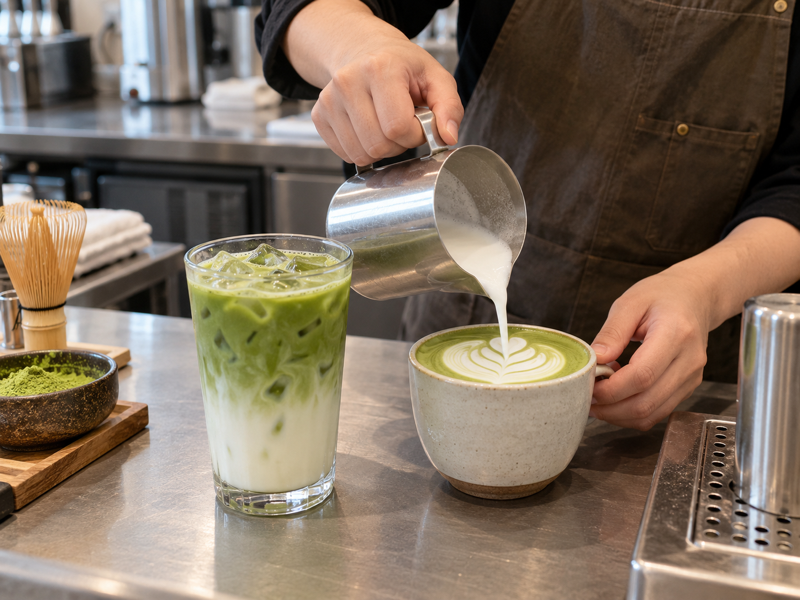
A matcha cafe latte should taste like tea after the milk goes in. It should also leave the counter without clumps, fit the cup the customer ordered, and look the same when another barista makes it. Those requirements are harder to meet than a single good tasting. This guide treats the latte as a service recipe: a measured matcha base, a chosen milk, controlled dilution, and a clear handoff standard for both hot and iced cups. All example amounts are pilot starting points, not a universal formula or nutrition claim.
Contents
- 1. What is a matcha cafe latte?
- 2. Which powder should a cafe test?
- 3. How should matcha be dispersed before milk is added?
- 4. How much matcha belongs in one cup?
- 5. Which milk works with the recipe?
- 6. Why does an iced latte need its own card?
- 7. How should sweetness and flavors be handled?
- 8. What should a barista recipe card include?
- 9. How can the cafe check quality during service?
- 10. How should a cafe launch the latte?
1. What is a matcha cafe latte?
A matcha cafe latte combines dispersed matcha with milk or a plant drink. Cafés may serve it hot, over ice, or with a measured flavor. The name should tell customers what they are buying. If the base includes a sweetened powder blend, list that in the ingredient review and describe the drink honestly. If coffee is added, name it rather than letting a customer assume a tea-only latte.
Define the house version before testing variations. Record the cup size, target drink weight, powder dose, water used for dispersion, milk SKU, sweetener, and whether the drink should have foam. A 250 mL hot cup and a 450 mL iced cup cannot share every number. Customer expectations also differ: a straight tea drinker may want a stronger tea note than someone ordering a dessert-style iced latte. Run separate tests instead of forcing both audiences into one ambiguous cup.
| Recipe element | Hot latte decision | Iced latte decision |
|---|---|---|
| Tea strength | Taste through warm milk | Survive ice dilution |
| Milk | Steam and foam behavior | Cold texture and sweetness |
| Water | Dispersion and final volume | Concentrate volume |
| Sweetener | Dissolves in hot base | Mixes evenly cold |
| Cup | Handoff temperature | Appearance after waiting |
2. Which powder should a cafe test?
Choose candidate powders against the latte, not a label on the pack. Make a baseline drink with identical milk, dose, water, and sweetness for each sample. Taste blind if possible. Note whether tea remains present after milk and whether bitterness grows as the cup cools. Look for gritty particles on the tongue or a green ring on a clear glass. A vivid dry powder can still make a weak latte.
Ask suppliers for an ingredient statement, lot code, storage instructions, and consistent pack format. If a powder is a premix, calculate the real matcha content and added sugar before comparing cost with pure matcha. A powder that needs a higher dose to taste like tea may be more expensive in use, even if its bag price is lower. Test a production lot before final approval, and keep a reference sample for later comparison.
3. How should matcha be dispersed before milk is added?
Weigh powder into a clean, dry vessel. Add a small, measured amount of water at the chosen temperature and mix until no dry pockets remain. A whisk, electric frother, or shaker can work if staff can repeat the method and clean the tool quickly. Sifting may help a powder that tends to clump, but it adds a step; test whether it changes the result enough to justify its place in a busy station.
Use the same vessel and mixing time in every trial. Then pour the base through a clear cup or across a white surface and inspect for clumps. If clumps persist, check powder storage, water amount, and sequence before increasing agitation without limit. Too much foam in the tea base can change the final appearance. Measure preparation time, because an elegant one-cup ritual may become unworkable when five iced lattes arrive together.
| Mixing method | Operational advantage | Check before approval |
|---|---|---|
| Bamboo or metal whisk | Visible control | Cleaning and station space |
| Electric frother | Fast for one cup | Splashing and battery upkeep |
| Shaker | Batch potential | Sediment and cleaning |
| Premade concentrate | Fast assembly | Hold time and food safety |
4. How much matcha belongs in one cup?
Start with the supplier's guidance and a fixed cup volume, then make a small dose ladder. For example, test a low, medium, and high dose while milk, water, and sweetener stay constant. Taste at the intended handoff temperature. The winning dose is the one that gives a recognizable tea note without pushing bitterness, grit, or cost beyond the menu brief. Write the selected weight in grams, not “one scoop.”
Check the dose during normal service. Scoops vary with packing and humidity, and a barista may add extra powder to fix a weak drink. That change can make costs unpredictable. If the latte tastes too thin, first confirm the actual milk volume and ice weight. A stronger powder is not always the answer to an oversized cup. For chain service, set a tolerance and periodically weigh real drinks made by different staff.
5. Which milk works with the recipe?
Taste the same matcha base with the exact dairy and plant milk SKUs the café will offer. Dairy may soften bitter edges; oat drinks can add sweetness and cereal notes; soy and coconut bring their own flavors. These are product-specific effects, not rules that cover every brand. Check ingredients and allergens in the chosen milk. A “plant milk” placeholder on the recipe card leaves too much to chance.
For hot service, test steaming at the café's intended handoff temperature and inspect foam after a short wait. For iced service, taste the cold milk and matcha after the ice begins to melt. If a milk separates or mutes the tea, test a different SKU or adjust the recipe deliberately. Do not let staff compensate by free-pouring syrup. The goal is a cup that tastes consistent whether customers choose the default milk or an advertised alternative.
| Milk test | What to observe | Decision |
|---|---|---|
| Straight cold milk | Existing sweetness | Syrup level |
| Hot steaming | Foam and texture | Steam method |
| Matcha plus milk | Tea visibility | Powder and dose |
| Short wait | Separation | SKU or mixing order |
| Allergen review | Ingredients and handling | Menu disclosure |
6. Why does an iced latte need its own card?
Ice is an ingredient in an iced latte. It changes drink volume, temperature, and flavor as it melts. Fix an ice weight for each cup size and test the drink at pour, after five minutes, and after the typical delivery or takeaway wait. A concentrate can keep the tea note more visible, but its water volume still belongs in the recipe. A tall cup filled with milk may make a well-prepared base taste weak.
Specify the order of assembly. Some cafés pour milk over ice then add the matcha base for a layered look. That cup may need an instruction to stir before drinking. Others mix thoroughly at the bar for a uniform flavor. Choose one house standard and train it. If the appearance drives the menu photo, test whether the layered cup remains attractive after a customer carries it. The finished drink matters more than the moment just before the picture.
7. How should sweetness and flavors be handled?
Make the plain latte work before adding flavors. Then test one syrup at a time in measured increments. Strawberry, vanilla, and citrus can all change how matcha's bitterness and aroma register, but their effects depend on the recipe and the ingredient used. A flavored puree may also change viscosity or settle. Keep the sweetener consistent during testing so the team can tell whether a new powder or flavor actually improved the cup.
Write separate cards for signature drinks. Include syrup grams, mixing step, visual finish, and any allergen or ingredient disclosure. If a drink is intentionally sweet, say so on the menu. A customer who expects a tea-led latte should be able to order one. Review the actual nutrition inputs rather than claiming a flavored drink is “healthy” because it contains matcha. The drink's full recipe, not its green color, determines what is in the cup.
| Flavor choice | Trial question | Service check |
|---|---|---|
| Plain | Is tea recognizable? | Base consistency |
| Vanilla | Does it flatten tea aroma? | Syrup dose |
| Berry puree | Does it settle or streak? | Mixing and hold |
| Citrus | Does it change milk texture? | Stability |
| Extra sweetener | Is sweetness balanced? | Accurate pumps |
8. What should a barista recipe card include?
A working card fits on the station and answers the questions staff ask during a rush. List cup size, grams of powder, milliliters of water, water temperature range, mixing method and time, milk SKU and amount, sweetener dose, ice weight, and final cup appearance. Include a clear remake rule for clumps or wrong milk. Use photos of a real approved cup if the café's documentation permits them.
Train staff by having them prepare three cups without coaching. Weigh and taste them against the reference. Note where they pause, reach across another worker, or choose a different vessel. Those observations may call for a station change rather than more instructions. Retest the recipe when milk, powder, cup size, or mixing tool changes. A card is a controlled record, not a decoration in a training folder.
9. How can the cafe check quality during service?
Use a short opening check: powder lot, storage condition, scale accuracy, milk SKU, clean mixing tools, and a reference cup. During service, watch for repeated clumps, overfilled cups, and long ticket times. Count remakes and record their cause. A drink that staff quietly remake five times in a shift may pass a taste review while hurting margin and pace.
Check both first and last cups from a prepared batch if the café uses concentrate. Settling and hold time can change strength. For single-cup service, sample across different operators. Compare cup weight as well as taste, since a change in milk volume can hide a dose issue. When a customer complains, keep the ticket, lot, and recipe information. That record helps locate the problem without blaming staff or suppliers on guesswork.
| Checkpoint | Evidence | Response |
|---|---|---|
| Opening | Lot, scale, tools | Correct setup |
| Mid-shift | Sample cup and ticket time | Coach or revise flow |
| Remake | Cause and frequency | Fix recurring step |
| New lot | Compare to retained sample | Approve or hold |
| New milk | Taste and texture trial | Update recipe |
10. How should a cafe launch the latte?
Run a limited pilot with the real cup, price, and staff plan. Sell the drink rather than only giving samples away. Record how many customers choose plain versus flavored, which milk they order, how long the drink takes, and whether anyone buys it again. Ask for specific feedback: too sweet, weak tea, clumps, odd aftertaste, or size mismatch. Those comments lead to decisions.
If the cup passes taste but fails service speed, test station placement and preparation sequence. If staff can make it fast but customers call it weak, change the ingredient or recipe rather than polishing the menu photo. Lock the final card only after a normal shift shows acceptable flavor, time, cost, and remake rate. A matcha cafe latte is ready when a regular barista can serve the approved cup on a busy day.
FAQ
Q1: Can a cafe prepare matcha base ahead of time?
It can if the café validates a safe hold method, flavor, color, and settling under its local food handling rules. Write a discard time.
Q2: Does an iced latte need more powder than a hot latte?
It may need a different concentration because ice dilutes the cup. Test the finished drink rather than applying one number automatically.
Q3: Is a whisk required?
No. Choose a mixing tool that delivers a smooth drink and can be cleaned and repeated during service.
Q4: Should a cafe sweeten every matcha latte?
That is a menu choice. Offer clear descriptions so customers know whether a cup is unsweetened, lightly sweetened, or dessert-like.
Q5: What is the clearest sign of a failed recipe?
If different staff produce noticeably different flavor or clumps under ordinary conditions, the recipe or workflow needs more work.
Related reading: matcha latte ratio and Matcha Coffee Latte (Iced Dirty Matcha Recipe).