
Kosher matcha buying combines documentation and tasting. A bright powder and a kosher logo in a sales deck do not tell a brand whether the exact product, facility and pack it plans to sell are covered. The practical route is to identify the product, ask for current certification evidence, and check each change to the formula or handling path before artwork is approved. Buyers still need a matcha that tastes right in the intended drink or food, so the quality trial and the certification review should travel together.
Contents: Product · Certifier · Scope · Ingredients · Equipment · Status · Destination · Quality · Artwork · Changes
1. What Exact Product Are You Buying?
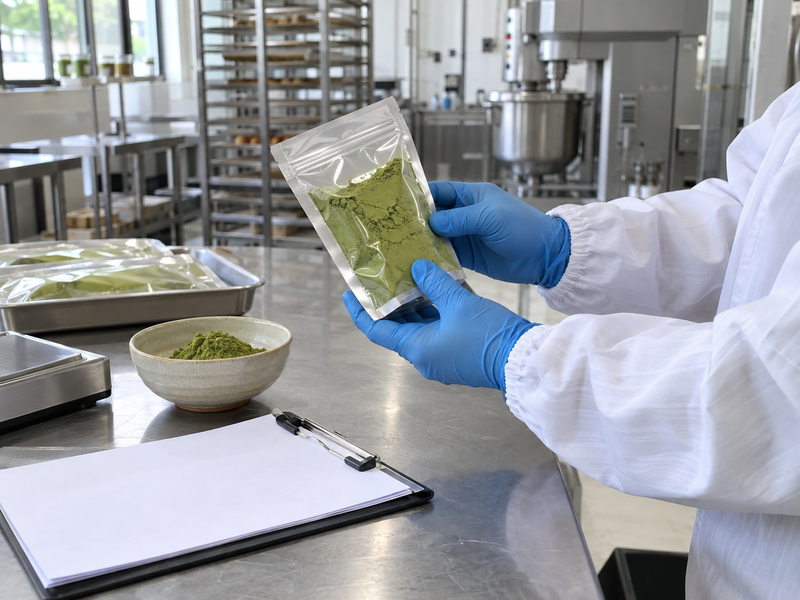
Name the item before asking about status
Begin with the supplier’s exact product name, SKU, ingredient statement, pack size and intended manufacturing site. A plain matcha powder, a sweetened latte blend and a canned drink are separate products even when the same tea appears in each. Keep samples labeled with the SKU and lot so the tasting team and procurement team discuss the same item. A statement that a company “makes kosher matcha” is too broad to approve an unlabeled sample. Put the planned final label beside the sample and check whether the names and pack format agree.
Define the use
A cafe may need certified powder for foodservice, while a retail brand may need a private-label pouch bearing a symbol. A bakery may be using the powder in another certified product. Write down that intended route because the evidence and artwork questions change with it. If the brand wants organic, origin or other claims too, keep those in separate review columns. One certificate should not be made to prove every claim. The first purchasing decision is a precise product description; the sensory decision comes after the candidate is identified.
| Product form | Ask the supplier for | Common mismatch |
|---|---|---|
| Plain powder | Exact certified item and pack | Generic company claim |
| Matcha blend | Full ingredient list and SKU | Powder certificate used for blend |
| Ready-to-drink | Finished product evidence | Ingredient certificate used for drink |
2. Which Certifier Covers the Product?
Verify through the issuing body
Ask for the name of the certifying organization and a current letter or database listing for the exact item. Where the certifier offers an online product search, use that source. OU Kosher’s letter search is one example of a system intended to let buyers verify certified products and share up-to-date letters. A logo in a brochure can be old, cropped or unrelated to the SKU under review. Save the record you relied on, including its date and any product schedule attached to it.
Ask the buyer’s customers what they require
Different retail and foodservice customers may have their own accepted certifiers or symbol rules. Get the destination customer’s requirement before the supplier has printed a custom pack. Do not assume that one respected certifier is automatically accepted by every buyer. If the evidence is unclear, ask the certifier or the customer’s compliance contact to confirm the product. This is more efficient than arguing from a website badge. The commercial specification should name the certifier and the item, not simply use the word “kosher” without a verification path.
3. Does the Certificate Cover This Facility and Pack?
Read the full certificate scope
Check the company name, site, product description, brand, certificate dates and any schedules or restrictions. A product may be certified at one facility but packed elsewhere, or the certification may cover a bulk bag but not a proposed consumer unit. Certification programs review production conditions as well as ingredients. OU’s account of its application process describes plant inspections and ingredient approval as parts of its review. Ask how the supplier will handle repacking, relabeling or outsourcing rather than treating those steps as invisible.
Match records to the shipment
The purchase order should identify the approved product and pack. On arrival, receiving staff can compare the delivered label, lot and supplier with the approved record. If the outer carton has a different brand or product name, stop and reconcile it before putting the powder into production. It also helps with recalls, artwork corrections and repeat orders. Keep the approved certificate alongside the supplier specification in the same controlled file.
| Certificate field | Compare with | Question to resolve |
|---|---|---|
| Product name | Sample and order | Is this the exact SKU? |
| Facility | Manufacturing record | Is the processing site covered? |
| Brand or pack | Proposed artwork | Is repacking included? |
| Validity | Order date | Is the record current? |
4. What Else Is in the Matcha Product?
Separate plain tea from blends
Plain matcha has a simple ingredient story, but many cafe products contain sugar, milk powders, flavors, emulsifiers or other components. Ask for the full formulation category and current ingredient list. The certifier’s review of a blend cannot be inferred from the certification of its matcha component. Conversely, a certified blend’s status does not make every future flavor extension certified. Ask for a distinct record when a new SKU is proposed. If the product carries a dairy or other specific designation, confirm exactly what the certifier’s symbol means for the finished item.
Manage substitutions
Suppliers may change a flavor house, sweetener or processing aid without changing the product’s public name. The supply agreement should require notice before a formulation change that affects the approved certification or ingredient statement. Request the updated certificate where needed and recheck the final packaging. A good buying file has a version number for the specification and label. That lets the team tell which formula was approved when a later shipment arrives. The job is to prevent quiet drift between the sample, the certificate and the product on shelf.
5. How Is the Product Processed and Packed?
Follow the material path
Ask where the tea is ground, blended, filled and sealed. If a contractor performs a step, determine how that step fits the certifier’s approved scope. Shared equipment and cleaning practices are matters for the certifier to assess; a buyer should not invent its own religious determination from a process flow diagram. Still, the buyer can request enough detail to confirm that the product path matches the submitted certificate. Keep the process and site names current, especially when a supplier offers both bulk powder and small consumer pouches.
Include the final pack
Private-label projects often spend months on flavor and design, then discover that the proposed pack is filled by a different company. Raise this before artwork approval. Ask who applies the certification mark, who checks each print run and who owns a packaging change. If the brand packs the powder itself, it needs to discuss that operation with the certifier rather than assuming the incoming bulk powder’s status carries over automatically. Document the agreed approach in the launch checklist and give the receiving and artwork teams the same version.
| Stage | Record to connect | Approval concern |
|---|---|---|
| Tea supply | Raw material identity | Correct powder and lot |
| Blending | Formula and site | Added ingredients and equipment |
| Filling | Pack site and format | Scope of final operation |
| Labeling | Approved artwork | Correct symbol and product name |
6. What Is the Current Certification Status?
Put a review date on the record
Certificates can expire or change. Log the issue and expiry dates, the source used to verify them, and the date the team last checked. Set a reminder before renewal if the product is a continuing purchase. A document from the day a supplier first pitched the product is not enough for a later order. If an online database and a PDF disagree, ask the certifier or supplier for clarification. Do not silently choose the more convenient answer. Where a certificate lists only some products, confirm that the SKU in the current shipment remains on the approved schedule.
Handle a gap before shipping
If the record has lapsed or the exact item is missing, hold the kosher claim until the status is resolved. That may require a new certificate, corrected product name or changed artwork. Keep the decision documented so sales and operations give customers the same answer. Certification questions are easier to settle before a purchase order or print run than after cartons have arrived. The team can still evaluate a powder’s color and flavor during a gap, but it should separate that product trial from authorization to sell it with a claim.
7. Will the Claim Work in Your Sales Market?
Check channel requirements early
A distributor, retailer or institutional customer may request a specific agency, certificate format or pack symbol. Collect those requirements while the supplier can still choose the right production and labeling route. Ask whether documentation is needed for bulk ingredients, consumer goods or both. Cross-border shipments may also require translated records or local review. The certifier and the customer’s compliance team are the right places to resolve acceptance questions. Avoid promising that a certificate from one market has universal reach.
Keep marketing claims narrow
Use the certified product name and the approved symbol exactly as allowed. Do not expand “kosher matcha powder” into a claim that every matcha product from the brand is certified. A cafe recipe with additional ingredients needs its own assessment if the finished menu item will carry a kosher claim. A product description can still discuss tea flavor, preparation and origin where evidence supports those points. Keeping certification language precise makes the commercial story more credible and reduces corrections across marketplaces, cartons and sales sheets.
8. Does the Powder Work in Your Application?
Taste the approved item in the finished product
Once the certification record is clear, run a normal matcha trial. Prepare the powder at the expected dose in the real milk, water, baking formula or blend. Compare aroma, bitterness, particle feel and green appearance. A certificate cannot tell you whether the tea survives a sweet bakery filling or settles too fast in a bottled drink. If several certified options are available, blind-taste them at equal powder mass and then examine cost and lead time. Keep the winning sample’s lot number with the quality notes.
Check repeatability
Request a second lot or another production sample before committing to a large order. Compare it with the approved reference in the finished application. Agree with the supplier on specification fields, acceptable variation and the documents that accompany each shipment. Matcha Village can discuss B2B matcha grades and OEM options through its product range; any kosher claim for a particular product must be supported by its own current certifier record. Taste and certification answer different questions, and the launch needs both answers.
| Trial | Compare | Keep in file |
|---|---|---|
| Sample cup | Color and tea flavor | Lot and recipe |
| Finished food | Flavor after process | Process conditions |
| Repeat lot | Variation from reference | Sensory notes |
9. What Can the Package and Listing Say?
Lock artwork only after review
Give the final pack proof, online listing and sales sheet to the people responsible for certification and market labels. Check the certifier’s mark, product name and any category designation against the current approval. A printer can easily copy an old symbol into a new design. If the project also makes organic, origin or ingredient claims, support those from the appropriate separate documents. Keep the approved proof version in the same folder as the certificate. When a retailer later asks why a claim appears, the team can answer from the file rather than reconstructing an email chain.
Make receiving simple
Show the approved product image or label to receiving staff. They need to know which SKU and mark to expect and who to contact if a carton differs. If the product is unpacked into a kitchen container, preserve the lot and original identification in the internal record. This protects traceability and keeps an unapproved substitute from entering a claimed product. A clear process at receiving is worth more than a complicated policy no one uses. Review it with a real delivery before scaling distribution.
10. How Will You Control Changes After Approval?
Define change triggers
The supplier should notify the buyer about a new formulation, site, packer, brand name or certification status. The buyer should notify the supplier if it plans to repackage the product or print a different claim. Identify who pauses an order and who authorizes restart after a document update. Treat a new lot as a normal quality check, while a changed production path may need a deeper certification review. Put those triggers into the supply agreement or approved-supplier procedure so they do not depend on a single employee remembering a conversation.
Review at renewal and reorder
At each scheduled review, compare the current certificate, SKU list and approved artwork with what the business is actually selling. Check a recent shipment’s lot documents and the product’s performance in use. A powder can remain certified but no longer meet the flavor target, or taste excellent while its paperwork needs attention. Keep both tracks visible. The best kosher matcha for a business is the one whose verified status, application quality and supply reliability continue to align after launch, not just on sample day.
| Change | First action | Evidence before restart |
|---|---|---|
| New ingredient | Hold claim review | Updated certifier approval |
| New packer | Check scope | Current product and site record |
| New artwork | Review mark | Approved print proof |
| Renewal | Verify status | Current certificate or listing |
FAQ
Q1: Is all plain matcha automatically kosher? Do not make that assumption for a commercial claim. Verify the exact product and handling route with an appropriate certifier.
Q2: Does a certified powder make a finished latte kosher? The whole finished product and its preparation conditions need appropriate review. The powder’s certificate covers only its stated scope.
Q3: Can a supplier’s logo image replace a certificate? A current product listing or letter from the certifier gives a better verification path. Match it to the SKU and facility.
Q4: Will every customer accept the same certification? Requirements vary by customer and market. Check the destination requirements before artwork and ordering.
Q5: What if the supplier changes the packer? Ask whether the change affects the certified scope and obtain updated approval or documentation before using the claim on the new pack.