
Is matcha gluten free? Pure matcha is powdered tea leaf, so gluten-containing grains are not an expected ingredient. That ingredient-level answer does not automatically authorize a gluten-free claim for every packed powder, latte blend, café drink, or bakery item. Other ingredients and cross-contact controls matter, and labeling rules depend on the sales market. A brand or importer needs a file that supports the specific finished SKU. This guide separates ingredient identity from claim eligibility, explains the supplier questions to ask, and gives food and beverage teams a practical route from formulation to a defensible label or menu description.
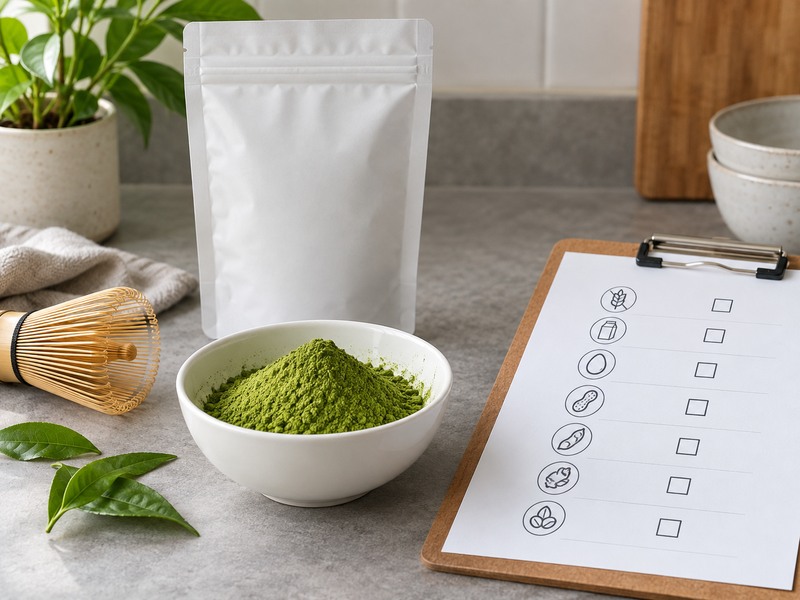
1. Is pure matcha naturally free of gluten ingredients?
Matcha made only from tea leaves has no wheat, barley, rye, or other gluten-containing grain in its intended ingredient list. Check the product specification and ingredient declaration rather than infer purity from a green powder or a marketing photograph. A product sold as matcha may be a formulated latte powder or flavored blend; those can contain additional ingredients. Even a pure powder can require cross-contact review if it was packed or handled on shared equipment. “No gluten grain intentionally added” and “qualified for a gluten-free claim” are different statements.
What should a buyer verify on the first document pass?
Request the ingredient statement, product specification, manufacturing or packing-site information, allergen and gluten-control declaration, and lot traceability. Read the exact SKU. A supplier may offer pure powder and a sweetened blend under the same brand name. Ask whether any processing aid, carrier, or flavor has been used, and whether the declaration covers the pack size being purchased. For a pure matcha inquiry, make the required market and claim explicit so the supplier can provide evidence that matches the application. A verbal assurance from sales is not a replacement for approved documents.
| Product | Ingredient-level question | Further review |
|---|---|---|
| Pure tea powder | Is tea the sole ingredient? | Cross-contact controls |
| Matcha blend | What else is present? | Each ingredient source |
| Café latte | What milk and syrup are used? | Station handling |
| Cookie or cake | Does formula contain flour? | Finished-product eligibility |
2. What does “gluten-free” mean on a U.S. food label?
In the United States, the claim has a defined federal rule. The FDA’s gluten and food labeling guidance explains that foods bearing “gluten-free” and equivalent claims must meet ingredient criteria and contain less than 20 parts per million of gluten. A food producer is responsible for the accuracy of its own label. The rule does not mean every naturally grain-free ingredient is automatically safe to label without reviewing the full process. Other countries have their own requirements and guidance, so an exporter should check each destination before using the same artwork.
How should a brand apply the rule to matcha?
Start with the exact finished food that will bear the claim. Check the whole chain. Review ingredients, suppliers, shared equipment, cleaning, packaging, and any unavoidable gluten presence. The FDA’s questions and answers on the final rule describes tools a manufacturer may use, including ingredient information, testing, and third-party certification. Choose controls appropriate to risk rather than treating one certificate as a universal guarantee. For a private-label pack, determine whether supplier, packer, or brand owns each part of the evidence and how changes reach the label approver.
3. Can a matcha latte blend contain gluten?
It can contain ingredients or be made under conditions that require review. A latte powder may include sugar, dairy or plant creamer, flavoring, cereal-derived components, or processing aids. The term “matcha latte powder” tells you its application, not its gluten status. Check every component’s declaration and the final blend’s manufacturing controls. Do not assume that “vegan,” “organic,” or “dairy-free” means gluten-free; those terms answer different questions. A buyer should obtain the current formula and site information before promising a dietary claim to a distributor or retailer.
What should procurement ask a blend supplier?
Request a complete ingredient and allergen statement, gluten-control description, product specification, certificate or test evidence where appropriate, and change-notification terms. Ask about substitutions. A flavor carrier or creamer supplier can change while the front label remains the same. Agree on whether any change to grain-derived inputs or shared-line conditions requires written approval. Test the actual blend for taste and dispersion, too; a gluten-free claim does not establish beverage quality. The matcha blends range may suit formulation work, but each proposed blend needs its own claim review.
| Blend component | Check | Why |
|---|---|---|
| Creamer | Source and carriers | Hidden formula complexity |
| Flavor | Full declaration | Carrier or process change |
| Sweetener | Supplier specification | Substitution risk |
| Finished blend | Site controls | Cross-contact risk |
4. What about gluten cross-contact in packing or cafés?
A single-ingredient powder can be exposed to gluten-containing material through shared equipment, airborne flour, utensils, or packing steps. The risk depends on the actual operation. A matcha pouch packed in a dedicated tea area has different controls from a café station next to wheat-flour pastries. Ask the supplier about its preventive controls and cleaning verification. A café should review its own scoops, shakers, blenders, counters, and storage. A gluten-free powder does not make a finished drink suitable for a sensitive customer if the station introduces gluten.
How should an operator map the route?
Trace the powder from sealed pack through opening, measuring, mixing, toppings, cup, and handoff. Look at shared tools. A blender used for cookie drinks or a spoon placed on a flour-dusted counter can undo good ingredient sourcing. Train staff on the site’s approved procedure and when they must decline a gluten-free assurance. The FDA’s food allergy information explains the regulatory attention to cross-contact and accurate allergen labeling in U.S. food manufacturing. Use local food safety guidance for the actual market and operation; gluten and major-allergen rules are related but not identical.
5. Is testing required for every batch?
Testing strategy depends on the product, risk, market, supplier history, and controls. The U.S. FDA does not prescribe one universal test schedule for all foods using the claim; manufacturers remain responsible for compliance. Testing can support verification, but a single negative result does not fix a weak ingredient or cleaning program. Ask what material was sampled, which lot it represents, which method was used, and what the laboratory’s reporting limit means. A certificate that says “gluten-free” without a lot, method, or scope may be too vague for a buyer’s file.
How can a brand design a defensible plan?
Have quality assess each ingredient, site, and product format, then define when supplier declarations, audits, line controls, and analytical testing are needed. Connect tests to decisions. A result should have an acceptance criterion and an action if it fails. Keep records of samples, methods, labs, results, and product release. If a powder is repacked into private-label tins, reassess the new packing step. If a latte blend changes formula, review evidence again before printing the same claim. Local rules and customer contracts may require more than the minimum regulatory position.
| Evidence type | Strength | Limitation |
|---|---|---|
| Ingredient statement | Identifies intended inputs | Does not prove site control |
| Supplier declaration | Describes procedures | Needs current scope |
| Analytical test | Measures sampled material | Does not cover every unit |
| Audit or certification | Reviews a system | Check product and site scope |
6. Can a café call a matcha drink gluten-free?
Only if the claim fits the drink and the café’s ingredients and handling. Review the powder, milk or plant drink, syrup, topping, and any premix. Check shared tools and preparation surfaces. Menu wording should match the confidence the operation can support under local rules. If a store cannot prevent cross-contact with a pastry ingredient, staff should not promise certainty merely because pure matcha contains no gluten grain. A chain needs one approved answer and procedure across locations rather than letting each barista make a judgment during service.
What should a customer-facing card say?
List the drink’s approved ingredients, permitted substitutions, preparation tools, and escalation path for allergy or gluten questions. Keep claims narrow. “Made with pure matcha” is an ingredient description; “gluten-free” is a claim about the whole drink and process. A different syrup or oat drink can change the evidence file, so substitutions need review. Train staff to use the documented response and to involve a manager when the request exceeds the site’s controls. Good communication is precise about what the business knows and what it can reliably do.
7. Why are matcha desserts a separate decision?
Many matcha cakes, cookies, and brownies use wheat flour. Even if the matcha powder is gluten-free, the finished dessert is not automatically eligible for that claim. A bakery may develop a gluten-free version using different ingredients and controlled handling, but it must validate texture, safety, labeling, and cross-contact. Shared mixers, trays, and packaging lines need assessment. Matcha itself can bring a color and tea flavor, yet it does not replace the functional role of flour in a formula. A gluten-free dessert requires its own product-development work.
What should a bakery document?
Keep the signed formula, supplier statements for every ingredient, site controls, testing plan if used, and finished-product label approval. Review the ordinary SKU first. If the standard matcha cake uses wheat flour, a gluten-free variant needs a distinct specification and process. Test the final texture and shelf life in the intended pack, because changing flour changes the food as well as the claim. Staff should not display gluten-free and ordinary slices together under a process that creates uncontrolled contact. The product name and visual similarity do not justify shared assumptions.
| Dessert step | Question | Control record |
|---|---|---|
| Formula | Any gluten-containing input? | Ingredient list |
| Mixing | Shared equipment? | Cleaning procedure |
| Baking | Shared trays or surfaces? | Site controls |
| Packing | Distinct label and line? | Batch record |
8. How should importers handle multiple markets?
A product may be sold across the United States, Europe, the Gulf, and other markets with different labeling and certification expectations. Do not use a single generic “global gluten-free” statement without market review. Start with the destination’s legal definition, language, documentary needs, and customer requirements. Decide whether one specification can serve all markets or whether separate packs are needed. Preserve lot traceability through import, relabeling, and distribution. A certificate valid for one scheme may not satisfy another buyer’s contract.
What belongs in an export checklist?
Record destination, proposed claim wording, applicable standard, product and site evidence, test plan, artwork, and importer approval. Keep versions separate. If a label is revised for one country, check that the correct cartons ship to that market. Ask the supplier for notice of facility, line, formula, or testing changes. Set minimum remaining shelf life and pack conditions as ordinary procurement terms. A buyer’s quality team should approve the claim before a purchase order commits branded packaging, especially when a private-label product will carry the buyer’s name.
9. How should a supplier be evaluated for gluten-free supply?
Evaluate product identity, preventive controls, traceability, documentation quality, testing or verification method, and willingness to notify changes. A price quote alone cannot answer a claim question. Ask for a lot-identified sample and the exact pack configuration that will ship. Review how the supplier handles shared equipment and deviations. A good supplier should be able to state what its declaration covers and what it does not. If a buyer requires a third-party certification, verify its scope and currency rather than relying on a logo in a presentation.
What should the purchase agreement include?
Name the product, claim-related specification, required records, acceptable change process, and action when a lot does not meet requirements. Write the trigger. A new creamer supplier, repacking site, or production line may require fresh review even when the taste is unchanged. Agree on retention samples and traceability expectations. Cost should be compared after the required control package is defined, since an unqualified lower-priced offer may create label and recall risk. A supplier of pure powder can support a brand’s program, but the final claim remains the brand’s responsibility for its sold product.
| Supplier question | Evidence | Buyer decision |
|---|---|---|
| What is in the SKU? | Current specification | Formula approval |
| Where is it handled? | Site controls | Risk assessment |
| How is compliance checked? | Tests and audits | Release plan |
| What changes are notified? | Contract term | Ongoing approval |
10. When can a brand make a gluten-free statement?
When the exact finished product and its supply chain meet the destination-market rule and the company can maintain the evidence through repeat production. Quality and regulatory staff should review the ingredient file, site controls, testing where appropriate, and final wording. Marketing should use the approved phrase and avoid extending it from powder to every drink or dessert using that powder. A new formula, supplier, site, or pack can trigger a fresh review. The approval should be recorded before artwork or menu systems publish the claim.
What is the most practical next step?
Send the supplier the specific SKU, market, intended gluten-free wording, and required documents. Ask for the exact product. A declaration for a pure powder cannot automatically cover a latte premix. Map the ingredient and handling route through the final pack or cup, then close identified gaps with controls and verification. This lets a buyer answer “is matcha gluten free?” precisely: pure tea powder has no intended gluten-grain ingredient, while a claim for a sold product depends on its entire formulation and process.
FAQs
Q1. Does pure matcha contain wheat? Pure tea powder has no wheat as an intended ingredient, but verify the exact SKU and handling evidence.
Q2. Are all matcha latte mixes gluten-free? No. Review every added ingredient and the blend’s manufacturing controls.
Q3. Is a gluten-free powder enough for a gluten-free café drink? No. Milk, syrups, toppings, and shared tools also need review.
Q4. Does every batch require a gluten test? The verification plan depends on product risk, controls, market rules, and customer requirements; one test cannot replace a sound system.
Q5. Can a wheat-flour matcha cookie be called gluten-free? No. The entire finished cookie must meet the relevant definition and process controls.