
Instant matcha latte powder is a measured dry blend designed to make a milk-style tea drink after water is added. Commercial success depends on powder dispersion, flavor, moisture protection, and consistent sachet filling. This guide focuses on manufacturing and sourcing a dry product. It differs from a freshly prepared matcha latte mix recipe, where store staff can adjust milk and syrup during service.
Search-intent reference: “Instant Matcha Latte Powder Recipe”. The title signals interest in a quick dry mix; the production analysis here is original.
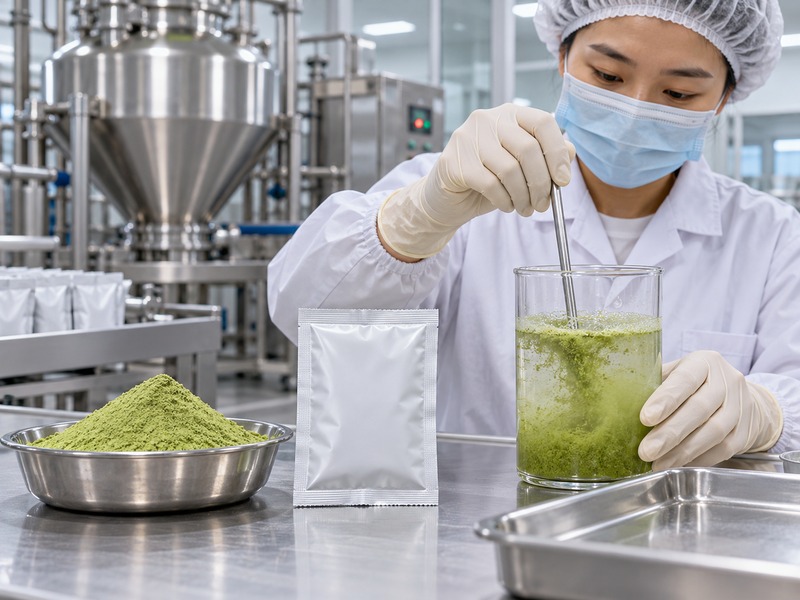
1. What does “instant” mean for a matcha blend?
Define the user preparation method
Matcha consists of finely ground tea leaves, so it disperses as particles rather than disappearing like a fully soluble extract. A latte powder can be quick to prepare without claiming that every green particle dissolves. State whether the consumer uses hot water, cold water, milk, a shaker, or a spoon. Specify serving powder mass, liquid mass, desired sweetness, cup texture, and acceptable sediment after waiting. Define the word: “instant” should describe a verified preparation experience, not promise a physical property the tea does not have.
A single-serve sachet, foodservice pouch, and bulk vending blend have different handling. Sachets need fill precision and barrier packaging. A vending blend needs reliable flow and low dust. A foodservice pouch must tolerate repeated opening and scooping. Decide the sales channel before locking the particle and pack specification. Test the preparation method on ordinary equipment, including a weak stir, because many buyers will not own a high-speed blender. A product can taste good under laboratory mixing yet leave dry green clumps in a mug.
2. Which matcha belongs in the dry formula?
Screen aroma after reconstitution and storage
A dry creamer and sweetener can soften tea flavor, so choose matcha in the complete powder blend. Compare candidate grades at equal inclusion and the same water amount. Look at color in powder and in the prepared cup, then taste after the intended wait. A fine matcha can still agglomerate if the surrounding ingredients absorb moisture. Test the sachet: performance after packed storage matters more than a freshly mixed bench scoop.
Request identity, origin, lot coding, storage advice, microbiological and contaminant documents suited to the market, and sample lots representative of production. Determine whether organic or other claims are required before selecting the tea. Grade names do not establish whether the finished latte tastes good at the planned price point. Matcha Village presents bulk matcha and blend options on its homepage; send the target powder recipe and preparation method when requesting samples. Keep a reference blend and reconstituted cup for comparing future tea lots.
| Matcha trial | Question | Evidence |
|---|---|---|
| Dry color | Does blend stay visually consistent? | Fixed-light sample photo |
| Cup color | Does tea show through creamer? | Standard reconstitution photo |
| Particle feel | Is sediment acceptable? | Timed cup notes |
| Lot control | Can grade be repeated? | Specification and test file |
3. How should the creamer or milk powder be chosen?
Read the full composition
Dairy powder, plant-based creamer, and mixed systems differ in fat, sweetness, solubility, mouthfeel, allergens, and label wording. A plant creamer may still contain a dairy-derived component, so a vegan or dairy-free claim needs a full supply review. Ask suppliers for ingredient declarations, recommended processing, particle properties, storage, and reconstitution guidance. Compare equal cups: a rich creamer at one dose and a light creamer at another cannot be judged only by price per kilogram.
Fat powder can contribute body but can also create a surface film or stale flavor during storage. Different carriers alter sweetness and powder flow. Prepare candidate blends with the same matcha and sugar system, then evaluate warm and cold water. If the product must work in cold water, a creamer selected only from hot-mug trials may fail. Check whether the supplier can maintain composition and provide change notices. Any change in creamer may force repeat sensory, label, and packaging work because the creamer often accounts for a large share of the sachet.
4. What should the sweetener system do?
Balance tea without hiding it
Sugar provides sweetness and bulk, while an alternative sweetener may need carriers and a different sensory strategy. A powder that looks inexpensive per serving can taste thin if sweetness replaces body without compensating ingredients. Set a sweetness target in a prepared cup and test it with the chosen creamer. Read the complete blend: sweetened creamer can contribute substantial sugar before any separate sugar is added.
Check flow and particle size when combining ingredients. A large contrast between fine matcha and coarse sugar can cause segregation during transport or filling. Dry ingredients may absorb moisture at different rates, creating clumps after opening. Use permitted anticaking or flow aids only after formulation, regulatory, and label review. A no-added-sugar product needs scrutiny of all compound ingredients and a separate mouthfeel trial. Avoid attaching a health message to a lower-sugar formula without market-specific evidence and approval. The commercial target is a repeatable cup with clear ingredient information.
5. What pilot blend can frame development?
Use a complete mass balance
The table gives an illustrative 100% powder blend, not a validated production formula. A 20 g sachet from this example would contain 1.6 g matcha, but the finished cup depends on the water amount and exact ingredients. Choose a preparation instruction and run sensory trials before fixing sachet mass. Hold one reference: changing tea, creamer, sweetener, and water volume in the same trial hides which input caused a weak cup.
Check that each commercial compound ingredient is represented correctly in the full label calculation. The functional blend line below is a placeholder for ingredients selected by a qualified formulator under the target market’s rules; it is not a recommendation for any specific additive. Measure powder density and flow so the filling equipment can handle it. Record mass lost to dust or line residue. A trial should compare hot stirring, cold stirring, and any advertised shaker method with the same sachet lot. If a product needs milk rather than water to taste acceptable, the package should say so clearly.
| Component | Illustrative blend % | Trial role |
|---|---|---|
| Matcha | 8 | Tea color and flavor |
| Specified creamer or milk powder | 45 | Body and milk note |
| Sugar system | 42 | Sweetness and bulk |
| Compatible carrier | 3 | Blend handling |
| Formulator-selected functional blend | 2 | Reconstitution trial |
6. How should a dry blend be manufactured?
Control humidity, order, and segregation
Approve each raw material lot before batching, then weigh against a controlled master formula. A preblend can distribute a low-dose component such as matcha before the main mix. The exact sequence should be validated on the plant’s mixer. Sample from different vessel locations and points in the fill run to check uniformity. Watch the transfer: a uniform tank can segregate when powder falls into a hopper or travels through a long conveyor.
Control room conditions according to the ingredients and equipment. Moisture pickup can create lumps, poor flow, and changing fill weights. Record mixer load, speed, time, sieve method if used, transfer path, and line rejects. A sieve may remove agglomerates, but it can also remove tea-rich material, so inspect retained residue. Clean equipment with allergen and color carryover in mind. Assign batch codes linking matcha, creamer, sugar, packaging, and operators. A blend should be released from evidence of uniformity and sensory performance rather than powder color viewed through a bag.
7. How can reconstitution be tested fairly?
Replicate ordinary customer tools
Prepare a sachet with weighed water at specified temperatures, using the spoon or shaker named on the pack. Record stirring time, lumps, foam, green sediment, flavor, and mouthfeel. Repeat after storage because a powder can change flow and wetting as it ages. Use the consumer mug: high-shear laboratory mixing can make a weak instant product look better than its normal preparation method.
Test hot and cold claims separately. Cold water often exposes wetting problems and may produce a thinner perception of body. If a customer adds milk instead of water, the cup may become overly rich or sweet; label any supported variant with its own directions. Observe tea sediment after a realistic drinking period, not only immediately after stirring. Matcha particles may settle without indicating spoilage, but visible dry lumps indicate a preparation or powder problem. Use a descriptive panel and a measurable rejection criterion that both development and quality teams can apply.
| Preparation test | Record | Decision |
|---|---|---|
| Hot spoon stir | Time and visible lumps | Core claim fit |
| Cold spoon stir | Wetting and sediment | Cold-use instruction |
| Shaker | Foam and body | Optional method |
| Stored sachet | Flow and taste | Sales-period evidence |
8. Which packaging protects the powder?
Barrier and seal quality matter
Matcha color and aroma are vulnerable to poor storage; creamers and sugars can absorb moisture. Select packaging after testing the final blend’s moisture behavior and expected distribution route. A single-serve sachet may limit repeated air exposure. A large pouch lowers pack cost per kilogram but needs a reliable reseal and user handling instructions. Inspect the seal: a strong formula can become lumpy in a pack with a weak seam.
Test fill weight, seal strength, pinholes, powder trapped in seals, and transport damage. Print batch codes that remain legible through shipping. Shelf-life work should track aroma, green color, caking, reconstitution, and microbiological status as relevant to the product. An accelerated storage screen can flag issues, but a market date needs evidence from the final pack and production process. If sachets are placed in a carton, consider how carton storage and retail lighting affect them. Packaging specifications belong in supplier and co-packer agreements, not only in artwork files.
| Pack format | Operational benefit | Validation point |
|---|---|---|
| Single sachet | Fixed serving mass | Seal and fill weight |
| Foodservice pouch | Lower pack count | Repeated-opening caking |
| Vending bulk pack | Machine feeding | Powder flow and dust |
| Cartoned sachets | Retail display | Transport damage and coding |
9. Which release checks and labels are needed?
Approve the powder and the prepared cup
Check incoming matcha, creamer, and other ingredients against specifications. For finished powder, monitor appearance, fill mass, blend uniformity, moisture or caking indicators, pack integrity, and a standard reconstitution cup. Label review covers ingredient order, allergens, nutrition, preparation, storage, and market-specific claims. Keep one reference sachet: dry color alone may hide a flavor or dispersion defect in the prepared drink.
A plant-based claim requires review of the full creamer and processing chain. “Instant” should be supported by the advertised preparation method. A claim that the powder fully dissolves may be inaccurate when it contains whole matcha particles. If a brand calls the item organic, verify certification for the exact materials and market. Track complaints by lot and symptom: hard lumps, dull color, thin body, excessive sweetness, or broken seals. Those categories help locate the source of failure. Any formula or package change should trigger targeted reapproval rather than a silent substitution.
| Release area | Powder check | Cup check |
|---|---|---|
| Identity | Lot and ingredient file | Tea profile |
| Flow | Caking and fill mass | Lumps after stirring |
| Color | Dry reference | Prepared reference |
| Pack | Seal and code | Performance after storage |
10. How should a brand cost and source the blend?
Price the prepared serving
Calculate ingredient cost per sachet from the actual blend percentage and landed prices. Add mixing loss, filling rejects, barrier film, carton, testing, freight, and customer returns. A lower-cost creamer may need a higher inclusion level or weaken cup quality. A more expensive matcha may require less powder for the same sensory target, but this must be shown in reconstitution tests. Cost the acceptable sachet: quoted bulk-powder price alone does not reflect a saleable unit.
Send a manufacturer the target cup, sachet size, hot or cold preparation requirements, sales market, annual volume, preferred pack, and required documents. Request pilot samples made on equipment close to the proposed production line. Matcha Village can discuss bulk tea and blend possibilities through its contact page. Ask each supplier how ingredient or process changes will be communicated. A workable instant matcha latte powder has a repeatable dry blend, a cup that customers can prepare as directed, and a pack that preserves both through its supported sales period.
FAQ
Q1: Does matcha fully dissolve in water? No. Matcha is powdered leaf, so fine particles remain suspended and may settle.
Q2: Can a powder be made without dairy? Yes, if the chosen creamer and full supply chain meet the intended claim and label rules.
Q3: Is cold water preparation automatic? No. Test the stored blend with cold water and the advertised stirring method.
Q4: Can a fresh café mix be packed as a sachet? It needs dry-blend development, uniformity testing, packaging, and shelf-life work.
Q5: What should a supplier sample include? Request the exact blend, preparation directions, specification, ingredient statement, lot code, and pack details.