
A bamboo whisk can make a smooth bowl of matcha, but its fine tines need an operating procedure in a busy café. Powder trapped near the handle, wet storage, and broken tines affect both drink quality and equipment hygiene. An occasional home-use rinse is not enough guidance for a chain serving many cups. This article explains how to clean a matcha whisk after service, how to dry and inspect it, and when replacement is the better decision. The procedure should be adapted to the whisk maker’s instructions and the café’s food safety plan, which governs cleaning frequency, sanitizing, and tool storage at the site.
1. Why does whisk care matter in commercial service?
A whisk contacts a ready-to-drink product and is reused across orders. Residual tea can dry between tines, while rough handling can split bamboo and change whisking performance. A whisk that no longer produces the standard drink wastes staff time and powder. For a café group, consistent care also reduces variation between locations. The correct tool procedure should cover cleaning, drying, storage, inspection, and replacement rather than treating a rinse as the entire job. A matcha bowl is part of the same cleaning system and should be handled under the site’s utensil rules.
What should a manager define first?
Identify the whisk model, its manufacturer’s care directions, intended number of uses, storage location, and a named person responsible for inspections. Start with the actual tool. Whisks differ in tine shape and durability, so a one-size instruction can damage a particular product. Decide whether the tool is used only for pure matcha or also for sweetened, dairy, or flavored mixes. Sticky ingredients can require different cleaning controls. The café’s food safety team should decide how the procedure fits local hygiene requirements. An attractive utensil on a display shelf is not automatically suitable for repeated commercial use.
| Care element | Standard to set | Why it matters |
|---|---|---|
| Cleaning | After-use method | Residue control |
| Drying | Location and time | Wet storage risk |
| Inspection | Tine and handle check | Foreign material prevention |
| Replacement | Clear discard rule | Consistent drinks |
2. What should staff do immediately after a drink?
Remove the whisk from the bowl and rinse it promptly according to the maker’s instructions. A brief rinse while matcha is still wet is easier than scraping off dried powder later. Direct water through the tines without crushing them against the sink or bowl. Avoid leaving the whisk soaking through a shift unless the manufacturer explicitly permits that practice. The goal is to remove visible tea while preserving the tool. If the whisk touched milk, syrup, or another allergen-containing ingredient, follow the site’s full cleaning and cross-contact procedure rather than relying on a quick tea-only rinse.
How can staff check that rinsing worked?
Look between the inner tines and around the base near the handle under good light. Turn the whisk over. Powder can remain where a quick top-down glance misses it. If residue persists, repeat the approved cleaning step or remove the tool for a more thorough procedure. Do not pull tines apart aggressively with fingers. A dirty-looking whisk should never be returned to the drink station just because a queue is forming. Keep enough approved tools or an alternate method available so cleaning time does not force staff into a shortcut. Record any repeated residue problem; it may signal a sticky formula or unsuitable whisk design.
3. Should soap or sanitizer be used on a bamboo whisk?
The answer depends on manufacturer guidance, the ingredients handled, and the café’s food safety program. Bamboo can be affected by prolonged moisture or harsh treatments, and a cleaning agent can leave taste if not handled correctly. A blanket “never use soap” instruction is unsafe for a tool exposed to milk or other allergens; a blanket “put it in the dishwasher” instruction may destroy the whisk. Get the tool maker’s care advice and let the food safety lead choose a compliant procedure for the operation. If bamboo cannot meet the required cleaning standard, change the tool or the service workflow.
How should a café document the decision?
Write the approved cleaning agent or water-only step, contact time if relevant, rinse, drying method, and use restrictions. Match the procedure to the drink. A whisk reserved for plain tea may have a different risk profile from one used in a flavored latte. Verify that staff can perform the steps between orders and at close. Check local requirements before making a sanitizing claim on an internal card. If a tool cannot be cleaned adequately after a particular ingredient, do not use it for that product. An equipment policy should protect guests and the utensil without depending on folklore about bamboo.
| Use case | Cleaning question | Escalation |
|---|---|---|
| Pure matcha and water | Is residue removed? | Inspect tines |
| Milk or flavored mix | Are allergens controlled? | Follow site plan |
| Shared tools | Can cross-contact be prevented? | Separate or replace tool |
| Damaged whisk | Can it be cleaned safely? | Remove from service |
4. How should the whisk dry between uses?
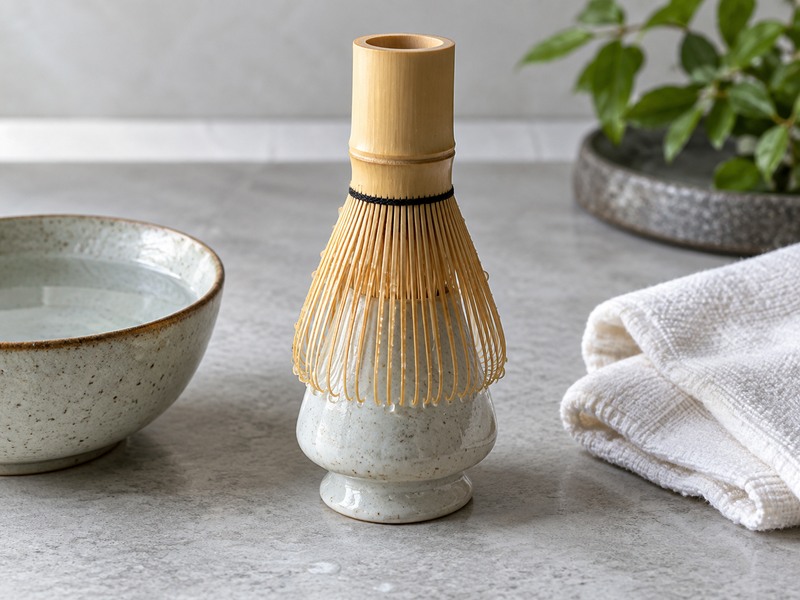
After cleaning, shake off excess water gently and place the whisk where air can reach the tines without contact with dirty surfaces. A suitable whisk holder may help retain shape and allow drying, but the holder itself must be clean. Do not trap a damp whisk in a closed tube or drawer. Avoid leaving it on a wet bar mat beside a sink. The station design should provide enough time and space for drying, especially when several drinks are made in succession. The site’s hygiene plan may require a clean rotation of tools.
What should closing staff inspect?
Check that each whisk has no visible powder, standing water, odor, or damaged tine. Look at the holder too. A clean whisk on a dirty stand is a weak storage practice. Put tools in the designated dry area and log any whisk removed from service. If the café uses chilled or humid back-room storage, assess whether that location actually permits drying. Train staff to avoid storing a whisk in its shipping sleeve after it has been used. A case designed for transport may protect dry new stock while trapping moisture around a used tool.
5. How do you inspect tines for damage?
Examine the outer and inner tines before service and after any reported snag, fall, or unusually rough wash. Look for splits, broken ends, deformation, loose bamboo fibers, and residue caught at the base. A minor change in shape may affect foam or mixing; a broken tine can become foreign material in a drink. Do not trim a damaged whisk and return it without an approved repair policy. Removing it is usually simpler and more defensible for a café. Keep replacement stock so one bad tool does not stop the menu.
What is a practical discard rule?
Write objective triggers: a missing tine, split or sharp fiber, persistent residue, odor, or inability to meet the reference drink. Do not wait for a complaint. Photograph examples for staff training and make it easy to mark a tool as out of service. A manager should verify replacements and investigate repeated early failures. Rough whisking against a narrow cup, crushing tines during washing, or storing them wet can shorten life. The matcha accessories range can start a tool discussion, but approve physical samples under the café’s real cleaning and service conditions.
| Inspection finding | Decision | Record |
|---|---|---|
| Clean, sound tines | Keep in service | Routine check |
| Bent shape | Compare performance | Manager review |
| Split or missing tine | Remove | Replacement log |
| Persistent odor or residue | Remove and investigate | Cleaning issue |
6. Can a whisk holder improve tool life?
A holder can support tine shape and keep a drying whisk off a flat surface, provided its size suits the whisk and it is cleaned regularly. It is not a substitute for rinsing or a guarantee of sanitation. Test whether staff can place and remove the whisk without snagging tines. A holder that is difficult to clean may create its own residue problem. If whisks are rotated between orders, label clean and used positions clearly so staff do not place a wet, unclean tool among ready-to-use utensils.
What should buyers check before ordering holders?
Request dimensions, material, stability, cleaning instructions, and a sample paired with the intended whisk. Test the pair. A holder designed for another tine shape may spread or compress bamboo. Check whether it survives the café’s cleaning method and fits available counter space. For a retail gift set, assess packaging and customer instructions as well as the look. For commercial use, prioritize hygiene and replacement access over display appearance. Keep a simple inventory count so locations have enough holders and whisks for a full shift without storing wet tools in improvised containers.
7. What cleaning schedule works for a busy café?
Define steps after each drink, during station checks, and at closing. After-use cleaning prevents tea from drying. Mid-shift inspection catches damaged tines and residue before repeated use. Closing gives staff time to inspect, dry, and store tools correctly. The exact frequency and sanitizing method should follow the operation’s hazard analysis and local requirements. A high-volume location may need multiple whisks in rotation, while a low-volume site may need fewer tools but greater attention to dry storage between uses.
How should training verify the method?
Demonstrate the cleaning process, then watch new staff perform it after several consecutive drinks. Use a real shift. Check whether the sink, drying place, and replacement stock are within easy reach. Ask the trainee to identify a deliberately damaged whisk and explain the discard rule. A poster that says “rinse whisk” is insufficient if it does not show where to check for trapped powder. Audit tools across locations and note recurring failures. If every store struggles with the same step, redesign the station or choose a different mixing tool rather than repeating the same training message.
| Timing | Task | Person responsible |
|---|---|---|
| After each use | Clean and inspect visible residue | Barista |
| Mid-shift | Check condition and rotation | Shift lead |
| Close | Full inspection and dry storage | Closing team |
| Reorder | Replace failed tools | Manager |
8. When is a different mixing tool more suitable?
A bamboo whisk is useful for a plain bowl and for a visible preparation ritual, but it may not be the best tool for every high-volume or allergen-heavy menu. An electric mixer, shaker, or other food-contact tool can be easier to standardize and clean under some workflows. Compare texture, time, cleaning, cost, and customer presentation. A commercial mixer must still be cleaned and inspected; it is not automatically safer. The choice should follow the recipe and site’s food safety program rather than tradition alone.
How should a chain compare tools?
Make the same drink at the same powder dose with each method and evaluate clumps, foam, sediment, speed, noise, cleaning time, and equipment failures. Count cleanup. A fast mixer that takes long to sanitize may slow the full service cycle. Ask whether each tool reaches corners of the chosen vessel without scraping or splashing. For a menu with plain bowls and sweetened lattes, separate tools may be the clearest solution. Document which method is approved for each product so staff do not improvise with a whisk meant only for water-based tea.
9. What should be checked when buying whisks in bulk?
Ask for material, dimensions, tine count or model, care instructions, packaging, replacement policy, and sample consistency. Test several units rather than one display sample. A café group should assess breakage in transport and performance after its own cleaning routine. Price per whisk matters less than cost per usable service period. A very cheap tool that sheds fibers or fails quickly can create drink remakes and staff frustration. Do not claim a fixed number of uses without data from the actual operation.
How can purchasing control quality over time?
Keep an approved sample and define an incoming check for split tines, malformed shape, contamination, or damaged packaging. Inspect the carton, then the tool. Ask suppliers to notify the buyer before changing material or construction. Track replacement rate by store; unusual failure patterns may indicate handling problems or a supplier shift. Matcha tea accessories can help frame kit options, while the signed equipment specification should govern commercial orders. A whisk supplied in a starter kit may need different packaging and instructions from one ordered for daily café use.
| Buying factor | Sample test | Business consequence |
|---|---|---|
| Tine integrity | Inspect several units | Foreign material risk |
| Ergonomics | Staff preparation trial | Service speed |
| Cleaning fit | Site procedure trial | Hygiene workload |
| Transit pack | Delivered-case inspection | Breakage cost |
10. How should a café approve its whisk-care procedure?
Approve the process with baristas, managers, quality staff, and the tool supplier’s instructions in view. The finished instruction should name the tool, approved uses, after-use steps, drying location, inspection criteria, and replacement path. Keep it short enough for a station card and detailed enough for training. Trial it during a rush, since an unrealistic cleaning step will be skipped when orders build. Periodically review drink quality and tool condition together; poor foam or clumps may point to technique, powder, or whisk damage.
What should be kept on file?
Keep the approved whisk model, care guidance, training record, inspection photographs, replacement log, and any relevant food safety review. Make defects easy to report. Staff should have a clean spare and a simple way to remove a questionable tool immediately. If a new whisk design is proposed, test it under the same recipe and cleaning procedure before roll-out. Good maintenance protects the cup and gives the café a repeatable answer to the practical question of how to clean a matcha whisk.
FAQs
Q1. Should a bamboo whisk go in a dishwasher? Follow the maker’s instructions and the site’s hygiene plan; do not assume the tool tolerates machine washing.
Q2. Is a water rinse always enough? No. Ingredients, residue, and cross-contact risks may require a different approved procedure.
Q3. Can a whisk be stored wet in its sleeve? Wet enclosed storage can trap moisture. Use the designated drying and storage method.
Q4. When should a whisk be replaced? Remove it for missing or split tines, persistent residue or odor, or failure to make the reference drink.
Q5. Do cafés need several whisks? A rotation can help busy sites clean and dry tools properly; set quantity from real order volume.